SUBSCRIBE TO OUR FREE NEWSLETTER
Daily news & progressive opinion—funded by the people, not the corporations—delivered straight to your inbox.
5
#000000
#FFFFFF
To donate by check, phone, or other method, see our More Ways to Give page.
The underwater pictures from the Maldives this weekend brought back a staggering rush of memories.
In 2009, when 350.org was still a fledgling organization and not the world's largest grassroots climate campaign, we'd called for our first global day of action. All around the world people rallied in iconic locations, from the summit of Antarctica's highest mountain to the middle of Times Square. There were 5,200 demonstrations in all, in what CNN called 'the most widespread day of political activity in the planet's history.' But maybe the most memorable was from the Maldives.
Or rather, from below the Maldives. Where newly elected president Mohamed Nasheed, who had taught his cabinet to scuba dive, convened their regular meeting underwater, on the edge of their threatened coral reef. There they signed a proclamation to the UN, asking that it work to lower the level of carbon in the atmosphere.
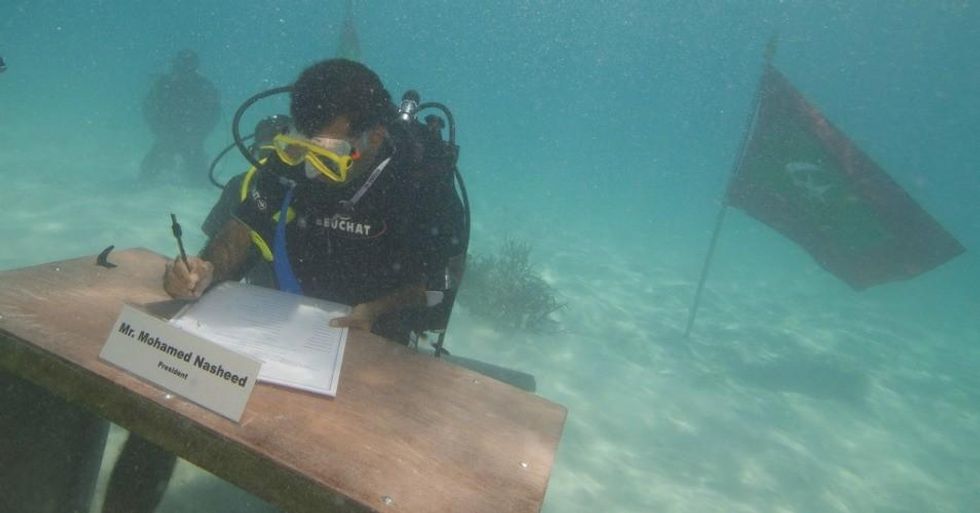
That picture helped bring home the newly dawning truth of global warming--that entire nations like the low-lying Maldives were on the edge of extinction. It also marked Nasheed as the most committed head of state in the climate fight.
But that's not all Nasheed represented. He's also the Mandela of the Indian Ocean, the man who through long years of nonviolent resistance freed his nation from a long tyranny and won its first democratic election.
That thug government just receded into the shadows, though, and a few years later overthrew Nasheed in a military coup. And now it has jailed him for 13 years on absurd charges of terrorism after a trial that would have delighted Kafka--among other things, the presiding judges were also witnesses against the accused.
The long-suffering people of the Maldives are fighting back, though--peacefully, with massive demonstrations night after night in the streets of Male. And over the weekend, a hundred of them dove down to the reef with scuba tanks, and with banners demanding Nasheed's release. The picture--a purposeful echo of the moment when he made the world notice his embattled archipelago--should alert the planet once more.
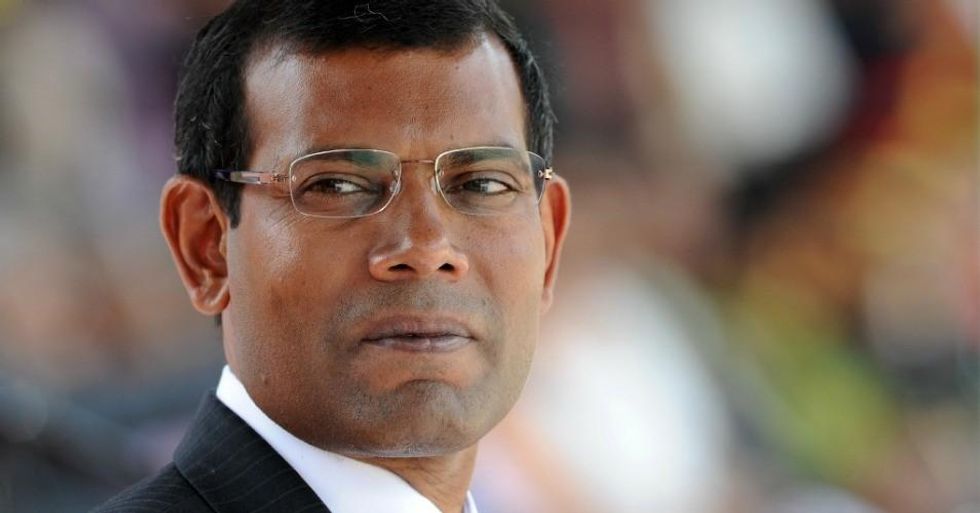
There are signs of international support beginning to emerge. Maybe most significantly the renowned human rights lawyer Amal Clooney (yes, that Clooney) has joined his defense team, bringing both great skill and a bright spotlight. But much more is needed.
For one thing, though Nasheed and his colleagues have not called for a tourist boycott, it's hard to imagine anyone with a conscience wanting to support the goons running the country at the moment. Its beaches are indeed beautiful--but they will be more beautiful once the Maldives have returned to democratic rule.
Our leaders, too, need to act. India, America, the EU all need to be firm in the demand for Nasheed's safety (there are great fears for his life as he returns to the prison where he's already spent so many years) and for his release.
For those of us in the worldwide climate movement, this is not just a moment to stand by one of our own. It's also a good reminder that we need working, inclusive, democratic governments if we are to make real progress. The autocrats now running the Maldives of course abandoned the Nasheed government's remarkable plan to turn the nation carbon-neutral and even offered to drill for oil in the surrounding waters; as in so many places around the world, tyranny and fossil fuel have a friendly working relationship.
The Maldives is existentially imperiled by a rising ocean. But before it can fully deal with that predicament it needs its voice back. At the moment that voice is languishing in prison. We all should work to get him out.
The underwater pictures from the Maldives this weekend brought back a staggering rush of memories.
In 2009, when 350.org was still a fledgling organization and not the world's largest grassroots climate campaign, we'd called for our first global day of action. All around the world people rallied in iconic locations, from the summit of Antarctica's highest mountain to the middle of Times Square. There were 5,200 demonstrations in all, in what CNN called 'the most widespread day of political activity in the planet's history.' But maybe the most memorable was from the Maldives.
Or rather, from below the Maldives. Where newly elected president Mohamed Nasheed, who had taught his cabinet to scuba dive, convened their regular meeting underwater, on the edge of their threatened coral reef. There they signed a proclamation to the UN, asking that it work to lower the level of carbon in the atmosphere.
That picture helped bring home the newly dawning truth of global warming--that entire nations like the low-lying Maldives were on the edge of extinction. It also marked Nasheed as the most committed head of state in the climate fight.
But that's not all Nasheed represented. He's also the Mandela of the Indian Ocean, the man who through long years of nonviolent resistance freed his nation from a long tyranny and won its first democratic election.
That thug government just receded into the shadows, though, and a few years later overthrew Nasheed in a military coup. And now it has jailed him for 13 years on absurd charges of terrorism after a trial that would have delighted Kafka--among other things, the presiding judges were also witnesses against the accused.
The long-suffering people of the Maldives are fighting back, though--peacefully, with massive demonstrations night after night in the streets of Male. And over the weekend, a hundred of them dove down to the reef with scuba tanks, and with banners demanding Nasheed's release. The picture--a purposeful echo of the moment when he made the world notice his embattled archipelago--should alert the planet once more.
There are signs of international support beginning to emerge. Maybe most significantly the renowned human rights lawyer Amal Clooney (yes, that Clooney) has joined his defense team, bringing both great skill and a bright spotlight. But much more is needed.
For one thing, though Nasheed and his colleagues have not called for a tourist boycott, it's hard to imagine anyone with a conscience wanting to support the goons running the country at the moment. Its beaches are indeed beautiful--but they will be more beautiful once the Maldives have returned to democratic rule.
Our leaders, too, need to act. India, America, the EU all need to be firm in the demand for Nasheed's safety (there are great fears for his life as he returns to the prison where he's already spent so many years) and for his release.
For those of us in the worldwide climate movement, this is not just a moment to stand by one of our own. It's also a good reminder that we need working, inclusive, democratic governments if we are to make real progress. The autocrats now running the Maldives of course abandoned the Nasheed government's remarkable plan to turn the nation carbon-neutral and even offered to drill for oil in the surrounding waters; as in so many places around the world, tyranny and fossil fuel have a friendly working relationship.
The Maldives is existentially imperiled by a rising ocean. But before it can fully deal with that predicament it needs its voice back. At the moment that voice is languishing in prison. We all should work to get him out.
The underwater pictures from the Maldives this weekend brought back a staggering rush of memories.
In 2009, when 350.org was still a fledgling organization and not the world's largest grassroots climate campaign, we'd called for our first global day of action. All around the world people rallied in iconic locations, from the summit of Antarctica's highest mountain to the middle of Times Square. There were 5,200 demonstrations in all, in what CNN called 'the most widespread day of political activity in the planet's history.' But maybe the most memorable was from the Maldives.
Or rather, from below the Maldives. Where newly elected president Mohamed Nasheed, who had taught his cabinet to scuba dive, convened their regular meeting underwater, on the edge of their threatened coral reef. There they signed a proclamation to the UN, asking that it work to lower the level of carbon in the atmosphere.
That picture helped bring home the newly dawning truth of global warming--that entire nations like the low-lying Maldives were on the edge of extinction. It also marked Nasheed as the most committed head of state in the climate fight.
But that's not all Nasheed represented. He's also the Mandela of the Indian Ocean, the man who through long years of nonviolent resistance freed his nation from a long tyranny and won its first democratic election.
That thug government just receded into the shadows, though, and a few years later overthrew Nasheed in a military coup. And now it has jailed him for 13 years on absurd charges of terrorism after a trial that would have delighted Kafka--among other things, the presiding judges were also witnesses against the accused.
The long-suffering people of the Maldives are fighting back, though--peacefully, with massive demonstrations night after night in the streets of Male. And over the weekend, a hundred of them dove down to the reef with scuba tanks, and with banners demanding Nasheed's release. The picture--a purposeful echo of the moment when he made the world notice his embattled archipelago--should alert the planet once more.
There are signs of international support beginning to emerge. Maybe most significantly the renowned human rights lawyer Amal Clooney (yes, that Clooney) has joined his defense team, bringing both great skill and a bright spotlight. But much more is needed.
For one thing, though Nasheed and his colleagues have not called for a tourist boycott, it's hard to imagine anyone with a conscience wanting to support the goons running the country at the moment. Its beaches are indeed beautiful--but they will be more beautiful once the Maldives have returned to democratic rule.
Our leaders, too, need to act. India, America, the EU all need to be firm in the demand for Nasheed's safety (there are great fears for his life as he returns to the prison where he's already spent so many years) and for his release.
For those of us in the worldwide climate movement, this is not just a moment to stand by one of our own. It's also a good reminder that we need working, inclusive, democratic governments if we are to make real progress. The autocrats now running the Maldives of course abandoned the Nasheed government's remarkable plan to turn the nation carbon-neutral and even offered to drill for oil in the surrounding waters; as in so many places around the world, tyranny and fossil fuel have a friendly working relationship.
The Maldives is existentially imperiled by a rising ocean. But before it can fully deal with that predicament it needs its voice back. At the moment that voice is languishing in prison. We all should work to get him out.