SUBSCRIBE TO OUR FREE NEWSLETTER
Daily news & progressive opinion—funded by the people, not the corporations—delivered straight to your inbox.
5
#000000
#FFFFFF
To donate by check, phone, or other method, see our More Ways to Give page.
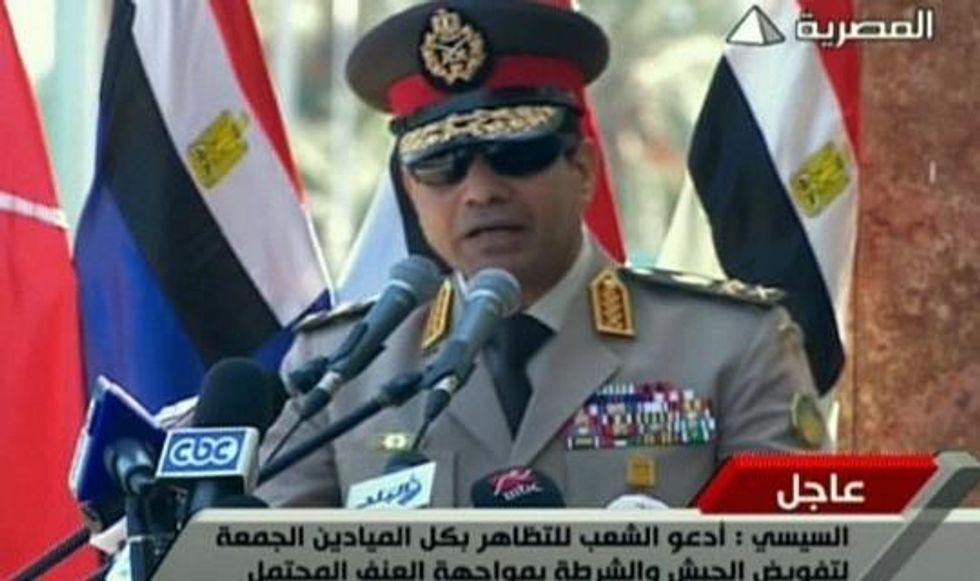
It can be argued that those military who stage coup d'etat only come into power because the people of their countries asked them to do so. What is not usually said, however, is that their coup is usually carefully orchestrated: from the lack of basic necessities for the majority of the population and widespread insecurity in the streets to complete demonization of the elected presidents in the media. In the meantime, regardless of how much time has passed since the coup in Egypt, the United States still refuses to call it a coup (if it walks like a duck, and quacks like a duck, then it is....).
So far, Al-Sisi's initial moves are suspect and make it seem that he is equally ruthless as General Pinochet. There is something untimely, not to say irresponsible, about calling the Egyptian people who supported the coup into Tahrir Square at the same time that Morsi's supporters were also demonstrating for their fallen leader. This assured that many more people would be killed, as so far has been proven, in addition to the 180 who were already killed since 30 June, when mass demonstrations were calling for the overthrow of President Mohamed Morsi.
Al-Sisi claimed that the nationwide rally supporting the overthrow of a democratically elected president -even if ineffectual- will give him the mandate to fight "violence and terrorism." Instead, as a result of Al-Sisi's directed repression the number of people killed can still reach or surpass those killed in Chile during Pinochet's despotic rule, more than 3,000.
"Security forces have repeatedly failed to protect protesters, bystanders and residents from attacks by armed assailants. They have also failed to intervene effectively to end violent clashes between rival groups," stated Hassiba Hadj Sahraoui, Amnesty International's Deputy Director of the Middle East and North Africa Programme.
Many among those now supporting the army seemed to have forgotten the past crimes the military committed, and are inclined to believe in the generals' good will and support for the country's democratic institutions. They may yet be disappointed. "Given the security forces routine use of excessive force, such a move is likely to lead to yet more unlawful killings, injuries, and other human rights violations," had presciently warned Hassiba Hadj Sahraoui before the July 26 events took place.
Events have proved him right. As of this writing, scores of civilians have been killed and injured, and there are claims on the use of torture by the security forces. The army's brutal repression crushes any possibility of a deal between the government and the Muslim Brotherhood. Will there to be an end to Egypt's present nightmare? It certainly will be, but not through the use of force and as long as the military are the ones really in power.
It can be argued that those military who stage coup d'etat only come into power because the people of their countries asked them to do so. What is not usually said, however, is that their coup is usually carefully orchestrated: from the lack of basic necessities for the majority of the population and widespread insecurity in the streets to complete demonization of the elected presidents in the media. In the meantime, regardless of how much time has passed since the coup in Egypt, the United States still refuses to call it a coup (if it walks like a duck, and quacks like a duck, then it is....).
So far, Al-Sisi's initial moves are suspect and make it seem that he is equally ruthless as General Pinochet. There is something untimely, not to say irresponsible, about calling the Egyptian people who supported the coup into Tahrir Square at the same time that Morsi's supporters were also demonstrating for their fallen leader. This assured that many more people would be killed, as so far has been proven, in addition to the 180 who were already killed since 30 June, when mass demonstrations were calling for the overthrow of President Mohamed Morsi.
Al-Sisi claimed that the nationwide rally supporting the overthrow of a democratically elected president -even if ineffectual- will give him the mandate to fight "violence and terrorism." Instead, as a result of Al-Sisi's directed repression the number of people killed can still reach or surpass those killed in Chile during Pinochet's despotic rule, more than 3,000.
"Security forces have repeatedly failed to protect protesters, bystanders and residents from attacks by armed assailants. They have also failed to intervene effectively to end violent clashes between rival groups," stated Hassiba Hadj Sahraoui, Amnesty International's Deputy Director of the Middle East and North Africa Programme.
Many among those now supporting the army seemed to have forgotten the past crimes the military committed, and are inclined to believe in the generals' good will and support for the country's democratic institutions. They may yet be disappointed. "Given the security forces routine use of excessive force, such a move is likely to lead to yet more unlawful killings, injuries, and other human rights violations," had presciently warned Hassiba Hadj Sahraoui before the July 26 events took place.
Events have proved him right. As of this writing, scores of civilians have been killed and injured, and there are claims on the use of torture by the security forces. The army's brutal repression crushes any possibility of a deal between the government and the Muslim Brotherhood. Will there to be an end to Egypt's present nightmare? It certainly will be, but not through the use of force and as long as the military are the ones really in power.
It can be argued that those military who stage coup d'etat only come into power because the people of their countries asked them to do so. What is not usually said, however, is that their coup is usually carefully orchestrated: from the lack of basic necessities for the majority of the population and widespread insecurity in the streets to complete demonization of the elected presidents in the media. In the meantime, regardless of how much time has passed since the coup in Egypt, the United States still refuses to call it a coup (if it walks like a duck, and quacks like a duck, then it is....).
So far, Al-Sisi's initial moves are suspect and make it seem that he is equally ruthless as General Pinochet. There is something untimely, not to say irresponsible, about calling the Egyptian people who supported the coup into Tahrir Square at the same time that Morsi's supporters were also demonstrating for their fallen leader. This assured that many more people would be killed, as so far has been proven, in addition to the 180 who were already killed since 30 June, when mass demonstrations were calling for the overthrow of President Mohamed Morsi.
Al-Sisi claimed that the nationwide rally supporting the overthrow of a democratically elected president -even if ineffectual- will give him the mandate to fight "violence and terrorism." Instead, as a result of Al-Sisi's directed repression the number of people killed can still reach or surpass those killed in Chile during Pinochet's despotic rule, more than 3,000.
"Security forces have repeatedly failed to protect protesters, bystanders and residents from attacks by armed assailants. They have also failed to intervene effectively to end violent clashes between rival groups," stated Hassiba Hadj Sahraoui, Amnesty International's Deputy Director of the Middle East and North Africa Programme.
Many among those now supporting the army seemed to have forgotten the past crimes the military committed, and are inclined to believe in the generals' good will and support for the country's democratic institutions. They may yet be disappointed. "Given the security forces routine use of excessive force, such a move is likely to lead to yet more unlawful killings, injuries, and other human rights violations," had presciently warned Hassiba Hadj Sahraoui before the July 26 events took place.
Events have proved him right. As of this writing, scores of civilians have been killed and injured, and there are claims on the use of torture by the security forces. The army's brutal repression crushes any possibility of a deal between the government and the Muslim Brotherhood. Will there to be an end to Egypt's present nightmare? It certainly will be, but not through the use of force and as long as the military are the ones really in power.