SUBSCRIBE TO OUR FREE NEWSLETTER
Daily news & progressive opinion—funded by the people, not the corporations—delivered straight to your inbox.
5
#000000
#FFFFFF
To donate by check, phone, or other method, see our More Ways to Give page.
An important centennial is a terrible thing to waste. Some historic anniversaries can change the way we look at life and help us reevaluate our values and behavior. One such anniversary arrives on January 11. On that day a century ago, a group of women walked out of a textile mill to march in the streets of Lawrence, Massachusetts. During the following days and weeks, thousands of workers, most of them immigrant women, joined them.
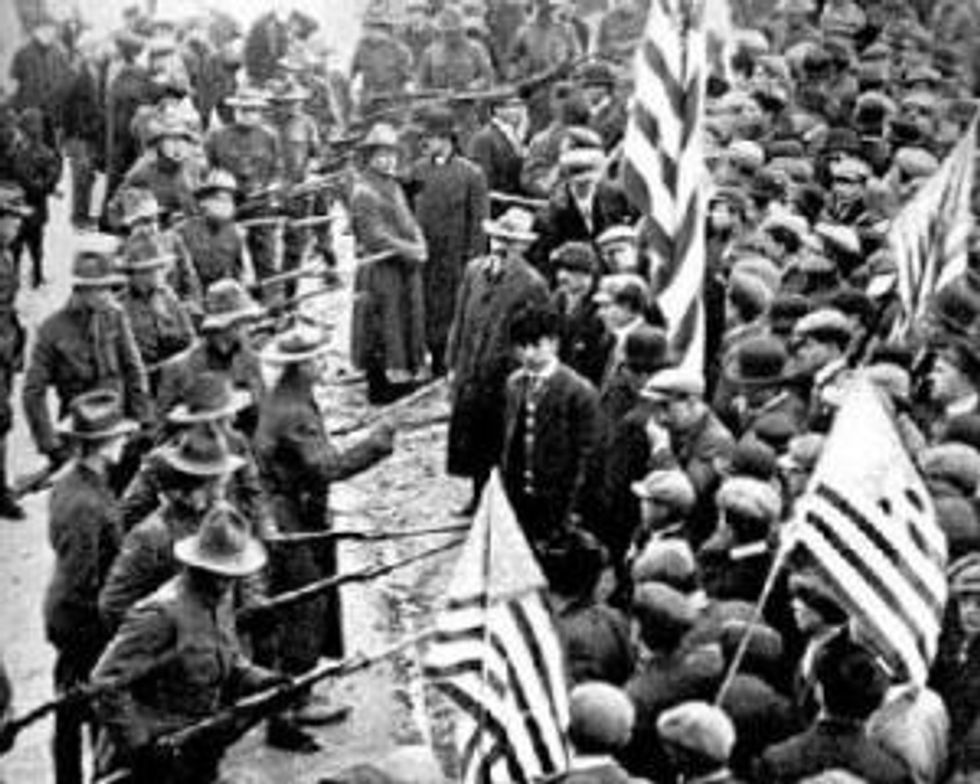
The strikers were led by a radical young union, the Industrial Workers of the World, but their demands were humble: a reduction working hours from 56 to 54 hours a week and a pay raise of two cents an hour--from 16 to 18 cents.
The strike lasted for two months. The workers marched daily, singing union anthems, and later listening to organizers. They faced clubs, bayonets, and frequent arrests. Many were hauled off to jail, children in tow. One, Annie LoPizzo, was shot and killed by the police.
Mill owners remained unmoved. But national sympathy for the impoverished strikers grew. Workers as far away as New York and Vermont took in the strikers' children to harbor them from violence, hunger and hardship. American newspapers were moved to support the workers' cause. Finally, in March, the mill owners cried uncle, conceding to the strike demands.
The strike is commonly referred to as the "Bread and Roses" strike, because some women were said to have held up a banner declaring, "We want bread, and roses, too!"
Judy Collins popularized a song about the strike, titled, of course, "Bread and Roses."
Small art and love and beauty their drudging spirits knew,
Yes, it is bread we fight for but we fight for roses too!
James Oppenheim's poem, from which the song was taken, was actually published before the Lawrence strike and was inspired by another strike. One verse would make it a suitable anthem for the Occupy protestors:
No more the drudge and idler, ten that toil where one reposes...
The final line:
Hearts starve as well as bodies, give us bread but give us roses.
Hearts starve as well as bodies. We do not live by bread alone. It's an old message with wellsprings deep in our religious traditions, and one the Bread and Roses centennial calls back to our attention. And it's a message we should not forget.
For half a century after the Lawrence strike, Americans fought for both higher wages--bread--and shorter hours--roses. Time to smell the roses. Time for "art and love and beauty," time for families, for nature, for learning, for friends and community, for reflection, rest and regeneration, time to meet non-material needs that deliver happiness, time to love and be loved. Yet somehow, we came to believe we could live on "bread" (stuff) alone, and the roses are left to wilt.
At one time, American workers had the highest pay and the shortest working hours of any people in the world. But these days, the American worker hears this: "You need to work more hours, for less pay. Or your job goes overseas." It is the old laissez faire refrain: Let the unregulated market determine wages and work hours.
You get what you measure. And we have neglected to measure non-material sources of happiness. Our prime economic indicator of success--the Gross Domestic Product (GDP)--measures neither real bread nor roses, but only what we spend on final products and services. If it is bought and sold it counts; otherwise, it's worth nothing.
Crash your Escalade and end up with insurance, legal, medical and repair bills, and you've had a stellar GDP day. Walk in the woods, volunteer, garden, spend time with your kids, and you've done nothing economically useful, despite the happiness these activities provide. Robert Kennedy got it right back in 1968. He observed that the Gross National Product (as the GDP was called then) "measures, in short, everything but that which makes life worthwhile."
We are constantly told that economic growth is the solution to our economy's woes. But what kind of growth? We need new measurements to tell us if our economic activities are adding benefits or costs, whether they are delivering or destroying bread and roses. Around the world, new indicators of success are emerging. The nation of Bhutan and the City of Seattle measure "happiness." Norway assesses its "natural capital." Baltimore examines "social capital." Maryland has a Genuine Progress Indicator.
But first, to get started, we need to ask ourselves: "What's the economy for, anyway?" What are our goals? The centennial of the Lawrence textile strike reminds us to value the roses and count them. It calls us to be gardeners of happiness, awakening our senses and watering the roses again.
An important centennial is a terrible thing to waste. Some historic anniversaries can change the way we look at life and help us reevaluate our values and behavior. One such anniversary arrives on January 11. On that day a century ago, a group of women walked out of a textile mill to march in the streets of Lawrence, Massachusetts. During the following days and weeks, thousands of workers, most of them immigrant women, joined them.
The strikers were led by a radical young union, the Industrial Workers of the World, but their demands were humble: a reduction working hours from 56 to 54 hours a week and a pay raise of two cents an hour--from 16 to 18 cents.
The strike lasted for two months. The workers marched daily, singing union anthems, and later listening to organizers. They faced clubs, bayonets, and frequent arrests. Many were hauled off to jail, children in tow. One, Annie LoPizzo, was shot and killed by the police.
Mill owners remained unmoved. But national sympathy for the impoverished strikers grew. Workers as far away as New York and Vermont took in the strikers' children to harbor them from violence, hunger and hardship. American newspapers were moved to support the workers' cause. Finally, in March, the mill owners cried uncle, conceding to the strike demands.
The strike is commonly referred to as the "Bread and Roses" strike, because some women were said to have held up a banner declaring, "We want bread, and roses, too!"
Judy Collins popularized a song about the strike, titled, of course, "Bread and Roses."
Small art and love and beauty their drudging spirits knew,
Yes, it is bread we fight for but we fight for roses too!
James Oppenheim's poem, from which the song was taken, was actually published before the Lawrence strike and was inspired by another strike. One verse would make it a suitable anthem for the Occupy protestors:
No more the drudge and idler, ten that toil where one reposes...
The final line:
Hearts starve as well as bodies, give us bread but give us roses.
Hearts starve as well as bodies. We do not live by bread alone. It's an old message with wellsprings deep in our religious traditions, and one the Bread and Roses centennial calls back to our attention. And it's a message we should not forget.
For half a century after the Lawrence strike, Americans fought for both higher wages--bread--and shorter hours--roses. Time to smell the roses. Time for "art and love and beauty," time for families, for nature, for learning, for friends and community, for reflection, rest and regeneration, time to meet non-material needs that deliver happiness, time to love and be loved. Yet somehow, we came to believe we could live on "bread" (stuff) alone, and the roses are left to wilt.
At one time, American workers had the highest pay and the shortest working hours of any people in the world. But these days, the American worker hears this: "You need to work more hours, for less pay. Or your job goes overseas." It is the old laissez faire refrain: Let the unregulated market determine wages and work hours.
You get what you measure. And we have neglected to measure non-material sources of happiness. Our prime economic indicator of success--the Gross Domestic Product (GDP)--measures neither real bread nor roses, but only what we spend on final products and services. If it is bought and sold it counts; otherwise, it's worth nothing.
Crash your Escalade and end up with insurance, legal, medical and repair bills, and you've had a stellar GDP day. Walk in the woods, volunteer, garden, spend time with your kids, and you've done nothing economically useful, despite the happiness these activities provide. Robert Kennedy got it right back in 1968. He observed that the Gross National Product (as the GDP was called then) "measures, in short, everything but that which makes life worthwhile."
We are constantly told that economic growth is the solution to our economy's woes. But what kind of growth? We need new measurements to tell us if our economic activities are adding benefits or costs, whether they are delivering or destroying bread and roses. Around the world, new indicators of success are emerging. The nation of Bhutan and the City of Seattle measure "happiness." Norway assesses its "natural capital." Baltimore examines "social capital." Maryland has a Genuine Progress Indicator.
But first, to get started, we need to ask ourselves: "What's the economy for, anyway?" What are our goals? The centennial of the Lawrence textile strike reminds us to value the roses and count them. It calls us to be gardeners of happiness, awakening our senses and watering the roses again.
An important centennial is a terrible thing to waste. Some historic anniversaries can change the way we look at life and help us reevaluate our values and behavior. One such anniversary arrives on January 11. On that day a century ago, a group of women walked out of a textile mill to march in the streets of Lawrence, Massachusetts. During the following days and weeks, thousands of workers, most of them immigrant women, joined them.
The strikers were led by a radical young union, the Industrial Workers of the World, but their demands were humble: a reduction working hours from 56 to 54 hours a week and a pay raise of two cents an hour--from 16 to 18 cents.
The strike lasted for two months. The workers marched daily, singing union anthems, and later listening to organizers. They faced clubs, bayonets, and frequent arrests. Many were hauled off to jail, children in tow. One, Annie LoPizzo, was shot and killed by the police.
Mill owners remained unmoved. But national sympathy for the impoverished strikers grew. Workers as far away as New York and Vermont took in the strikers' children to harbor them from violence, hunger and hardship. American newspapers were moved to support the workers' cause. Finally, in March, the mill owners cried uncle, conceding to the strike demands.
The strike is commonly referred to as the "Bread and Roses" strike, because some women were said to have held up a banner declaring, "We want bread, and roses, too!"
Judy Collins popularized a song about the strike, titled, of course, "Bread and Roses."
Small art and love and beauty their drudging spirits knew,
Yes, it is bread we fight for but we fight for roses too!
James Oppenheim's poem, from which the song was taken, was actually published before the Lawrence strike and was inspired by another strike. One verse would make it a suitable anthem for the Occupy protestors:
No more the drudge and idler, ten that toil where one reposes...
The final line:
Hearts starve as well as bodies, give us bread but give us roses.
Hearts starve as well as bodies. We do not live by bread alone. It's an old message with wellsprings deep in our religious traditions, and one the Bread and Roses centennial calls back to our attention. And it's a message we should not forget.
For half a century after the Lawrence strike, Americans fought for both higher wages--bread--and shorter hours--roses. Time to smell the roses. Time for "art and love and beauty," time for families, for nature, for learning, for friends and community, for reflection, rest and regeneration, time to meet non-material needs that deliver happiness, time to love and be loved. Yet somehow, we came to believe we could live on "bread" (stuff) alone, and the roses are left to wilt.
At one time, American workers had the highest pay and the shortest working hours of any people in the world. But these days, the American worker hears this: "You need to work more hours, for less pay. Or your job goes overseas." It is the old laissez faire refrain: Let the unregulated market determine wages and work hours.
You get what you measure. And we have neglected to measure non-material sources of happiness. Our prime economic indicator of success--the Gross Domestic Product (GDP)--measures neither real bread nor roses, but only what we spend on final products and services. If it is bought and sold it counts; otherwise, it's worth nothing.
Crash your Escalade and end up with insurance, legal, medical and repair bills, and you've had a stellar GDP day. Walk in the woods, volunteer, garden, spend time with your kids, and you've done nothing economically useful, despite the happiness these activities provide. Robert Kennedy got it right back in 1968. He observed that the Gross National Product (as the GDP was called then) "measures, in short, everything but that which makes life worthwhile."
We are constantly told that economic growth is the solution to our economy's woes. But what kind of growth? We need new measurements to tell us if our economic activities are adding benefits or costs, whether they are delivering or destroying bread and roses. Around the world, new indicators of success are emerging. The nation of Bhutan and the City of Seattle measure "happiness." Norway assesses its "natural capital." Baltimore examines "social capital." Maryland has a Genuine Progress Indicator.
But first, to get started, we need to ask ourselves: "What's the economy for, anyway?" What are our goals? The centennial of the Lawrence textile strike reminds us to value the roses and count them. It calls us to be gardeners of happiness, awakening our senses and watering the roses again.