

SUBSCRIBE TO OUR FREE NEWSLETTER
Daily news & progressive opinion—funded by the people, not the corporations—delivered straight to your inbox.
5
#000000
#FFFFFF
To donate by check, phone, or other method, see our More Ways to Give page.
Daily news & progressive opinion—funded by the people, not the corporations—delivered straight to your inbox.
Jacob Swenson-Lengyel, jacob@npa-us.org, 312.316.3973
Members and allies of National People's Action (NPA) from Detroit, MI, Chicago, IL and Buffalo, NY traveled to Pittsburgh, PA to give testimony at the first of four Environmental Protection Agency hearings on the Federal Implementation Plan proposed as part of the Clean Power Plan (CPP). The new rule sets the first ever limits on carbon pollution from power plants.
Members and allies of National People's Action (NPA) from Detroit, MI, Chicago, IL and Buffalo, NY traveled to Pittsburgh, PA to give testimony at the first of four Environmental Protection Agency hearings on the Federal Implementation Plan proposed as part of the Clean Power Plan (CPP). The new rule sets the first ever limits on carbon pollution from power plants. While applauding the plan, NPA leaders are calling on the EPA to go even further to ensure equity for those most impacted by the dirty energy economy and the climate crisis by protecting low income communities and communities of color from pollution and expanding access to renewables and clean energy jobs for those communities.
The dirty energy economy disproportionately impacts low income communities and communities of color. Sixty-eight percent of African Americans live within 30 miles of a coal fired power plant and eighty percent of Latinos live in areas that are failing to meet federal EPA air quality standards. One in six African American kids and one in nine Latino kids suffer from asthma. African American kids are four times as likely to die from asthma attacks as white children.
NPA members and allies say the government has a responsibility to right these wrongs as they prepare to implement the Clean Power Plan. The Federal Implementation Plan should ensure that the communities most impacted by dirty energy are first in line to experience the benefits of the Clean Power Plan.
"We can't take a color-blind approach to a problem that disproportionately impacts people of color," said Jordan Estevao, Senior Strategist at National People's Action. "We need the EPA to ensure equity for those who are most impacted."
"I raised my family less than ten miles from the Cheswick power plant in Pittsburgh," said Carmen Alexander, an organizer with NPA ally New Voices Pittsburgh. "All three of my sons have asthma. Now my grandson, Elijah has asthma, too. Our communities have been hardest hit. The EPA must ensure that resources are dedicated to cleaning up our communities, that we have access to renewable energy and energy efficiency, and that we are trained and hired for new clean energy jobs."
"In Buffalo, we're paving the way when it comes to building an equitable new energy economy," said Lucy Velez from PUSH Buffalo. "We're creating jobs for low income people and people of color, while making homes more energy efficient and taking back control for our community. This is a model for the kind of change we want to see happen across the country."
People's Action builds the power of poor and working people, in rural, suburban, and urban areas to win change through issue campaigns and elections.
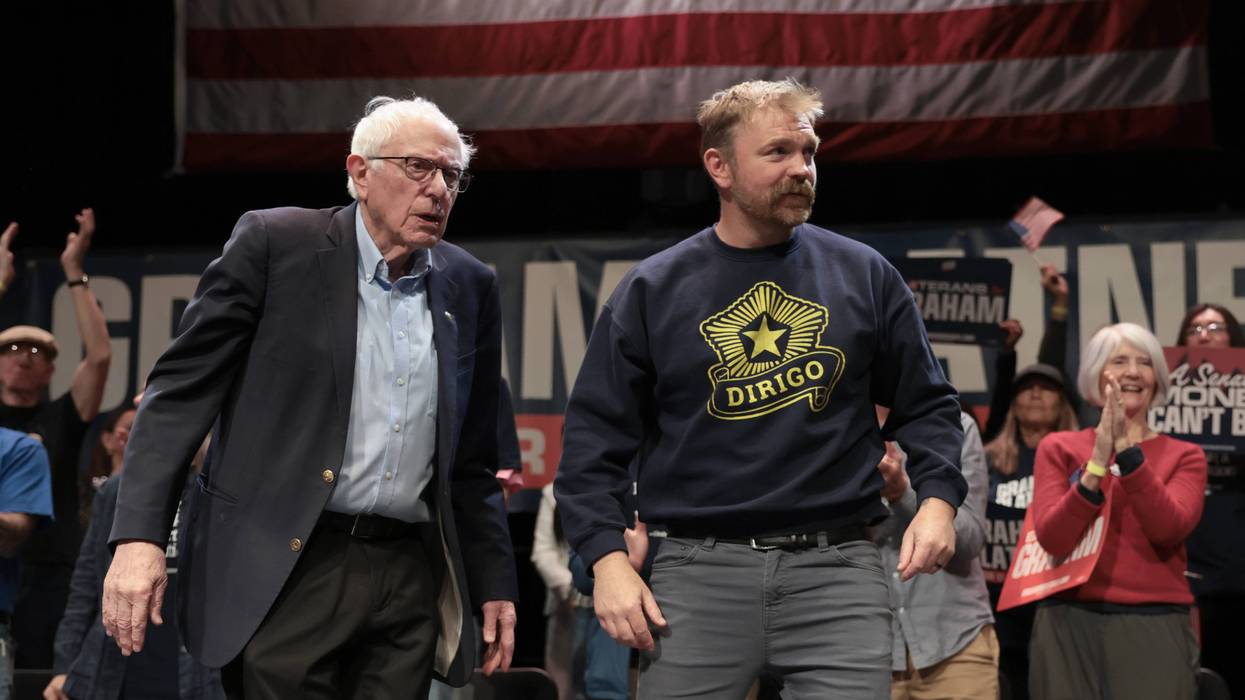
The senator said he spoke with the Democratic candidate "about the best path forward for Maine" and recommended that he leave the race.
US Sen. Bernie Sanders, among the earliest and most prominent congressional backers of Graham Platner's campaign to unseat Republican Sen. Susan Collins, has joined growing calls for the Maine Democrat to exit the race following sexual assault allegations.
"I have spoken with Graham Platner about the best path forward for Maine," Sanders (I-Vt.) said in a Tuesday statement. "In light of these very serious allegations, I have recommended that he step aside."

"Meanwhile, Trump wants to hike military spending to $1.5 trillion a year," said one observer.
Days after President Donald Trump made his latest dismissive remark about the cost of living and Americans' struggles to afford housing, new polling released Tuesday finds that nearly the entire voting public views the US as facing an affordability crisis and are increasingly pessimistic that the economy—and working people—will recover.
The Harris Poll, conducted on behalf of The Guardian newspaper, found that 57% of respondents believe the economy is still getting worse for Americans even after the US and Iran signed a peace deal last month to end the conflict started in February by the Trump administration and Israel—a war that sent oil prices soaring.
The average price of gas in the US is still $3.79 per gallon, despite the fact that Brent crude prices have fallen sharply.
Across party lines, about half of respondents said they are struggling to afford basic items like gas and groceries, and two-thirds of Americans, including nearly half of Republican voters, said they do not believe the Trump administration will improve the affordability crisis.
The poll was taken nearly a week after Trump, who ran on lowering costs for Americans, refused to sign affordable housing legislation, calling the bipartisan bill "a big yawn."
In May, as the administration was negotiating an end to the Iran War, Trump said that he did not “think about Americans’ financial situation,” even as the Middle East conflict he and Israel started hit family budgets hard.
A month earlier, he said the federal government "can’t take care of daycare" and healthcare programs for Americans, because it was focused on one thing and one thing only: "military protection."
According to the new survey, gas is at the top of the list of expenses that Americans are struggling to afford, with 52% saying they are having trouble keeping up with the cost. More than half of respondents also reported having trouble affording groceries, and 46% said they are struggling to make their loan payments and pay for utilities.
Trump ended the Biden administration's Saving on a Valuable Education (SAVE) program, terminating the income-based student loan repayment plan for millions of borrowers. A report by Democrats on the Joint Economic Committee in March also found that the average utility bill was up by $110, or 6.4%, over last year, following the Republican Party's elimination of tax credits for solar and wind power and as Trump pushed for the unregulated expansion of energy-sucking artificial intelligence data centers, despite warnings that they would drive up household utility bills.
The president's tariffs and his refusal to take on corporate consolidation in the meatpacking industry have also contributed to high grocery prices, recent analyses have found.
The Harris Poll found that 57% of Americans believe the economy is steadily getting worse, compared with 46% who said so in February. Just 16% said the economy is getting stronger, and only 27% of Republicans said the same. In February, 49% of Republican voters reported a positive outlook on the economy.
The survey also found that 54% of respondents said neither the Republican Party nor the Democratic Party has a solution to the growing affordability crisis.
However, the poll was taken on the heels of several electoral victories by progressive and democratic socialist candidates who have centered the needs of working families, demanded that billionaires pay their fair share in taxes, and called for Medicare for All and universal childcare—programs that would be similar to ones that are commonplace in other wealthy countries.
In New York City, Mayor Zohran Mamdani, a democratic socialist, has made strides toward a universal childcare program, a wealth tax, and a rent freeze for rent-stabilized housing units to address the economic inequality and cost-of-living crises.
On Monday, Trump claimed that "a social Democrat is a communist," in an apparent reference to democratic socialists like Mamdani and US House candidates Melat Kiros in Colorado's 1st District, Claire Valdez in New York's 7th District, and Darializa Avila Chevalier in New York's 13th District.
"If you look at the people that are running, it's crazy what they're doing," said Trump. "But we'll never let that happen to this country... There's no appetite for it."
But in The New York Times on Tuesday, Lindsay Owens of the progressive think tank Groundwork Collaborative suggested the recent elections prove there is, in fact, an "appetite" for candidates who recognize the affordability crisis, and prioritize solutions.
“The economic populist moment is here," she said.

Over half of Democratic voters in the US believe Israel is guilty of genocide in Gaza, and nearly 60% feel the American government is "too supportive" of its top ally in the Middle East.
A survey published Tuesday offered the latest evidence of US public opinion souring on Israel, with more than half of Democratic voters and a nearly third of all American adults saying they believe the 1,000-plus-day assault on Gaza amounts to genocide.
The Associated Press-NORC Center for Public Affairs Research poll, conducted between June 11 and June 17 of this year, found that 52% of Democratic voters "say Israel has committed genocide against Palestinians." Thirty-one percent of all US adults—and 30% of Jewish adults—believe the Israeli military has committed genocide in Gaza, which has been obliterated with the help of American weaponry and diplomatic support from both a Democratic and Republican administration.
Harold Kalmus, a 69-year-old Democratic voter from Arden, Delaware who is Jewish, told The Associated Press that the Israeli military has inflicted "unspeakable horror" on the Gaza Strip, where Israel's massive bombing campaign and ground attacks have killed more than 70,000 people—including tens of thousands of children—since October 7, 2023.
"They’re trying to wipe out a civilization as far as I’m concerned,” said Kalmus.
The new survey found that nearly 60% of Democratic voters—including 51% of Jewish Democrats—now believe the US government is "too supportive" of Israel, up from 45% percent in a January 2024 AP-NORC poll.
AP described Americans' increasingly negative views of Israel as a "dramatic erosion of support for the longtime US ally, with rising opposition from Democrats and signs of division among Republicans."
"Younger Democrats—those 45 and younger—are still more likely than older ones to say that the United States is 'not supportive enough' of the Palestinians, but older Democrats are catching up to their younger counterparts," the outlet noted. "About 57% of older Democrats now say the US should do more for the Palestinians, up from 39% two years ago."
The findings came amid internal Democratic Party turmoil over a House amendment that aims to strike $3.3 billion in US military aid to Israel from annual defense policy legislation. Leading progressive lawmakers, including top members of the Congressional Progressive Caucus, have spoken out in support of the amendment, with Rep. Ilhan Omar (D-Minn.) calling it "a no-brainer."
But top Democrats, including the ranking members of the House Armed Services and Foreign Affairs Committees, have expressed opposition to the amendment, which stands little chance of passing the Republican-controlled House.
“I don’t want Israel to be without what they need,” Rep. Gregory Meeks (D-NY), the top Democrat on the House Foreign Affairs Committee, said last week.
In the Senate, a small number of leading Democrats—including Senate Minority Leader Chuck Schumer (D-NY) and Sen. Kirsten Gillibrand (D-NY)—joined Republicans in April to block resolutions aimed at preventing the Trump administration from transferring more bombs and bulldozers to the Israeli government.
A poll released last month found that 82% of Democratic voters in New York oppose US weapons transfers to Israel, leaving Schumer and Gillibrand far out of step with their constituents.