SUBSCRIBE TO OUR FREE NEWSLETTER
Daily news & progressive opinion—funded by the people, not the corporations—delivered straight to your inbox.
5
#000000
#FFFFFF
To donate by check, phone, or other method, see our More Ways to Give page.
Daily news & progressive opinion—funded by the people, not the corporations—delivered straight to your inbox.
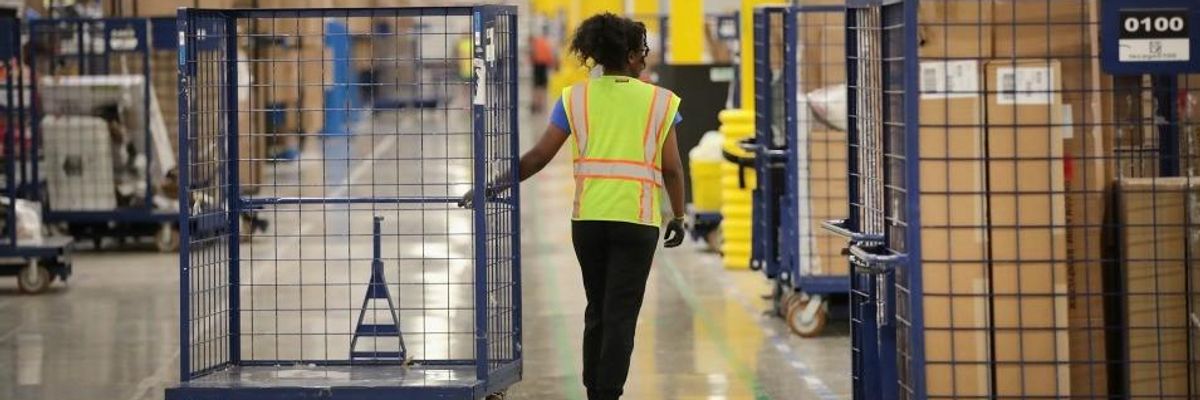
Large corporations like Amazon received the vast majority of the Republican tax cuts in 2017, while workers who keep those companies running in offices and warehouses across the country got just six percent of the cuts. (Photo: Scott Olson/Getty Images)
A new six-month analysis of President Donald Trump's 2017 tax cuts details how workers received little benefit from the plan, despite the savings many of their powerful corporate employers received.
The Center for Public Integrity (CPI) interviewed independent tax analysts and officials who were involved in the Republican Party's effort to sell the so-called American Tax Cuts and Jobs Act to the public--and within their own party ranks. Progressive critics have consistently called the law nothing nothing more than a "tax scam."
The GOP's insistence on a tax law which included the largest corporate tax cut in U.S. history--from 35 to 21 percent--resulted in companies saving about $150 billion in the first year after the passage in December 2017.
Trump and then-House Speaker Paul Ryan had spent months telling Americans they stood to save hundreds or even thousands of dollars in taxes, with Trump telling one crowd that the average family would see a pay raise of about $4,000, a benefit that would "trickle down" from employers' corporate tax cuts.
In fact, CPI reporters Peter Cary and Allan Holmes wrote in The Guardian, companies instead distributed their savings amongst the few Americans who hold stock in their corporations:
The bulk of the $150 billion the tax cut put into the hands of corporations in 2018 went into shareholder dividends and stock buy-backs, both of which line the pockets of the 10 percent of Americans who own 84 percent of the stocks.
Just 6 percent of the tax savings was spent on workers, according to Just Capital, a not-for-profit that tracks the Russell 1000 index.
Far from the $4,000 raises Trump alluded to, CPI found, the average paycheck went up about $6, or $233 per year.
The report also detailed how Republicans pushed through a proposal which would force the government to borrow trillions of dollars, despite the GOP's frequent claims of opposition to adding to the federal deficit:
In a meeting that was the key turning point in the entire process, the Senate's most vocal deficit hawk, Republican Bob Corker of Tennessee,who wanted to create no new debt, sat down with the Senate's most strident supply-sider, Republican Pat Toomey of Pennsylvania, who wanted to borrow $2.5 trillion to pay for the tax cuts. They agreed on borrowing $1.5 trillion over 10 years. The meeting lasted all of 10 minutes.
CPI drew three main conclusions from their extensive research into the effects of the tax cuts: that the law "was first and foremost a gift to multinationals;" that Republicans' claims that they aimed to "reform" the tax code without adding to the deficit were "meaningless;" and that it left the tax system vulnerable to abuse by corporations committed to tax avoidance.
The law "contained egregious mistakes, created massive new loopholes, and opened the door to new forms of tax avoidance," write Cary and Holmes.
The group's findings were released a day after a Monmouth poll showed that the long-term effects of Trump's $1.5 trillion tax plan have not been lost on the working families who were largely left out of its benefits.
Just 12 percent of people polled by Monmouth said they had "benefited a great deal from recent growth in the U.S. economy," and 18 percent said Trump's economic policies had helped the middle class. The poll was taken as the president points to low unemployment numbers, a growing GDP, and a strong stock market as irrefutable evidence that the economy is working for all Americans.
"Maybe Americans are better off than they were a few years ago on average," wrote Vice's Alex Norcia of the poll, "but maybe they're also more aware of inequality, or have a sense of being cheated."
Dear Common Dreams reader, It’s been nearly 30 years since I co-founded Common Dreams with my late wife, Lina Newhouser. We had the radical notion that journalism should serve the public good, not corporate profits. It was clear to us from the outset what it would take to build such a project. No paid advertisements. No corporate sponsors. No millionaire publisher telling us what to think or do. Many people said we wouldn't last a year, but we proved those doubters wrong. Together with a tremendous team of journalists and dedicated staff, we built an independent media outlet free from the constraints of profits and corporate control. Our mission has always been simple: To inform. To inspire. To ignite change for the common good. Building Common Dreams was not easy. Our survival was never guaranteed. When you take on the most powerful forces—Wall Street greed, fossil fuel industry destruction, Big Tech lobbyists, and uber-rich oligarchs who have spent billions upon billions rigging the economy and democracy in their favor—the only bulwark you have is supporters who believe in your work. But here’s the urgent message from me today. It's never been this bad out there. And it's never been this hard to keep us going. At the very moment Common Dreams is most needed, the threats we face are intensifying. We need your support now more than ever. We don't accept corporate advertising and never will. We don't have a paywall because we don't think people should be blocked from critical news based on their ability to pay. Everything we do is funded by the donations of readers like you. When everyone does the little they can afford, we are strong. But if that support retreats or dries up, so do we. Will you donate now to make sure Common Dreams not only survives but thrives? —Craig Brown, Co-founder |
A new six-month analysis of President Donald Trump's 2017 tax cuts details how workers received little benefit from the plan, despite the savings many of their powerful corporate employers received.
The Center for Public Integrity (CPI) interviewed independent tax analysts and officials who were involved in the Republican Party's effort to sell the so-called American Tax Cuts and Jobs Act to the public--and within their own party ranks. Progressive critics have consistently called the law nothing nothing more than a "tax scam."
The GOP's insistence on a tax law which included the largest corporate tax cut in U.S. history--from 35 to 21 percent--resulted in companies saving about $150 billion in the first year after the passage in December 2017.
Trump and then-House Speaker Paul Ryan had spent months telling Americans they stood to save hundreds or even thousands of dollars in taxes, with Trump telling one crowd that the average family would see a pay raise of about $4,000, a benefit that would "trickle down" from employers' corporate tax cuts.
In fact, CPI reporters Peter Cary and Allan Holmes wrote in The Guardian, companies instead distributed their savings amongst the few Americans who hold stock in their corporations:
The bulk of the $150 billion the tax cut put into the hands of corporations in 2018 went into shareholder dividends and stock buy-backs, both of which line the pockets of the 10 percent of Americans who own 84 percent of the stocks.
Just 6 percent of the tax savings was spent on workers, according to Just Capital, a not-for-profit that tracks the Russell 1000 index.
Far from the $4,000 raises Trump alluded to, CPI found, the average paycheck went up about $6, or $233 per year.
The report also detailed how Republicans pushed through a proposal which would force the government to borrow trillions of dollars, despite the GOP's frequent claims of opposition to adding to the federal deficit:
In a meeting that was the key turning point in the entire process, the Senate's most vocal deficit hawk, Republican Bob Corker of Tennessee,who wanted to create no new debt, sat down with the Senate's most strident supply-sider, Republican Pat Toomey of Pennsylvania, who wanted to borrow $2.5 trillion to pay for the tax cuts. They agreed on borrowing $1.5 trillion over 10 years. The meeting lasted all of 10 minutes.
CPI drew three main conclusions from their extensive research into the effects of the tax cuts: that the law "was first and foremost a gift to multinationals;" that Republicans' claims that they aimed to "reform" the tax code without adding to the deficit were "meaningless;" and that it left the tax system vulnerable to abuse by corporations committed to tax avoidance.
The law "contained egregious mistakes, created massive new loopholes, and opened the door to new forms of tax avoidance," write Cary and Holmes.
The group's findings were released a day after a Monmouth poll showed that the long-term effects of Trump's $1.5 trillion tax plan have not been lost on the working families who were largely left out of its benefits.
Just 12 percent of people polled by Monmouth said they had "benefited a great deal from recent growth in the U.S. economy," and 18 percent said Trump's economic policies had helped the middle class. The poll was taken as the president points to low unemployment numbers, a growing GDP, and a strong stock market as irrefutable evidence that the economy is working for all Americans.
"Maybe Americans are better off than they were a few years ago on average," wrote Vice's Alex Norcia of the poll, "but maybe they're also more aware of inequality, or have a sense of being cheated."
A new six-month analysis of President Donald Trump's 2017 tax cuts details how workers received little benefit from the plan, despite the savings many of their powerful corporate employers received.
The Center for Public Integrity (CPI) interviewed independent tax analysts and officials who were involved in the Republican Party's effort to sell the so-called American Tax Cuts and Jobs Act to the public--and within their own party ranks. Progressive critics have consistently called the law nothing nothing more than a "tax scam."
The GOP's insistence on a tax law which included the largest corporate tax cut in U.S. history--from 35 to 21 percent--resulted in companies saving about $150 billion in the first year after the passage in December 2017.
Trump and then-House Speaker Paul Ryan had spent months telling Americans they stood to save hundreds or even thousands of dollars in taxes, with Trump telling one crowd that the average family would see a pay raise of about $4,000, a benefit that would "trickle down" from employers' corporate tax cuts.
In fact, CPI reporters Peter Cary and Allan Holmes wrote in The Guardian, companies instead distributed their savings amongst the few Americans who hold stock in their corporations:
The bulk of the $150 billion the tax cut put into the hands of corporations in 2018 went into shareholder dividends and stock buy-backs, both of which line the pockets of the 10 percent of Americans who own 84 percent of the stocks.
Just 6 percent of the tax savings was spent on workers, according to Just Capital, a not-for-profit that tracks the Russell 1000 index.
Far from the $4,000 raises Trump alluded to, CPI found, the average paycheck went up about $6, or $233 per year.
The report also detailed how Republicans pushed through a proposal which would force the government to borrow trillions of dollars, despite the GOP's frequent claims of opposition to adding to the federal deficit:
In a meeting that was the key turning point in the entire process, the Senate's most vocal deficit hawk, Republican Bob Corker of Tennessee,who wanted to create no new debt, sat down with the Senate's most strident supply-sider, Republican Pat Toomey of Pennsylvania, who wanted to borrow $2.5 trillion to pay for the tax cuts. They agreed on borrowing $1.5 trillion over 10 years. The meeting lasted all of 10 minutes.
CPI drew three main conclusions from their extensive research into the effects of the tax cuts: that the law "was first and foremost a gift to multinationals;" that Republicans' claims that they aimed to "reform" the tax code without adding to the deficit were "meaningless;" and that it left the tax system vulnerable to abuse by corporations committed to tax avoidance.
The law "contained egregious mistakes, created massive new loopholes, and opened the door to new forms of tax avoidance," write Cary and Holmes.
The group's findings were released a day after a Monmouth poll showed that the long-term effects of Trump's $1.5 trillion tax plan have not been lost on the working families who were largely left out of its benefits.
Just 12 percent of people polled by Monmouth said they had "benefited a great deal from recent growth in the U.S. economy," and 18 percent said Trump's economic policies had helped the middle class. The poll was taken as the president points to low unemployment numbers, a growing GDP, and a strong stock market as irrefutable evidence that the economy is working for all Americans.
"Maybe Americans are better off than they were a few years ago on average," wrote Vice's Alex Norcia of the poll, "but maybe they're also more aware of inequality, or have a sense of being cheated."