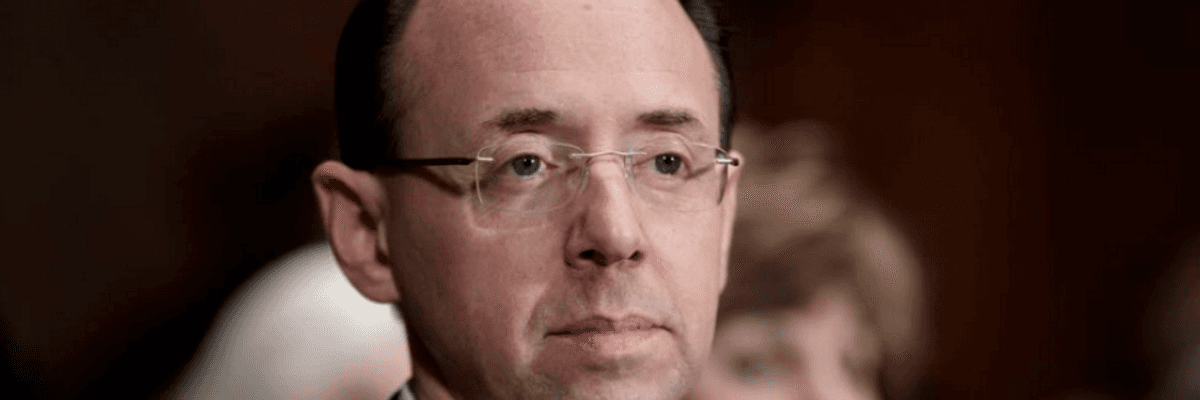
U.S. Deputy Attorney General Rod Rosenstein appeared to be the target of a tweet by President Donald Trump on Friday morning. (Photo: AP)
Despite Nationwide Effort to Insulate Deputy AG From Trump, Rosenstein Reportedly Has Exit Plan
"Let's hope this means Rosenstein believes that Mueller’s work is largely done and can no longer be derailed."
While an aggressive push by grassroots organizations and congressional lawmakers was made to ensure Deputy Attorney General Rod Rosentein was not improperly removed or forced out of his position at the U.S. Justice Department, multiple media outlets reported Wednesday morning that he has indicated to the White House his intention to leave within the coming weeks.
Rosenstein, ABC News reports, "has communicated to President Donald Trump and White House officials his plan to depart the administration around the time William Barr, Trump's nominee for attorney general, would take office following a Senate confirmation."
According to CNN:
The deputy attorney general has been managing special counsel Robert Mueller's Russia investigation and has signaled to other officials that he would leave when he was satisfied that Mueller's investigation was either complete or close enough to completion that it was protected.
When exactly Rosenstein leaves could shift depending on the timing of Barr's confirmation and the naming of a new deputy attorney general. An official briefed on the discussions said Rosenstein wants to ensure a smooth transition, which includes the Mueller investigation.
Barr's Senate confirmation hearing begins January 15, which means a confirmation vote at the earliest would occur in mid-February.
There has been paramount concern among Trump critics that Rosenstein would be forced out or fired as a way for the president to assert more control over the Mueller probe.
We are at a crossroads
This country and this world are at a monumental crossroads. In a few short weeks, US voters will have an opportunity to beat back the forces of fascism and confront the billionaires who are rigging the economy, our media system, and our democracy, making it increasingly impossible for ordinary people to get by. We’re not just talking about the election. We’re talking about what must be done once these fascist elements are vanquished from power. We need a bolder set of solutions than what either major party has so far been willing to offer and a working-class movement ready to fight like hell for it. Trump didn't emerge from nowhere. The conditions that fueled MAGA authoritarianism were created by decades of radical neoliberal economic policies and a corrupt political system dominated by corporate interests. They slashed taxes on the super-rich, promising that the benefits would trickle down. They said giveaways to the corporate titans would make life more affordable for the rest of us. It was all bullshit. And when a bitter, betrayed populace searches for someone to blame, right-wing demagogues have little trouble finding scapegoats. People know when they're being lied to, but you won't hear any of this from the corporate media. Only independent journalism—powered and funded by people who believe in building a better world—can deliver truly trustworthy daily news. Our Fall Campaign is underway, and we need your help. To power our newsroom through the rest of the year, we need to raise $125,000 by midnight on October 31. So if you share our vision, please contribute whatever you can to sustain our work. |
While an aggressive push by grassroots organizations and congressional lawmakers was made to ensure Deputy Attorney General Rod Rosentein was not improperly removed or forced out of his position at the U.S. Justice Department, multiple media outlets reported Wednesday morning that he has indicated to the White House his intention to leave within the coming weeks.
Rosenstein, ABC News reports, "has communicated to President Donald Trump and White House officials his plan to depart the administration around the time William Barr, Trump's nominee for attorney general, would take office following a Senate confirmation."
According to CNN:
The deputy attorney general has been managing special counsel Robert Mueller's Russia investigation and has signaled to other officials that he would leave when he was satisfied that Mueller's investigation was either complete or close enough to completion that it was protected.
When exactly Rosenstein leaves could shift depending on the timing of Barr's confirmation and the naming of a new deputy attorney general. An official briefed on the discussions said Rosenstein wants to ensure a smooth transition, which includes the Mueller investigation.
Barr's Senate confirmation hearing begins January 15, which means a confirmation vote at the earliest would occur in mid-February.
There has been paramount concern among Trump critics that Rosenstein would be forced out or fired as a way for the president to assert more control over the Mueller probe.
While an aggressive push by grassroots organizations and congressional lawmakers was made to ensure Deputy Attorney General Rod Rosentein was not improperly removed or forced out of his position at the U.S. Justice Department, multiple media outlets reported Wednesday morning that he has indicated to the White House his intention to leave within the coming weeks.
Rosenstein, ABC News reports, "has communicated to President Donald Trump and White House officials his plan to depart the administration around the time William Barr, Trump's nominee for attorney general, would take office following a Senate confirmation."
According to CNN:
The deputy attorney general has been managing special counsel Robert Mueller's Russia investigation and has signaled to other officials that he would leave when he was satisfied that Mueller's investigation was either complete or close enough to completion that it was protected.
When exactly Rosenstein leaves could shift depending on the timing of Barr's confirmation and the naming of a new deputy attorney general. An official briefed on the discussions said Rosenstein wants to ensure a smooth transition, which includes the Mueller investigation.
Barr's Senate confirmation hearing begins January 15, which means a confirmation vote at the earliest would occur in mid-February.
There has been paramount concern among Trump critics that Rosenstein would be forced out or fired as a way for the president to assert more control over the Mueller probe.