

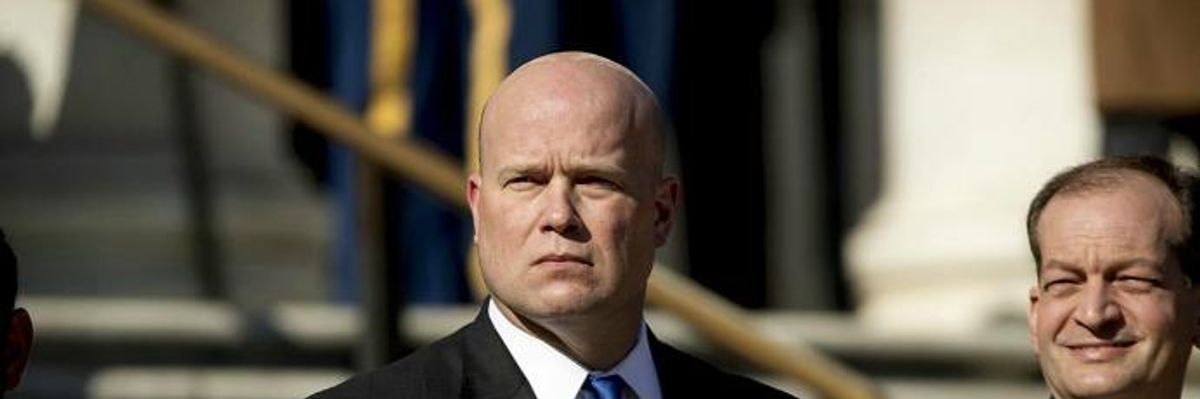
Acting Attorney General Matthew Whitaker was appointed after President Donald Trump fired Jeff Sessions last week. (Photo: Andrew Harnik/AP)
Absent Senate's Consent, Maryland Argues Trump Appointment of Acting AG Matthew Whitaker Unlawful
The significant authority of attorney general "calls for the highest levels of integrity and personal judgment, prerequisites safeguarded by the Constitution's command that principal officers be subject to the oversight and check provided by Senate confirmation."
Maryland on Tuesday mounted the first court challenge to President Donald Trump's appointment of Matthew Whitaker as acting attorney general after he fired Jeff Sessions last week.
The state, according to the New York Times, is requesting an injunction to prevent Whitaker from acting as attorney general, arguing that under federal law, the position should instead belong to Deputy Attorney General Rod Rosenstein, who has been overseeing Special Counsel Robert Mueller's probe of alleged election meddling and obstruction of justice since Sessions recused himself.
Trump's appointment of Whitaker, an outspoken critic of the Mueller investigation, has been widely denounced as a ploy hamstring the probe.
The action comes as part of an ongoing case about the Affordable Care Act in which Sessions is named as a defendant. As Sessions is no longer the nation's top law enforcement official, Judge Ellen L. Hollander of the Federal District Court for the District of Maryland must decided who is the legal successor in the case.
While the Trump administration has claimed that Whitaker meets all requirements under the Federal Vacancies Act of 1998, Maryland, as the Times reports, argues that under the Attorney General Succession Act and the appointments clause of the Constitution--which states that "principal officers" of the federal government must be appointed "with the advice and consent of the Senate"--Sessions' successor must be Rosenstein until the Senate confirms a permanent replacement.
The significant authority of attorney general, the filing reportedly declares, "calls for the highest levels of integrity and personal judgment, prerequisites safeguarded by the Constitution's command that principal officers be subject to the oversight and check provided by Senate confirmation." The president, it states, may not "bypass the constitutional and statutory requirements for appointing someone to that office."
We are at a crossroads
This country and this world are at a monumental crossroads. In a few short weeks, US voters will have an opportunity to beat back the forces of fascism and confront the billionaires who are rigging the economy, our media system, and our democracy, making it increasingly impossible for ordinary people to get by. We’re not just talking about the election. We’re talking about what must be done once these fascist elements are vanquished from power. We need a bolder set of solutions than what either major party has so far been willing to offer and a working-class movement ready to fight like hell for it. Trump didn't emerge from nowhere. The conditions that fueled MAGA authoritarianism were created by decades of radical neoliberal economic policies and a corrupt political system dominated by corporate interests. They slashed taxes on the super-rich, promising that the benefits would trickle down. They said giveaways to the corporate titans would make life more affordable for the rest of us. It was all bullshit. And when a bitter, betrayed populace searches for someone to blame, right-wing demagogues have little trouble finding scapegoats. People know when they're being lied to, but you won't hear any of this from the corporate media. Only independent journalism—powered and funded by people who believe in building a better world—can deliver truly trustworthy daily news. Our Fall Campaign is underway, and we need your help. To power our newsroom through the rest of the year, we need to raise $125,000 by midnight on October 31. So if you share our vision, please contribute whatever you can to sustain our work. |
Maryland on Tuesday mounted the first court challenge to President Donald Trump's appointment of Matthew Whitaker as acting attorney general after he fired Jeff Sessions last week.
The state, according to the New York Times, is requesting an injunction to prevent Whitaker from acting as attorney general, arguing that under federal law, the position should instead belong to Deputy Attorney General Rod Rosenstein, who has been overseeing Special Counsel Robert Mueller's probe of alleged election meddling and obstruction of justice since Sessions recused himself.
Trump's appointment of Whitaker, an outspoken critic of the Mueller investigation, has been widely denounced as a ploy hamstring the probe.
The action comes as part of an ongoing case about the Affordable Care Act in which Sessions is named as a defendant. As Sessions is no longer the nation's top law enforcement official, Judge Ellen L. Hollander of the Federal District Court for the District of Maryland must decided who is the legal successor in the case.
While the Trump administration has claimed that Whitaker meets all requirements under the Federal Vacancies Act of 1998, Maryland, as the Times reports, argues that under the Attorney General Succession Act and the appointments clause of the Constitution--which states that "principal officers" of the federal government must be appointed "with the advice and consent of the Senate"--Sessions' successor must be Rosenstein until the Senate confirms a permanent replacement.
The significant authority of attorney general, the filing reportedly declares, "calls for the highest levels of integrity and personal judgment, prerequisites safeguarded by the Constitution's command that principal officers be subject to the oversight and check provided by Senate confirmation." The president, it states, may not "bypass the constitutional and statutory requirements for appointing someone to that office."