SUBSCRIBE TO OUR FREE NEWSLETTER
Daily news & progressive opinion—funded by the people, not the corporations—delivered straight to your inbox.
5
#000000
#FFFFFF
To donate by check, phone, or other method, see our More Ways to Give page.
Daily news & progressive opinion—funded by the people, not the corporations—delivered straight to your inbox.
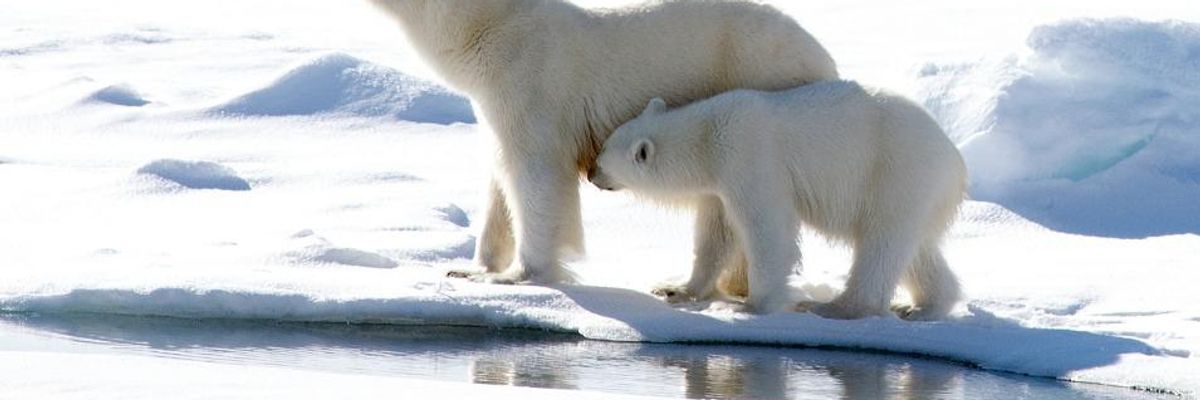
The strongest sea ice in the Arctic began breaking up for the first time in recorded history, according to scientists. (Photo: Christopher Michel/Flickr/cc)
After abnormal heatwaves this year in the Arctic, the region's oldest and thickest sea ice has thinned out considerably--to the point of breaking up in recent days.
As the Guardian reported, the Norwegian Ice Service found this week that the ice cover in the area off the northern coast of Greenland has been at record low levels at least 14 days in the past month, sometimes reaching levels 40 percent lower than the average for this time of year.
The new development is causing grave concerns among climate scientists regarding their previously-held beliefs about the Arctic's ice.
"Open water off the north coast of Greenland is unusual," Ruth Mottram of the Danish Meteorological Institute told the Guardian. "This area has often been called 'the last ice area' as it has been suggested that the last perennial sea ice in the Arctic will occur here."
Heatwaves last February and this month as well as warm winds have pushed ice that is generally about 65 feet thick away from Greenland's northern coast. Warming trends that have been maintained over the last 15 years, according to scientists, has made ice that's usually packed close together, much less stable.
Generally, "The ice there has nowhere else to go so it piles up," research scientist Walt Meier of the US National Snow and Ice Data Center told the Guardian. "However, that was not the case this past winter in February and March and now. The ice is being pushed away from the coast by the winds."
"It's a pretty dramatic indication of the transformation of the Arctic sea ice and Arctic climate," Meier added.
Another climate researcher, Thomas Lavergne of the Norwegian Meteorological Institute, called the findings "scary" on social media.
Scientists have traced the record-defying ice thinning back to a notable heatwave in February.
As Common Dreams reported, a weather station in northern Greenland usually registers temperatures of about -4 degrees Fahrenheit in February, but this year there were 10 days that month where warm winds and temperatures above freezing were recorded.
Dear Common Dreams reader, The U.S. is on a fast track to authoritarianism like nothing I've ever seen. Meanwhile, corporate news outlets are utterly capitulating to Trump, twisting their coverage to avoid drawing his ire while lining up to stuff cash in his pockets. That's why I believe that Common Dreams is doing the best and most consequential reporting that we've ever done. Our small but mighty team is a progressive reporting powerhouse, covering the news every day that the corporate media never will. Our mission has always been simple: To inform. To inspire. And to ignite change for the common good. Now here's the key piece that I want all our readers to understand: None of this would be possible without your financial support. That's not just some fundraising cliche. It's the absolute and literal truth. We don't accept corporate advertising and never will. We don't have a paywall because we don't think people should be blocked from critical news based on their ability to pay. Everything we do is funded by the donations of readers like you. Will you donate now to help power the nonprofit, independent reporting of Common Dreams? Thank you for being a vital member of our community. Together, we can keep independent journalism alive when it’s needed most. - Craig Brown, Co-founder |
After abnormal heatwaves this year in the Arctic, the region's oldest and thickest sea ice has thinned out considerably--to the point of breaking up in recent days.
As the Guardian reported, the Norwegian Ice Service found this week that the ice cover in the area off the northern coast of Greenland has been at record low levels at least 14 days in the past month, sometimes reaching levels 40 percent lower than the average for this time of year.
The new development is causing grave concerns among climate scientists regarding their previously-held beliefs about the Arctic's ice.
"Open water off the north coast of Greenland is unusual," Ruth Mottram of the Danish Meteorological Institute told the Guardian. "This area has often been called 'the last ice area' as it has been suggested that the last perennial sea ice in the Arctic will occur here."
Heatwaves last February and this month as well as warm winds have pushed ice that is generally about 65 feet thick away from Greenland's northern coast. Warming trends that have been maintained over the last 15 years, according to scientists, has made ice that's usually packed close together, much less stable.
Generally, "The ice there has nowhere else to go so it piles up," research scientist Walt Meier of the US National Snow and Ice Data Center told the Guardian. "However, that was not the case this past winter in February and March and now. The ice is being pushed away from the coast by the winds."
"It's a pretty dramatic indication of the transformation of the Arctic sea ice and Arctic climate," Meier added.
Another climate researcher, Thomas Lavergne of the Norwegian Meteorological Institute, called the findings "scary" on social media.
Scientists have traced the record-defying ice thinning back to a notable heatwave in February.
As Common Dreams reported, a weather station in northern Greenland usually registers temperatures of about -4 degrees Fahrenheit in February, but this year there were 10 days that month where warm winds and temperatures above freezing were recorded.
After abnormal heatwaves this year in the Arctic, the region's oldest and thickest sea ice has thinned out considerably--to the point of breaking up in recent days.
As the Guardian reported, the Norwegian Ice Service found this week that the ice cover in the area off the northern coast of Greenland has been at record low levels at least 14 days in the past month, sometimes reaching levels 40 percent lower than the average for this time of year.
The new development is causing grave concerns among climate scientists regarding their previously-held beliefs about the Arctic's ice.
"Open water off the north coast of Greenland is unusual," Ruth Mottram of the Danish Meteorological Institute told the Guardian. "This area has often been called 'the last ice area' as it has been suggested that the last perennial sea ice in the Arctic will occur here."
Heatwaves last February and this month as well as warm winds have pushed ice that is generally about 65 feet thick away from Greenland's northern coast. Warming trends that have been maintained over the last 15 years, according to scientists, has made ice that's usually packed close together, much less stable.
Generally, "The ice there has nowhere else to go so it piles up," research scientist Walt Meier of the US National Snow and Ice Data Center told the Guardian. "However, that was not the case this past winter in February and March and now. The ice is being pushed away from the coast by the winds."
"It's a pretty dramatic indication of the transformation of the Arctic sea ice and Arctic climate," Meier added.
Another climate researcher, Thomas Lavergne of the Norwegian Meteorological Institute, called the findings "scary" on social media.
Scientists have traced the record-defying ice thinning back to a notable heatwave in February.
As Common Dreams reported, a weather station in northern Greenland usually registers temperatures of about -4 degrees Fahrenheit in February, but this year there were 10 days that month where warm winds and temperatures above freezing were recorded.