SUBSCRIBE TO OUR FREE NEWSLETTER
Daily news & progressive opinion—funded by the people, not the corporations—delivered straight to your inbox.
5
#000000
#FFFFFF
To donate by check, phone, or other method, see our More Ways to Give page.
Daily news & progressive opinion—funded by the people, not the corporations—delivered straight to your inbox.
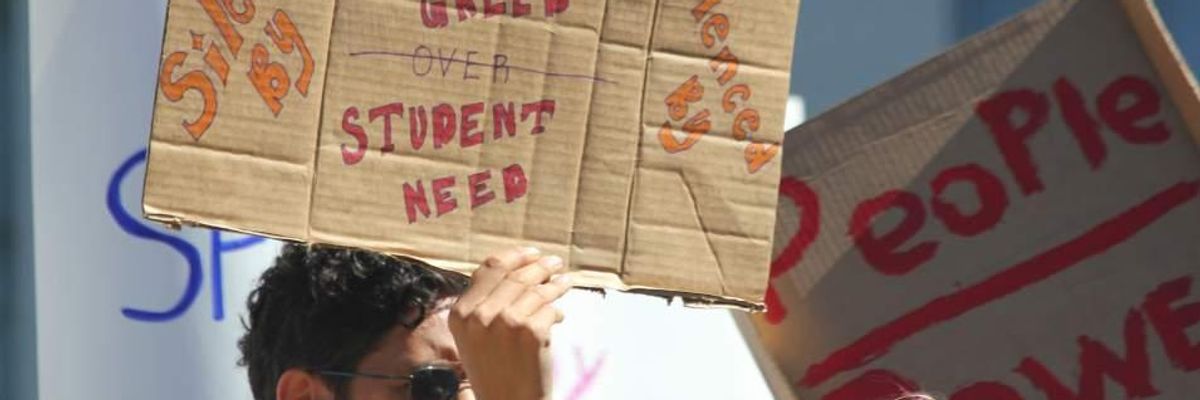
Education Secretary Betsy DeVos moved to roll back regulations on low-performing for-profit college programs, which leave graduates with degrees that do little to help them find gainful employment. (Photo: Quinn Dombrowski/Flickr/cc)
In her latest move aimed at propping up the for-profit education corporations in which she herself has invested, Education Secretary Betsy DeVos on Friday moved to rescind a rule which has held for-profit colleges accountable for the expensive, often fruitless degrees their students were fraudulently peddled.
The Department of Education (DOE) unveiled a plan to eliminate the Obama-era gainful employment rule, which beginning in 2015 forced for-profit institutions to prove that their graduates could use their degrees to secure jobs--as the schools aggressively, yet misleadingly, advertised--that would allow them to support themselves and pay back their taxpayer-funded loans.
The department was sued last year by 18 state attorneys general, including Barbara Underwood in New York, for delaying implementation of the rule, which was meant to revoke federal funding and financial aid from under-performing for-profit schools.
In announcing that she would rescind the rule, DeVos attempted to divert attention away from the for-profit education industry--which has been accused of defrauding tens of thousands of students--by offering to provide students with career placement, earnings, and debt information regarding all U.S. colleges and universities including public and private schools.
While the student loan crisis and falling wages affect graduates of not-for-profit schools as well as businesses like the ones targeted by the gainful employment rule, studies including one by the National Bureau of Economic Research have found that graduates of schools like the Corinthian Colleges chain have worse outcomes than those of public or private colleges and universities.
The proposed elimination of the gainful employment rule, which is subject to a 30-day comment period and is planned to go into effect next July, is the latest move in DeVos's multi-pronged effort to protect for profit institutions from being held accountable for defrauding students. Last month she unveiled a plan to make it harder for students of for profit colleges to get debt relief.
"Her extreme proposal to rescind this rule is further proof that there is no line Secretary DeVos won't cross to pad the pockets of for-profit colleges--even leaving students and taxpayers to foot the bill," said Sen. Patty Murray (D-Wash.).
Author John Dean noted that DeVos's repeated handouts to the for-profit education industry is unsurprising given her financial interests in the business.
Dear Common Dreams reader, It’s been nearly 30 years since I co-founded Common Dreams with my late wife, Lina Newhouser. We had the radical notion that journalism should serve the public good, not corporate profits. It was clear to us from the outset what it would take to build such a project. No paid advertisements. No corporate sponsors. No millionaire publisher telling us what to think or do. Many people said we wouldn't last a year, but we proved those doubters wrong. Together with a tremendous team of journalists and dedicated staff, we built an independent media outlet free from the constraints of profits and corporate control. Our mission has always been simple: To inform. To inspire. To ignite change for the common good. Building Common Dreams was not easy. Our survival was never guaranteed. When you take on the most powerful forces—Wall Street greed, fossil fuel industry destruction, Big Tech lobbyists, and uber-rich oligarchs who have spent billions upon billions rigging the economy and democracy in their favor—the only bulwark you have is supporters who believe in your work. But here’s the urgent message from me today. It's never been this bad out there. And it's never been this hard to keep us going. At the very moment Common Dreams is most needed, the threats we face are intensifying. We need your support now more than ever. We don't accept corporate advertising and never will. We don't have a paywall because we don't think people should be blocked from critical news based on their ability to pay. Everything we do is funded by the donations of readers like you. When everyone does the little they can afford, we are strong. But if that support retreats or dries up, so do we. Will you donate now to make sure Common Dreams not only survives but thrives? —Craig Brown, Co-founder |
In her latest move aimed at propping up the for-profit education corporations in which she herself has invested, Education Secretary Betsy DeVos on Friday moved to rescind a rule which has held for-profit colleges accountable for the expensive, often fruitless degrees their students were fraudulently peddled.
The Department of Education (DOE) unveiled a plan to eliminate the Obama-era gainful employment rule, which beginning in 2015 forced for-profit institutions to prove that their graduates could use their degrees to secure jobs--as the schools aggressively, yet misleadingly, advertised--that would allow them to support themselves and pay back their taxpayer-funded loans.
The department was sued last year by 18 state attorneys general, including Barbara Underwood in New York, for delaying implementation of the rule, which was meant to revoke federal funding and financial aid from under-performing for-profit schools.
In announcing that she would rescind the rule, DeVos attempted to divert attention away from the for-profit education industry--which has been accused of defrauding tens of thousands of students--by offering to provide students with career placement, earnings, and debt information regarding all U.S. colleges and universities including public and private schools.
While the student loan crisis and falling wages affect graduates of not-for-profit schools as well as businesses like the ones targeted by the gainful employment rule, studies including one by the National Bureau of Economic Research have found that graduates of schools like the Corinthian Colleges chain have worse outcomes than those of public or private colleges and universities.
The proposed elimination of the gainful employment rule, which is subject to a 30-day comment period and is planned to go into effect next July, is the latest move in DeVos's multi-pronged effort to protect for profit institutions from being held accountable for defrauding students. Last month she unveiled a plan to make it harder for students of for profit colleges to get debt relief.
"Her extreme proposal to rescind this rule is further proof that there is no line Secretary DeVos won't cross to pad the pockets of for-profit colleges--even leaving students and taxpayers to foot the bill," said Sen. Patty Murray (D-Wash.).
Author John Dean noted that DeVos's repeated handouts to the for-profit education industry is unsurprising given her financial interests in the business.
In her latest move aimed at propping up the for-profit education corporations in which she herself has invested, Education Secretary Betsy DeVos on Friday moved to rescind a rule which has held for-profit colleges accountable for the expensive, often fruitless degrees their students were fraudulently peddled.
The Department of Education (DOE) unveiled a plan to eliminate the Obama-era gainful employment rule, which beginning in 2015 forced for-profit institutions to prove that their graduates could use their degrees to secure jobs--as the schools aggressively, yet misleadingly, advertised--that would allow them to support themselves and pay back their taxpayer-funded loans.
The department was sued last year by 18 state attorneys general, including Barbara Underwood in New York, for delaying implementation of the rule, which was meant to revoke federal funding and financial aid from under-performing for-profit schools.
In announcing that she would rescind the rule, DeVos attempted to divert attention away from the for-profit education industry--which has been accused of defrauding tens of thousands of students--by offering to provide students with career placement, earnings, and debt information regarding all U.S. colleges and universities including public and private schools.
While the student loan crisis and falling wages affect graduates of not-for-profit schools as well as businesses like the ones targeted by the gainful employment rule, studies including one by the National Bureau of Economic Research have found that graduates of schools like the Corinthian Colleges chain have worse outcomes than those of public or private colleges and universities.
The proposed elimination of the gainful employment rule, which is subject to a 30-day comment period and is planned to go into effect next July, is the latest move in DeVos's multi-pronged effort to protect for profit institutions from being held accountable for defrauding students. Last month she unveiled a plan to make it harder for students of for profit colleges to get debt relief.
"Her extreme proposal to rescind this rule is further proof that there is no line Secretary DeVos won't cross to pad the pockets of for-profit colleges--even leaving students and taxpayers to foot the bill," said Sen. Patty Murray (D-Wash.).
Author John Dean noted that DeVos's repeated handouts to the for-profit education industry is unsurprising given her financial interests in the business.