SUBSCRIBE TO OUR FREE NEWSLETTER
Daily news & progressive opinion—funded by the people, not the corporations—delivered straight to your inbox.
5
#000000
#FFFFFF
To donate by check, phone, or other method, see our More Ways to Give page.
Daily news & progressive opinion—funded by the people, not the corporations—delivered straight to your inbox.
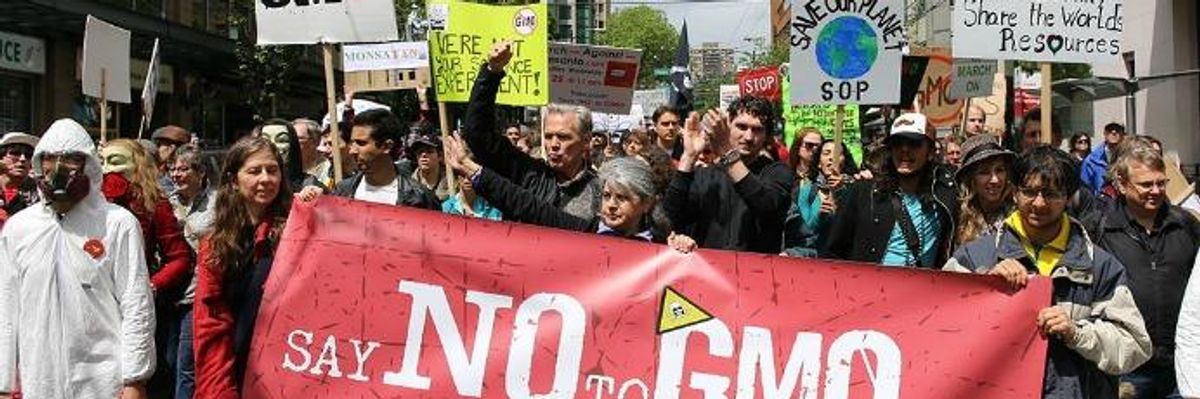
"Indians deserve to grow, produce, distribute good food for all, instead of bad food and fake food imposed by the unscientific, undemocratic, anti-national labelling rules for the profits of the GMO and junk food industry at the cost of people's health," author and food sovereignty activist Vandana Shiva wrote in a recent column. (Photo: Wikipedia Commons/cc)
Despite India's law barring genetically modified (GM) foods from being produced or sold in the country without government approval, a study by the New Delhi-based Centre for Science and Environment (CSE) found that thanks to lax enforcement, a deeply flawed labeling system, and corporate deception, Indian supermarkets are inundated with GM foods.
"Most GM foods in the study did not disclose GM on their labels and 15 percent made false claims saying they were GM-free."
-- Sunita Narain, Centre for Science and Environment
After conducting tests on "domestically produced and imported edible oils, processed and packaged foods, and infant foods," CSE researchers found that 32 percent of the samples tested contained genetically modified organisms (GMOs), and 80 percent of the GMO-positive foods were imported from the United States, Canada, the Netherlands, Thailand, and the United Arab Emirates.
"Most GM foods in the study did not disclose GM on their labels and 15 percent made false claims saying they were GM-free," Sunita Narain, CSE's director general, said in a statement.
CSE's results expose "large-scale illegal presence and sale of genetically modified (GM) processed foods in the country," researchers wrote in a summary of their findings. "GM contamination was found in infant food, sold for children with medical ailments, including allergies. Two products by Abbott Laboratories, the American healthcare company, were found to be GM-positive--one was for lactose-intolerant infants and the other was a hypoallergenic (for minimizing the possibility of an allergic reaction). Neither product has any label warning parents that this food has GM ingredients."
"We had been hearing about the presence of illegal GM food in India, and decided to do a reality check by testing processed foods," CSE deputy director general Chandra Bhushan said. "We were shocked to know the scale in which GM foods have penetrated the Indian market. The regulatory authorities are to blame here."
"Indians deserve to grow, produce, distribute good food for all, instead of bad food and fake food imposed by the unscientific, undemocratic, anti-national labelling rules for the profits of the GMO and junk food industry at the cost of people's health."
--Vandana Shiva
As noted author and food sovereignty activist Vandana Shiva observed in a recent column, the labeling system established by the Food Safety and Standards Authority's (FSSAI)--the body responsible for food regulation and safety in India--was flawed from the start.
"The FSSAI rules are undemocratic because the FSSAI is advised by the same corporations that have spread unhealthy food across the industrial world, and now want to impose it on India--Coke, Pepsi and Nestle," Shiva wrote. "This translates into corporate food fascism."
She added, "Indians deserve to grow, produce, distribute good food for all, instead of bad food and fake food imposed by the unscientific, undemocratic, anti-national labeling rules for the profits of the GMO and junk food industry at the cost of people's health and our national food and health sovereignty."
Dear Common Dreams reader, It’s been nearly 30 years since I co-founded Common Dreams with my late wife, Lina Newhouser. We had the radical notion that journalism should serve the public good, not corporate profits. It was clear to us from the outset what it would take to build such a project. No paid advertisements. No corporate sponsors. No millionaire publisher telling us what to think or do. Many people said we wouldn't last a year, but we proved those doubters wrong. Together with a tremendous team of journalists and dedicated staff, we built an independent media outlet free from the constraints of profits and corporate control. Our mission has always been simple: To inform. To inspire. To ignite change for the common good. Building Common Dreams was not easy. Our survival was never guaranteed. When you take on the most powerful forces—Wall Street greed, fossil fuel industry destruction, Big Tech lobbyists, and uber-rich oligarchs who have spent billions upon billions rigging the economy and democracy in their favor—the only bulwark you have is supporters who believe in your work. But here’s the urgent message from me today. It's never been this bad out there. And it's never been this hard to keep us going. At the very moment Common Dreams is most needed, the threats we face are intensifying. We need your support now more than ever. We don't accept corporate advertising and never will. We don't have a paywall because we don't think people should be blocked from critical news based on their ability to pay. Everything we do is funded by the donations of readers like you. When everyone does the little they can afford, we are strong. But if that support retreats or dries up, so do we. Will you donate now to make sure Common Dreams not only survives but thrives? —Craig Brown, Co-founder |
Despite India's law barring genetically modified (GM) foods from being produced or sold in the country without government approval, a study by the New Delhi-based Centre for Science and Environment (CSE) found that thanks to lax enforcement, a deeply flawed labeling system, and corporate deception, Indian supermarkets are inundated with GM foods.
"Most GM foods in the study did not disclose GM on their labels and 15 percent made false claims saying they were GM-free."
-- Sunita Narain, Centre for Science and Environment
After conducting tests on "domestically produced and imported edible oils, processed and packaged foods, and infant foods," CSE researchers found that 32 percent of the samples tested contained genetically modified organisms (GMOs), and 80 percent of the GMO-positive foods were imported from the United States, Canada, the Netherlands, Thailand, and the United Arab Emirates.
"Most GM foods in the study did not disclose GM on their labels and 15 percent made false claims saying they were GM-free," Sunita Narain, CSE's director general, said in a statement.
CSE's results expose "large-scale illegal presence and sale of genetically modified (GM) processed foods in the country," researchers wrote in a summary of their findings. "GM contamination was found in infant food, sold for children with medical ailments, including allergies. Two products by Abbott Laboratories, the American healthcare company, were found to be GM-positive--one was for lactose-intolerant infants and the other was a hypoallergenic (for minimizing the possibility of an allergic reaction). Neither product has any label warning parents that this food has GM ingredients."
"We had been hearing about the presence of illegal GM food in India, and decided to do a reality check by testing processed foods," CSE deputy director general Chandra Bhushan said. "We were shocked to know the scale in which GM foods have penetrated the Indian market. The regulatory authorities are to blame here."
"Indians deserve to grow, produce, distribute good food for all, instead of bad food and fake food imposed by the unscientific, undemocratic, anti-national labelling rules for the profits of the GMO and junk food industry at the cost of people's health."
--Vandana Shiva
As noted author and food sovereignty activist Vandana Shiva observed in a recent column, the labeling system established by the Food Safety and Standards Authority's (FSSAI)--the body responsible for food regulation and safety in India--was flawed from the start.
"The FSSAI rules are undemocratic because the FSSAI is advised by the same corporations that have spread unhealthy food across the industrial world, and now want to impose it on India--Coke, Pepsi and Nestle," Shiva wrote. "This translates into corporate food fascism."
She added, "Indians deserve to grow, produce, distribute good food for all, instead of bad food and fake food imposed by the unscientific, undemocratic, anti-national labeling rules for the profits of the GMO and junk food industry at the cost of people's health and our national food and health sovereignty."
Despite India's law barring genetically modified (GM) foods from being produced or sold in the country without government approval, a study by the New Delhi-based Centre for Science and Environment (CSE) found that thanks to lax enforcement, a deeply flawed labeling system, and corporate deception, Indian supermarkets are inundated with GM foods.
"Most GM foods in the study did not disclose GM on their labels and 15 percent made false claims saying they were GM-free."
-- Sunita Narain, Centre for Science and Environment
After conducting tests on "domestically produced and imported edible oils, processed and packaged foods, and infant foods," CSE researchers found that 32 percent of the samples tested contained genetically modified organisms (GMOs), and 80 percent of the GMO-positive foods were imported from the United States, Canada, the Netherlands, Thailand, and the United Arab Emirates.
"Most GM foods in the study did not disclose GM on their labels and 15 percent made false claims saying they were GM-free," Sunita Narain, CSE's director general, said in a statement.
CSE's results expose "large-scale illegal presence and sale of genetically modified (GM) processed foods in the country," researchers wrote in a summary of their findings. "GM contamination was found in infant food, sold for children with medical ailments, including allergies. Two products by Abbott Laboratories, the American healthcare company, were found to be GM-positive--one was for lactose-intolerant infants and the other was a hypoallergenic (for minimizing the possibility of an allergic reaction). Neither product has any label warning parents that this food has GM ingredients."
"We had been hearing about the presence of illegal GM food in India, and decided to do a reality check by testing processed foods," CSE deputy director general Chandra Bhushan said. "We were shocked to know the scale in which GM foods have penetrated the Indian market. The regulatory authorities are to blame here."
"Indians deserve to grow, produce, distribute good food for all, instead of bad food and fake food imposed by the unscientific, undemocratic, anti-national labelling rules for the profits of the GMO and junk food industry at the cost of people's health."
--Vandana Shiva
As noted author and food sovereignty activist Vandana Shiva observed in a recent column, the labeling system established by the Food Safety and Standards Authority's (FSSAI)--the body responsible for food regulation and safety in India--was flawed from the start.
"The FSSAI rules are undemocratic because the FSSAI is advised by the same corporations that have spread unhealthy food across the industrial world, and now want to impose it on India--Coke, Pepsi and Nestle," Shiva wrote. "This translates into corporate food fascism."
She added, "Indians deserve to grow, produce, distribute good food for all, instead of bad food and fake food imposed by the unscientific, undemocratic, anti-national labeling rules for the profits of the GMO and junk food industry at the cost of people's health and our national food and health sovereignty."