SUBSCRIBE TO OUR FREE NEWSLETTER
Daily news & progressive opinion—funded by the people, not the corporations—delivered straight to your inbox.
5
#000000
#FFFFFF
To donate by check, phone, or other method, see our More Ways to Give page.
Daily news & progressive opinion—funded by the people, not the corporations—delivered straight to your inbox.
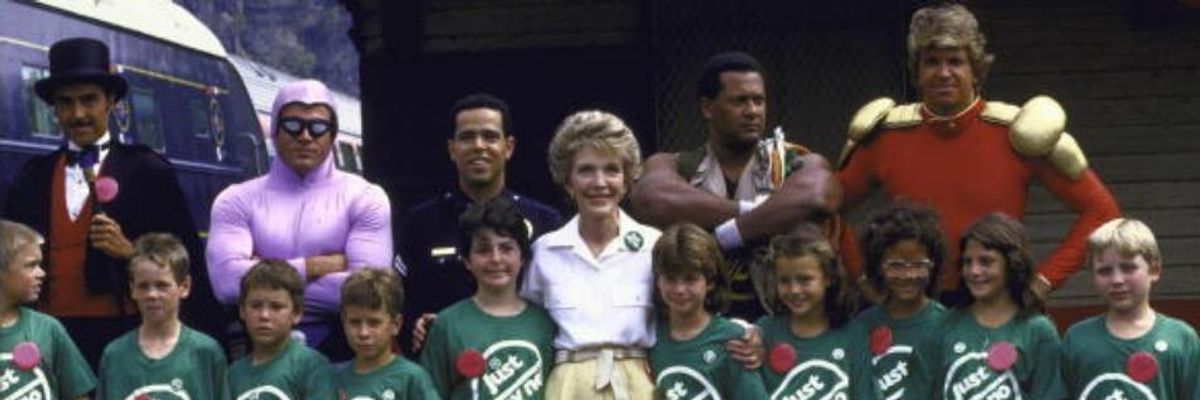
President Donald Trump's speech on the opioid epidemic brought to mind First Lady Nancy Reagan's "Just Say No" anti-drug campaign of the 1980s, which many drug policy experts have denounced as simplistic and ineffective. (Photo: Cynthia Johnson/Getty Images)
In a speech officially unveiling his administration's plan to combat the nation's ongoing opioid epidemic, President Donald Trump on Monday saod he would fight the crisis with "toughness", the creation of "very...very...bad commercials" aimed at children; and--as expected--proposed that the death penalty be applied to drug dealers.
However, as drug policy reform advocates feared, he showed little understanding of the origins of the crisis and neglected to mention numerous measures public health experts have advocated for to stop the deadly epidemic.
A key tenet of Trump's plan to combat the crisis, which killed nearly 64,000 Americans in 2016, is to launch an advertising campaign showing the effects of opioid use.
"The best way to beat the drug crisis is to keep people from getting hooked on drugs to begin with," he told a crowd in Manchester, N.H. "As part of that effort--so important, this is something I've been strongly in favor of--spending a lot of money on great commercials showing how bad it is."
The ads, Trump added, would be "very...very...bad commercials...And when they see those commercials, hopefully they're not going to be going to drugs of any kind."
The proposal struck critics as similar to First Lady Nancy Reagan's "Just Say No" campaign of the 1980s, which has been denounced as "simplistic and vague" and which studies have shown did not make young Americans any less likely to use drugs.
While Trump spent a large portion of his speech talking about keeping kids away from drugs, statistics show that Americans in their 50s and 60s are most at risk for overdosing on prescription opioids--a major driver of the overall crisis.
The prevalence of heroin abuse is of greater concern among younger Americans, but recent studies have shown that three-quarters of people who began using heroin in the 2000s abused prescription opioid painkillers first. Doctors have suggested that lax prescribing practices within their own profession continue to contribute to the opioid crisis--calling into question the notion that commercials would successfully steer Americans away from the drugs.
The president also linked the epidemic to immigration, urging Democrats to back his plan to "build the wall to keep the damn drugs out" and leading audience members in the chant, "Build the wall!"
But drug policy experts say that tougher border security would have little to no effect on the prevalence of drugs in the U.S.
"A wall alone cannot stop the flow of drugs into the United States," Christopher Wilson of the Mexico Institute at the Wilson Center, told Vox last year. "...history shows us that border enforcement has been much more effective at changing the when and where of drugs being brought into the United States rather than the overall amount of drugs being brought into the United States."
Critics also expressed shock at the president's proposal to seek the death penalty for drug dealers--a plan that was hinted at last week. Trump has expressed admiration for Filipino President Rodrigo Duterte's drug war--which has resulted in the deaths of thousands, many in poor communities--and the stringent drug policies applied by Singapore's government.
"We can have all the blue ribbon committees we want but if we don't get tough on the drug dealers we're wasting our time...and that toughness includes the death penalty," said the president.
The remark was condemned on social media by many, including drug policy experts, who have long said drug addition should be treated as a public health issue instead of a criminal matter.
Dear Common Dreams reader, It’s been nearly 30 years since I co-founded Common Dreams with my late wife, Lina Newhouser. We had the radical notion that journalism should serve the public good, not corporate profits. It was clear to us from the outset what it would take to build such a project. No paid advertisements. No corporate sponsors. No millionaire publisher telling us what to think or do. Many people said we wouldn't last a year, but we proved those doubters wrong. Together with a tremendous team of journalists and dedicated staff, we built an independent media outlet free from the constraints of profits and corporate control. Our mission has always been simple: To inform. To inspire. To ignite change for the common good. Building Common Dreams was not easy. Our survival was never guaranteed. When you take on the most powerful forces—Wall Street greed, fossil fuel industry destruction, Big Tech lobbyists, and uber-rich oligarchs who have spent billions upon billions rigging the economy and democracy in their favor—the only bulwark you have is supporters who believe in your work. But here’s the urgent message from me today. It's never been this bad out there. And it's never been this hard to keep us going. At the very moment Common Dreams is most needed, the threats we face are intensifying. We need your support now more than ever. We don't accept corporate advertising and never will. We don't have a paywall because we don't think people should be blocked from critical news based on their ability to pay. Everything we do is funded by the donations of readers like you. When everyone does the little they can afford, we are strong. But if that support retreats or dries up, so do we. Will you donate now to make sure Common Dreams not only survives but thrives? —Craig Brown, Co-founder |
In a speech officially unveiling his administration's plan to combat the nation's ongoing opioid epidemic, President Donald Trump on Monday saod he would fight the crisis with "toughness", the creation of "very...very...bad commercials" aimed at children; and--as expected--proposed that the death penalty be applied to drug dealers.
However, as drug policy reform advocates feared, he showed little understanding of the origins of the crisis and neglected to mention numerous measures public health experts have advocated for to stop the deadly epidemic.
A key tenet of Trump's plan to combat the crisis, which killed nearly 64,000 Americans in 2016, is to launch an advertising campaign showing the effects of opioid use.
"The best way to beat the drug crisis is to keep people from getting hooked on drugs to begin with," he told a crowd in Manchester, N.H. "As part of that effort--so important, this is something I've been strongly in favor of--spending a lot of money on great commercials showing how bad it is."
The ads, Trump added, would be "very...very...bad commercials...And when they see those commercials, hopefully they're not going to be going to drugs of any kind."
The proposal struck critics as similar to First Lady Nancy Reagan's "Just Say No" campaign of the 1980s, which has been denounced as "simplistic and vague" and which studies have shown did not make young Americans any less likely to use drugs.
While Trump spent a large portion of his speech talking about keeping kids away from drugs, statistics show that Americans in their 50s and 60s are most at risk for overdosing on prescription opioids--a major driver of the overall crisis.
The prevalence of heroin abuse is of greater concern among younger Americans, but recent studies have shown that three-quarters of people who began using heroin in the 2000s abused prescription opioid painkillers first. Doctors have suggested that lax prescribing practices within their own profession continue to contribute to the opioid crisis--calling into question the notion that commercials would successfully steer Americans away from the drugs.
The president also linked the epidemic to immigration, urging Democrats to back his plan to "build the wall to keep the damn drugs out" and leading audience members in the chant, "Build the wall!"
But drug policy experts say that tougher border security would have little to no effect on the prevalence of drugs in the U.S.
"A wall alone cannot stop the flow of drugs into the United States," Christopher Wilson of the Mexico Institute at the Wilson Center, told Vox last year. "...history shows us that border enforcement has been much more effective at changing the when and where of drugs being brought into the United States rather than the overall amount of drugs being brought into the United States."
Critics also expressed shock at the president's proposal to seek the death penalty for drug dealers--a plan that was hinted at last week. Trump has expressed admiration for Filipino President Rodrigo Duterte's drug war--which has resulted in the deaths of thousands, many in poor communities--and the stringent drug policies applied by Singapore's government.
"We can have all the blue ribbon committees we want but if we don't get tough on the drug dealers we're wasting our time...and that toughness includes the death penalty," said the president.
The remark was condemned on social media by many, including drug policy experts, who have long said drug addition should be treated as a public health issue instead of a criminal matter.
In a speech officially unveiling his administration's plan to combat the nation's ongoing opioid epidemic, President Donald Trump on Monday saod he would fight the crisis with "toughness", the creation of "very...very...bad commercials" aimed at children; and--as expected--proposed that the death penalty be applied to drug dealers.
However, as drug policy reform advocates feared, he showed little understanding of the origins of the crisis and neglected to mention numerous measures public health experts have advocated for to stop the deadly epidemic.
A key tenet of Trump's plan to combat the crisis, which killed nearly 64,000 Americans in 2016, is to launch an advertising campaign showing the effects of opioid use.
"The best way to beat the drug crisis is to keep people from getting hooked on drugs to begin with," he told a crowd in Manchester, N.H. "As part of that effort--so important, this is something I've been strongly in favor of--spending a lot of money on great commercials showing how bad it is."
The ads, Trump added, would be "very...very...bad commercials...And when they see those commercials, hopefully they're not going to be going to drugs of any kind."
The proposal struck critics as similar to First Lady Nancy Reagan's "Just Say No" campaign of the 1980s, which has been denounced as "simplistic and vague" and which studies have shown did not make young Americans any less likely to use drugs.
While Trump spent a large portion of his speech talking about keeping kids away from drugs, statistics show that Americans in their 50s and 60s are most at risk for overdosing on prescription opioids--a major driver of the overall crisis.
The prevalence of heroin abuse is of greater concern among younger Americans, but recent studies have shown that three-quarters of people who began using heroin in the 2000s abused prescription opioid painkillers first. Doctors have suggested that lax prescribing practices within their own profession continue to contribute to the opioid crisis--calling into question the notion that commercials would successfully steer Americans away from the drugs.
The president also linked the epidemic to immigration, urging Democrats to back his plan to "build the wall to keep the damn drugs out" and leading audience members in the chant, "Build the wall!"
But drug policy experts say that tougher border security would have little to no effect on the prevalence of drugs in the U.S.
"A wall alone cannot stop the flow of drugs into the United States," Christopher Wilson of the Mexico Institute at the Wilson Center, told Vox last year. "...history shows us that border enforcement has been much more effective at changing the when and where of drugs being brought into the United States rather than the overall amount of drugs being brought into the United States."
Critics also expressed shock at the president's proposal to seek the death penalty for drug dealers--a plan that was hinted at last week. Trump has expressed admiration for Filipino President Rodrigo Duterte's drug war--which has resulted in the deaths of thousands, many in poor communities--and the stringent drug policies applied by Singapore's government.
"We can have all the blue ribbon committees we want but if we don't get tough on the drug dealers we're wasting our time...and that toughness includes the death penalty," said the president.
The remark was condemned on social media by many, including drug policy experts, who have long said drug addition should be treated as a public health issue instead of a criminal matter.