SUBSCRIBE TO OUR FREE NEWSLETTER
Daily news & progressive opinion—funded by the people, not the corporations—delivered straight to your inbox.
5
#000000
#FFFFFF
To donate by check, phone, or other method, see our More Ways to Give page.
Daily news & progressive opinion—funded by the people, not the corporations—delivered straight to your inbox.
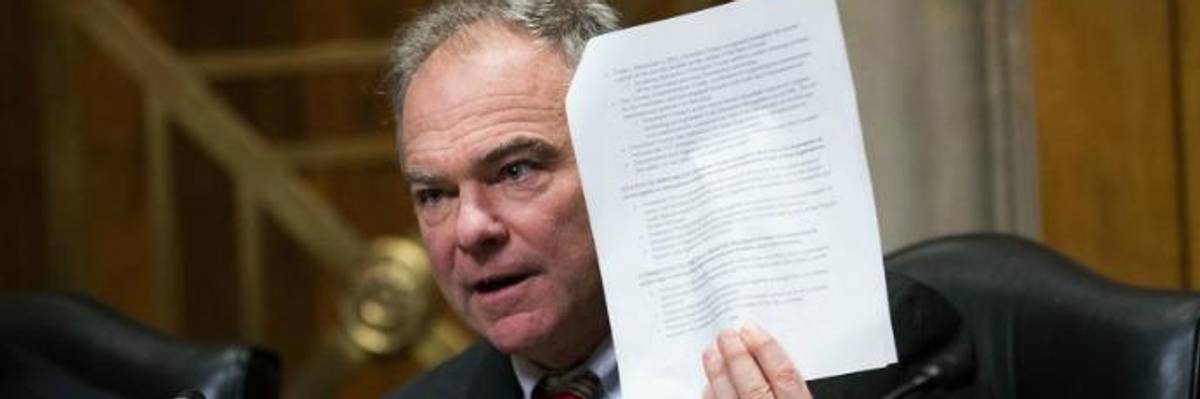
"Montanans and North Dakotans aren't itching to let bankers sell toxic mortgages again. In fact, if anything binds most Americans together, it's their mutual hatred of the banks," observed The Week's Jeff Spross. (Photo: Drew Angerer/Getty Images)
Do Democrats actually believe that rewarding Wall Street will help them win re-election?
"There's no way that any vote in a red state or a blue state that supports Wall Street like this is a benefit at the polls."
--Charles Chamberlain, Democracy for America
That key question has been asked with growing frequency in recent days as a relatively large faction of centrist Democrats--led by Sens. Tim Kaine (D-Va.) and Heidi Heitkamp (N.D.)--has partnered with Republicans in the Senate to advance a deregulatory bill denounced by progressive lawmakers and independent commentators as a giveaway to massive banks and a possible catalyst for the next financial meltdown.
Robert Borasage, co-founder of Campaign for America's Future (CAF), argued in an interview with The Hill Tuesday that the final vote this week on the bank measure (S.2155) will be a "very significant thing, both symbolically and in substance."
As the GOP-crafted bill has sailed through the Senate, much of the media coverage has framed Democratic support for the legislation as pragmatism on the part of red-state senators facing tough re-election bids in 2018.
But progressives argue that any vote to relieve Wall Street will harm, not help, Democrats' chances--and new polling data (pdf) bolsters this view.
"There's no way that any vote in a red state or a blue state that supports Wall Street like this is a benefit at the polls," Charles Chamberlain, executive director of Democracy for America, told The Hill. "When you have a [Democratic Sen.] Jon Tester in Montana that votes in the wrong way on an issue like this, he's hurting his chances for reelection, he's not helping."
On Monday, 16 Democrats and Sen. Angus King (I-Maine) voted with the GOP to end debate on the deregulatory measure--labeled the "Bank Lobbyist Act" by Warren and other progressive opponents--effectively ensuring its passage later this week.
"The Democratic senators preparing to vote for this thing are either Wall Street toadies or complete political naifs."
--Jeff Spross, The Week
As CAF's Richard Eskow observed in an article on Tuesday, "These 16 Democrats have collectively received $24,488,961 in campaign contributions from savings and investment firms and commercial banks."
While Kaine and other corporate Democrats have attempted to insulate themselves from criticism by introducing amendments ostensibly aimed at improving the bill's enforcement provisions, The Intercept's Dave Dayen argues that these proposed changes are "pretend" fixes, given that Kaine openly admitted he will not fight for the changes.
"I don't need my amendment to pass," Kaine told a reporter on Monday. "I think the bill is solid as it is."
According to a survey (pdf) published last month by Public Policy Polling, most Americans are likely to disagree with Kaine's assessment. Most voters, including most Republicans, are far less likely to vote for a candidate who supports deregulating big banks, the poll found.
"Montanans and North Dakotans aren't itching to let bankers sell toxic mortgages again. In fact, if anything binds most Americans together, it's their mutual hatred of the banks," observed The Week's Jeff Spross on Tuesday. "The Democratic senators preparing to vote for this thing are either Wall Street toadies or complete political naifs. I leave it to readers to decide which is more likely. And which is worse."
Dear Common Dreams reader, It’s been nearly 30 years since I co-founded Common Dreams with my late wife, Lina Newhouser. We had the radical notion that journalism should serve the public good, not corporate profits. It was clear to us from the outset what it would take to build such a project. No paid advertisements. No corporate sponsors. No millionaire publisher telling us what to think or do. Many people said we wouldn't last a year, but we proved those doubters wrong. Together with a tremendous team of journalists and dedicated staff, we built an independent media outlet free from the constraints of profits and corporate control. Our mission has always been simple: To inform. To inspire. To ignite change for the common good. Building Common Dreams was not easy. Our survival was never guaranteed. When you take on the most powerful forces—Wall Street greed, fossil fuel industry destruction, Big Tech lobbyists, and uber-rich oligarchs who have spent billions upon billions rigging the economy and democracy in their favor—the only bulwark you have is supporters who believe in your work. But here’s the urgent message from me today. It's never been this bad out there. And it's never been this hard to keep us going. At the very moment Common Dreams is most needed, the threats we face are intensifying. We need your support now more than ever. We don't accept corporate advertising and never will. We don't have a paywall because we don't think people should be blocked from critical news based on their ability to pay. Everything we do is funded by the donations of readers like you. When everyone does the little they can afford, we are strong. But if that support retreats or dries up, so do we. Will you donate now to make sure Common Dreams not only survives but thrives? —Craig Brown, Co-founder |
Do Democrats actually believe that rewarding Wall Street will help them win re-election?
"There's no way that any vote in a red state or a blue state that supports Wall Street like this is a benefit at the polls."
--Charles Chamberlain, Democracy for America
That key question has been asked with growing frequency in recent days as a relatively large faction of centrist Democrats--led by Sens. Tim Kaine (D-Va.) and Heidi Heitkamp (N.D.)--has partnered with Republicans in the Senate to advance a deregulatory bill denounced by progressive lawmakers and independent commentators as a giveaway to massive banks and a possible catalyst for the next financial meltdown.
Robert Borasage, co-founder of Campaign for America's Future (CAF), argued in an interview with The Hill Tuesday that the final vote this week on the bank measure (S.2155) will be a "very significant thing, both symbolically and in substance."
As the GOP-crafted bill has sailed through the Senate, much of the media coverage has framed Democratic support for the legislation as pragmatism on the part of red-state senators facing tough re-election bids in 2018.
But progressives argue that any vote to relieve Wall Street will harm, not help, Democrats' chances--and new polling data (pdf) bolsters this view.
"There's no way that any vote in a red state or a blue state that supports Wall Street like this is a benefit at the polls," Charles Chamberlain, executive director of Democracy for America, told The Hill. "When you have a [Democratic Sen.] Jon Tester in Montana that votes in the wrong way on an issue like this, he's hurting his chances for reelection, he's not helping."
On Monday, 16 Democrats and Sen. Angus King (I-Maine) voted with the GOP to end debate on the deregulatory measure--labeled the "Bank Lobbyist Act" by Warren and other progressive opponents--effectively ensuring its passage later this week.
"The Democratic senators preparing to vote for this thing are either Wall Street toadies or complete political naifs."
--Jeff Spross, The Week
As CAF's Richard Eskow observed in an article on Tuesday, "These 16 Democrats have collectively received $24,488,961 in campaign contributions from savings and investment firms and commercial banks."
While Kaine and other corporate Democrats have attempted to insulate themselves from criticism by introducing amendments ostensibly aimed at improving the bill's enforcement provisions, The Intercept's Dave Dayen argues that these proposed changes are "pretend" fixes, given that Kaine openly admitted he will not fight for the changes.
"I don't need my amendment to pass," Kaine told a reporter on Monday. "I think the bill is solid as it is."
According to a survey (pdf) published last month by Public Policy Polling, most Americans are likely to disagree with Kaine's assessment. Most voters, including most Republicans, are far less likely to vote for a candidate who supports deregulating big banks, the poll found.
"Montanans and North Dakotans aren't itching to let bankers sell toxic mortgages again. In fact, if anything binds most Americans together, it's their mutual hatred of the banks," observed The Week's Jeff Spross on Tuesday. "The Democratic senators preparing to vote for this thing are either Wall Street toadies or complete political naifs. I leave it to readers to decide which is more likely. And which is worse."
Do Democrats actually believe that rewarding Wall Street will help them win re-election?
"There's no way that any vote in a red state or a blue state that supports Wall Street like this is a benefit at the polls."
--Charles Chamberlain, Democracy for America
That key question has been asked with growing frequency in recent days as a relatively large faction of centrist Democrats--led by Sens. Tim Kaine (D-Va.) and Heidi Heitkamp (N.D.)--has partnered with Republicans in the Senate to advance a deregulatory bill denounced by progressive lawmakers and independent commentators as a giveaway to massive banks and a possible catalyst for the next financial meltdown.
Robert Borasage, co-founder of Campaign for America's Future (CAF), argued in an interview with The Hill Tuesday that the final vote this week on the bank measure (S.2155) will be a "very significant thing, both symbolically and in substance."
As the GOP-crafted bill has sailed through the Senate, much of the media coverage has framed Democratic support for the legislation as pragmatism on the part of red-state senators facing tough re-election bids in 2018.
But progressives argue that any vote to relieve Wall Street will harm, not help, Democrats' chances--and new polling data (pdf) bolsters this view.
"There's no way that any vote in a red state or a blue state that supports Wall Street like this is a benefit at the polls," Charles Chamberlain, executive director of Democracy for America, told The Hill. "When you have a [Democratic Sen.] Jon Tester in Montana that votes in the wrong way on an issue like this, he's hurting his chances for reelection, he's not helping."
On Monday, 16 Democrats and Sen. Angus King (I-Maine) voted with the GOP to end debate on the deregulatory measure--labeled the "Bank Lobbyist Act" by Warren and other progressive opponents--effectively ensuring its passage later this week.
"The Democratic senators preparing to vote for this thing are either Wall Street toadies or complete political naifs."
--Jeff Spross, The Week
As CAF's Richard Eskow observed in an article on Tuesday, "These 16 Democrats have collectively received $24,488,961 in campaign contributions from savings and investment firms and commercial banks."
While Kaine and other corporate Democrats have attempted to insulate themselves from criticism by introducing amendments ostensibly aimed at improving the bill's enforcement provisions, The Intercept's Dave Dayen argues that these proposed changes are "pretend" fixes, given that Kaine openly admitted he will not fight for the changes.
"I don't need my amendment to pass," Kaine told a reporter on Monday. "I think the bill is solid as it is."
According to a survey (pdf) published last month by Public Policy Polling, most Americans are likely to disagree with Kaine's assessment. Most voters, including most Republicans, are far less likely to vote for a candidate who supports deregulating big banks, the poll found.
"Montanans and North Dakotans aren't itching to let bankers sell toxic mortgages again. In fact, if anything binds most Americans together, it's their mutual hatred of the banks," observed The Week's Jeff Spross on Tuesday. "The Democratic senators preparing to vote for this thing are either Wall Street toadies or complete political naifs. I leave it to readers to decide which is more likely. And which is worse."