SUBSCRIBE TO OUR FREE NEWSLETTER
Daily news & progressive opinion—funded by the people, not the corporations—delivered straight to your inbox.
5
#000000
#FFFFFF
To donate by check, phone, or other method, see our More Ways to Give page.
Daily news & progressive opinion—funded by the people, not the corporations—delivered straight to your inbox.
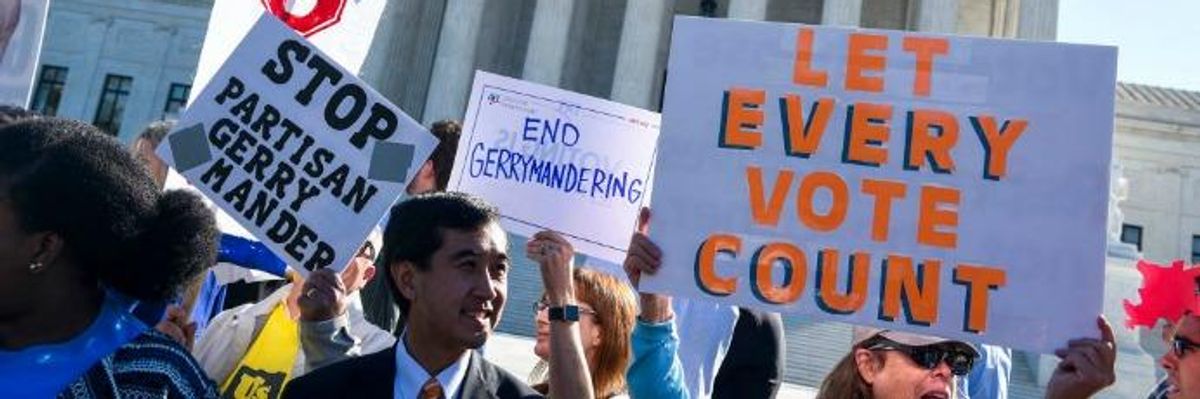
People hold signs during a rally to call for 'An End to Partisan Gerrymandering' at the Supreme Court of the United States on October 3, 2017 in Washington, DC. (Photo by Leigh Vogel/Getty Images)
In a ruling hailed as a major and historic "victory for democracy," a federal court on Tuesday deemed North Carolina's 2016 congressional map unconstitutional on the grounds that it was drawn to discriminate against Democratic voters--marking the first time a federal court has struck down a redistricting plan for partisan gerrymandering.
"The gerrymandered map struck down by the court today robbed much of the state of a representative voice in the nation's capital."
-- Karen Hobert Flynn, Common Cause
"Every American deserves representation in Washington, but the gerrymandered map struck down by the court today robbed much of the state of a representative voice in the nation's capital," said Karen Hobert Flynn, president of Common Cause, one of the advocacy groups the legal challenge against North Carolina's Republican Party. "Partisan gerrymanders are quite simply undemocratic."
The three-judge panel's decision (pdf) on Tuesday may have been unique in its stand against extreme partisan redistricting, but it was not the first time North Carolina's Republican-drawn congressional map has been struck down for violating the constitutional rights of voters. As Prema Levy of Mother Jones points out, "the state's previous map was deemed illegal for being racially gerrymandered in 2016"--years after the map allowed the GOP to take a vast majority of the state's House seats.
Following the 2016 ruling, North Carolina Republicans explicitly looked to structure the state's congressional map to give themselves a "partisan advantage"--resulting in what the Brennan Center for Justice called "one of the worst partisan gerrymanders of the decade."
"I acknowledge freely that this would be a political gerrymander, which is not against the law," Rep. David Lewis (R-N.C.), chairman of the state House's Redistricting Committee, declared during a 2016 meeting. "I think electing Republicans is better than electing Democrats. So I drew this map to help foster what I think is better for the country."
The North Carolina district court's determination on Tuesday that extreme partisan gerrymandering is, in fact, unconstitutional--violating the Equal Protection Clause, the First Amendment, and the Election Clause of Article I of the Constitution--is likely to gain national significance in the coming months, as the Supreme Court is currently considering two similar partisan gerrymandering cases in Wisconsin and Maryland.
North Carolina Republicans are expected to appeal to the Supreme Court to put the ruling on hold until the other two cases are decided--a delay that would allow the current map to remain in place through the 2018 midterm elections.
J. Michael Bitzer, professor of political science at Catawba College, told the New York Times that if Tuesday's ruling is upheld, it "gives hope to Democrats" looking to wrest control of the state's legislature from the GOP.
"I can imagine the Republicans being furious, but they have to see political reality, and it's not just in the next two weeks: It's come November," Bitzer concluded.
Dear Common Dreams reader, It’s been nearly 30 years since I co-founded Common Dreams with my late wife, Lina Newhouser. We had the radical notion that journalism should serve the public good, not corporate profits. It was clear to us from the outset what it would take to build such a project. No paid advertisements. No corporate sponsors. No millionaire publisher telling us what to think or do. Many people said we wouldn't last a year, but we proved those doubters wrong. Together with a tremendous team of journalists and dedicated staff, we built an independent media outlet free from the constraints of profits and corporate control. Our mission has always been simple: To inform. To inspire. To ignite change for the common good. Building Common Dreams was not easy. Our survival was never guaranteed. When you take on the most powerful forces—Wall Street greed, fossil fuel industry destruction, Big Tech lobbyists, and uber-rich oligarchs who have spent billions upon billions rigging the economy and democracy in their favor—the only bulwark you have is supporters who believe in your work. But here’s the urgent message from me today. It's never been this bad out there. And it's never been this hard to keep us going. At the very moment Common Dreams is most needed, the threats we face are intensifying. We need your support now more than ever. We don't accept corporate advertising and never will. We don't have a paywall because we don't think people should be blocked from critical news based on their ability to pay. Everything we do is funded by the donations of readers like you. When everyone does the little they can afford, we are strong. But if that support retreats or dries up, so do we. Will you donate now to make sure Common Dreams not only survives but thrives? —Craig Brown, Co-founder |
In a ruling hailed as a major and historic "victory for democracy," a federal court on Tuesday deemed North Carolina's 2016 congressional map unconstitutional on the grounds that it was drawn to discriminate against Democratic voters--marking the first time a federal court has struck down a redistricting plan for partisan gerrymandering.
"The gerrymandered map struck down by the court today robbed much of the state of a representative voice in the nation's capital."
-- Karen Hobert Flynn, Common Cause
"Every American deserves representation in Washington, but the gerrymandered map struck down by the court today robbed much of the state of a representative voice in the nation's capital," said Karen Hobert Flynn, president of Common Cause, one of the advocacy groups the legal challenge against North Carolina's Republican Party. "Partisan gerrymanders are quite simply undemocratic."
The three-judge panel's decision (pdf) on Tuesday may have been unique in its stand against extreme partisan redistricting, but it was not the first time North Carolina's Republican-drawn congressional map has been struck down for violating the constitutional rights of voters. As Prema Levy of Mother Jones points out, "the state's previous map was deemed illegal for being racially gerrymandered in 2016"--years after the map allowed the GOP to take a vast majority of the state's House seats.
Following the 2016 ruling, North Carolina Republicans explicitly looked to structure the state's congressional map to give themselves a "partisan advantage"--resulting in what the Brennan Center for Justice called "one of the worst partisan gerrymanders of the decade."
"I acknowledge freely that this would be a political gerrymander, which is not against the law," Rep. David Lewis (R-N.C.), chairman of the state House's Redistricting Committee, declared during a 2016 meeting. "I think electing Republicans is better than electing Democrats. So I drew this map to help foster what I think is better for the country."
The North Carolina district court's determination on Tuesday that extreme partisan gerrymandering is, in fact, unconstitutional--violating the Equal Protection Clause, the First Amendment, and the Election Clause of Article I of the Constitution--is likely to gain national significance in the coming months, as the Supreme Court is currently considering two similar partisan gerrymandering cases in Wisconsin and Maryland.
North Carolina Republicans are expected to appeal to the Supreme Court to put the ruling on hold until the other two cases are decided--a delay that would allow the current map to remain in place through the 2018 midterm elections.
J. Michael Bitzer, professor of political science at Catawba College, told the New York Times that if Tuesday's ruling is upheld, it "gives hope to Democrats" looking to wrest control of the state's legislature from the GOP.
"I can imagine the Republicans being furious, but they have to see political reality, and it's not just in the next two weeks: It's come November," Bitzer concluded.
In a ruling hailed as a major and historic "victory for democracy," a federal court on Tuesday deemed North Carolina's 2016 congressional map unconstitutional on the grounds that it was drawn to discriminate against Democratic voters--marking the first time a federal court has struck down a redistricting plan for partisan gerrymandering.
"The gerrymandered map struck down by the court today robbed much of the state of a representative voice in the nation's capital."
-- Karen Hobert Flynn, Common Cause
"Every American deserves representation in Washington, but the gerrymandered map struck down by the court today robbed much of the state of a representative voice in the nation's capital," said Karen Hobert Flynn, president of Common Cause, one of the advocacy groups the legal challenge against North Carolina's Republican Party. "Partisan gerrymanders are quite simply undemocratic."
The three-judge panel's decision (pdf) on Tuesday may have been unique in its stand against extreme partisan redistricting, but it was not the first time North Carolina's Republican-drawn congressional map has been struck down for violating the constitutional rights of voters. As Prema Levy of Mother Jones points out, "the state's previous map was deemed illegal for being racially gerrymandered in 2016"--years after the map allowed the GOP to take a vast majority of the state's House seats.
Following the 2016 ruling, North Carolina Republicans explicitly looked to structure the state's congressional map to give themselves a "partisan advantage"--resulting in what the Brennan Center for Justice called "one of the worst partisan gerrymanders of the decade."
"I acknowledge freely that this would be a political gerrymander, which is not against the law," Rep. David Lewis (R-N.C.), chairman of the state House's Redistricting Committee, declared during a 2016 meeting. "I think electing Republicans is better than electing Democrats. So I drew this map to help foster what I think is better for the country."
The North Carolina district court's determination on Tuesday that extreme partisan gerrymandering is, in fact, unconstitutional--violating the Equal Protection Clause, the First Amendment, and the Election Clause of Article I of the Constitution--is likely to gain national significance in the coming months, as the Supreme Court is currently considering two similar partisan gerrymandering cases in Wisconsin and Maryland.
North Carolina Republicans are expected to appeal to the Supreme Court to put the ruling on hold until the other two cases are decided--a delay that would allow the current map to remain in place through the 2018 midterm elections.
J. Michael Bitzer, professor of political science at Catawba College, told the New York Times that if Tuesday's ruling is upheld, it "gives hope to Democrats" looking to wrest control of the state's legislature from the GOP.
"I can imagine the Republicans being furious, but they have to see political reality, and it's not just in the next two weeks: It's come November," Bitzer concluded.