SUBSCRIBE TO OUR FREE NEWSLETTER
Daily news & progressive opinion—funded by the people, not the corporations—delivered straight to your inbox.
5
#000000
#FFFFFF
To donate by check, phone, or other method, see our More Ways to Give page.
Daily news & progressive opinion—funded by the people, not the corporations—delivered straight to your inbox.
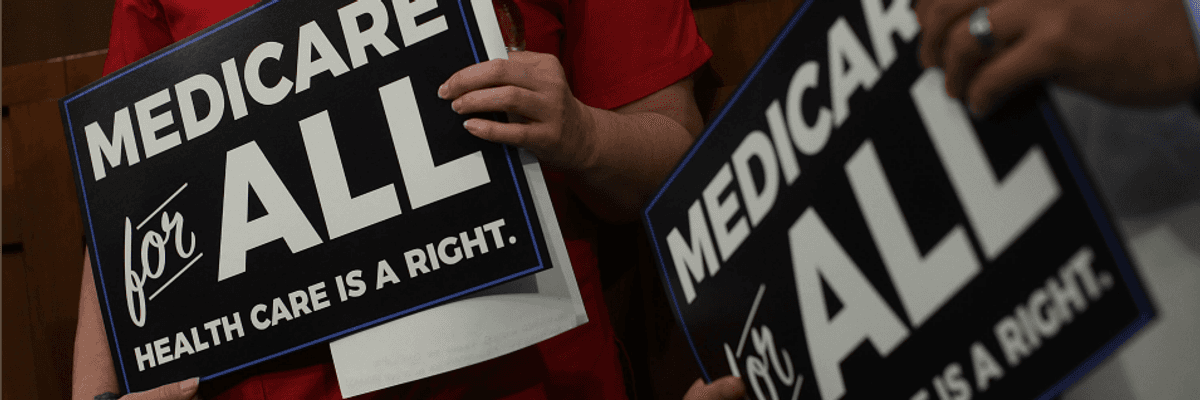
Supporters of U.S. Sen. Bernie Sanders (I-VT) hold signs during an event on health care September 13, 2017 on Capitol Hill in Washington, DC. Sen. Sanders held an event to introduce the Medicare for All Act of 2017. (Photo: Alex Wong/Getty Images)
Amid the explosive anecdotal accounts contained in the new book, Fire & Fury: Inside the Trump White House by Michael Wolff, is an exchange between the president and top aides in which Trump reportedly demanded to know: "Why can't Medicare simply cover everybody?"
While fellow journalists have questioned Wolff's integrity as a reporter, and the White House has characterized his book as a work of "fantasy," the publisher has pushed up its release after Trump himself intervened with legal threats to block it from being release.
Despite that, Wolff apparently was given wide-ranging access, says he recorded many of his interviews with top staffers and insiders, and stands by the accounts contained in Fire & Fury. Speaking to NBC News on Friday morning, Wolff said he stands by "absolutely everything" reported in his book.
"My credibility," he said of Trump's attacks against him, "is being questioned by a man who has less credibility than perhaps anyone who has ever walked on Earth."
On the issue of healthcare, according to an excerpt, Wolff writes:
Trump had little or no interest in the central Republican goal of repealing Obamacare. The details of the contested legislation were, to him, particularly boring; his attention would begin wandering from the first words of a policy discussion. He would have been able to enumerate few of the particulars of Obamacare--other than expressing glee about the silly Obama pledge that everyone could keep his or her doctor--and he certainly could not make any kind of meaningful distinction, positive or negative, between the healthcare system before Obamacare and the one after.
That reporting, of course, largely betrays the fact that Trump repeatedly promised to repeal the Affordable Care Act (aka Obamacare) and supported numerous attempts by Republicans in Congress to do exactly that. By signing the "GOP tax scam" into law just before the Christmas holiday, Trump specifically bragged that a key component and victory of the legislation was its ending of the ACA's individual mandate--a provision that experts say will force an estimated 13 million people to lose their coverage.
However, while Trump is documented as knowing very little about how the ACA actually worked or healthcare policy overall, he has repeatedly let slip--both as a candidate and since taking office--that he perceives the wisdom of a system that covers everyone and even said explicitly at one point that "government's gonna pay for it."
In May of 2017, President Trump praised Australia as having "better healthcare" than Americans have in the United States, though it was unclear if he actually knew the Australians enjoy a single-payer system administered by the government.
And during the 2016 presidential campaign, Trump told 60 Minute's Scott Pelley that though it was a very "un-Republican thing for me to say," he would create a universal system which would "take care of everybody"--even those too poor to afford private insurance. Watch:
Dear Common Dreams reader, It’s been nearly 30 years since I co-founded Common Dreams with my late wife, Lina Newhouser. We had the radical notion that journalism should serve the public good, not corporate profits. It was clear to us from the outset what it would take to build such a project. No paid advertisements. No corporate sponsors. No millionaire publisher telling us what to think or do. Many people said we wouldn't last a year, but we proved those doubters wrong. Together with a tremendous team of journalists and dedicated staff, we built an independent media outlet free from the constraints of profits and corporate control. Our mission has always been simple: To inform. To inspire. To ignite change for the common good. Building Common Dreams was not easy. Our survival was never guaranteed. When you take on the most powerful forces—Wall Street greed, fossil fuel industry destruction, Big Tech lobbyists, and uber-rich oligarchs who have spent billions upon billions rigging the economy and democracy in their favor—the only bulwark you have is supporters who believe in your work. But here’s the urgent message from me today. It's never been this bad out there. And it's never been this hard to keep us going. At the very moment Common Dreams is most needed, the threats we face are intensifying. We need your support now more than ever. We don't accept corporate advertising and never will. We don't have a paywall because we don't think people should be blocked from critical news based on their ability to pay. Everything we do is funded by the donations of readers like you. When everyone does the little they can afford, we are strong. But if that support retreats or dries up, so do we. Will you donate now to make sure Common Dreams not only survives but thrives? —Craig Brown, Co-founder |
Amid the explosive anecdotal accounts contained in the new book, Fire & Fury: Inside the Trump White House by Michael Wolff, is an exchange between the president and top aides in which Trump reportedly demanded to know: "Why can't Medicare simply cover everybody?"
While fellow journalists have questioned Wolff's integrity as a reporter, and the White House has characterized his book as a work of "fantasy," the publisher has pushed up its release after Trump himself intervened with legal threats to block it from being release.
Despite that, Wolff apparently was given wide-ranging access, says he recorded many of his interviews with top staffers and insiders, and stands by the accounts contained in Fire & Fury. Speaking to NBC News on Friday morning, Wolff said he stands by "absolutely everything" reported in his book.
"My credibility," he said of Trump's attacks against him, "is being questioned by a man who has less credibility than perhaps anyone who has ever walked on Earth."
On the issue of healthcare, according to an excerpt, Wolff writes:
Trump had little or no interest in the central Republican goal of repealing Obamacare. The details of the contested legislation were, to him, particularly boring; his attention would begin wandering from the first words of a policy discussion. He would have been able to enumerate few of the particulars of Obamacare--other than expressing glee about the silly Obama pledge that everyone could keep his or her doctor--and he certainly could not make any kind of meaningful distinction, positive or negative, between the healthcare system before Obamacare and the one after.
That reporting, of course, largely betrays the fact that Trump repeatedly promised to repeal the Affordable Care Act (aka Obamacare) and supported numerous attempts by Republicans in Congress to do exactly that. By signing the "GOP tax scam" into law just before the Christmas holiday, Trump specifically bragged that a key component and victory of the legislation was its ending of the ACA's individual mandate--a provision that experts say will force an estimated 13 million people to lose their coverage.
However, while Trump is documented as knowing very little about how the ACA actually worked or healthcare policy overall, he has repeatedly let slip--both as a candidate and since taking office--that he perceives the wisdom of a system that covers everyone and even said explicitly at one point that "government's gonna pay for it."
In May of 2017, President Trump praised Australia as having "better healthcare" than Americans have in the United States, though it was unclear if he actually knew the Australians enjoy a single-payer system administered by the government.
And during the 2016 presidential campaign, Trump told 60 Minute's Scott Pelley that though it was a very "un-Republican thing for me to say," he would create a universal system which would "take care of everybody"--even those too poor to afford private insurance. Watch:
Amid the explosive anecdotal accounts contained in the new book, Fire & Fury: Inside the Trump White House by Michael Wolff, is an exchange between the president and top aides in which Trump reportedly demanded to know: "Why can't Medicare simply cover everybody?"
While fellow journalists have questioned Wolff's integrity as a reporter, and the White House has characterized his book as a work of "fantasy," the publisher has pushed up its release after Trump himself intervened with legal threats to block it from being release.
Despite that, Wolff apparently was given wide-ranging access, says he recorded many of his interviews with top staffers and insiders, and stands by the accounts contained in Fire & Fury. Speaking to NBC News on Friday morning, Wolff said he stands by "absolutely everything" reported in his book.
"My credibility," he said of Trump's attacks against him, "is being questioned by a man who has less credibility than perhaps anyone who has ever walked on Earth."
On the issue of healthcare, according to an excerpt, Wolff writes:
Trump had little or no interest in the central Republican goal of repealing Obamacare. The details of the contested legislation were, to him, particularly boring; his attention would begin wandering from the first words of a policy discussion. He would have been able to enumerate few of the particulars of Obamacare--other than expressing glee about the silly Obama pledge that everyone could keep his or her doctor--and he certainly could not make any kind of meaningful distinction, positive or negative, between the healthcare system before Obamacare and the one after.
That reporting, of course, largely betrays the fact that Trump repeatedly promised to repeal the Affordable Care Act (aka Obamacare) and supported numerous attempts by Republicans in Congress to do exactly that. By signing the "GOP tax scam" into law just before the Christmas holiday, Trump specifically bragged that a key component and victory of the legislation was its ending of the ACA's individual mandate--a provision that experts say will force an estimated 13 million people to lose their coverage.
However, while Trump is documented as knowing very little about how the ACA actually worked or healthcare policy overall, he has repeatedly let slip--both as a candidate and since taking office--that he perceives the wisdom of a system that covers everyone and even said explicitly at one point that "government's gonna pay for it."
In May of 2017, President Trump praised Australia as having "better healthcare" than Americans have in the United States, though it was unclear if he actually knew the Australians enjoy a single-payer system administered by the government.
And during the 2016 presidential campaign, Trump told 60 Minute's Scott Pelley that though it was a very "un-Republican thing for me to say," he would create a universal system which would "take care of everybody"--even those too poor to afford private insurance. Watch: