SUBSCRIBE TO OUR FREE NEWSLETTER
Daily news & progressive opinion—funded by the people, not the corporations—delivered straight to your inbox.
5
#000000
#FFFFFF
To donate by check, phone, or other method, see our More Ways to Give page.


Daily news & progressive opinion—funded by the people, not the corporations—delivered straight to your inbox.
For the first time, solar power is becoming the cheapest form of electricity production in the world, according to new statistics from Bloomberg New Energy Finance (BNEF) released Thursday.
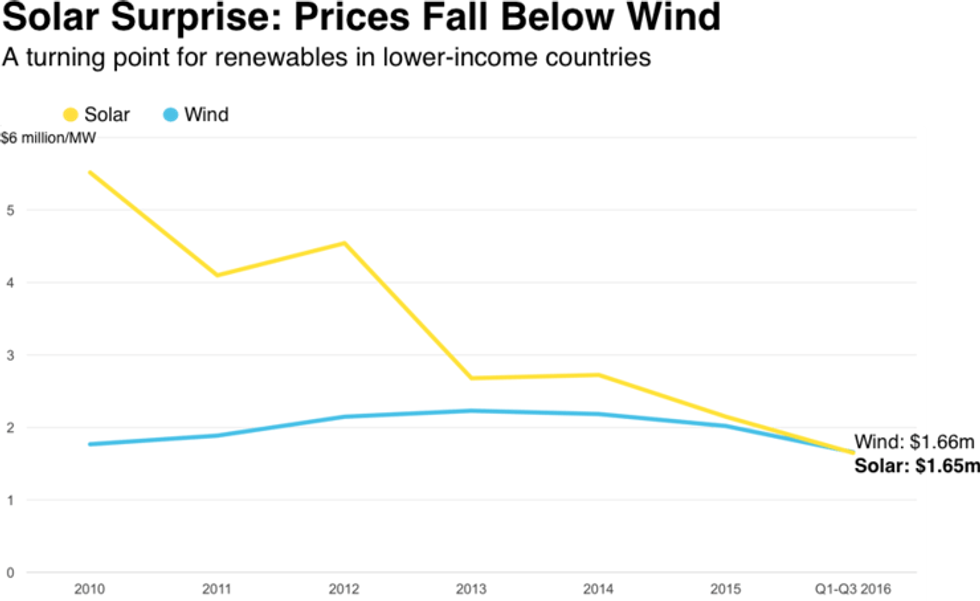
While unsubsidized solar has occasionally done better than coal and gas in individual projects, 2016 marked the first time that the renewable energy source has out-performed fossil fuels on a large scale--and new solar projects are also turning out to be cheaper than new wind power projects, BNEF reports in its new analysis, Climatescope.
The cost of solar in 58 developing nations dropped to about a third of 2010 levels, with China in particular adding a record number of solar projects. And as the Independent notes, solar "has proved a godsend for remote islands such as Ta'u, part of America Samoa, in the South Pacific."
In fact, Ta'u has been able to abandon the use of fossil fuels altogether and power itself almost entirely on renewable energy.
"Solar investment has gone from nothing--literally nothing--like five years ago to quite a lot," said Ethan Zindler, head of BNEF's U.S. policy analysis.

BNEF chairman Michael Liebreich also told investors this week that "[r]enewables are robustly entering the era of undercutting" fossil fuel prices.
Unsurprisingly, developing countries are at the forefront of this advancement, having invested in clean energy economies to stave off the catastrophic effects of climate change at a greater rate than wealthy nations.
"[F]or populations still relying on expensive kerosene generators, or who have no electricity at all, and for those living in the dangerous smog of thickly populated cities," Bloomberg reports, "the shift to renewables and increasingly to solar can't come soon enough."
Dear Common Dreams reader, It’s been nearly 30 years since I co-founded Common Dreams with my late wife, Lina Newhouser. We had the radical notion that journalism should serve the public good, not corporate profits. It was clear to us from the outset what it would take to build such a project. No paid advertisements. No corporate sponsors. No millionaire publisher telling us what to think or do. Many people said we wouldn't last a year, but we proved those doubters wrong. Together with a tremendous team of journalists and dedicated staff, we built an independent media outlet free from the constraints of profits and corporate control. Our mission has always been simple: To inform. To inspire. To ignite change for the common good. Building Common Dreams was not easy. Our survival was never guaranteed. When you take on the most powerful forces—Wall Street greed, fossil fuel industry destruction, Big Tech lobbyists, and uber-rich oligarchs who have spent billions upon billions rigging the economy and democracy in their favor—the only bulwark you have is supporters who believe in your work. But here’s the urgent message from me today. It's never been this bad out there. And it's never been this hard to keep us going. At the very moment Common Dreams is most needed, the threats we face are intensifying. We need your support now more than ever. We don't accept corporate advertising and never will. We don't have a paywall because we don't think people should be blocked from critical news based on their ability to pay. Everything we do is funded by the donations of readers like you. When everyone does the little they can afford, we are strong. But if that support retreats or dries up, so do we. Will you donate now to make sure Common Dreams not only survives but thrives? —Craig Brown, Co-founder |
For the first time, solar power is becoming the cheapest form of electricity production in the world, according to new statistics from Bloomberg New Energy Finance (BNEF) released Thursday.
While unsubsidized solar has occasionally done better than coal and gas in individual projects, 2016 marked the first time that the renewable energy source has out-performed fossil fuels on a large scale--and new solar projects are also turning out to be cheaper than new wind power projects, BNEF reports in its new analysis, Climatescope.
The cost of solar in 58 developing nations dropped to about a third of 2010 levels, with China in particular adding a record number of solar projects. And as the Independent notes, solar "has proved a godsend for remote islands such as Ta'u, part of America Samoa, in the South Pacific."
In fact, Ta'u has been able to abandon the use of fossil fuels altogether and power itself almost entirely on renewable energy.
"Solar investment has gone from nothing--literally nothing--like five years ago to quite a lot," said Ethan Zindler, head of BNEF's U.S. policy analysis.

BNEF chairman Michael Liebreich also told investors this week that "[r]enewables are robustly entering the era of undercutting" fossil fuel prices.
Unsurprisingly, developing countries are at the forefront of this advancement, having invested in clean energy economies to stave off the catastrophic effects of climate change at a greater rate than wealthy nations.
"[F]or populations still relying on expensive kerosene generators, or who have no electricity at all, and for those living in the dangerous smog of thickly populated cities," Bloomberg reports, "the shift to renewables and increasingly to solar can't come soon enough."
For the first time, solar power is becoming the cheapest form of electricity production in the world, according to new statistics from Bloomberg New Energy Finance (BNEF) released Thursday.
While unsubsidized solar has occasionally done better than coal and gas in individual projects, 2016 marked the first time that the renewable energy source has out-performed fossil fuels on a large scale--and new solar projects are also turning out to be cheaper than new wind power projects, BNEF reports in its new analysis, Climatescope.
The cost of solar in 58 developing nations dropped to about a third of 2010 levels, with China in particular adding a record number of solar projects. And as the Independent notes, solar "has proved a godsend for remote islands such as Ta'u, part of America Samoa, in the South Pacific."
In fact, Ta'u has been able to abandon the use of fossil fuels altogether and power itself almost entirely on renewable energy.
"Solar investment has gone from nothing--literally nothing--like five years ago to quite a lot," said Ethan Zindler, head of BNEF's U.S. policy analysis.

BNEF chairman Michael Liebreich also told investors this week that "[r]enewables are robustly entering the era of undercutting" fossil fuel prices.
Unsurprisingly, developing countries are at the forefront of this advancement, having invested in clean energy economies to stave off the catastrophic effects of climate change at a greater rate than wealthy nations.
"[F]or populations still relying on expensive kerosene generators, or who have no electricity at all, and for those living in the dangerous smog of thickly populated cities," Bloomberg reports, "the shift to renewables and increasingly to solar can't come soon enough."