SUBSCRIBE TO OUR FREE NEWSLETTER
Daily news & progressive opinion—funded by the people, not the corporations—delivered straight to your inbox.
5
#000000
#FFFFFF
To donate by check, phone, or other method, see our More Ways to Give page.
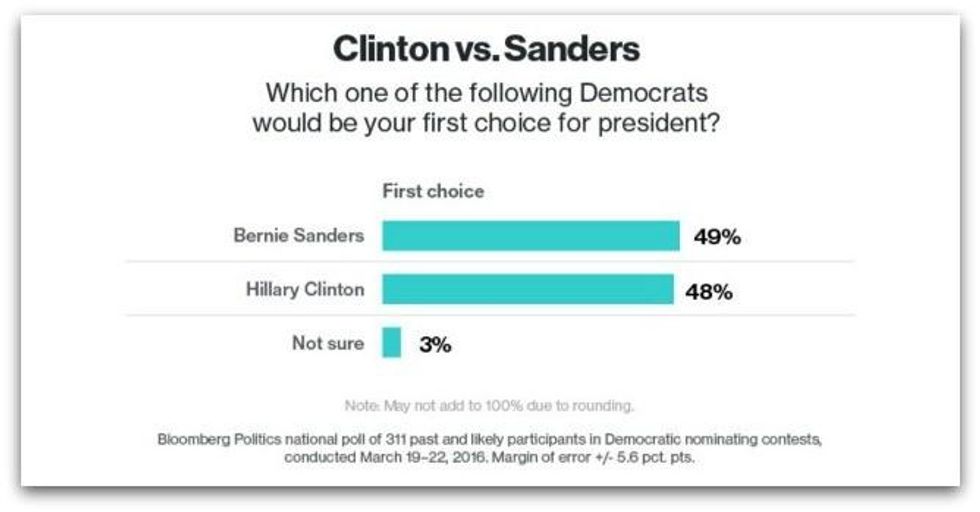
Signaling that the primary race is far from over, a new national poll shows Bernie Sanders tied with Hillary Clinton among those who have voted or plan to vote in a Democratic contest this year.
The Bloomberg Politics survey found 49 percent of respondents preferred Sanders, while 48 percent backed Clinton.
Bloomberg reports: "By a more than 2-to-1 ratio, Democratic primary voters say Sanders would fight harder than Clinton for the middle class and do the most to rein in the power of Wall Street. Nearly six in 10 say the Vermont senator cares the most about people like them, and 64 percent see him as the most honest and trustworthy candidate. Just a quarter of voters said that of Clinton."
J. Ann Selzer, whose firm conducted the poll, told Bloomberg, "It comes down to this: Bernie Sanders is the one Democrats see as looking out for them--meaning he will build a stronger middle class at the expense of Wall Street. They trust him to do it. In the end, Hillary Clinton has a trust problem."
To that end, Politico notes, "voters were split on her changing views on the Trans-Pacific Partnership (46 percent bothered to 48 percent unbothered) and a majority said her paid speeches to Wall Street firms were a concern (54 percent to 45 percent)."
However, the poll suggested that "Clinton may...benefit from the shifting focus to foreign policy in the wake of Tuesday's terrorist attacks in Brussels, which killed at least 31 people," Bloomberg wrote. "Asked which candidate can best combat Islamic terrorism, Clinton bests Sanders by a more than 3-to-1 ratio."
Still, Sanders continues to best Clinton in hypothetical general-election match-ups. While both candidates hold leads over billionaire Donald Trump and Sen. Ted Cruz, only Sanders earned more support than Ohio Gov. John Kasich, who led Clinton by four points.
As Bloomberg noted:
The survey also signaled some trouble for Clinton in holding on to Sanders supporters in November. In general-election match-ups, Sanders holds a 24-point edge over Donald Trump, a 12-point lead over Ted Cruz, and a 4-point advantage over John Kasich among likely general-election voters. Clinton, by contrast, trails Kasich by 4 percentage points. She would carry a sizable lead into a contest against Cruz, where she holds a 9-point advantage, and Trump, whom she beats by 18 points.
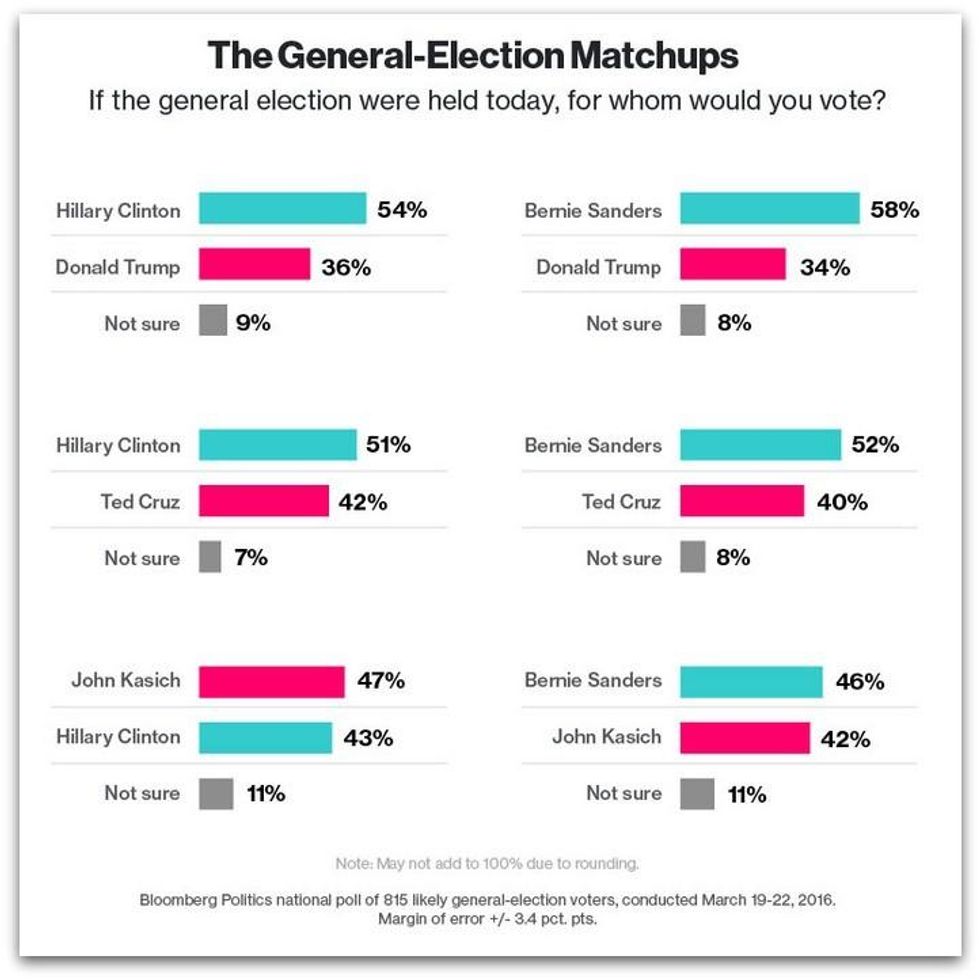
The national poll of 1,000 adults was conducted March 19-22 by Selzer & Co. of West Des Moines, Iowa. The subgroup of 311 Democratic primary voters had a margin of error of +/- 5.6 percentage points. The subgroup of 815 likely general-election voters had a margin of error of +/- 3.4 percentage points.
Alaska, Hawaii, and Washington state hold closed Democratic primaries on Saturday.
As Sanders told the Los Angeles Times editorial board on Tuesday: "I have a lot of very fervent supporters out there and we're not going to give up until the last vote is counted."
Signaling that the primary race is far from over, a new national poll shows Bernie Sanders tied with Hillary Clinton among those who have voted or plan to vote in a Democratic contest this year.
The Bloomberg Politics survey found 49 percent of respondents preferred Sanders, while 48 percent backed Clinton.
Bloomberg reports: "By a more than 2-to-1 ratio, Democratic primary voters say Sanders would fight harder than Clinton for the middle class and do the most to rein in the power of Wall Street. Nearly six in 10 say the Vermont senator cares the most about people like them, and 64 percent see him as the most honest and trustworthy candidate. Just a quarter of voters said that of Clinton."
J. Ann Selzer, whose firm conducted the poll, told Bloomberg, "It comes down to this: Bernie Sanders is the one Democrats see as looking out for them--meaning he will build a stronger middle class at the expense of Wall Street. They trust him to do it. In the end, Hillary Clinton has a trust problem."
To that end, Politico notes, "voters were split on her changing views on the Trans-Pacific Partnership (46 percent bothered to 48 percent unbothered) and a majority said her paid speeches to Wall Street firms were a concern (54 percent to 45 percent)."
However, the poll suggested that "Clinton may...benefit from the shifting focus to foreign policy in the wake of Tuesday's terrorist attacks in Brussels, which killed at least 31 people," Bloomberg wrote. "Asked which candidate can best combat Islamic terrorism, Clinton bests Sanders by a more than 3-to-1 ratio."
Still, Sanders continues to best Clinton in hypothetical general-election match-ups. While both candidates hold leads over billionaire Donald Trump and Sen. Ted Cruz, only Sanders earned more support than Ohio Gov. John Kasich, who led Clinton by four points.
As Bloomberg noted:
The survey also signaled some trouble for Clinton in holding on to Sanders supporters in November. In general-election match-ups, Sanders holds a 24-point edge over Donald Trump, a 12-point lead over Ted Cruz, and a 4-point advantage over John Kasich among likely general-election voters. Clinton, by contrast, trails Kasich by 4 percentage points. She would carry a sizable lead into a contest against Cruz, where she holds a 9-point advantage, and Trump, whom she beats by 18 points.
The national poll of 1,000 adults was conducted March 19-22 by Selzer & Co. of West Des Moines, Iowa. The subgroup of 311 Democratic primary voters had a margin of error of +/- 5.6 percentage points. The subgroup of 815 likely general-election voters had a margin of error of +/- 3.4 percentage points.
Alaska, Hawaii, and Washington state hold closed Democratic primaries on Saturday.
As Sanders told the Los Angeles Times editorial board on Tuesday: "I have a lot of very fervent supporters out there and we're not going to give up until the last vote is counted."
Signaling that the primary race is far from over, a new national poll shows Bernie Sanders tied with Hillary Clinton among those who have voted or plan to vote in a Democratic contest this year.
The Bloomberg Politics survey found 49 percent of respondents preferred Sanders, while 48 percent backed Clinton.
Bloomberg reports: "By a more than 2-to-1 ratio, Democratic primary voters say Sanders would fight harder than Clinton for the middle class and do the most to rein in the power of Wall Street. Nearly six in 10 say the Vermont senator cares the most about people like them, and 64 percent see him as the most honest and trustworthy candidate. Just a quarter of voters said that of Clinton."
J. Ann Selzer, whose firm conducted the poll, told Bloomberg, "It comes down to this: Bernie Sanders is the one Democrats see as looking out for them--meaning he will build a stronger middle class at the expense of Wall Street. They trust him to do it. In the end, Hillary Clinton has a trust problem."
To that end, Politico notes, "voters were split on her changing views on the Trans-Pacific Partnership (46 percent bothered to 48 percent unbothered) and a majority said her paid speeches to Wall Street firms were a concern (54 percent to 45 percent)."
However, the poll suggested that "Clinton may...benefit from the shifting focus to foreign policy in the wake of Tuesday's terrorist attacks in Brussels, which killed at least 31 people," Bloomberg wrote. "Asked which candidate can best combat Islamic terrorism, Clinton bests Sanders by a more than 3-to-1 ratio."
Still, Sanders continues to best Clinton in hypothetical general-election match-ups. While both candidates hold leads over billionaire Donald Trump and Sen. Ted Cruz, only Sanders earned more support than Ohio Gov. John Kasich, who led Clinton by four points.
As Bloomberg noted:
The survey also signaled some trouble for Clinton in holding on to Sanders supporters in November. In general-election match-ups, Sanders holds a 24-point edge over Donald Trump, a 12-point lead over Ted Cruz, and a 4-point advantage over John Kasich among likely general-election voters. Clinton, by contrast, trails Kasich by 4 percentage points. She would carry a sizable lead into a contest against Cruz, where she holds a 9-point advantage, and Trump, whom she beats by 18 points.
The national poll of 1,000 adults was conducted March 19-22 by Selzer & Co. of West Des Moines, Iowa. The subgroup of 311 Democratic primary voters had a margin of error of +/- 5.6 percentage points. The subgroup of 815 likely general-election voters had a margin of error of +/- 3.4 percentage points.
Alaska, Hawaii, and Washington state hold closed Democratic primaries on Saturday.
As Sanders told the Los Angeles Times editorial board on Tuesday: "I have a lot of very fervent supporters out there and we're not going to give up until the last vote is counted."