SUBSCRIBE TO OUR FREE NEWSLETTER
Daily news & progressive opinion—funded by the people, not the corporations—delivered straight to your inbox.
5
#000000
#FFFFFF
To donate by check, phone, or other method, see our More Ways to Give page.
Daily news & progressive opinion—funded by the people, not the corporations—delivered straight to your inbox.
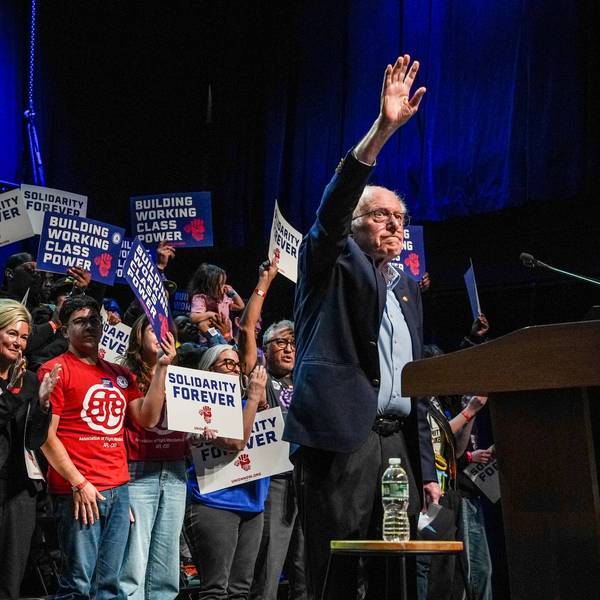
Speaking Tuesday at Johnson State College in Vermont--on the same day data from the New York Fed showed student-loan delinquencies are on the rise--Sen. Bernie Sanders (I-Vt.) called for a "revolution" in the way higher education is funded in the U.S.
"Because of the high cost of higher education, many bright young people can no longer afford to go to college and millions of others are leaving school saddled with debt," he said. "This is absurd. This is absolutely counter-productive to our efforts to create a strong economy."
"We must fundamentally restructure our student loan program. It makes no sense that students and their parents are forced to pay interest rates for higher education loans that are much higher than they pay for car loans or housing mortgages."
--Senator Bernie Sanders
The senator proposed tuition-free courses for freshmen and sophomores at all public colleges and universities, and suggested tying increased federal funding to greater state support for higher education. He also called for reforms to the federal student loan program--reforms that could be paid for by closing loopholes that give tax breaks to large corporations and the wealthy.
At a town hall meeting at Lyndon State College on Monday, Sanders reportedly said: "Can we afford to invest in higher education? The answer is yes we can. But one of the things that we have to do is institute real tax reform."
The non-profit Project on Student Debt reported at the end of last year that of those U.S. students who did graduate in the class of 2012, seven in 10 had educational debt.
Education loan balances have skyrocketed over the past decade, and data from the New York Fed released Tuesday showed that Americans are struggling to keep up with payments. The nation's student-loan balance climbed by $31 billion last quarter to a whopping $1.16 trillion, making it the largest source of debt after mortgages.
According to Bloomberg, the data showed 11.3 percent of student loans were delinquent in the final three months of 2014, up from 11.1 percent in the prior quarter.
The publication notes: "Delinquency rates for student loans probably understate the actual situation... About half of the student loans are in deferment, in grace periods or in forbearance, temporarily removing them from the repayment cycle."
"Although we've seen an overall improvement in delinquency rates since the Great Recession, the increasing trend in student-loan balances and delinquencies is concerning," Donghoon Lee, research officer at the New York Fed, told Bloomberg in an e-mailed statement. "Student-loan delinquencies and repayment problems appear to be reducing borrowers' ability to form their own households."
In his speech, delivered just before Sanders--a potential 2016 presidential candidate--heads to Iowa for a three-day visit, the senator declared: "We need a revolution in the way higher education is funded. We must fundamentally restructure our student loan program."
He added: "It makes no sense that students and their parents are forced to pay interest rates for higher education loans that are much higher than they pay for car loans or housing mortgages. We must also end the practice of the government making $127 billion over the next decade in profits from student loans."
Dear Common Dreams reader, It’s been nearly 30 years since I co-founded Common Dreams with my late wife, Lina Newhouser. We had the radical notion that journalism should serve the public good, not corporate profits. It was clear to us from the outset what it would take to build such a project. No paid advertisements. No corporate sponsors. No millionaire publisher telling us what to think or do. Many people said we wouldn't last a year, but we proved those doubters wrong. Together with a tremendous team of journalists and dedicated staff, we built an independent media outlet free from the constraints of profits and corporate control. Our mission has always been simple: To inform. To inspire. To ignite change for the common good. Building Common Dreams was not easy. Our survival was never guaranteed. When you take on the most powerful forces—Wall Street greed, fossil fuel industry destruction, Big Tech lobbyists, and uber-rich oligarchs who have spent billions upon billions rigging the economy and democracy in their favor—the only bulwark you have is supporters who believe in your work. But here’s the urgent message from me today. It's never been this bad out there. And it's never been this hard to keep us going. At the very moment Common Dreams is most needed, the threats we face are intensifying. We need your support now more than ever. We don't accept corporate advertising and never will. We don't have a paywall because we don't think people should be blocked from critical news based on their ability to pay. Everything we do is funded by the donations of readers like you. When everyone does the little they can afford, we are strong. But if that support retreats or dries up, so do we. Will you donate now to make sure Common Dreams not only survives but thrives? —Craig Brown, Co-founder |
Speaking Tuesday at Johnson State College in Vermont--on the same day data from the New York Fed showed student-loan delinquencies are on the rise--Sen. Bernie Sanders (I-Vt.) called for a "revolution" in the way higher education is funded in the U.S.
"Because of the high cost of higher education, many bright young people can no longer afford to go to college and millions of others are leaving school saddled with debt," he said. "This is absurd. This is absolutely counter-productive to our efforts to create a strong economy."
"We must fundamentally restructure our student loan program. It makes no sense that students and their parents are forced to pay interest rates for higher education loans that are much higher than they pay for car loans or housing mortgages."
--Senator Bernie Sanders
The senator proposed tuition-free courses for freshmen and sophomores at all public colleges and universities, and suggested tying increased federal funding to greater state support for higher education. He also called for reforms to the federal student loan program--reforms that could be paid for by closing loopholes that give tax breaks to large corporations and the wealthy.
At a town hall meeting at Lyndon State College on Monday, Sanders reportedly said: "Can we afford to invest in higher education? The answer is yes we can. But one of the things that we have to do is institute real tax reform."
The non-profit Project on Student Debt reported at the end of last year that of those U.S. students who did graduate in the class of 2012, seven in 10 had educational debt.
Education loan balances have skyrocketed over the past decade, and data from the New York Fed released Tuesday showed that Americans are struggling to keep up with payments. The nation's student-loan balance climbed by $31 billion last quarter to a whopping $1.16 trillion, making it the largest source of debt after mortgages.
According to Bloomberg, the data showed 11.3 percent of student loans were delinquent in the final three months of 2014, up from 11.1 percent in the prior quarter.
The publication notes: "Delinquency rates for student loans probably understate the actual situation... About half of the student loans are in deferment, in grace periods or in forbearance, temporarily removing them from the repayment cycle."
"Although we've seen an overall improvement in delinquency rates since the Great Recession, the increasing trend in student-loan balances and delinquencies is concerning," Donghoon Lee, research officer at the New York Fed, told Bloomberg in an e-mailed statement. "Student-loan delinquencies and repayment problems appear to be reducing borrowers' ability to form their own households."
In his speech, delivered just before Sanders--a potential 2016 presidential candidate--heads to Iowa for a three-day visit, the senator declared: "We need a revolution in the way higher education is funded. We must fundamentally restructure our student loan program."
He added: "It makes no sense that students and their parents are forced to pay interest rates for higher education loans that are much higher than they pay for car loans or housing mortgages. We must also end the practice of the government making $127 billion over the next decade in profits from student loans."
Speaking Tuesday at Johnson State College in Vermont--on the same day data from the New York Fed showed student-loan delinquencies are on the rise--Sen. Bernie Sanders (I-Vt.) called for a "revolution" in the way higher education is funded in the U.S.
"Because of the high cost of higher education, many bright young people can no longer afford to go to college and millions of others are leaving school saddled with debt," he said. "This is absurd. This is absolutely counter-productive to our efforts to create a strong economy."
"We must fundamentally restructure our student loan program. It makes no sense that students and their parents are forced to pay interest rates for higher education loans that are much higher than they pay for car loans or housing mortgages."
--Senator Bernie Sanders
The senator proposed tuition-free courses for freshmen and sophomores at all public colleges and universities, and suggested tying increased federal funding to greater state support for higher education. He also called for reforms to the federal student loan program--reforms that could be paid for by closing loopholes that give tax breaks to large corporations and the wealthy.
At a town hall meeting at Lyndon State College on Monday, Sanders reportedly said: "Can we afford to invest in higher education? The answer is yes we can. But one of the things that we have to do is institute real tax reform."
The non-profit Project on Student Debt reported at the end of last year that of those U.S. students who did graduate in the class of 2012, seven in 10 had educational debt.
Education loan balances have skyrocketed over the past decade, and data from the New York Fed released Tuesday showed that Americans are struggling to keep up with payments. The nation's student-loan balance climbed by $31 billion last quarter to a whopping $1.16 trillion, making it the largest source of debt after mortgages.
According to Bloomberg, the data showed 11.3 percent of student loans were delinquent in the final three months of 2014, up from 11.1 percent in the prior quarter.
The publication notes: "Delinquency rates for student loans probably understate the actual situation... About half of the student loans are in deferment, in grace periods or in forbearance, temporarily removing them from the repayment cycle."
"Although we've seen an overall improvement in delinquency rates since the Great Recession, the increasing trend in student-loan balances and delinquencies is concerning," Donghoon Lee, research officer at the New York Fed, told Bloomberg in an e-mailed statement. "Student-loan delinquencies and repayment problems appear to be reducing borrowers' ability to form their own households."
In his speech, delivered just before Sanders--a potential 2016 presidential candidate--heads to Iowa for a three-day visit, the senator declared: "We need a revolution in the way higher education is funded. We must fundamentally restructure our student loan program."
He added: "It makes no sense that students and their parents are forced to pay interest rates for higher education loans that are much higher than they pay for car loans or housing mortgages. We must also end the practice of the government making $127 billion over the next decade in profits from student loans."