SUBSCRIBE TO OUR FREE NEWSLETTER
Daily news & progressive opinion—funded by the people, not the corporations—delivered straight to your inbox.
5
#000000
#FFFFFF
To donate by check, phone, or other method, see our More Ways to Give page.
In the wake of the NSA mass surveillance scandal, an overwhelming majority of investigative journalists believe that the U.S. government is spying on them, and large numbers say that this belief impacts the way they go about their reporting, a Pew Research Center poll released Thursday reveals.
The findings are based on a December online survey, conducted in association with Columbia University's Tow Center for Digital Journalism, of 671 journalists who are members of Investigative Reporters and Editors, Inc., which is a non-profit organization for journalists.
According to the poll, approximately two out of three investigative journalists believe the U.S. government "has probably collected data" from their phones, emails, or online communications.
For national security, foreign affairs, and federal government reporters, the number is even higher at 71 percent.
Eighty percent of respondents think that their status as a journalist makes them more likely to be snooped on.
These beliefs have real repercussions.
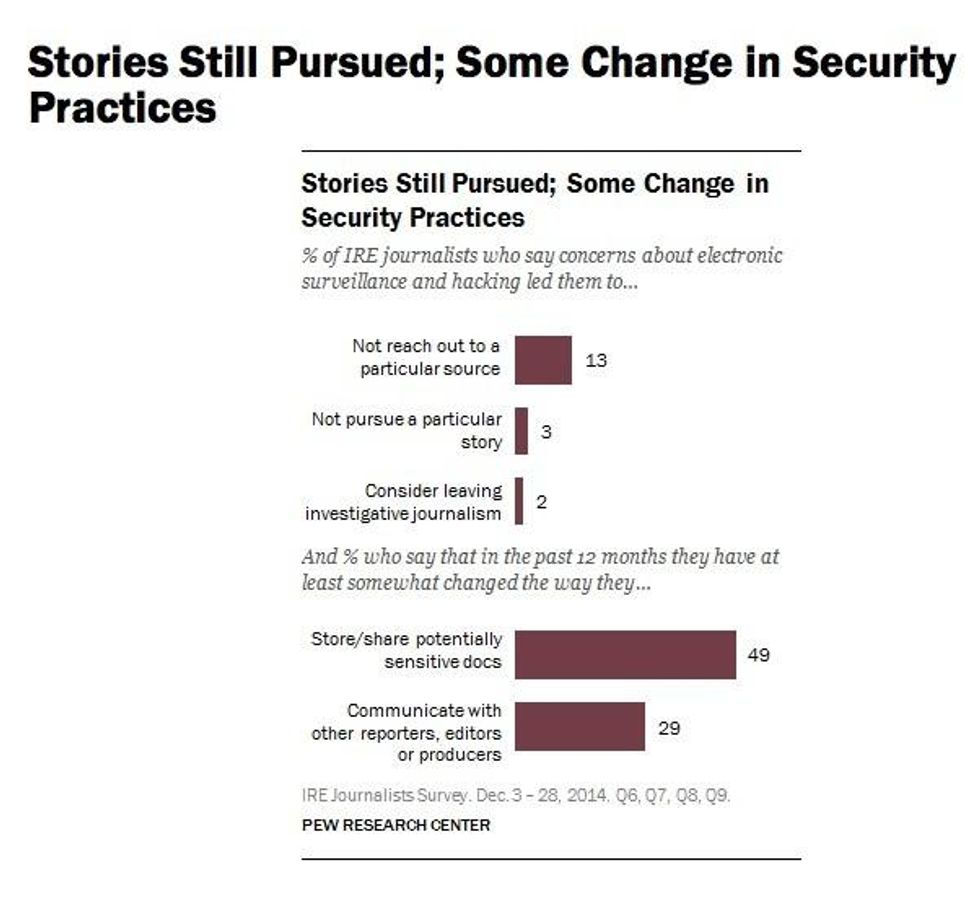
Under the threat of surveillance, journalists are changing the way they go about their work, as the following graph summarizing report data shows:
According to the study, journalists have little faith in their internet service providers, and mixed trust in the outlets and organizations they work for, to protect the security of their communications.
The survey follows numerous warnings from journalists that, in a digital age, the threat of federal snooping threatens the basic fabric of reporting, including establishing and communicating with sources.
"As the government stores more and more data, it will become next to impossible for journalists to keep sources confidential," wrote Geoffrey King of the Committee to Protect Journalists in an article published last year.
"Regardless of whether the NSA's programs are as carefully targeted as it claims, the agency's infamous secrecy and expansive capabilities have cast a deep shadow on press freedom worldwide," he continued.
In the wake of the NSA mass surveillance scandal, an overwhelming majority of investigative journalists believe that the U.S. government is spying on them, and large numbers say that this belief impacts the way they go about their reporting, a Pew Research Center poll released Thursday reveals.
The findings are based on a December online survey, conducted in association with Columbia University's Tow Center for Digital Journalism, of 671 journalists who are members of Investigative Reporters and Editors, Inc., which is a non-profit organization for journalists.
According to the poll, approximately two out of three investigative journalists believe the U.S. government "has probably collected data" from their phones, emails, or online communications.
For national security, foreign affairs, and federal government reporters, the number is even higher at 71 percent.
Eighty percent of respondents think that their status as a journalist makes them more likely to be snooped on.
These beliefs have real repercussions.
Under the threat of surveillance, journalists are changing the way they go about their work, as the following graph summarizing report data shows:
According to the study, journalists have little faith in their internet service providers, and mixed trust in the outlets and organizations they work for, to protect the security of their communications.
The survey follows numerous warnings from journalists that, in a digital age, the threat of federal snooping threatens the basic fabric of reporting, including establishing and communicating with sources.
"As the government stores more and more data, it will become next to impossible for journalists to keep sources confidential," wrote Geoffrey King of the Committee to Protect Journalists in an article published last year.
"Regardless of whether the NSA's programs are as carefully targeted as it claims, the agency's infamous secrecy and expansive capabilities have cast a deep shadow on press freedom worldwide," he continued.
In the wake of the NSA mass surveillance scandal, an overwhelming majority of investigative journalists believe that the U.S. government is spying on them, and large numbers say that this belief impacts the way they go about their reporting, a Pew Research Center poll released Thursday reveals.
The findings are based on a December online survey, conducted in association with Columbia University's Tow Center for Digital Journalism, of 671 journalists who are members of Investigative Reporters and Editors, Inc., which is a non-profit organization for journalists.
According to the poll, approximately two out of three investigative journalists believe the U.S. government "has probably collected data" from their phones, emails, or online communications.
For national security, foreign affairs, and federal government reporters, the number is even higher at 71 percent.
Eighty percent of respondents think that their status as a journalist makes them more likely to be snooped on.
These beliefs have real repercussions.
Under the threat of surveillance, journalists are changing the way they go about their work, as the following graph summarizing report data shows:
According to the study, journalists have little faith in their internet service providers, and mixed trust in the outlets and organizations they work for, to protect the security of their communications.
The survey follows numerous warnings from journalists that, in a digital age, the threat of federal snooping threatens the basic fabric of reporting, including establishing and communicating with sources.
"As the government stores more and more data, it will become next to impossible for journalists to keep sources confidential," wrote Geoffrey King of the Committee to Protect Journalists in an article published last year.
"Regardless of whether the NSA's programs are as carefully targeted as it claims, the agency's infamous secrecy and expansive capabilities have cast a deep shadow on press freedom worldwide," he continued.