SUBSCRIBE TO OUR FREE NEWSLETTER
Daily news & progressive opinion—funded by the people, not the corporations—delivered straight to your inbox.
5
#000000
#FFFFFF
To donate by check, phone, or other method, see our More Ways to Give page.
Daily news & progressive opinion—funded by the people, not the corporations—delivered straight to your inbox.
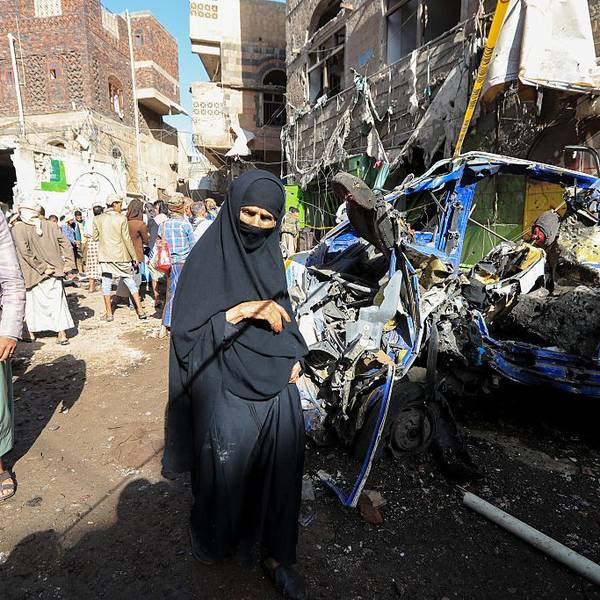
A fragile ceasefire was reached but instability continues in Yemen's capital following deadly clashes between Shiite rebels and government forces.
BBC News reported:
On Monday morning, columns of black smoke rose from streets around the presidential palace and a military area south of it, as soldiers from the Presidential Guard and Houthi fighters fired heavy machine-guns, rocket-propelled grenades and artillery shells at each other's positions.
Information minister Nadia al-Saqqaf told reporters that the attack on the presidential palace constituted "an attempted coup."
CNN reports that the cause of the newest clashes was unclear:
Government officials characterize it as a power grab by the Houthis. Houthis say Yemen's military attacked people demanding that authorities lift road closures introduced as a security measure after the presidential chief of staff was abducted in Sanaa a few days ago.
Al Jazeera adds:
A deal signed in September between political parties and the Houthis called for the formation of a new unity government followed by the withdrawal of Houthi fighters from the capital. The fighters have remained in place.
The Houthis, who have launched attacks on al-Qaeda's Yemen branch, are viewed as Shia Iran's ally in its regional struggle for influence with Saudi Arabia.
The deputy health minister said that at least nine people were killed and scores were wounded in Monday's violence.
UN High Commissioner for Human Rights Zeid Ra'ad Al Hussein said earlier this month that the conflicts gripping other areas of the world caused little global attention to be given to Yemen, where he said "utterly deplorable" acts of violence plagued stability and took a terrible toll on civilians.
Indeed, an attack in Sanaa that killed at least 37 people on the same day as the attack on Charlie Hebdo in Paris carried out by suspected Islamist militants was largely overshadowed.
As tweets on Monday from Yemenis indicate, the newest violence marks the continuation of disaster for civilians in the impoverished nation:
In September, just ahead of the Houthis' seizure of the capital, President Obama lauded the U.S. military approach in Yemen targeting terrorists a success.
At the Washington, D.C.-based Middle East Institute in December, April Longley Alley wrote that "the country appears poised for yet another round of upheaval, possibly more transformative than the events of 2011."
Dear Common Dreams reader, It’s been nearly 30 years since I co-founded Common Dreams with my late wife, Lina Newhouser. We had the radical notion that journalism should serve the public good, not corporate profits. It was clear to us from the outset what it would take to build such a project. No paid advertisements. No corporate sponsors. No millionaire publisher telling us what to think or do. Many people said we wouldn't last a year, but we proved those doubters wrong. Together with a tremendous team of journalists and dedicated staff, we built an independent media outlet free from the constraints of profits and corporate control. Our mission has always been simple: To inform. To inspire. To ignite change for the common good. Building Common Dreams was not easy. Our survival was never guaranteed. When you take on the most powerful forces—Wall Street greed, fossil fuel industry destruction, Big Tech lobbyists, and uber-rich oligarchs who have spent billions upon billions rigging the economy and democracy in their favor—the only bulwark you have is supporters who believe in your work. But here’s the urgent message from me today. It's never been this bad out there. And it's never been this hard to keep us going. At the very moment Common Dreams is most needed, the threats we face are intensifying. We need your support now more than ever. We don't accept corporate advertising and never will. We don't have a paywall because we don't think people should be blocked from critical news based on their ability to pay. Everything we do is funded by the donations of readers like you. When everyone does the little they can afford, we are strong. But if that support retreats or dries up, so do we. Will you donate now to make sure Common Dreams not only survives but thrives? —Craig Brown, Co-founder |
A fragile ceasefire was reached but instability continues in Yemen's capital following deadly clashes between Shiite rebels and government forces.
BBC News reported:
On Monday morning, columns of black smoke rose from streets around the presidential palace and a military area south of it, as soldiers from the Presidential Guard and Houthi fighters fired heavy machine-guns, rocket-propelled grenades and artillery shells at each other's positions.
Information minister Nadia al-Saqqaf told reporters that the attack on the presidential palace constituted "an attempted coup."
CNN reports that the cause of the newest clashes was unclear:
Government officials characterize it as a power grab by the Houthis. Houthis say Yemen's military attacked people demanding that authorities lift road closures introduced as a security measure after the presidential chief of staff was abducted in Sanaa a few days ago.
Al Jazeera adds:
A deal signed in September between political parties and the Houthis called for the formation of a new unity government followed by the withdrawal of Houthi fighters from the capital. The fighters have remained in place.
The Houthis, who have launched attacks on al-Qaeda's Yemen branch, are viewed as Shia Iran's ally in its regional struggle for influence with Saudi Arabia.
The deputy health minister said that at least nine people were killed and scores were wounded in Monday's violence.
UN High Commissioner for Human Rights Zeid Ra'ad Al Hussein said earlier this month that the conflicts gripping other areas of the world caused little global attention to be given to Yemen, where he said "utterly deplorable" acts of violence plagued stability and took a terrible toll on civilians.
Indeed, an attack in Sanaa that killed at least 37 people on the same day as the attack on Charlie Hebdo in Paris carried out by suspected Islamist militants was largely overshadowed.
As tweets on Monday from Yemenis indicate, the newest violence marks the continuation of disaster for civilians in the impoverished nation:
In September, just ahead of the Houthis' seizure of the capital, President Obama lauded the U.S. military approach in Yemen targeting terrorists a success.
At the Washington, D.C.-based Middle East Institute in December, April Longley Alley wrote that "the country appears poised for yet another round of upheaval, possibly more transformative than the events of 2011."
A fragile ceasefire was reached but instability continues in Yemen's capital following deadly clashes between Shiite rebels and government forces.
BBC News reported:
On Monday morning, columns of black smoke rose from streets around the presidential palace and a military area south of it, as soldiers from the Presidential Guard and Houthi fighters fired heavy machine-guns, rocket-propelled grenades and artillery shells at each other's positions.
Information minister Nadia al-Saqqaf told reporters that the attack on the presidential palace constituted "an attempted coup."
CNN reports that the cause of the newest clashes was unclear:
Government officials characterize it as a power grab by the Houthis. Houthis say Yemen's military attacked people demanding that authorities lift road closures introduced as a security measure after the presidential chief of staff was abducted in Sanaa a few days ago.
Al Jazeera adds:
A deal signed in September between political parties and the Houthis called for the formation of a new unity government followed by the withdrawal of Houthi fighters from the capital. The fighters have remained in place.
The Houthis, who have launched attacks on al-Qaeda's Yemen branch, are viewed as Shia Iran's ally in its regional struggle for influence with Saudi Arabia.
The deputy health minister said that at least nine people were killed and scores were wounded in Monday's violence.
UN High Commissioner for Human Rights Zeid Ra'ad Al Hussein said earlier this month that the conflicts gripping other areas of the world caused little global attention to be given to Yemen, where he said "utterly deplorable" acts of violence plagued stability and took a terrible toll on civilians.
Indeed, an attack in Sanaa that killed at least 37 people on the same day as the attack on Charlie Hebdo in Paris carried out by suspected Islamist militants was largely overshadowed.
As tweets on Monday from Yemenis indicate, the newest violence marks the continuation of disaster for civilians in the impoverished nation:
In September, just ahead of the Houthis' seizure of the capital, President Obama lauded the U.S. military approach in Yemen targeting terrorists a success.
At the Washington, D.C.-based Middle East Institute in December, April Longley Alley wrote that "the country appears poised for yet another round of upheaval, possibly more transformative than the events of 2011."