SUBSCRIBE TO OUR FREE NEWSLETTER
Daily news & progressive opinion—funded by the people, not the corporations—delivered straight to your inbox.
5
#000000
#FFFFFF
To donate by check, phone, or other method, see our More Ways to Give page.
Daily news & progressive opinion—funded by the people, not the corporations—delivered straight to your inbox.
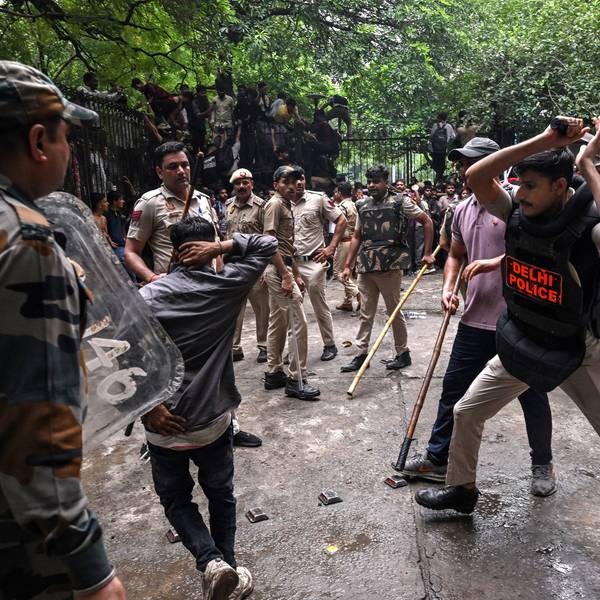
Police in Hong Kong unleashed tear gas on a massive, peaceful protest outside of government headquarters on Sunday morning, where tens of thousands of activists had gathered to demand free elections and universal suffrage.
The sit-in, which started Friday night, was part of a continuing series of actions organized by Hong Kong students and activist collective Occupy Central with Peace and Love that had brought parts of the region to standstill over the weekend, particularly after some protesters climbed over police barricades and shut down traffic on a six-lane highway. Protesters screamed "Shame!" and "Remove the blockade!" at police as they used force and tear gas to break up the demonstration.
Earlier in the day, police also squirted pepper spray and wielded batons at protesters, many of whom held open umbrellas as shields. Others used gauze, surgical masks, and goggles to protect their eyes. Many protesters donned yellow ribbons to symbolize hope for change.
The Chinese government has condemned the protests. But the movement began as a response to a recent Beijing ruling which effectively ended the possibility of true democracy in Hong Kong, as officials reneged on a promise to introduce universal suffrage in their next round of elections for the region's Chief Executive, due in 2017. Per the ruling, residents will only be able to vote on a representative from a small pool of candidates who have been vetted by a pro-establishment committee.
Benny Tai, one of the leaders of the Occupy Central movement, expressed his surprise at the rapid growth of the protest and said at a rally on Sunday that their demands could no longer be ignored. "It is totally unexpected," Tai said. "It's all about our pursuit of democracy. Beijing now sees it; the world now sees it."
"C.Y. Leung, do you see it?" he added, referring to the region's current Chief Executive, who previously said that "raw emotion" would achieve nothing in the fight for democracy and that his administration was "resolute in opposing the unlawful occupation actions by Occupy Central."
Students joined the movement by boycotting classes and eventually joining the demonstrations in the city's financial hub.
Occupy Central had previously said that its planned civil disobedience actions were set to begin on October 1, but on Sunday conceded that the student movement needed their support immediately.
"Occupy Central starts right now," Tai said.
The size of the crowds grew and diminished over the course of the weekend, at one point swelling to 50,000. Organizers estimated that roughly 10,000 were still camped out in front of government headquarters on Sunday night. Residents sent donations of bottled water and other supplies.
Political analyst Sonny Lo told AFP that the protests marked a turning point in Hong Kong's campaign for democracy. "From now on there will be more confrontation, possibly violent ones between citizens and police," he said.
Jimmy Lai, a Hong Kong-based entrepreneur who has long been an outspoken critic of the Chinese government, joined the protests over the weekend and told Reuters, "The more Hong Kong citizens come, the more unlikely the police can clear up the place."
"Even if we get beaten up, we cannot fight back," Lai said. "We will win this war with love and peace."
Protesters are using #OccupyCentral to provide live updates.
Dear Common Dreams reader, It’s been nearly 30 years since I co-founded Common Dreams with my late wife, Lina Newhouser. We had the radical notion that journalism should serve the public good, not corporate profits. It was clear to us from the outset what it would take to build such a project. No paid advertisements. No corporate sponsors. No millionaire publisher telling us what to think or do. Many people said we wouldn't last a year, but we proved those doubters wrong. Together with a tremendous team of journalists and dedicated staff, we built an independent media outlet free from the constraints of profits and corporate control. Our mission has always been simple: To inform. To inspire. To ignite change for the common good. Building Common Dreams was not easy. Our survival was never guaranteed. When you take on the most powerful forces—Wall Street greed, fossil fuel industry destruction, Big Tech lobbyists, and uber-rich oligarchs who have spent billions upon billions rigging the economy and democracy in their favor—the only bulwark you have is supporters who believe in your work. But here’s the urgent message from me today. It's never been this bad out there. And it's never been this hard to keep us going. At the very moment Common Dreams is most needed, the threats we face are intensifying. We need your support now more than ever. We don't accept corporate advertising and never will. We don't have a paywall because we don't think people should be blocked from critical news based on their ability to pay. Everything we do is funded by the donations of readers like you. When everyone does the little they can afford, we are strong. But if that support retreats or dries up, so do we. Will you donate now to make sure Common Dreams not only survives but thrives? —Craig Brown, Co-founder |
Police in Hong Kong unleashed tear gas on a massive, peaceful protest outside of government headquarters on Sunday morning, where tens of thousands of activists had gathered to demand free elections and universal suffrage.
The sit-in, which started Friday night, was part of a continuing series of actions organized by Hong Kong students and activist collective Occupy Central with Peace and Love that had brought parts of the region to standstill over the weekend, particularly after some protesters climbed over police barricades and shut down traffic on a six-lane highway. Protesters screamed "Shame!" and "Remove the blockade!" at police as they used force and tear gas to break up the demonstration.
Earlier in the day, police also squirted pepper spray and wielded batons at protesters, many of whom held open umbrellas as shields. Others used gauze, surgical masks, and goggles to protect their eyes. Many protesters donned yellow ribbons to symbolize hope for change.
The Chinese government has condemned the protests. But the movement began as a response to a recent Beijing ruling which effectively ended the possibility of true democracy in Hong Kong, as officials reneged on a promise to introduce universal suffrage in their next round of elections for the region's Chief Executive, due in 2017. Per the ruling, residents will only be able to vote on a representative from a small pool of candidates who have been vetted by a pro-establishment committee.
Benny Tai, one of the leaders of the Occupy Central movement, expressed his surprise at the rapid growth of the protest and said at a rally on Sunday that their demands could no longer be ignored. "It is totally unexpected," Tai said. "It's all about our pursuit of democracy. Beijing now sees it; the world now sees it."
"C.Y. Leung, do you see it?" he added, referring to the region's current Chief Executive, who previously said that "raw emotion" would achieve nothing in the fight for democracy and that his administration was "resolute in opposing the unlawful occupation actions by Occupy Central."
Students joined the movement by boycotting classes and eventually joining the demonstrations in the city's financial hub.
Occupy Central had previously said that its planned civil disobedience actions were set to begin on October 1, but on Sunday conceded that the student movement needed their support immediately.
"Occupy Central starts right now," Tai said.
The size of the crowds grew and diminished over the course of the weekend, at one point swelling to 50,000. Organizers estimated that roughly 10,000 were still camped out in front of government headquarters on Sunday night. Residents sent donations of bottled water and other supplies.
Political analyst Sonny Lo told AFP that the protests marked a turning point in Hong Kong's campaign for democracy. "From now on there will be more confrontation, possibly violent ones between citizens and police," he said.
Jimmy Lai, a Hong Kong-based entrepreneur who has long been an outspoken critic of the Chinese government, joined the protests over the weekend and told Reuters, "The more Hong Kong citizens come, the more unlikely the police can clear up the place."
"Even if we get beaten up, we cannot fight back," Lai said. "We will win this war with love and peace."
Protesters are using #OccupyCentral to provide live updates.
Police in Hong Kong unleashed tear gas on a massive, peaceful protest outside of government headquarters on Sunday morning, where tens of thousands of activists had gathered to demand free elections and universal suffrage.
The sit-in, which started Friday night, was part of a continuing series of actions organized by Hong Kong students and activist collective Occupy Central with Peace and Love that had brought parts of the region to standstill over the weekend, particularly after some protesters climbed over police barricades and shut down traffic on a six-lane highway. Protesters screamed "Shame!" and "Remove the blockade!" at police as they used force and tear gas to break up the demonstration.
Earlier in the day, police also squirted pepper spray and wielded batons at protesters, many of whom held open umbrellas as shields. Others used gauze, surgical masks, and goggles to protect their eyes. Many protesters donned yellow ribbons to symbolize hope for change.
The Chinese government has condemned the protests. But the movement began as a response to a recent Beijing ruling which effectively ended the possibility of true democracy in Hong Kong, as officials reneged on a promise to introduce universal suffrage in their next round of elections for the region's Chief Executive, due in 2017. Per the ruling, residents will only be able to vote on a representative from a small pool of candidates who have been vetted by a pro-establishment committee.
Benny Tai, one of the leaders of the Occupy Central movement, expressed his surprise at the rapid growth of the protest and said at a rally on Sunday that their demands could no longer be ignored. "It is totally unexpected," Tai said. "It's all about our pursuit of democracy. Beijing now sees it; the world now sees it."
"C.Y. Leung, do you see it?" he added, referring to the region's current Chief Executive, who previously said that "raw emotion" would achieve nothing in the fight for democracy and that his administration was "resolute in opposing the unlawful occupation actions by Occupy Central."
Students joined the movement by boycotting classes and eventually joining the demonstrations in the city's financial hub.
Occupy Central had previously said that its planned civil disobedience actions were set to begin on October 1, but on Sunday conceded that the student movement needed their support immediately.
"Occupy Central starts right now," Tai said.
The size of the crowds grew and diminished over the course of the weekend, at one point swelling to 50,000. Organizers estimated that roughly 10,000 were still camped out in front of government headquarters on Sunday night. Residents sent donations of bottled water and other supplies.
Political analyst Sonny Lo told AFP that the protests marked a turning point in Hong Kong's campaign for democracy. "From now on there will be more confrontation, possibly violent ones between citizens and police," he said.
Jimmy Lai, a Hong Kong-based entrepreneur who has long been an outspoken critic of the Chinese government, joined the protests over the weekend and told Reuters, "The more Hong Kong citizens come, the more unlikely the police can clear up the place."
"Even if we get beaten up, we cannot fight back," Lai said. "We will win this war with love and peace."
Protesters are using #OccupyCentral to provide live updates.