SUBSCRIBE TO OUR FREE NEWSLETTER
Daily news & progressive opinion—funded by the people, not the corporations—delivered straight to your inbox.
5
#000000
#FFFFFF
To donate by check, phone, or other method, see our More Ways to Give page.
Scientists are attributing the decline of this essential pollinating population to the ongoing drought and the "explosive" increase in the use of genetically modified crops in the American corn belt.
"Because farmers have planted over 120 million acres of crops resistant to the milkweed-killing herbicide glyphosate, the monarchs' essential food supply has been all but destroyed."
Released by the Mexican government along with the World Wildlife Fund (WWF), a recent survey found a 59% decrease in the area occupied by monarch colonies wintering in the forests of central Mexico, the Los Angeles Times reports.
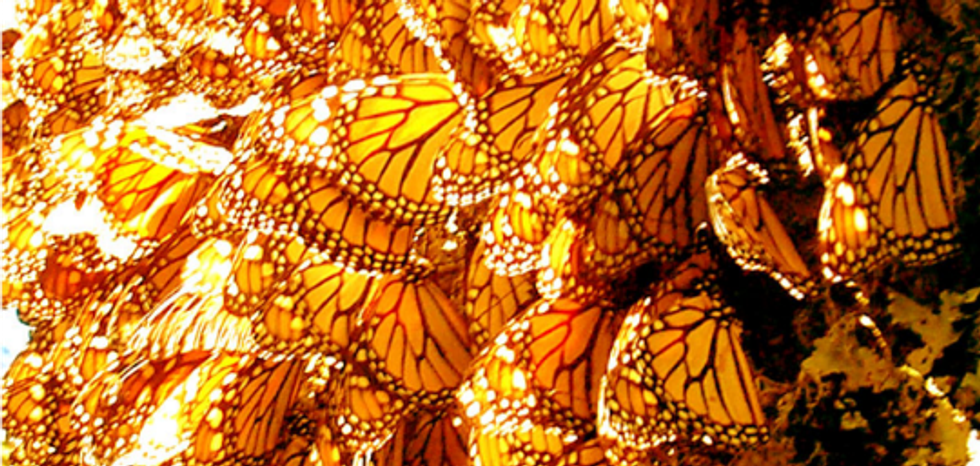
Because of the difficulty in counting butterflies, scientists rely on measurements of the area that butterflies occupy to estimate their numbers; 1 hectare may contain as many as 50 million butterflies.
"The report of the dwindling Monarch butterfly winter residence in Mexico is ominous," said leading entomologist Lincoln Brower.
According to Chip Taylor, director of the conservation group Monarch Watch at the University of Kansas, the decline was "hastened" by North America's ongoing drought and record-breaking heat.
However, the more "alarming" source of decline, according to Taylor and Omar Vidal, head of WWF in Mexico, is the "explosive increase" in the use of herbicide-tolerant genetically modified soybean and corn crops across America's farmland which, the New York Times reports, has "enabled farmers to wipe out the milkweed," on which monarch larvae feed almost exclusively.
"The American Midwest's corn belt is a critical feeding ground for monarchs, which once found a ready source of milkweed growing between the rows of millions of acres of soybean and corn," they continue. However, as farmers have planted over 120 million acres of crops resistant to the milkweed-killing herbicide glyphosate, the monarchs' essential food supply is all but destroyed.
"That habitat is virtually gone. We've lost well over 120 million acres, and probably closer to 150 million acres," Mr. Taylor said.
Previously, environmental groups cited logging in Mexico's forests, the butterfly's winter habitat, as the primary threat to the population. Since the area was declared a nature reserve in 2000, that is now considered a lesser threat.
"The conservation of the Monarch butterfly is a shared responsibility between Mexico, the United States and Canada," said Vidal. "By protecting the reserves and having practically eliminated large-scale illegal logging, Mexico has done its part. It is now necessary for the United States and Canada to do their part and protect the butterflies' habitat in their territories."
Like bees, butterflies provide essential pollinating functions for entire ecosystems."The fruits, nuts, seeds and foliage that everything else feeds on," said Taylor. "If we pull the monarchs out of the system, we're really pulling the rug out from under a whole lot of other species."
According to Nature World News,
the Monarch butterflies begin life as an egg that hatch into larvae (which feed almost exclusively on the milkweed plant). These larvae become caterpillars and in the fourth stage they become butterflies. Only Monarchs born between late summer and early fall make the migration. Even though it takes about four generations of the Monarchs to make the incredible journey, each butterfly knows the way and at times, these butterflies have been found to come back to the same tree from where their great grandparents had begun the journey.
"This is one of the world's great migrations," said Chip Taylor. "It would be a shame to lose it."
_____________________
Scientists are attributing the decline of this essential pollinating population to the ongoing drought and the "explosive" increase in the use of genetically modified crops in the American corn belt.
"Because farmers have planted over 120 million acres of crops resistant to the milkweed-killing herbicide glyphosate, the monarchs' essential food supply has been all but destroyed."
Released by the Mexican government along with the World Wildlife Fund (WWF), a recent survey found a 59% decrease in the area occupied by monarch colonies wintering in the forests of central Mexico, the Los Angeles Times reports.
Because of the difficulty in counting butterflies, scientists rely on measurements of the area that butterflies occupy to estimate their numbers; 1 hectare may contain as many as 50 million butterflies.
"The report of the dwindling Monarch butterfly winter residence in Mexico is ominous," said leading entomologist Lincoln Brower.
According to Chip Taylor, director of the conservation group Monarch Watch at the University of Kansas, the decline was "hastened" by North America's ongoing drought and record-breaking heat.
However, the more "alarming" source of decline, according to Taylor and Omar Vidal, head of WWF in Mexico, is the "explosive increase" in the use of herbicide-tolerant genetically modified soybean and corn crops across America's farmland which, the New York Times reports, has "enabled farmers to wipe out the milkweed," on which monarch larvae feed almost exclusively.
"The American Midwest's corn belt is a critical feeding ground for monarchs, which once found a ready source of milkweed growing between the rows of millions of acres of soybean and corn," they continue. However, as farmers have planted over 120 million acres of crops resistant to the milkweed-killing herbicide glyphosate, the monarchs' essential food supply is all but destroyed.
"That habitat is virtually gone. We've lost well over 120 million acres, and probably closer to 150 million acres," Mr. Taylor said.
Previously, environmental groups cited logging in Mexico's forests, the butterfly's winter habitat, as the primary threat to the population. Since the area was declared a nature reserve in 2000, that is now considered a lesser threat.
"The conservation of the Monarch butterfly is a shared responsibility between Mexico, the United States and Canada," said Vidal. "By protecting the reserves and having practically eliminated large-scale illegal logging, Mexico has done its part. It is now necessary for the United States and Canada to do their part and protect the butterflies' habitat in their territories."
Like bees, butterflies provide essential pollinating functions for entire ecosystems."The fruits, nuts, seeds and foliage that everything else feeds on," said Taylor. "If we pull the monarchs out of the system, we're really pulling the rug out from under a whole lot of other species."
According to Nature World News,
the Monarch butterflies begin life as an egg that hatch into larvae (which feed almost exclusively on the milkweed plant). These larvae become caterpillars and in the fourth stage they become butterflies. Only Monarchs born between late summer and early fall make the migration. Even though it takes about four generations of the Monarchs to make the incredible journey, each butterfly knows the way and at times, these butterflies have been found to come back to the same tree from where their great grandparents had begun the journey.
"This is one of the world's great migrations," said Chip Taylor. "It would be a shame to lose it."
_____________________
Scientists are attributing the decline of this essential pollinating population to the ongoing drought and the "explosive" increase in the use of genetically modified crops in the American corn belt.
"Because farmers have planted over 120 million acres of crops resistant to the milkweed-killing herbicide glyphosate, the monarchs' essential food supply has been all but destroyed."
Released by the Mexican government along with the World Wildlife Fund (WWF), a recent survey found a 59% decrease in the area occupied by monarch colonies wintering in the forests of central Mexico, the Los Angeles Times reports.
Because of the difficulty in counting butterflies, scientists rely on measurements of the area that butterflies occupy to estimate their numbers; 1 hectare may contain as many as 50 million butterflies.
"The report of the dwindling Monarch butterfly winter residence in Mexico is ominous," said leading entomologist Lincoln Brower.
According to Chip Taylor, director of the conservation group Monarch Watch at the University of Kansas, the decline was "hastened" by North America's ongoing drought and record-breaking heat.
However, the more "alarming" source of decline, according to Taylor and Omar Vidal, head of WWF in Mexico, is the "explosive increase" in the use of herbicide-tolerant genetically modified soybean and corn crops across America's farmland which, the New York Times reports, has "enabled farmers to wipe out the milkweed," on which monarch larvae feed almost exclusively.
"The American Midwest's corn belt is a critical feeding ground for monarchs, which once found a ready source of milkweed growing between the rows of millions of acres of soybean and corn," they continue. However, as farmers have planted over 120 million acres of crops resistant to the milkweed-killing herbicide glyphosate, the monarchs' essential food supply is all but destroyed.
"That habitat is virtually gone. We've lost well over 120 million acres, and probably closer to 150 million acres," Mr. Taylor said.
Previously, environmental groups cited logging in Mexico's forests, the butterfly's winter habitat, as the primary threat to the population. Since the area was declared a nature reserve in 2000, that is now considered a lesser threat.
"The conservation of the Monarch butterfly is a shared responsibility between Mexico, the United States and Canada," said Vidal. "By protecting the reserves and having practically eliminated large-scale illegal logging, Mexico has done its part. It is now necessary for the United States and Canada to do their part and protect the butterflies' habitat in their territories."
Like bees, butterflies provide essential pollinating functions for entire ecosystems."The fruits, nuts, seeds and foliage that everything else feeds on," said Taylor. "If we pull the monarchs out of the system, we're really pulling the rug out from under a whole lot of other species."
According to Nature World News,
the Monarch butterflies begin life as an egg that hatch into larvae (which feed almost exclusively on the milkweed plant). These larvae become caterpillars and in the fourth stage they become butterflies. Only Monarchs born between late summer and early fall make the migration. Even though it takes about four generations of the Monarchs to make the incredible journey, each butterfly knows the way and at times, these butterflies have been found to come back to the same tree from where their great grandparents had begun the journey.
"This is one of the world's great migrations," said Chip Taylor. "It would be a shame to lose it."
_____________________