SUBSCRIBE TO OUR FREE NEWSLETTER
Daily news & progressive opinion—funded by the people, not the corporations—delivered straight to your inbox.
5
#000000
#FFFFFF
To donate by check, phone, or other method, see our More Ways to Give page.
Daily news & progressive opinion—funded by the people, not the corporations—delivered straight to your inbox.
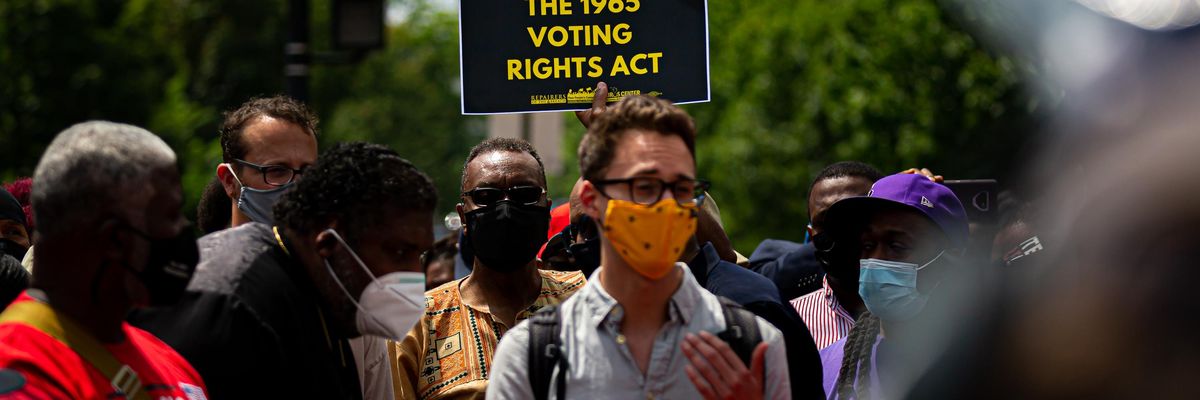
The Poor People's Campaign rallied and marched in Washington DC, where faith leaders, low-wage workers, and poor people from around the country protested for the US Senate to end the filibuster, protect voting rights, and raise the federal minimum wage to $15 an hour. (Photo: Michael Nigro/Pacific Press/LightRocket via Getty Images)
The Republicans have won a narrow majority in the House of Representatives. Depending on the outcome in the two seats that have not yet been called, a swing of between three and five seats would have left the House in Democratic hands.
One would have thought that there is common ground that the Supreme Court has a fundamental responsibility to safeguard our democratic system of government.
The Republicans can thank five of the six Supreme Court justices appointed by Republican presidents 3/4 Samuel Alito, Amy Coney Barrett, Neil Gorsuch, Brett Kavanaugh and Clarence Thomas. The election outcome was very likely changed by their Feb. 7, 2022, decision to make it clear that the Voting Rights Act would not be enforced this year to prevent states from using congressional districts drawn in violation of the law.
On Jan. 24, 2022, a three-judge Alabama District Court panel ruled in a 225-page opinion after a seven-day hearing that an "extremely robust body of evidence" "compels" the conclusion that Alabama's congressional districting plan adopted by its Republican legislature "substantially likely violates" the Voting Rights Act by unlawfully diluting the votes of Alabama's Black citizens. No one could argue that this was a partisan determination. Two of the three judges were nominated by former President Donald Trump and the third was originally nominated by President Ronald Reagan. They directed that Alabama redraw its congressional districts to comply with the law in this year's congressional elections. That would have given the Democrats an additional seat and the Republicans would have lost one.
Alabama asked the Supreme Court to stop that from happening. On Feb. 7, the five justices granted that request. Three of them did not feel any need to explain their decision. But Kavanaugh wrote a concurrence that was joined by Alito. He insisted it was too close to the election to require a change in the congressional districts because it "would require heroic efforts" by the state authorities to redraw the districts "and even heroic efforts likely would not be enough to avoid chaos and confusion."
Chief Justice John Roberts did not buy that explanation. He dissented, observing "the District Court properly applied existing law in an extensive opinion with no apparent errors for our correction" and that decision should apply to this year's elections. Justice Elena Kagan agreed in an opinion joined by then-Justice Stephen Breyer and Justice Sonia Sotomayor. As Kagan pointed out, the Alabama "legislature enacted its current plan in less than a week." And Alabama did not even argue it could not redraw the plan to comply with the law in time for the elections.
Yet--more than two and a half months later--on April 27, New York's highest state court further demonstrated that Kavanaugh's too close to the election explanation does not hold water. The New York court ruled New York's congressional districting plan adopted by its Democratic legislature violates the state constitution and must be redrawn for this year's elections. Unlike Alabama, New York complied, adopted a new plan, and moved its primary scheduled for June 28 back to September. "Heroic efforts" were not required. There was no "chaos and confusion." And while the plan the New York court rejected was expected to convert three Republican seats into Democratic seats, it was the Democrats that lost three seats under the new plan that resulted from the order.
But the Supreme Court's Alabama order--that there was too little time before the election to require compliance with the law--remained in place.
Other courts followed its lead. On Feb. 28, a federal court in Georgia ruled it was likely that Georgia's redistricting plan unlawfully dilutes the votes of Georgia's Black citizens. But, citing the Alabama ruling three weeks earlier, the Georgia court found it was too late to require a new plan in time for this year's elections. That meant at least a second congressional district that would have elected a Democrat this year instead elected a Republican. Then, on June 28, the Supreme Court itself stayed a Louisiana federal court order to create an additional Black majority district because Louisiana's redistricting plan violates the Voting Rights Act. Yet, a third district thereby became Republican this year that likely would have been Democratic. On March 11, a lawsuit was filed in federal court in Florida that alleges the Florida redistricting plan unlawfully dilutes the vote of Black Floridians and deprives them of two Black majority congressional seats. But by then the Supreme Court's Alabama ruling had already made clear the court would not allow a change to apply to this year's elections. Similar lawsuits were brought in Texas federal court in late 2021 alleging Texas's redistricting plan for this year's elections unlawfully dilutes the votes of Latino and Black voters. And in Ohio, the state Supreme Court struck down a redistricting plan that gives Republicans two-thirds of the state's 15 congressional seats even though Republicans comprise about 55 percent of the registered voters, but it ruled the gerrymandered map would apply this year.
What is particularly troubling about the Alabama ruling is that no matter where any Supreme Court justice fits on the political spectrum, and no matter what their judicial philosophy might be, one would have thought that there is common ground that the Supreme Court has a fundamental responsibility to safeguard our democratic system of government. That should mean, at a minimum, not allowing the outcome of our elections, and potentially control over one of our branches of government, to be determined by state legislators trying to game the system in violation of the law.
Dear Common Dreams reader, It’s been nearly 30 years since I co-founded Common Dreams with my late wife, Lina Newhouser. We had the radical notion that journalism should serve the public good, not corporate profits. It was clear to us from the outset what it would take to build such a project. No paid advertisements. No corporate sponsors. No millionaire publisher telling us what to think or do. Many people said we wouldn't last a year, but we proved those doubters wrong. Together with a tremendous team of journalists and dedicated staff, we built an independent media outlet free from the constraints of profits and corporate control. Our mission has always been simple: To inform. To inspire. To ignite change for the common good. Building Common Dreams was not easy. Our survival was never guaranteed. When you take on the most powerful forces—Wall Street greed, fossil fuel industry destruction, Big Tech lobbyists, and uber-rich oligarchs who have spent billions upon billions rigging the economy and democracy in their favor—the only bulwark you have is supporters who believe in your work. But here’s the urgent message from me today. It's never been this bad out there. And it's never been this hard to keep us going. At the very moment Common Dreams is most needed, the threats we face are intensifying. We need your support now more than ever. We don't accept corporate advertising and never will. We don't have a paywall because we don't think people should be blocked from critical news based on their ability to pay. Everything we do is funded by the donations of readers like you. When everyone does the little they can afford, we are strong. But if that support retreats or dries up, so do we. Will you donate now to make sure Common Dreams not only survives but thrives? —Craig Brown, Co-founder |
The Republicans have won a narrow majority in the House of Representatives. Depending on the outcome in the two seats that have not yet been called, a swing of between three and five seats would have left the House in Democratic hands.
One would have thought that there is common ground that the Supreme Court has a fundamental responsibility to safeguard our democratic system of government.
The Republicans can thank five of the six Supreme Court justices appointed by Republican presidents 3/4 Samuel Alito, Amy Coney Barrett, Neil Gorsuch, Brett Kavanaugh and Clarence Thomas. The election outcome was very likely changed by their Feb. 7, 2022, decision to make it clear that the Voting Rights Act would not be enforced this year to prevent states from using congressional districts drawn in violation of the law.
On Jan. 24, 2022, a three-judge Alabama District Court panel ruled in a 225-page opinion after a seven-day hearing that an "extremely robust body of evidence" "compels" the conclusion that Alabama's congressional districting plan adopted by its Republican legislature "substantially likely violates" the Voting Rights Act by unlawfully diluting the votes of Alabama's Black citizens. No one could argue that this was a partisan determination. Two of the three judges were nominated by former President Donald Trump and the third was originally nominated by President Ronald Reagan. They directed that Alabama redraw its congressional districts to comply with the law in this year's congressional elections. That would have given the Democrats an additional seat and the Republicans would have lost one.
Alabama asked the Supreme Court to stop that from happening. On Feb. 7, the five justices granted that request. Three of them did not feel any need to explain their decision. But Kavanaugh wrote a concurrence that was joined by Alito. He insisted it was too close to the election to require a change in the congressional districts because it "would require heroic efforts" by the state authorities to redraw the districts "and even heroic efforts likely would not be enough to avoid chaos and confusion."
Chief Justice John Roberts did not buy that explanation. He dissented, observing "the District Court properly applied existing law in an extensive opinion with no apparent errors for our correction" and that decision should apply to this year's elections. Justice Elena Kagan agreed in an opinion joined by then-Justice Stephen Breyer and Justice Sonia Sotomayor. As Kagan pointed out, the Alabama "legislature enacted its current plan in less than a week." And Alabama did not even argue it could not redraw the plan to comply with the law in time for the elections.
Yet--more than two and a half months later--on April 27, New York's highest state court further demonstrated that Kavanaugh's too close to the election explanation does not hold water. The New York court ruled New York's congressional districting plan adopted by its Democratic legislature violates the state constitution and must be redrawn for this year's elections. Unlike Alabama, New York complied, adopted a new plan, and moved its primary scheduled for June 28 back to September. "Heroic efforts" were not required. There was no "chaos and confusion." And while the plan the New York court rejected was expected to convert three Republican seats into Democratic seats, it was the Democrats that lost three seats under the new plan that resulted from the order.
But the Supreme Court's Alabama order--that there was too little time before the election to require compliance with the law--remained in place.
Other courts followed its lead. On Feb. 28, a federal court in Georgia ruled it was likely that Georgia's redistricting plan unlawfully dilutes the votes of Georgia's Black citizens. But, citing the Alabama ruling three weeks earlier, the Georgia court found it was too late to require a new plan in time for this year's elections. That meant at least a second congressional district that would have elected a Democrat this year instead elected a Republican. Then, on June 28, the Supreme Court itself stayed a Louisiana federal court order to create an additional Black majority district because Louisiana's redistricting plan violates the Voting Rights Act. Yet, a third district thereby became Republican this year that likely would have been Democratic. On March 11, a lawsuit was filed in federal court in Florida that alleges the Florida redistricting plan unlawfully dilutes the vote of Black Floridians and deprives them of two Black majority congressional seats. But by then the Supreme Court's Alabama ruling had already made clear the court would not allow a change to apply to this year's elections. Similar lawsuits were brought in Texas federal court in late 2021 alleging Texas's redistricting plan for this year's elections unlawfully dilutes the votes of Latino and Black voters. And in Ohio, the state Supreme Court struck down a redistricting plan that gives Republicans two-thirds of the state's 15 congressional seats even though Republicans comprise about 55 percent of the registered voters, but it ruled the gerrymandered map would apply this year.
What is particularly troubling about the Alabama ruling is that no matter where any Supreme Court justice fits on the political spectrum, and no matter what their judicial philosophy might be, one would have thought that there is common ground that the Supreme Court has a fundamental responsibility to safeguard our democratic system of government. That should mean, at a minimum, not allowing the outcome of our elections, and potentially control over one of our branches of government, to be determined by state legislators trying to game the system in violation of the law.
The Republicans have won a narrow majority in the House of Representatives. Depending on the outcome in the two seats that have not yet been called, a swing of between three and five seats would have left the House in Democratic hands.
One would have thought that there is common ground that the Supreme Court has a fundamental responsibility to safeguard our democratic system of government.
The Republicans can thank five of the six Supreme Court justices appointed by Republican presidents 3/4 Samuel Alito, Amy Coney Barrett, Neil Gorsuch, Brett Kavanaugh and Clarence Thomas. The election outcome was very likely changed by their Feb. 7, 2022, decision to make it clear that the Voting Rights Act would not be enforced this year to prevent states from using congressional districts drawn in violation of the law.
On Jan. 24, 2022, a three-judge Alabama District Court panel ruled in a 225-page opinion after a seven-day hearing that an "extremely robust body of evidence" "compels" the conclusion that Alabama's congressional districting plan adopted by its Republican legislature "substantially likely violates" the Voting Rights Act by unlawfully diluting the votes of Alabama's Black citizens. No one could argue that this was a partisan determination. Two of the three judges were nominated by former President Donald Trump and the third was originally nominated by President Ronald Reagan. They directed that Alabama redraw its congressional districts to comply with the law in this year's congressional elections. That would have given the Democrats an additional seat and the Republicans would have lost one.
Alabama asked the Supreme Court to stop that from happening. On Feb. 7, the five justices granted that request. Three of them did not feel any need to explain their decision. But Kavanaugh wrote a concurrence that was joined by Alito. He insisted it was too close to the election to require a change in the congressional districts because it "would require heroic efforts" by the state authorities to redraw the districts "and even heroic efforts likely would not be enough to avoid chaos and confusion."
Chief Justice John Roberts did not buy that explanation. He dissented, observing "the District Court properly applied existing law in an extensive opinion with no apparent errors for our correction" and that decision should apply to this year's elections. Justice Elena Kagan agreed in an opinion joined by then-Justice Stephen Breyer and Justice Sonia Sotomayor. As Kagan pointed out, the Alabama "legislature enacted its current plan in less than a week." And Alabama did not even argue it could not redraw the plan to comply with the law in time for the elections.
Yet--more than two and a half months later--on April 27, New York's highest state court further demonstrated that Kavanaugh's too close to the election explanation does not hold water. The New York court ruled New York's congressional districting plan adopted by its Democratic legislature violates the state constitution and must be redrawn for this year's elections. Unlike Alabama, New York complied, adopted a new plan, and moved its primary scheduled for June 28 back to September. "Heroic efforts" were not required. There was no "chaos and confusion." And while the plan the New York court rejected was expected to convert three Republican seats into Democratic seats, it was the Democrats that lost three seats under the new plan that resulted from the order.
But the Supreme Court's Alabama order--that there was too little time before the election to require compliance with the law--remained in place.
Other courts followed its lead. On Feb. 28, a federal court in Georgia ruled it was likely that Georgia's redistricting plan unlawfully dilutes the votes of Georgia's Black citizens. But, citing the Alabama ruling three weeks earlier, the Georgia court found it was too late to require a new plan in time for this year's elections. That meant at least a second congressional district that would have elected a Democrat this year instead elected a Republican. Then, on June 28, the Supreme Court itself stayed a Louisiana federal court order to create an additional Black majority district because Louisiana's redistricting plan violates the Voting Rights Act. Yet, a third district thereby became Republican this year that likely would have been Democratic. On March 11, a lawsuit was filed in federal court in Florida that alleges the Florida redistricting plan unlawfully dilutes the vote of Black Floridians and deprives them of two Black majority congressional seats. But by then the Supreme Court's Alabama ruling had already made clear the court would not allow a change to apply to this year's elections. Similar lawsuits were brought in Texas federal court in late 2021 alleging Texas's redistricting plan for this year's elections unlawfully dilutes the votes of Latino and Black voters. And in Ohio, the state Supreme Court struck down a redistricting plan that gives Republicans two-thirds of the state's 15 congressional seats even though Republicans comprise about 55 percent of the registered voters, but it ruled the gerrymandered map would apply this year.
What is particularly troubling about the Alabama ruling is that no matter where any Supreme Court justice fits on the political spectrum, and no matter what their judicial philosophy might be, one would have thought that there is common ground that the Supreme Court has a fundamental responsibility to safeguard our democratic system of government. That should mean, at a minimum, not allowing the outcome of our elections, and potentially control over one of our branches of government, to be determined by state legislators trying to game the system in violation of the law.