SUBSCRIBE TO OUR FREE NEWSLETTER
Daily news & progressive opinion—funded by the people, not the corporations—delivered straight to your inbox.
5
#000000
#FFFFFF
To donate by check, phone, or other method, see our More Ways to Give page.
Daily news & progressive opinion—funded by the people, not the corporations—delivered straight to your inbox.
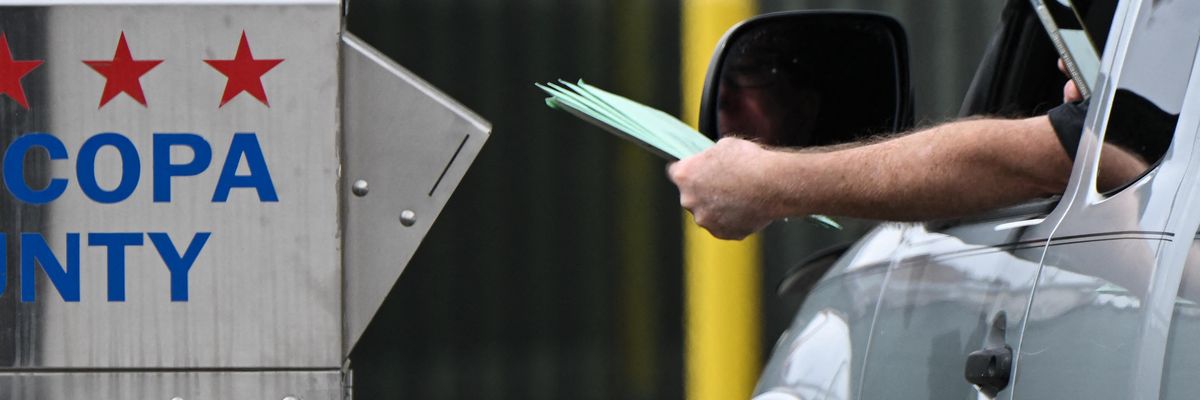
A driver uses a smartphone as they drop off multiple ballots into a ballot drop box for early voting outside of the Maricopa County Tabulation and Election Center ahead of the Arizona midterm elections in Phoenix, Arizona on November 3, 2022. (Photo: PATRICK T. FALLON/AFP via Getty Images)
Freedom requires that people are able to influence decisions about policies that affect their lives. In many states, ballot initiatives offer a way for residents to make certain policy choices directly, from the voting booth. In one of those states, Arizona, voters this November will consider a constitutional amendment that joins a growing, worrisome trend of state efforts to simultaneously erode state tax systems and weaken democratic norms. If approved, the measure would both hamstring the state's ability to raise adequate revenues for vital services and empower a minority to thwart policies that a majority of Arizonans support.
The people of Arizona deserve a real voice in their government--a voice that legislators should honor and respect, rather than weaken or reverse.
The ballot question, Proposition 132, asks voters whether they want to permanently increase the threshold to approve initiatives or referenda that impose a tax from a majority of votes cast in an election to 60 percent (a supermajority) of votes cast. This move would override voters' democratic rights by making it harder to amend or repeal harmful or inequitable laws and by tilting power away from voters and toward state legislators--weakening the balance of power enshrined in that state's constitution. Only nine states require some form of supermajority threshold at the ballot, and Arizona's could prove among the strictest.
The ballot process has been critical to meeting Arizona's needs. Voters have used it to raise revenue for key priorities and to respond to crises. For example, in 2010, they voted for a measure to balance the state budget after the Great Recession led to a revenue shortfall. And in 2020, they approved an initiative to raise taxes on the highest-income Arizonans to fund a nearly $1 billion boost to the state's underfunded education system. Notwithstanding a clear mandate by voters, the legislature negated the approved referendum and instead gave a $2 billion tax cut particularly beneficial to the wealthiest households.
A measure on the ballot this November would increase the state sales tax by 0.1 percent to generate $190 million for rural firefighters and paramedics.
Over the years, several ballot measures with important benefits for Arizona communities passed with less than 60 percent of the vote, including measures that boosted funding for early childhood education, K-12 schools, and health care programs such as the Arizona Health Care Cost Containment System. Had Proposition 132 been in place at the time of these referenda, they all would have failed. That's especially problematic in Arizona because the state constitution already requires a two-thirds vote of the legislature to raise taxes (including reforming or eliminating tax breaks). That makes it tough to raise adequate funds for good schools, health care, and transportation systems without going to the ballot. The ballot process is a backstop to ensuring that important measures with majority support among Arizonans have a pathway to enactment.
Proposition 132 would also undermine voters' ability to repeal or reform possible instances of legislative overreach, including this year's dangerous tax cuts that stand to drain billions in revenue from schools, health care systems, and public infrastructure projects over coming years and that disproportionately benefit rich households.
Proposition 132 has emerged at a time when Arizona's legislature and courts have taken several other steps that erode democracy and restrict individual freedoms. For example:
Supermajority requirements have a sordid history. The earliest supermajority taxation requirement still on the books was enacted in Mississippi in 1890 and enshrined in the same constitution that stripped Black people's voting rights. It mandated a three-fifths supermajority for any tax increase and came in direct response to efforts by Reconstruction-era, biracial governments to raise significant revenues for schools, infrastructure, and other needs. That barrier to raising adequate revenue has protected white wealth in Mississippi for generations and prevented needed investments in low-income people and communities of color.
The people of Arizona deserve a real voice in their government--a voice that legislators should honor and respect, rather than weaken or reverse. But Proposition 132 would do the opposite: shift power from voters to the legislature, weaken people's ability to advance proactive reforms or reverse legislative overreach, and diminish a constitutional right designed to protect that state's voters and communities. It would make smart investments in education, infrastructure, and other needed supports far less likely, and regressive measures like tax cuts for the wealthy and affronts on social justice far more. Such a step would weaken democracy and undermine Arizonans' ability to shape their futures--their freedom--a value we all share and should protect.
Dear Common Dreams reader, It’s been nearly 30 years since I co-founded Common Dreams with my late wife, Lina Newhouser. We had the radical notion that journalism should serve the public good, not corporate profits. It was clear to us from the outset what it would take to build such a project. No paid advertisements. No corporate sponsors. No millionaire publisher telling us what to think or do. Many people said we wouldn't last a year, but we proved those doubters wrong. Together with a tremendous team of journalists and dedicated staff, we built an independent media outlet free from the constraints of profits and corporate control. Our mission has always been simple: To inform. To inspire. To ignite change for the common good. Building Common Dreams was not easy. Our survival was never guaranteed. When you take on the most powerful forces—Wall Street greed, fossil fuel industry destruction, Big Tech lobbyists, and uber-rich oligarchs who have spent billions upon billions rigging the economy and democracy in their favor—the only bulwark you have is supporters who believe in your work. But here’s the urgent message from me today. It's never been this bad out there. And it's never been this hard to keep us going. At the very moment Common Dreams is most needed, the threats we face are intensifying. We need your support now more than ever. We don't accept corporate advertising and never will. We don't have a paywall because we don't think people should be blocked from critical news based on their ability to pay. Everything we do is funded by the donations of readers like you. When everyone does the little they can afford, we are strong. But if that support retreats or dries up, so do we. Will you donate now to make sure Common Dreams not only survives but thrives? —Craig Brown, Co-founder |
Freedom requires that people are able to influence decisions about policies that affect their lives. In many states, ballot initiatives offer a way for residents to make certain policy choices directly, from the voting booth. In one of those states, Arizona, voters this November will consider a constitutional amendment that joins a growing, worrisome trend of state efforts to simultaneously erode state tax systems and weaken democratic norms. If approved, the measure would both hamstring the state's ability to raise adequate revenues for vital services and empower a minority to thwart policies that a majority of Arizonans support.
The people of Arizona deserve a real voice in their government--a voice that legislators should honor and respect, rather than weaken or reverse.
The ballot question, Proposition 132, asks voters whether they want to permanently increase the threshold to approve initiatives or referenda that impose a tax from a majority of votes cast in an election to 60 percent (a supermajority) of votes cast. This move would override voters' democratic rights by making it harder to amend or repeal harmful or inequitable laws and by tilting power away from voters and toward state legislators--weakening the balance of power enshrined in that state's constitution. Only nine states require some form of supermajority threshold at the ballot, and Arizona's could prove among the strictest.
The ballot process has been critical to meeting Arizona's needs. Voters have used it to raise revenue for key priorities and to respond to crises. For example, in 2010, they voted for a measure to balance the state budget after the Great Recession led to a revenue shortfall. And in 2020, they approved an initiative to raise taxes on the highest-income Arizonans to fund a nearly $1 billion boost to the state's underfunded education system. Notwithstanding a clear mandate by voters, the legislature negated the approved referendum and instead gave a $2 billion tax cut particularly beneficial to the wealthiest households.
A measure on the ballot this November would increase the state sales tax by 0.1 percent to generate $190 million for rural firefighters and paramedics.
Over the years, several ballot measures with important benefits for Arizona communities passed with less than 60 percent of the vote, including measures that boosted funding for early childhood education, K-12 schools, and health care programs such as the Arizona Health Care Cost Containment System. Had Proposition 132 been in place at the time of these referenda, they all would have failed. That's especially problematic in Arizona because the state constitution already requires a two-thirds vote of the legislature to raise taxes (including reforming or eliminating tax breaks). That makes it tough to raise adequate funds for good schools, health care, and transportation systems without going to the ballot. The ballot process is a backstop to ensuring that important measures with majority support among Arizonans have a pathway to enactment.
Proposition 132 would also undermine voters' ability to repeal or reform possible instances of legislative overreach, including this year's dangerous tax cuts that stand to drain billions in revenue from schools, health care systems, and public infrastructure projects over coming years and that disproportionately benefit rich households.
Proposition 132 has emerged at a time when Arizona's legislature and courts have taken several other steps that erode democracy and restrict individual freedoms. For example:
Supermajority requirements have a sordid history. The earliest supermajority taxation requirement still on the books was enacted in Mississippi in 1890 and enshrined in the same constitution that stripped Black people's voting rights. It mandated a three-fifths supermajority for any tax increase and came in direct response to efforts by Reconstruction-era, biracial governments to raise significant revenues for schools, infrastructure, and other needs. That barrier to raising adequate revenue has protected white wealth in Mississippi for generations and prevented needed investments in low-income people and communities of color.
The people of Arizona deserve a real voice in their government--a voice that legislators should honor and respect, rather than weaken or reverse. But Proposition 132 would do the opposite: shift power from voters to the legislature, weaken people's ability to advance proactive reforms or reverse legislative overreach, and diminish a constitutional right designed to protect that state's voters and communities. It would make smart investments in education, infrastructure, and other needed supports far less likely, and regressive measures like tax cuts for the wealthy and affronts on social justice far more. Such a step would weaken democracy and undermine Arizonans' ability to shape their futures--their freedom--a value we all share and should protect.
Freedom requires that people are able to influence decisions about policies that affect their lives. In many states, ballot initiatives offer a way for residents to make certain policy choices directly, from the voting booth. In one of those states, Arizona, voters this November will consider a constitutional amendment that joins a growing, worrisome trend of state efforts to simultaneously erode state tax systems and weaken democratic norms. If approved, the measure would both hamstring the state's ability to raise adequate revenues for vital services and empower a minority to thwart policies that a majority of Arizonans support.
The people of Arizona deserve a real voice in their government--a voice that legislators should honor and respect, rather than weaken or reverse.
The ballot question, Proposition 132, asks voters whether they want to permanently increase the threshold to approve initiatives or referenda that impose a tax from a majority of votes cast in an election to 60 percent (a supermajority) of votes cast. This move would override voters' democratic rights by making it harder to amend or repeal harmful or inequitable laws and by tilting power away from voters and toward state legislators--weakening the balance of power enshrined in that state's constitution. Only nine states require some form of supermajority threshold at the ballot, and Arizona's could prove among the strictest.
The ballot process has been critical to meeting Arizona's needs. Voters have used it to raise revenue for key priorities and to respond to crises. For example, in 2010, they voted for a measure to balance the state budget after the Great Recession led to a revenue shortfall. And in 2020, they approved an initiative to raise taxes on the highest-income Arizonans to fund a nearly $1 billion boost to the state's underfunded education system. Notwithstanding a clear mandate by voters, the legislature negated the approved referendum and instead gave a $2 billion tax cut particularly beneficial to the wealthiest households.
A measure on the ballot this November would increase the state sales tax by 0.1 percent to generate $190 million for rural firefighters and paramedics.
Over the years, several ballot measures with important benefits for Arizona communities passed with less than 60 percent of the vote, including measures that boosted funding for early childhood education, K-12 schools, and health care programs such as the Arizona Health Care Cost Containment System. Had Proposition 132 been in place at the time of these referenda, they all would have failed. That's especially problematic in Arizona because the state constitution already requires a two-thirds vote of the legislature to raise taxes (including reforming or eliminating tax breaks). That makes it tough to raise adequate funds for good schools, health care, and transportation systems without going to the ballot. The ballot process is a backstop to ensuring that important measures with majority support among Arizonans have a pathway to enactment.
Proposition 132 would also undermine voters' ability to repeal or reform possible instances of legislative overreach, including this year's dangerous tax cuts that stand to drain billions in revenue from schools, health care systems, and public infrastructure projects over coming years and that disproportionately benefit rich households.
Proposition 132 has emerged at a time when Arizona's legislature and courts have taken several other steps that erode democracy and restrict individual freedoms. For example:
Supermajority requirements have a sordid history. The earliest supermajority taxation requirement still on the books was enacted in Mississippi in 1890 and enshrined in the same constitution that stripped Black people's voting rights. It mandated a three-fifths supermajority for any tax increase and came in direct response to efforts by Reconstruction-era, biracial governments to raise significant revenues for schools, infrastructure, and other needs. That barrier to raising adequate revenue has protected white wealth in Mississippi for generations and prevented needed investments in low-income people and communities of color.
The people of Arizona deserve a real voice in their government--a voice that legislators should honor and respect, rather than weaken or reverse. But Proposition 132 would do the opposite: shift power from voters to the legislature, weaken people's ability to advance proactive reforms or reverse legislative overreach, and diminish a constitutional right designed to protect that state's voters and communities. It would make smart investments in education, infrastructure, and other needed supports far less likely, and regressive measures like tax cuts for the wealthy and affronts on social justice far more. Such a step would weaken democracy and undermine Arizonans' ability to shape their futures--their freedom--a value we all share and should protect.