SUBSCRIBE TO OUR FREE NEWSLETTER
Daily news & progressive opinion—funded by the people, not the corporations—delivered straight to your inbox.
5
#000000
#FFFFFF
To donate by check, phone, or other method, see our More Ways to Give page.
Daily news & progressive opinion—funded by the people, not the corporations—delivered straight to your inbox.
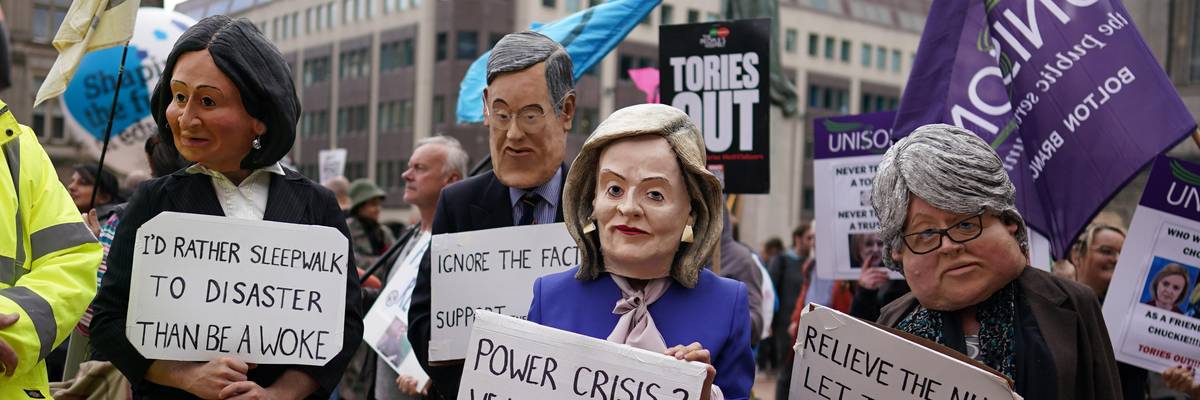
Protesters dressed as Prime Minister Liz Truss and other members of her cabinet stand with placards as they take part in a protest at Victoria Square on the first day of the Conservative Party Conference at the ICC on October 02, 2022 in Birmingham, England. The Conservative Party lags 33 points behind Labour in recent opinion polls. (Photo by Ian Forsyth/Getty Images)
"The Queen's final act of service to the nation was to selflessly buy the economy one last fortnight," said one tweet when all four wheels finally came off the British economy.
The Queen's death and funeral took up the first twelve days of Liz Truss's tenure, so the new prime minister's work of destruction could not get properly underway until last Friday. Then, however, Truss and her faithful sidekick Kwasi Kwarteng, the new Chancellor of the Exchequer (finance minister), got to work with amazing speed.
Kwarteng's 'mini-Budget' on Friday was a suicide note that virtually guarantees defeat for the Conservative Party at the next election, two years from now. There is growing doubt that Truss's government can even survive that long.
She is the fourth Conservative prime minister in the past six years, and at each turn of the wheel the party she currently leads has grown more mutinous. Moreover, it did not choose her as its leader.
That choice was made not by her fellow Conservative members of parliament but by the party's 160,000 paid-up members, who tend to be old, white, non-urban and very ideological.
What drew them to her was her fanatical devotion to the cause of lower taxes and a smaller state, as exemplified in a book she and Kwarteng co-authored ten years ago called 'Britannia Unchained'.
So as soon as the Queen's obsequies were safely past, she and Kwarteng gave them what they longed for: a Budget that is the political equivalent of asset-stripping. It contains unfunded tax cuts, mostly to the benefit of the rich, of around $50 billion a year.
Where will the money come from to make up the lost tax income, plus an extra PS65 billion to help voters cover horrendously high energy costs this winter due to the Russian invasion of Ukraine?
Why, they'll just borrow it all. All that extra spending will allegedly boost the growth rate of the British economy from an average of 1.5% a year to 2.5%, and the extra tax revenue will easily cover that.
At least that's what Liz Truss believes, in the firm belief that she is walking in the footsteps of her heroine, sainted former prime minister Margaret Thatcher. She is not.
The Blessed Margaret cut taxes, but she also cut government spending. The Truss-Kwarteng partnership is spending like a drunken sailor on shore leave. It's not 'Britannia Unchained'; it's 'Britannia Unhinged'.
Nobody believes this will work except a few right-wing think tanks that try to justify low taxes for the rich by touting the old 'trickle-down' model, also known as the 'horse and sparrow' theory: feed the horses enough oats, and eventually there will be lots of horse-poop for the sparrows to eat.
The sad news for Truss and Kwarteng is that the 'free market' they so revere isn't stupid. The value of the British pound is already collapsing. Former US Treasury secretary Larry Summers says: "My guess is that the pound will find its way below parity with both the dollar and the euro."
Meanwhile, investors look at Truss and Kwarteng's business model, do the math, and flee. In the words of Paul Donovan, chief economist at UBS Global Wealth Management, they now see the Conservative Party as a 'doomsday cult'.
And as interest rates soar to fight runaway inflation, millions of Britons find they cannot afford to pay their mortgages. The poor cannot even afford to feed their children. The strikes and protests proliferate.
It's probably around this time - midwinter, say - that the next rebellion occurs in the Conservatives' parliamentary party. However, changing horses would make little difference unless the policy changes. It wouldn't.
The next prime minister would be chosen by the same tiny band of Conservative Party members, no matter who the MPs want - and the members' mindset favors the ideological purist over the pragmatic realist. As one MP said: "You can have as many leadership elections as you like. You are only going to end up with the nutter winning."
The International Monetary Fund (IMF) has already issued its first warning to the United Kingdom to get its house in order. Larry Summers accuses the British government of "behaving like an emerging market turning itself into a submerging market," but Truss is not shifting.
It's a bit like the slow-motion car crash that brought the Sri Lankan government and economy down, which took more than six months from start to finish. Liz Truss's government will not last a year, and the Conservative Party may then split, leading to an early election (due anyway by 2024).
The Labour party is already seventeen points ahead in the polls, and its lead may even widen. It will be a wild ride, but the next British government will be led by Labour, which will rapidly reverse everything that Truss aspires to do.
Dear Common Dreams reader, It’s been nearly 30 years since I co-founded Common Dreams with my late wife, Lina Newhouser. We had the radical notion that journalism should serve the public good, not corporate profits. It was clear to us from the outset what it would take to build such a project. No paid advertisements. No corporate sponsors. No millionaire publisher telling us what to think or do. Many people said we wouldn't last a year, but we proved those doubters wrong. Together with a tremendous team of journalists and dedicated staff, we built an independent media outlet free from the constraints of profits and corporate control. Our mission has always been simple: To inform. To inspire. To ignite change for the common good. Building Common Dreams was not easy. Our survival was never guaranteed. When you take on the most powerful forces—Wall Street greed, fossil fuel industry destruction, Big Tech lobbyists, and uber-rich oligarchs who have spent billions upon billions rigging the economy and democracy in their favor—the only bulwark you have is supporters who believe in your work. But here’s the urgent message from me today. It's never been this bad out there. And it's never been this hard to keep us going. At the very moment Common Dreams is most needed, the threats we face are intensifying. We need your support now more than ever. We don't accept corporate advertising and never will. We don't have a paywall because we don't think people should be blocked from critical news based on their ability to pay. Everything we do is funded by the donations of readers like you. When everyone does the little they can afford, we are strong. But if that support retreats or dries up, so do we. Will you donate now to make sure Common Dreams not only survives but thrives? —Craig Brown, Co-founder |
"The Queen's final act of service to the nation was to selflessly buy the economy one last fortnight," said one tweet when all four wheels finally came off the British economy.
The Queen's death and funeral took up the first twelve days of Liz Truss's tenure, so the new prime minister's work of destruction could not get properly underway until last Friday. Then, however, Truss and her faithful sidekick Kwasi Kwarteng, the new Chancellor of the Exchequer (finance minister), got to work with amazing speed.
Kwarteng's 'mini-Budget' on Friday was a suicide note that virtually guarantees defeat for the Conservative Party at the next election, two years from now. There is growing doubt that Truss's government can even survive that long.
She is the fourth Conservative prime minister in the past six years, and at each turn of the wheel the party she currently leads has grown more mutinous. Moreover, it did not choose her as its leader.
That choice was made not by her fellow Conservative members of parliament but by the party's 160,000 paid-up members, who tend to be old, white, non-urban and very ideological.
What drew them to her was her fanatical devotion to the cause of lower taxes and a smaller state, as exemplified in a book she and Kwarteng co-authored ten years ago called 'Britannia Unchained'.
So as soon as the Queen's obsequies were safely past, she and Kwarteng gave them what they longed for: a Budget that is the political equivalent of asset-stripping. It contains unfunded tax cuts, mostly to the benefit of the rich, of around $50 billion a year.
Where will the money come from to make up the lost tax income, plus an extra PS65 billion to help voters cover horrendously high energy costs this winter due to the Russian invasion of Ukraine?
Why, they'll just borrow it all. All that extra spending will allegedly boost the growth rate of the British economy from an average of 1.5% a year to 2.5%, and the extra tax revenue will easily cover that.
At least that's what Liz Truss believes, in the firm belief that she is walking in the footsteps of her heroine, sainted former prime minister Margaret Thatcher. She is not.
The Blessed Margaret cut taxes, but she also cut government spending. The Truss-Kwarteng partnership is spending like a drunken sailor on shore leave. It's not 'Britannia Unchained'; it's 'Britannia Unhinged'.
Nobody believes this will work except a few right-wing think tanks that try to justify low taxes for the rich by touting the old 'trickle-down' model, also known as the 'horse and sparrow' theory: feed the horses enough oats, and eventually there will be lots of horse-poop for the sparrows to eat.
The sad news for Truss and Kwarteng is that the 'free market' they so revere isn't stupid. The value of the British pound is already collapsing. Former US Treasury secretary Larry Summers says: "My guess is that the pound will find its way below parity with both the dollar and the euro."
Meanwhile, investors look at Truss and Kwarteng's business model, do the math, and flee. In the words of Paul Donovan, chief economist at UBS Global Wealth Management, they now see the Conservative Party as a 'doomsday cult'.
And as interest rates soar to fight runaway inflation, millions of Britons find they cannot afford to pay their mortgages. The poor cannot even afford to feed their children. The strikes and protests proliferate.
It's probably around this time - midwinter, say - that the next rebellion occurs in the Conservatives' parliamentary party. However, changing horses would make little difference unless the policy changes. It wouldn't.
The next prime minister would be chosen by the same tiny band of Conservative Party members, no matter who the MPs want - and the members' mindset favors the ideological purist over the pragmatic realist. As one MP said: "You can have as many leadership elections as you like. You are only going to end up with the nutter winning."
The International Monetary Fund (IMF) has already issued its first warning to the United Kingdom to get its house in order. Larry Summers accuses the British government of "behaving like an emerging market turning itself into a submerging market," but Truss is not shifting.
It's a bit like the slow-motion car crash that brought the Sri Lankan government and economy down, which took more than six months from start to finish. Liz Truss's government will not last a year, and the Conservative Party may then split, leading to an early election (due anyway by 2024).
The Labour party is already seventeen points ahead in the polls, and its lead may even widen. It will be a wild ride, but the next British government will be led by Labour, which will rapidly reverse everything that Truss aspires to do.
"The Queen's final act of service to the nation was to selflessly buy the economy one last fortnight," said one tweet when all four wheels finally came off the British economy.
The Queen's death and funeral took up the first twelve days of Liz Truss's tenure, so the new prime minister's work of destruction could not get properly underway until last Friday. Then, however, Truss and her faithful sidekick Kwasi Kwarteng, the new Chancellor of the Exchequer (finance minister), got to work with amazing speed.
Kwarteng's 'mini-Budget' on Friday was a suicide note that virtually guarantees defeat for the Conservative Party at the next election, two years from now. There is growing doubt that Truss's government can even survive that long.
She is the fourth Conservative prime minister in the past six years, and at each turn of the wheel the party she currently leads has grown more mutinous. Moreover, it did not choose her as its leader.
That choice was made not by her fellow Conservative members of parliament but by the party's 160,000 paid-up members, who tend to be old, white, non-urban and very ideological.
What drew them to her was her fanatical devotion to the cause of lower taxes and a smaller state, as exemplified in a book she and Kwarteng co-authored ten years ago called 'Britannia Unchained'.
So as soon as the Queen's obsequies were safely past, she and Kwarteng gave them what they longed for: a Budget that is the political equivalent of asset-stripping. It contains unfunded tax cuts, mostly to the benefit of the rich, of around $50 billion a year.
Where will the money come from to make up the lost tax income, plus an extra PS65 billion to help voters cover horrendously high energy costs this winter due to the Russian invasion of Ukraine?
Why, they'll just borrow it all. All that extra spending will allegedly boost the growth rate of the British economy from an average of 1.5% a year to 2.5%, and the extra tax revenue will easily cover that.
At least that's what Liz Truss believes, in the firm belief that she is walking in the footsteps of her heroine, sainted former prime minister Margaret Thatcher. She is not.
The Blessed Margaret cut taxes, but she also cut government spending. The Truss-Kwarteng partnership is spending like a drunken sailor on shore leave. It's not 'Britannia Unchained'; it's 'Britannia Unhinged'.
Nobody believes this will work except a few right-wing think tanks that try to justify low taxes for the rich by touting the old 'trickle-down' model, also known as the 'horse and sparrow' theory: feed the horses enough oats, and eventually there will be lots of horse-poop for the sparrows to eat.
The sad news for Truss and Kwarteng is that the 'free market' they so revere isn't stupid. The value of the British pound is already collapsing. Former US Treasury secretary Larry Summers says: "My guess is that the pound will find its way below parity with both the dollar and the euro."
Meanwhile, investors look at Truss and Kwarteng's business model, do the math, and flee. In the words of Paul Donovan, chief economist at UBS Global Wealth Management, they now see the Conservative Party as a 'doomsday cult'.
And as interest rates soar to fight runaway inflation, millions of Britons find they cannot afford to pay their mortgages. The poor cannot even afford to feed their children. The strikes and protests proliferate.
It's probably around this time - midwinter, say - that the next rebellion occurs in the Conservatives' parliamentary party. However, changing horses would make little difference unless the policy changes. It wouldn't.
The next prime minister would be chosen by the same tiny band of Conservative Party members, no matter who the MPs want - and the members' mindset favors the ideological purist over the pragmatic realist. As one MP said: "You can have as many leadership elections as you like. You are only going to end up with the nutter winning."
The International Monetary Fund (IMF) has already issued its first warning to the United Kingdom to get its house in order. Larry Summers accuses the British government of "behaving like an emerging market turning itself into a submerging market," but Truss is not shifting.
It's a bit like the slow-motion car crash that brought the Sri Lankan government and economy down, which took more than six months from start to finish. Liz Truss's government will not last a year, and the Conservative Party may then split, leading to an early election (due anyway by 2024).
The Labour party is already seventeen points ahead in the polls, and its lead may even widen. It will be a wild ride, but the next British government will be led by Labour, which will rapidly reverse everything that Truss aspires to do.