SUBSCRIBE TO OUR FREE NEWSLETTER
Daily news & progressive opinion—funded by the people, not the corporations—delivered straight to your inbox.
5
#000000
#FFFFFF
To donate by check, phone, or other method, see our More Ways to Give page.
Daily news & progressive opinion—funded by the people, not the corporations—delivered straight to your inbox.
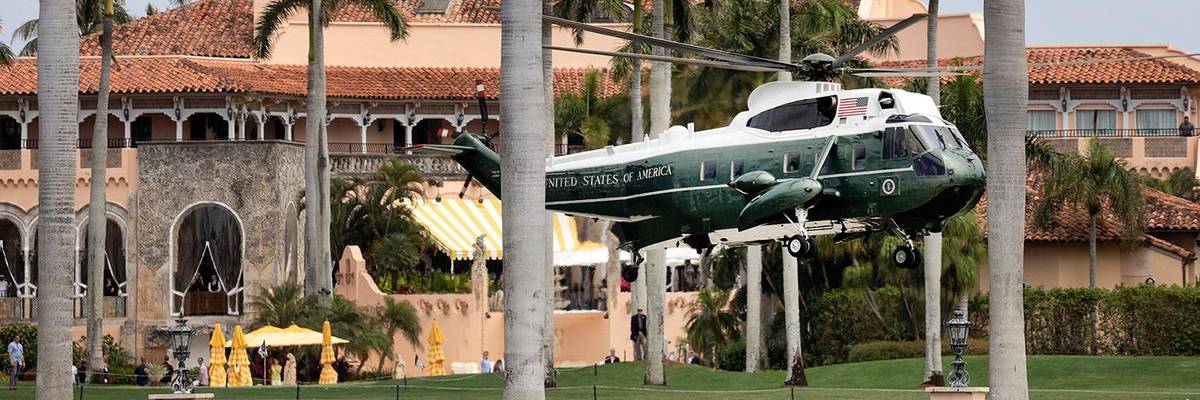
Marine One lifted off after returning then-President Donald Trump to Mar-a-Lago on March 29, 2019. (Photo: Joyce N. Boghosian/White House)
In 2018, Chief Justice John Roberts said, "We do not have Obama judges or Trump judges, Bush judges or Clinton judges."
This proved to be true following the 2020 presidential election, when judges appointed by Democratic and Republican Presidents, including Trump appointees, acted at a historic moment to reject the dozens of meritless lawsuits brought by former President Trump and his allies to overturn the election of Joe Biden as President.
A decision by federal District Court Judge Aileen Cannon may be a harbinger of things to come that could prove Chief Justice Roberts' claim wrong.
Judge Cannon's decision on Monday ordered the appointment of a special master to review the more than 11,000 documents that were removed last month from Mar-a-Lago under a court-approved search warrant in order to retrieve classified, secret, and top secret documents improperly taken by Trump to his country club and home in Florida.
Until the special master completes their work, Cannon also halted the Justice Department's review of the documents in its criminal investigation. This could slow down the investigation for months.
(This afternoon, the Justice Department announced they would move for Judge Cannon to stay the portion of her ruling enjoining the government from further review of the classified documents taken from Mar-a-Lago, while they appeal the decision.)
Last week, Cannon issued a preliminary order that she was inclined to grant Trump's special master request. This was highly unusual in that she seemingly decided the merits of the case before the Justice Department even had a chance to respond to Trump's lawsuit.
Cannon's decision on Monday authorized the special master to review the documents not only for Trump's claims of attorney-client privilege but also for his claims of executive privilege. The latter was also highly unusual, if not unprecedented. (Yesterday, a Washington Post investigation revealed that one of the documents seized at Mar-a-Lago included top secret information about a foreign government's nuclear capabilities.)
The Cannon decision has been widely criticized. According to The Washington Post, "The sheer volume of criticism on the opinion is remarkable, as is the ideological range of voices expressing it, from Harvard constitutional scholar Laurence Tribe to former attorney general William P. Barr."
Barr, a staunch Trump defender during his tenure as Attorney General in the Trump Administration, labeled Cannon's decision "deeply flawed" and "wrong."
In a particularly criticized passage of her decision, Judge Cannon found that as a former President "the stigma associated with the subject seizure is in a league of its own." In doing so, she appeared to be giving private citizen Trump preferential treatment, violating the fundamental principle of our country that all citizens should be treated equally under the law.
In a final unusual action, Judge Cannon denied a motion to allow the filing of an amicus brief that had been submitted by a distinguished group that included former Assistant, Deputy, and Acting Attorneys General and top Justice Department officials who served in previous Republican Administrations. (The brief was prepared by co-counsels Paul, Weiss, Rifkind, Wharton & Garrison, LLP; Amb. Norman Eisen (ret.); and myself.)
The brief strongly disagreed with the decision Judge Cannon ultimately reached. She gave no reason why she would not allow it to be filed.
The federal judiciary is the last line of defense in our constitutional system and did a historic job in protecting our democracy from former President Trump's coup attempt in 2020.
There are millions of election deniers in our country, including a substantial number of candidates running for office, who hope to set the stage for a Trump victory in 2024, regardless of the actual outcome of the election.
How many judges like Cannon are out there? That could determine whether the judiciary continues to serve as the last line of defense for our democracy.
Dear Common Dreams reader, It’s been nearly 30 years since I co-founded Common Dreams with my late wife, Lina Newhouser. We had the radical notion that journalism should serve the public good, not corporate profits. It was clear to us from the outset what it would take to build such a project. No paid advertisements. No corporate sponsors. No millionaire publisher telling us what to think or do. Many people said we wouldn't last a year, but we proved those doubters wrong. Together with a tremendous team of journalists and dedicated staff, we built an independent media outlet free from the constraints of profits and corporate control. Our mission has always been simple: To inform. To inspire. To ignite change for the common good. Building Common Dreams was not easy. Our survival was never guaranteed. When you take on the most powerful forces—Wall Street greed, fossil fuel industry destruction, Big Tech lobbyists, and uber-rich oligarchs who have spent billions upon billions rigging the economy and democracy in their favor—the only bulwark you have is supporters who believe in your work. But here’s the urgent message from me today. It's never been this bad out there. And it's never been this hard to keep us going. At the very moment Common Dreams is most needed, the threats we face are intensifying. We need your support now more than ever. We don't accept corporate advertising and never will. We don't have a paywall because we don't think people should be blocked from critical news based on their ability to pay. Everything we do is funded by the donations of readers like you. When everyone does the little they can afford, we are strong. But if that support retreats or dries up, so do we. Will you donate now to make sure Common Dreams not only survives but thrives? —Craig Brown, Co-founder |
In 2018, Chief Justice John Roberts said, "We do not have Obama judges or Trump judges, Bush judges or Clinton judges."
This proved to be true following the 2020 presidential election, when judges appointed by Democratic and Republican Presidents, including Trump appointees, acted at a historic moment to reject the dozens of meritless lawsuits brought by former President Trump and his allies to overturn the election of Joe Biden as President.
A decision by federal District Court Judge Aileen Cannon may be a harbinger of things to come that could prove Chief Justice Roberts' claim wrong.
Judge Cannon's decision on Monday ordered the appointment of a special master to review the more than 11,000 documents that were removed last month from Mar-a-Lago under a court-approved search warrant in order to retrieve classified, secret, and top secret documents improperly taken by Trump to his country club and home in Florida.
Until the special master completes their work, Cannon also halted the Justice Department's review of the documents in its criminal investigation. This could slow down the investigation for months.
(This afternoon, the Justice Department announced they would move for Judge Cannon to stay the portion of her ruling enjoining the government from further review of the classified documents taken from Mar-a-Lago, while they appeal the decision.)
Last week, Cannon issued a preliminary order that she was inclined to grant Trump's special master request. This was highly unusual in that she seemingly decided the merits of the case before the Justice Department even had a chance to respond to Trump's lawsuit.
Cannon's decision on Monday authorized the special master to review the documents not only for Trump's claims of attorney-client privilege but also for his claims of executive privilege. The latter was also highly unusual, if not unprecedented. (Yesterday, a Washington Post investigation revealed that one of the documents seized at Mar-a-Lago included top secret information about a foreign government's nuclear capabilities.)
The Cannon decision has been widely criticized. According to The Washington Post, "The sheer volume of criticism on the opinion is remarkable, as is the ideological range of voices expressing it, from Harvard constitutional scholar Laurence Tribe to former attorney general William P. Barr."
Barr, a staunch Trump defender during his tenure as Attorney General in the Trump Administration, labeled Cannon's decision "deeply flawed" and "wrong."
In a particularly criticized passage of her decision, Judge Cannon found that as a former President "the stigma associated with the subject seizure is in a league of its own." In doing so, she appeared to be giving private citizen Trump preferential treatment, violating the fundamental principle of our country that all citizens should be treated equally under the law.
In a final unusual action, Judge Cannon denied a motion to allow the filing of an amicus brief that had been submitted by a distinguished group that included former Assistant, Deputy, and Acting Attorneys General and top Justice Department officials who served in previous Republican Administrations. (The brief was prepared by co-counsels Paul, Weiss, Rifkind, Wharton & Garrison, LLP; Amb. Norman Eisen (ret.); and myself.)
The brief strongly disagreed with the decision Judge Cannon ultimately reached. She gave no reason why she would not allow it to be filed.
The federal judiciary is the last line of defense in our constitutional system and did a historic job in protecting our democracy from former President Trump's coup attempt in 2020.
There are millions of election deniers in our country, including a substantial number of candidates running for office, who hope to set the stage for a Trump victory in 2024, regardless of the actual outcome of the election.
How many judges like Cannon are out there? That could determine whether the judiciary continues to serve as the last line of defense for our democracy.
In 2018, Chief Justice John Roberts said, "We do not have Obama judges or Trump judges, Bush judges or Clinton judges."
This proved to be true following the 2020 presidential election, when judges appointed by Democratic and Republican Presidents, including Trump appointees, acted at a historic moment to reject the dozens of meritless lawsuits brought by former President Trump and his allies to overturn the election of Joe Biden as President.
A decision by federal District Court Judge Aileen Cannon may be a harbinger of things to come that could prove Chief Justice Roberts' claim wrong.
Judge Cannon's decision on Monday ordered the appointment of a special master to review the more than 11,000 documents that were removed last month from Mar-a-Lago under a court-approved search warrant in order to retrieve classified, secret, and top secret documents improperly taken by Trump to his country club and home in Florida.
Until the special master completes their work, Cannon also halted the Justice Department's review of the documents in its criminal investigation. This could slow down the investigation for months.
(This afternoon, the Justice Department announced they would move for Judge Cannon to stay the portion of her ruling enjoining the government from further review of the classified documents taken from Mar-a-Lago, while they appeal the decision.)
Last week, Cannon issued a preliminary order that she was inclined to grant Trump's special master request. This was highly unusual in that she seemingly decided the merits of the case before the Justice Department even had a chance to respond to Trump's lawsuit.
Cannon's decision on Monday authorized the special master to review the documents not only for Trump's claims of attorney-client privilege but also for his claims of executive privilege. The latter was also highly unusual, if not unprecedented. (Yesterday, a Washington Post investigation revealed that one of the documents seized at Mar-a-Lago included top secret information about a foreign government's nuclear capabilities.)
The Cannon decision has been widely criticized. According to The Washington Post, "The sheer volume of criticism on the opinion is remarkable, as is the ideological range of voices expressing it, from Harvard constitutional scholar Laurence Tribe to former attorney general William P. Barr."
Barr, a staunch Trump defender during his tenure as Attorney General in the Trump Administration, labeled Cannon's decision "deeply flawed" and "wrong."
In a particularly criticized passage of her decision, Judge Cannon found that as a former President "the stigma associated with the subject seizure is in a league of its own." In doing so, she appeared to be giving private citizen Trump preferential treatment, violating the fundamental principle of our country that all citizens should be treated equally under the law.
In a final unusual action, Judge Cannon denied a motion to allow the filing of an amicus brief that had been submitted by a distinguished group that included former Assistant, Deputy, and Acting Attorneys General and top Justice Department officials who served in previous Republican Administrations. (The brief was prepared by co-counsels Paul, Weiss, Rifkind, Wharton & Garrison, LLP; Amb. Norman Eisen (ret.); and myself.)
The brief strongly disagreed with the decision Judge Cannon ultimately reached. She gave no reason why she would not allow it to be filed.
The federal judiciary is the last line of defense in our constitutional system and did a historic job in protecting our democracy from former President Trump's coup attempt in 2020.
There are millions of election deniers in our country, including a substantial number of candidates running for office, who hope to set the stage for a Trump victory in 2024, regardless of the actual outcome of the election.
How many judges like Cannon are out there? That could determine whether the judiciary continues to serve as the last line of defense for our democracy.