SUBSCRIBE TO OUR FREE NEWSLETTER
Daily news & progressive opinion—funded by the people, not the corporations—delivered straight to your inbox.
5
#000000
#FFFFFF
To donate by check, phone, or other method, see our More Ways to Give page.
Daily news & progressive opinion—funded by the people, not the corporations—delivered straight to your inbox.
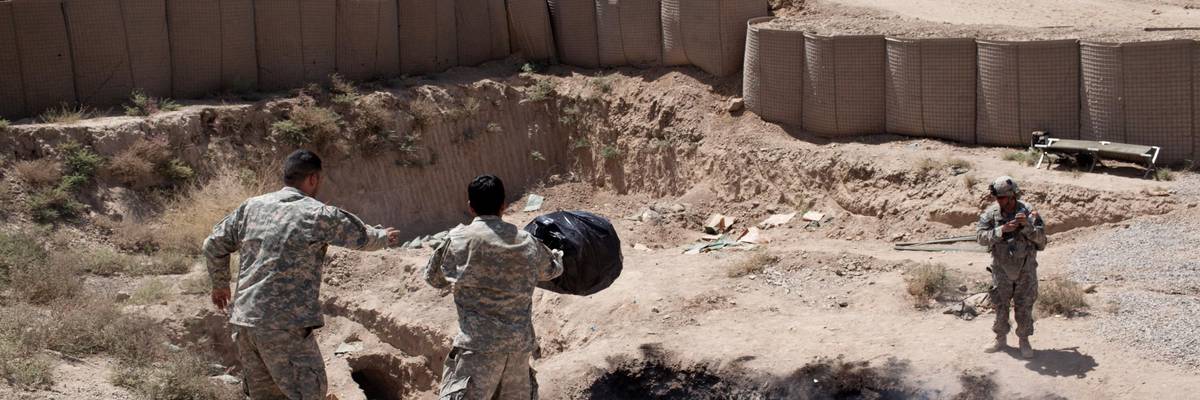
Two interpreters for Bravo troop dump their trash in the base's "burn pit." in the Pashmul area in the Zhari District of Kandahar Province in Afghanistan in 2012. (Photo: Sebastian Meyer/Corbis via Getty Images)
Military veterans and their supporters camped out in front of the U.S. Capitol for close to a week after Republican senators withdrew their support for a major expansion of health care for veterans exposed to toxic "burn pits" in Iraq and Afghanistan. Formally titled, "The Sergeant First Class Heath Robinson Honoring our Promise to Address Comprehensive Toxics Act of 2022," the PACT Act targets the Pentagon's reliance on burn pits for disposing of the vast amounts of waste produced during the invasions and occupations of Iraq and Afghanistan. Plumes of polluted smoke and particulates from the burn pits injured up to an estimated 3.5 million U.S. service members over the past two decades.
The scars of the U.S. invasions and occupations of Iraq and Afghanistan are deep, spanning decades. We will never know how many millions were killed or injured.
After blocking the bill, Senate Republicans faced withering criticism from veterans and their supporters, including renowned comedian Jon Stewart. "I'm not sure I've ever seen a situation where people who have already given so much had to fight so hard to get so little," said Stewart, deadly serious, flanked by vets and families of veterans who died from the exposure.
Earlier, Stewart assailed the Republicans:
"Ain't this a bitch? America's heroes, who fought in our wars, outside, sweating their asses off, with oxygen, battling all kinds of ailments, while these motherf*****s sit in the air conditioning, walled off from any of it. They don't have to hear it. They don't have to see it."
Stewart wept after the Senate finally passed the bill.
Burn pits were used to dispose of everything from trash, tires, paint and other volatile organic solvents, batteries, unexploded ordnance, petroleum products, plastics, and medical waste, including body parts. These constantly burning dumps were often sited adjacent to barracks. Little or no protective gear was provided for impacted soldiers.
"Burn pits are massive incineration fields, sometimes as big as football fields, but there were many smaller ones throughout Iraq and Afghanistan, as well," Purdue University anthropology professor Kali Rubaii said on the Democracy Now! news hour.
The Department of Veterans Affairs (VA) has identified a slew of cancers related to burn pit exposure, along with skin problems, asthma, bronchitis, respiratory, pulmonary and cardiovascular problems, migraines and other neurological conditions.
These illnesses could have been prevented. The military typically used jet or diesel fuel to burn everything, creating far more pollution than high-temperature incinerators. But using incinerators would have cost more money. Waste disposal was handled by the military contractor Kellogg, Brown & Root, or KBR, a subsidiary of Halliburton. Halliburton's CEO prior to 2001 was Dick Cheney. Cheney then became U.S. Vice President and was a key architect of the invasions and occupations of Afghanistan and Iraq. KBR received no-bid contracts to handle an array of logistics for the wars, including waste disposal. KBR chose cheap and dirty burn pits, maximizing profits.
"War is a racket," retired U.S. Marine Maj. Gen. Smedley Butler wrote in 1935. Butler was a career Marine, admitting, in a 1931 speech, "I spent most of my time being a high-class muscle man for Big Business, for Wall Street and the bankers," Butler said. "I was a racketeer, a gangster for capitalism."
The close to $700 billion appropriated in the PACT ACT for the next ten years will help alleviate some suffering caused by Halliburton's war profiteering, but only for U.S. victims. It won't do a thing for the people in Iraq and Afghanistan.
"Veterans saw acute, short-term exposure to burn pits at peak health, at the prime of their lives," Kali Rubaii, who recently returned from the heavily war-impacted Iraqi city of Fallujah, said. "Iraqis faced long-term, diffuse exposure at all stages of the life course, so the health effects were varied and widespread. Living near U.S. bases in Iraq, and therefore near burn pits, increased the likelihood of giving birth to a child with a birth defect or of getting cancer.
"Burn pits are not the biggest figure of environmental and health harm for Iraqis," Professor Rabii elaborated. "They have also been facing military occupation, bombings, shootings, displacement and layers of military incursion by different occupation forces since the U.S. invasion. These things have all added up to collapse in public infrastructure that would be used to contend with the health effects of burn pits, poor overall health, and damaged conditions for farming and fishing."
She concluded, "There is one really great way to avoid war-related injury, which is to not go [to war]."
The scars of the U.S. invasions and occupations of Iraq and Afghanistan are deep, spanning decades. We will never know how many millions were killed or injured. The United States bears responsibility, and owes the survivors reparations, no less than has been pledged, belatedly, to U.S. veterans.
Dear Common Dreams reader, It’s been nearly 30 years since I co-founded Common Dreams with my late wife, Lina Newhouser. We had the radical notion that journalism should serve the public good, not corporate profits. It was clear to us from the outset what it would take to build such a project. No paid advertisements. No corporate sponsors. No millionaire publisher telling us what to think or do. Many people said we wouldn't last a year, but we proved those doubters wrong. Together with a tremendous team of journalists and dedicated staff, we built an independent media outlet free from the constraints of profits and corporate control. Our mission has always been simple: To inform. To inspire. To ignite change for the common good. Building Common Dreams was not easy. Our survival was never guaranteed. When you take on the most powerful forces—Wall Street greed, fossil fuel industry destruction, Big Tech lobbyists, and uber-rich oligarchs who have spent billions upon billions rigging the economy and democracy in their favor—the only bulwark you have is supporters who believe in your work. But here’s the urgent message from me today. It's never been this bad out there. And it's never been this hard to keep us going. At the very moment Common Dreams is most needed, the threats we face are intensifying. We need your support now more than ever. We don't accept corporate advertising and never will. We don't have a paywall because we don't think people should be blocked from critical news based on their ability to pay. Everything we do is funded by the donations of readers like you. When everyone does the little they can afford, we are strong. But if that support retreats or dries up, so do we. Will you donate now to make sure Common Dreams not only survives but thrives? —Craig Brown, Co-founder |
Military veterans and their supporters camped out in front of the U.S. Capitol for close to a week after Republican senators withdrew their support for a major expansion of health care for veterans exposed to toxic "burn pits" in Iraq and Afghanistan. Formally titled, "The Sergeant First Class Heath Robinson Honoring our Promise to Address Comprehensive Toxics Act of 2022," the PACT Act targets the Pentagon's reliance on burn pits for disposing of the vast amounts of waste produced during the invasions and occupations of Iraq and Afghanistan. Plumes of polluted smoke and particulates from the burn pits injured up to an estimated 3.5 million U.S. service members over the past two decades.
The scars of the U.S. invasions and occupations of Iraq and Afghanistan are deep, spanning decades. We will never know how many millions were killed or injured.
After blocking the bill, Senate Republicans faced withering criticism from veterans and their supporters, including renowned comedian Jon Stewart. "I'm not sure I've ever seen a situation where people who have already given so much had to fight so hard to get so little," said Stewart, deadly serious, flanked by vets and families of veterans who died from the exposure.
Earlier, Stewart assailed the Republicans:
"Ain't this a bitch? America's heroes, who fought in our wars, outside, sweating their asses off, with oxygen, battling all kinds of ailments, while these motherf*****s sit in the air conditioning, walled off from any of it. They don't have to hear it. They don't have to see it."
Stewart wept after the Senate finally passed the bill.
Burn pits were used to dispose of everything from trash, tires, paint and other volatile organic solvents, batteries, unexploded ordnance, petroleum products, plastics, and medical waste, including body parts. These constantly burning dumps were often sited adjacent to barracks. Little or no protective gear was provided for impacted soldiers.
"Burn pits are massive incineration fields, sometimes as big as football fields, but there were many smaller ones throughout Iraq and Afghanistan, as well," Purdue University anthropology professor Kali Rubaii said on the Democracy Now! news hour.
The Department of Veterans Affairs (VA) has identified a slew of cancers related to burn pit exposure, along with skin problems, asthma, bronchitis, respiratory, pulmonary and cardiovascular problems, migraines and other neurological conditions.
These illnesses could have been prevented. The military typically used jet or diesel fuel to burn everything, creating far more pollution than high-temperature incinerators. But using incinerators would have cost more money. Waste disposal was handled by the military contractor Kellogg, Brown & Root, or KBR, a subsidiary of Halliburton. Halliburton's CEO prior to 2001 was Dick Cheney. Cheney then became U.S. Vice President and was a key architect of the invasions and occupations of Afghanistan and Iraq. KBR received no-bid contracts to handle an array of logistics for the wars, including waste disposal. KBR chose cheap and dirty burn pits, maximizing profits.
"War is a racket," retired U.S. Marine Maj. Gen. Smedley Butler wrote in 1935. Butler was a career Marine, admitting, in a 1931 speech, "I spent most of my time being a high-class muscle man for Big Business, for Wall Street and the bankers," Butler said. "I was a racketeer, a gangster for capitalism."
The close to $700 billion appropriated in the PACT ACT for the next ten years will help alleviate some suffering caused by Halliburton's war profiteering, but only for U.S. victims. It won't do a thing for the people in Iraq and Afghanistan.
"Veterans saw acute, short-term exposure to burn pits at peak health, at the prime of their lives," Kali Rubaii, who recently returned from the heavily war-impacted Iraqi city of Fallujah, said. "Iraqis faced long-term, diffuse exposure at all stages of the life course, so the health effects were varied and widespread. Living near U.S. bases in Iraq, and therefore near burn pits, increased the likelihood of giving birth to a child with a birth defect or of getting cancer.
"Burn pits are not the biggest figure of environmental and health harm for Iraqis," Professor Rabii elaborated. "They have also been facing military occupation, bombings, shootings, displacement and layers of military incursion by different occupation forces since the U.S. invasion. These things have all added up to collapse in public infrastructure that would be used to contend with the health effects of burn pits, poor overall health, and damaged conditions for farming and fishing."
She concluded, "There is one really great way to avoid war-related injury, which is to not go [to war]."
The scars of the U.S. invasions and occupations of Iraq and Afghanistan are deep, spanning decades. We will never know how many millions were killed or injured. The United States bears responsibility, and owes the survivors reparations, no less than has been pledged, belatedly, to U.S. veterans.
Military veterans and their supporters camped out in front of the U.S. Capitol for close to a week after Republican senators withdrew their support for a major expansion of health care for veterans exposed to toxic "burn pits" in Iraq and Afghanistan. Formally titled, "The Sergeant First Class Heath Robinson Honoring our Promise to Address Comprehensive Toxics Act of 2022," the PACT Act targets the Pentagon's reliance on burn pits for disposing of the vast amounts of waste produced during the invasions and occupations of Iraq and Afghanistan. Plumes of polluted smoke and particulates from the burn pits injured up to an estimated 3.5 million U.S. service members over the past two decades.
The scars of the U.S. invasions and occupations of Iraq and Afghanistan are deep, spanning decades. We will never know how many millions were killed or injured.
After blocking the bill, Senate Republicans faced withering criticism from veterans and their supporters, including renowned comedian Jon Stewart. "I'm not sure I've ever seen a situation where people who have already given so much had to fight so hard to get so little," said Stewart, deadly serious, flanked by vets and families of veterans who died from the exposure.
Earlier, Stewart assailed the Republicans:
"Ain't this a bitch? America's heroes, who fought in our wars, outside, sweating their asses off, with oxygen, battling all kinds of ailments, while these motherf*****s sit in the air conditioning, walled off from any of it. They don't have to hear it. They don't have to see it."
Stewart wept after the Senate finally passed the bill.
Burn pits were used to dispose of everything from trash, tires, paint and other volatile organic solvents, batteries, unexploded ordnance, petroleum products, plastics, and medical waste, including body parts. These constantly burning dumps were often sited adjacent to barracks. Little or no protective gear was provided for impacted soldiers.
"Burn pits are massive incineration fields, sometimes as big as football fields, but there were many smaller ones throughout Iraq and Afghanistan, as well," Purdue University anthropology professor Kali Rubaii said on the Democracy Now! news hour.
The Department of Veterans Affairs (VA) has identified a slew of cancers related to burn pit exposure, along with skin problems, asthma, bronchitis, respiratory, pulmonary and cardiovascular problems, migraines and other neurological conditions.
These illnesses could have been prevented. The military typically used jet or diesel fuel to burn everything, creating far more pollution than high-temperature incinerators. But using incinerators would have cost more money. Waste disposal was handled by the military contractor Kellogg, Brown & Root, or KBR, a subsidiary of Halliburton. Halliburton's CEO prior to 2001 was Dick Cheney. Cheney then became U.S. Vice President and was a key architect of the invasions and occupations of Afghanistan and Iraq. KBR received no-bid contracts to handle an array of logistics for the wars, including waste disposal. KBR chose cheap and dirty burn pits, maximizing profits.
"War is a racket," retired U.S. Marine Maj. Gen. Smedley Butler wrote in 1935. Butler was a career Marine, admitting, in a 1931 speech, "I spent most of my time being a high-class muscle man for Big Business, for Wall Street and the bankers," Butler said. "I was a racketeer, a gangster for capitalism."
The close to $700 billion appropriated in the PACT ACT for the next ten years will help alleviate some suffering caused by Halliburton's war profiteering, but only for U.S. victims. It won't do a thing for the people in Iraq and Afghanistan.
"Veterans saw acute, short-term exposure to burn pits at peak health, at the prime of their lives," Kali Rubaii, who recently returned from the heavily war-impacted Iraqi city of Fallujah, said. "Iraqis faced long-term, diffuse exposure at all stages of the life course, so the health effects were varied and widespread. Living near U.S. bases in Iraq, and therefore near burn pits, increased the likelihood of giving birth to a child with a birth defect or of getting cancer.
"Burn pits are not the biggest figure of environmental and health harm for Iraqis," Professor Rabii elaborated. "They have also been facing military occupation, bombings, shootings, displacement and layers of military incursion by different occupation forces since the U.S. invasion. These things have all added up to collapse in public infrastructure that would be used to contend with the health effects of burn pits, poor overall health, and damaged conditions for farming and fishing."
She concluded, "There is one really great way to avoid war-related injury, which is to not go [to war]."
The scars of the U.S. invasions and occupations of Iraq and Afghanistan are deep, spanning decades. We will never know how many millions were killed or injured. The United States bears responsibility, and owes the survivors reparations, no less than has been pledged, belatedly, to U.S. veterans.