SUBSCRIBE TO OUR FREE NEWSLETTER
Daily news & progressive opinion—funded by the people, not the corporations—delivered straight to your inbox.
5
#000000
#FFFFFF
To donate by check, phone, or other method, see our More Ways to Give page.
Daily news & progressive opinion—funded by the people, not the corporations—delivered straight to your inbox.
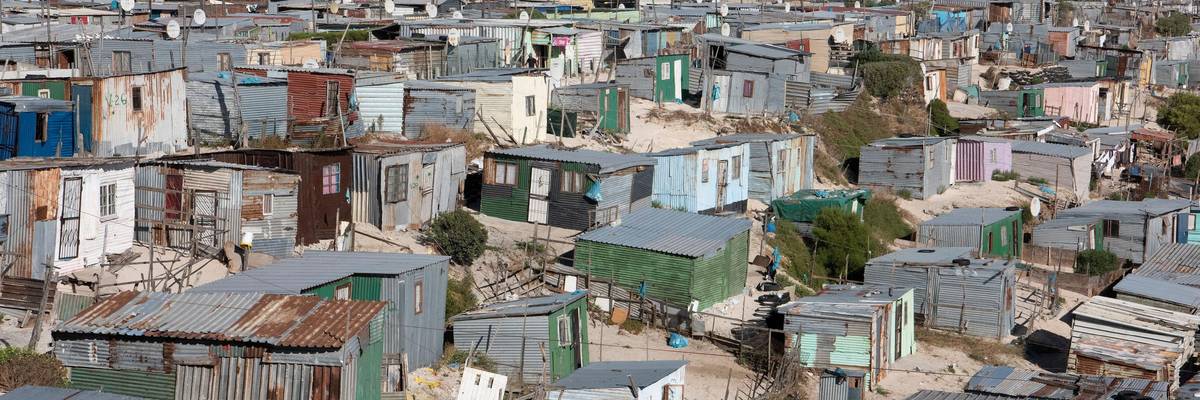
A general view of informal settlements and other parts of Khayelitsha, home to millions of people in mostly impoverished circumstances, with the back of Table Mountain visible, about 35km from the centre of Cape Town on February 22, 2022. The City of Cape Town estimates that about 31 neighbourhoods have no access to clean water. That includes sprawling districts filled with shacks, but also working-class neighbourhoods. (Photo: RODGER BOSCH/AFP via Getty Images)
Where I grew up, prayer filled the crisp, smoggy air at the first sight of day. The chorus of azans sounding from surrounding mosques brought the world back to life. Walking to school, women in vibrant saris jostled past with orange garlands made of marigolds in tow. They'd drape them at temples to thank their gods; and I thanked mine on my knees before bedtime.
The real culprits of these seemingly biblical droughts, floods, and locust infestations are cooped up in their corner offices in far off lands, away from the public's gaze.
This dusty township south of the country's economic capital was truly diverse, culturally. But despite the array of cultural backgrounds among my neighbours, like many of the racially segregated communities created by the aparthied government, they struggled to adapt to a culture of diversity enshrined in the South African Constitution--a struggle still apparent 30 years into our democracy.
South Africa is laced with communities like these, which remained insular after the 1994 election of Nelson Mandela as president, to this day. These communities fell behind while our constitutional democracy propelled change elsewhere on the continent, and even around the globe. (Ours is said to be one of the most progressive constitutions in the world.)
An ignorance of our core constitutional principles often reverts them back to their age-old value systems as a gauge of morality. And within many of these cultures, people like me are not only condemned to the bowels of hell, but are seen as a symptom and a sign of the end times--as per the religious text 86% of South Africans claim to subscribe to: The Holy Bible.
Coupled with the devastation that the climate crisis is wreaking on the world, let alone the African continent, right-wing rhetoric and religious dogma have steered blame away from the greedy colonial corporations pillaging the Earth to those bearing the proverbial scarlet letter of progressiveness (that many have been led to believe these religious texts warn us about).
The real culprits of these seemingly biblical droughts, floods and locust infestations are cooped up in their corner offices in far off lands, away from the public's gaze. The sheer spatial design of our townships keep the majority of poor South Africans far away from the displays of opulence in the leafy, almost exclusively white suburbs.
It is the so-called "wayward" members of society, who live down the road in our ghettos, that have become easy and attainable targets for retribution. We've become sacrificial lambs in our communities' efforts to save the world.
Recently, research by the Intergovernmental Panel on Climate Change (IPCC) confirmed that the Southern African region was already experiencing climate changes that are more rapid, and with impacts that are more severe, than the global average.
But we don't need a report to tell us that; over the past two years, locust infestations we observed in East Africa now plague our agricultural provinces, droughts have dried up our taps in some parts, while severe floodings have claimed countless lives in others. (All of this, while the Covid-19 pandemic relentlessly tore families apart.)
During this time, we also saw an unprecedented number of hate crimes perpetrated against members of the LGBTIQ+ community--including the brutal murders of 20 gender-nonconforming individuals. The surge of violence against LGBTIQ+ people prompted President Cyril Ramaphosa to publicly denounce the attacks and prioritise new protective legislation.
Slow-onset climate change impacts, like water scarcity, lower crop and ecosystem productivity, are forcing people to migrate in search of opportunities elsewhere in a country where the climate crisis is fast shrinking what little opportunity is left to find.
The impact of climate change on our food security is already apparent; the cost of food has skyrocketed in tandem with the rate of unemployment and poverty in our country. An estimated 40% of South Africans go to bed hungry--a figure that will certainly rise as the impact of the Russian war on Ukraine compounds exiting food injustice across the continent.
And if South Africans cannot afford food, they certainly cannot afford to go to university--one of the only places to formally learn about climate change in our educational system. Also, there is still a large portion of our population without access to the internet. This means that millions of South Africans rely on these personal networks and communities to make sense of what is happening (and as already established, the vast majority of them belong to faith-based communities).
Hunger often leaves people vulnerable to manipulation by the powerful--and religion has long been used as a means to sustain systems of exploitation across the continent. It makes sense that so many people are misguidedly seeking redemption in an era defined by fear-mongering, instead of challenging the root of their deprivation: the real reason we may face the end.
Without effective sensitization of the climate crisis in grassroots communities, historically marginalised groups such as the LGBTIQ+ community not only remain at risk of violence, but are systematically excluded from our failing economy, as well as relief efforts aimed at alleviating climate impacts.
"When the people shall have nothing more to eat, they will eat the rich," philosopher Jean-Jacques Rousseau famously said. Yet, history has shown us time and again that it is society's most vulnerable who are thrown out to the wolves--for reason often gives way to hunger pains, and my people are starving.
Shaping a sustainable equitable future that puts people and the planet before corporate greed and elite profiteering is possible. As we tackle the crises of climate, inequality, and health, it's clear there isn't one form of development that all countries and communities must follow. Building a better world is within our reach--and it takes all of us. Join the conversation for #AlternativeFutures.
Dear Common Dreams reader, It’s been nearly 30 years since I co-founded Common Dreams with my late wife, Lina Newhouser. We had the radical notion that journalism should serve the public good, not corporate profits. It was clear to us from the outset what it would take to build such a project. No paid advertisements. No corporate sponsors. No millionaire publisher telling us what to think or do. Many people said we wouldn't last a year, but we proved those doubters wrong. Together with a tremendous team of journalists and dedicated staff, we built an independent media outlet free from the constraints of profits and corporate control. Our mission has always been simple: To inform. To inspire. To ignite change for the common good. Building Common Dreams was not easy. Our survival was never guaranteed. When you take on the most powerful forces—Wall Street greed, fossil fuel industry destruction, Big Tech lobbyists, and uber-rich oligarchs who have spent billions upon billions rigging the economy and democracy in their favor—the only bulwark you have is supporters who believe in your work. But here’s the urgent message from me today. It's never been this bad out there. And it's never been this hard to keep us going. At the very moment Common Dreams is most needed, the threats we face are intensifying. We need your support now more than ever. We don't accept corporate advertising and never will. We don't have a paywall because we don't think people should be blocked from critical news based on their ability to pay. Everything we do is funded by the donations of readers like you. When everyone does the little they can afford, we are strong. But if that support retreats or dries up, so do we. Will you donate now to make sure Common Dreams not only survives but thrives? —Craig Brown, Co-founder |
Where I grew up, prayer filled the crisp, smoggy air at the first sight of day. The chorus of azans sounding from surrounding mosques brought the world back to life. Walking to school, women in vibrant saris jostled past with orange garlands made of marigolds in tow. They'd drape them at temples to thank their gods; and I thanked mine on my knees before bedtime.
The real culprits of these seemingly biblical droughts, floods, and locust infestations are cooped up in their corner offices in far off lands, away from the public's gaze.
This dusty township south of the country's economic capital was truly diverse, culturally. But despite the array of cultural backgrounds among my neighbours, like many of the racially segregated communities created by the aparthied government, they struggled to adapt to a culture of diversity enshrined in the South African Constitution--a struggle still apparent 30 years into our democracy.
South Africa is laced with communities like these, which remained insular after the 1994 election of Nelson Mandela as president, to this day. These communities fell behind while our constitutional democracy propelled change elsewhere on the continent, and even around the globe. (Ours is said to be one of the most progressive constitutions in the world.)
An ignorance of our core constitutional principles often reverts them back to their age-old value systems as a gauge of morality. And within many of these cultures, people like me are not only condemned to the bowels of hell, but are seen as a symptom and a sign of the end times--as per the religious text 86% of South Africans claim to subscribe to: The Holy Bible.
Coupled with the devastation that the climate crisis is wreaking on the world, let alone the African continent, right-wing rhetoric and religious dogma have steered blame away from the greedy colonial corporations pillaging the Earth to those bearing the proverbial scarlet letter of progressiveness (that many have been led to believe these religious texts warn us about).
The real culprits of these seemingly biblical droughts, floods and locust infestations are cooped up in their corner offices in far off lands, away from the public's gaze. The sheer spatial design of our townships keep the majority of poor South Africans far away from the displays of opulence in the leafy, almost exclusively white suburbs.
It is the so-called "wayward" members of society, who live down the road in our ghettos, that have become easy and attainable targets for retribution. We've become sacrificial lambs in our communities' efforts to save the world.
Recently, research by the Intergovernmental Panel on Climate Change (IPCC) confirmed that the Southern African region was already experiencing climate changes that are more rapid, and with impacts that are more severe, than the global average.
But we don't need a report to tell us that; over the past two years, locust infestations we observed in East Africa now plague our agricultural provinces, droughts have dried up our taps in some parts, while severe floodings have claimed countless lives in others. (All of this, while the Covid-19 pandemic relentlessly tore families apart.)
During this time, we also saw an unprecedented number of hate crimes perpetrated against members of the LGBTIQ+ community--including the brutal murders of 20 gender-nonconforming individuals. The surge of violence against LGBTIQ+ people prompted President Cyril Ramaphosa to publicly denounce the attacks and prioritise new protective legislation.
Slow-onset climate change impacts, like water scarcity, lower crop and ecosystem productivity, are forcing people to migrate in search of opportunities elsewhere in a country where the climate crisis is fast shrinking what little opportunity is left to find.
The impact of climate change on our food security is already apparent; the cost of food has skyrocketed in tandem with the rate of unemployment and poverty in our country. An estimated 40% of South Africans go to bed hungry--a figure that will certainly rise as the impact of the Russian war on Ukraine compounds exiting food injustice across the continent.
And if South Africans cannot afford food, they certainly cannot afford to go to university--one of the only places to formally learn about climate change in our educational system. Also, there is still a large portion of our population without access to the internet. This means that millions of South Africans rely on these personal networks and communities to make sense of what is happening (and as already established, the vast majority of them belong to faith-based communities).
Hunger often leaves people vulnerable to manipulation by the powerful--and religion has long been used as a means to sustain systems of exploitation across the continent. It makes sense that so many people are misguidedly seeking redemption in an era defined by fear-mongering, instead of challenging the root of their deprivation: the real reason we may face the end.
Without effective sensitization of the climate crisis in grassroots communities, historically marginalised groups such as the LGBTIQ+ community not only remain at risk of violence, but are systematically excluded from our failing economy, as well as relief efforts aimed at alleviating climate impacts.
"When the people shall have nothing more to eat, they will eat the rich," philosopher Jean-Jacques Rousseau famously said. Yet, history has shown us time and again that it is society's most vulnerable who are thrown out to the wolves--for reason often gives way to hunger pains, and my people are starving.
Shaping a sustainable equitable future that puts people and the planet before corporate greed and elite profiteering is possible. As we tackle the crises of climate, inequality, and health, it's clear there isn't one form of development that all countries and communities must follow. Building a better world is within our reach--and it takes all of us. Join the conversation for #AlternativeFutures.
Where I grew up, prayer filled the crisp, smoggy air at the first sight of day. The chorus of azans sounding from surrounding mosques brought the world back to life. Walking to school, women in vibrant saris jostled past with orange garlands made of marigolds in tow. They'd drape them at temples to thank their gods; and I thanked mine on my knees before bedtime.
The real culprits of these seemingly biblical droughts, floods, and locust infestations are cooped up in their corner offices in far off lands, away from the public's gaze.
This dusty township south of the country's economic capital was truly diverse, culturally. But despite the array of cultural backgrounds among my neighbours, like many of the racially segregated communities created by the aparthied government, they struggled to adapt to a culture of diversity enshrined in the South African Constitution--a struggle still apparent 30 years into our democracy.
South Africa is laced with communities like these, which remained insular after the 1994 election of Nelson Mandela as president, to this day. These communities fell behind while our constitutional democracy propelled change elsewhere on the continent, and even around the globe. (Ours is said to be one of the most progressive constitutions in the world.)
An ignorance of our core constitutional principles often reverts them back to their age-old value systems as a gauge of morality. And within many of these cultures, people like me are not only condemned to the bowels of hell, but are seen as a symptom and a sign of the end times--as per the religious text 86% of South Africans claim to subscribe to: The Holy Bible.
Coupled with the devastation that the climate crisis is wreaking on the world, let alone the African continent, right-wing rhetoric and religious dogma have steered blame away from the greedy colonial corporations pillaging the Earth to those bearing the proverbial scarlet letter of progressiveness (that many have been led to believe these religious texts warn us about).
The real culprits of these seemingly biblical droughts, floods and locust infestations are cooped up in their corner offices in far off lands, away from the public's gaze. The sheer spatial design of our townships keep the majority of poor South Africans far away from the displays of opulence in the leafy, almost exclusively white suburbs.
It is the so-called "wayward" members of society, who live down the road in our ghettos, that have become easy and attainable targets for retribution. We've become sacrificial lambs in our communities' efforts to save the world.
Recently, research by the Intergovernmental Panel on Climate Change (IPCC) confirmed that the Southern African region was already experiencing climate changes that are more rapid, and with impacts that are more severe, than the global average.
But we don't need a report to tell us that; over the past two years, locust infestations we observed in East Africa now plague our agricultural provinces, droughts have dried up our taps in some parts, while severe floodings have claimed countless lives in others. (All of this, while the Covid-19 pandemic relentlessly tore families apart.)
During this time, we also saw an unprecedented number of hate crimes perpetrated against members of the LGBTIQ+ community--including the brutal murders of 20 gender-nonconforming individuals. The surge of violence against LGBTIQ+ people prompted President Cyril Ramaphosa to publicly denounce the attacks and prioritise new protective legislation.
Slow-onset climate change impacts, like water scarcity, lower crop and ecosystem productivity, are forcing people to migrate in search of opportunities elsewhere in a country where the climate crisis is fast shrinking what little opportunity is left to find.
The impact of climate change on our food security is already apparent; the cost of food has skyrocketed in tandem with the rate of unemployment and poverty in our country. An estimated 40% of South Africans go to bed hungry--a figure that will certainly rise as the impact of the Russian war on Ukraine compounds exiting food injustice across the continent.
And if South Africans cannot afford food, they certainly cannot afford to go to university--one of the only places to formally learn about climate change in our educational system. Also, there is still a large portion of our population without access to the internet. This means that millions of South Africans rely on these personal networks and communities to make sense of what is happening (and as already established, the vast majority of them belong to faith-based communities).
Hunger often leaves people vulnerable to manipulation by the powerful--and religion has long been used as a means to sustain systems of exploitation across the continent. It makes sense that so many people are misguidedly seeking redemption in an era defined by fear-mongering, instead of challenging the root of their deprivation: the real reason we may face the end.
Without effective sensitization of the climate crisis in grassroots communities, historically marginalised groups such as the LGBTIQ+ community not only remain at risk of violence, but are systematically excluded from our failing economy, as well as relief efforts aimed at alleviating climate impacts.
"When the people shall have nothing more to eat, they will eat the rich," philosopher Jean-Jacques Rousseau famously said. Yet, history has shown us time and again that it is society's most vulnerable who are thrown out to the wolves--for reason often gives way to hunger pains, and my people are starving.
Shaping a sustainable equitable future that puts people and the planet before corporate greed and elite profiteering is possible. As we tackle the crises of climate, inequality, and health, it's clear there isn't one form of development that all countries and communities must follow. Building a better world is within our reach--and it takes all of us. Join the conversation for #AlternativeFutures.