SUBSCRIBE TO OUR FREE NEWSLETTER
Daily news & progressive opinion—funded by the people, not the corporations—delivered straight to your inbox.
5
#000000
#FFFFFF
To donate by check, phone, or other method, see our More Ways to Give page.
Daily news & progressive opinion—funded by the people, not the corporations—delivered straight to your inbox.
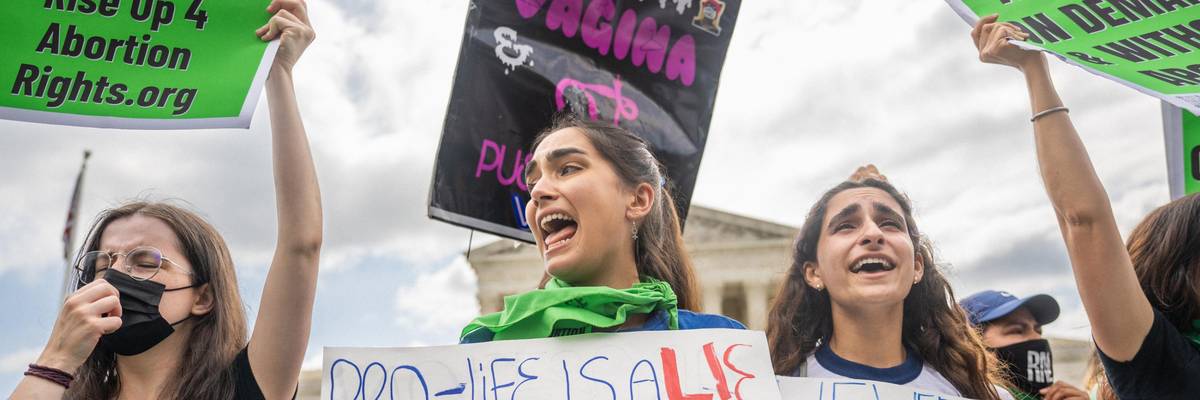
Abortion rights activists react to the Dobbs v Jackson Women's Health Organization ruling in front of the U.S. Supreme Court on June 24, 2022 in Washington, DC. The Court's decision in Dobbs v Jackson Women's Health overturns the landmark 50-year-old Roe v Wade case and erases a federal right to an abortion.
After half a century, Americans' constitutional right to get an abortion has been overturned by the Supreme Court.
The ruling in Dobbs v. Jackson Women's Health Organization--handed down on June 24, 2022--has far-reaching consequences. The Conversation asked Nicole Huberfeld and Linda C. McClain, health law and constitutional law experts at Boston University, to explain what just happened, and what happens next.
The Supreme Court decided by a 6-3 majority to uphold Mississippi's ban on abortion after 15 weeks of pregnancy. In doing so, the justices overturned two key decisions protecting access to abortion: 1973's Roe v. Wade and Planned Parenthood v. Casey, decided in 1992.
The court's opinion, written by Justice Samuel Alito, said that the Constitution does not mention abortion. Nor does the Constitution guarantee abortion rights via another right, the right to liberty.
The opinion rejected Roe's and Casey's argument that the constitutional right to liberty included an individual's right to privacy in choosing to have an abortion, in the same way that it protects other decisions concerning intimate sexual conduct, such as contraception and marriage. According to the opinion, abortion is "fundamentally different" because it destroys fetal life.
The court's narrow approach to the concept of constitutional liberty is at odds with the broader position it took in the earlier Casey ruling, as well as in a landmark marriage equality case, 2015's Obergefell v. Hodges. But the majority said that nothing in their opinion should affect the right of same-sex couples to marry.
Alito's opinion also rejected the legal principle of "stare decisis," or adhering to precedent. Supporters of the right to abortion argue that the Casey and Roe rulings should have been left in place as, in the words of the Casey ruling, reproductive rights allow women to "participate equally in the economic and social life of the Nation."
The ruling does not mean that abortion is banned throughout the U.S. Rather, arguments about the legality of abortion will now play out in state legislatures, where, Alito noted, women "are not without electoral or political power."
States will be allowed to regulate or prohibit abortion subject only to what is known as "rational basis" review--this is a weaker standard than Casey's "undue burden" test. Under Casey's undue burden test, states were prevented from enacting restrictions that placed substantial obstacles in the path of those seeking abortion. Now, abortion bans will be presumed to be legal as long as there is a "rational basis" for the legislature to believe the law serves legitimate state interests.
In a strenuous dissent, Justices Stephen Breyer, Elena Kagan and Sonia Sotomayor faulted the court's narrow approach to liberty and challenged its disregard both for stare decisis and for the impact of overruling Roe and Casey on the lives of women in the United States. The dissenters said the impact of the decision would be "the curtailment of women's rights, and of their status as free and equal citizens." They also expressed deep concern over the ruling's effect on poor women's ability to access abortion services in the U.S.
This is a huge moment. The court's ruling has done what reproductive rights advocates feared for decades: It has taken away the constitutional right to privacy that protected access to abortion.
This decision was decades in the making. Thirty years ago when Casey was being argued, many legal experts thought the court was poised to overrule Roe. Then, the court had eight justices appointed by Republican presidents, several of whom indicated readiness to overrule in dissenting opinions.
Instead, Republican appointees Anthony Kennedy, Sandra Day O'Connor and David Souter upheld Roe. They revised its framework to allow more state regulation throughout pregnancy and weakened the test for evaluating those laws. Under Roe's "strict scrutiny" test, any restriction on the right to privacy to access an abortion had to be "narrowly tailored" to further a "compelling" state interest. But Casey's "undue burden" test gave states wider latitude to regulate abortion.
Even before the Casey decision, abortion opponents in Congress had restricted access for poor women and members of the military greatly by limiting the use of federal funds to pay for abortion services.
In recent years, states have adopted numerous restrictions on abortion that would not have survived Roe's tougher "strict scrutiny" test. Even so, many state restrictions have been struck down in federal courts under the undue burden test, including bans on abortions prior to fetal viability and so-called "TRAP"--targeted regulation of abortion provider--laws that made it harder to keep clinics open.
President Donald Trump's pledge to appoint "pro-life" justices to federal courts--and his appointment of three conservative Supreme Court justices--finally made possible the goal of opponents of legal abortion: overruling Roe and Casey.
Even before Dobbs, the ability to access abortion was limited by a patchwork of laws across the United States. Republican states have more restrictive laws than Democratic ones, with people living in the Midwest and South subject to the strongest limits.
Thirteen states have so-called "trigger laws," which greatly restrict access to abortion. These will soon go into effect now that the Supreme Court has overturned Roe and Casey, requiring only state attorney general certification or other action by a state official.
Nine states have pre-Roe laws never taken off the books that significantly restrict or ban access to abortion. Altogether, nearly half of states will restrict access to abortion through a variety of measures like banning abortion from six weeks of pregnancy--before many women know they are pregnant--and limiting the reasons abortions may be obtained, such as forbidding abortion in the case of fetal anomalies.
Meanwhile, 16 states and the District of Columbia protect access to abortion in a variety of ways, such as state statutes, constitutional amendments or state Supreme Court decisions.
None of the states that limit abortion access currently criminalize the pregnant person's action. Rather, they threaten health care providers with civil or criminal actions, including loss of their license to practice medicine.
Some states are creating "safe havens" where people can travel to access an abortion legally. People have already been traveling to states like Massachusetts from highly restrictive states.
The court's decision may drive federal action, too.
The House of Representatives passed the Women's Health Protection Act, which protects health care providers and pregnant people seeking abortion, but Senate Republicans have blocked the bill from coming up for a vote. Congress could also reconsider providing limited Medicaid payment for abortion, but such federal legislation also seems unlikely to succeed.
President Joe Biden could use executive power to instruct federal agencies to review existing regulations to ensure that access to abortion continues to occur in as many places as possible. Congressional Republicans could test the water on nationwide abortion bans. While such efforts are likely to fail, these efforts could cause confusion for people who are already vulnerable.
Unintended pregnancies and abortions are more common among poor women and women of color, both in the U.S. and around the world.
Research shows that people have abortions whether lawful or not, but in nations where access to abortion is limited or outlawed, women are more likely to suffer negative health outcomes, such as infection, excessive bleeding and uterine perforation. Those who must carry a pregnancy to full term are more likely to suffer pregnancy-related deaths.
The state-by-state access to abortion resulting from this decision means many people will have to travel farther to obtain an abortion. And distance will mean fewer people will get abortions, especially lower-income women--a fact the Supreme Court itself recognized in 2016.
But since 2020, medication abortion--a two-pill regimen of mifepristone and misoprostol--has been the most common method of ending pregnancy in the U.S. The coronavirus pandemic accelerated this shift, as it drove the Food and Drug Administration to make medication abortions more available by allowing doctors to prescribe the pills through telemedicine and permitting medication to be mailed without in-person consultation.
Many states that restrict access to abortion also are trying to prevent medication abortion. But stopping telehealth providers from mailing pills will be a challenge. Further, because the FDA approved this regimen, states will be contradicting federal law, setting up conflict that may lead to more litigation.
The Supreme Court's rolling back a right that has been recognized for 50 years puts the U.S. in the minority of nations, most of which are moving toward liberalization. Nevertheless, even though abortion is seen by many as essential health care, the cultural fight will surely continue.
Dear Common Dreams reader, It’s been nearly 30 years since I co-founded Common Dreams with my late wife, Lina Newhouser. We had the radical notion that journalism should serve the public good, not corporate profits. It was clear to us from the outset what it would take to build such a project. No paid advertisements. No corporate sponsors. No millionaire publisher telling us what to think or do. Many people said we wouldn't last a year, but we proved those doubters wrong. Together with a tremendous team of journalists and dedicated staff, we built an independent media outlet free from the constraints of profits and corporate control. Our mission has always been simple: To inform. To inspire. To ignite change for the common good. Building Common Dreams was not easy. Our survival was never guaranteed. When you take on the most powerful forces—Wall Street greed, fossil fuel industry destruction, Big Tech lobbyists, and uber-rich oligarchs who have spent billions upon billions rigging the economy and democracy in their favor—the only bulwark you have is supporters who believe in your work. But here’s the urgent message from me today. It's never been this bad out there. And it's never been this hard to keep us going. At the very moment Common Dreams is most needed, the threats we face are intensifying. We need your support now more than ever. We don't accept corporate advertising and never will. We don't have a paywall because we don't think people should be blocked from critical news based on their ability to pay. Everything we do is funded by the donations of readers like you. When everyone does the little they can afford, we are strong. But if that support retreats or dries up, so do we. Will you donate now to make sure Common Dreams not only survives but thrives? —Craig Brown, Co-founder |
After half a century, Americans' constitutional right to get an abortion has been overturned by the Supreme Court.
The ruling in Dobbs v. Jackson Women's Health Organization--handed down on June 24, 2022--has far-reaching consequences. The Conversation asked Nicole Huberfeld and Linda C. McClain, health law and constitutional law experts at Boston University, to explain what just happened, and what happens next.
The Supreme Court decided by a 6-3 majority to uphold Mississippi's ban on abortion after 15 weeks of pregnancy. In doing so, the justices overturned two key decisions protecting access to abortion: 1973's Roe v. Wade and Planned Parenthood v. Casey, decided in 1992.
The court's opinion, written by Justice Samuel Alito, said that the Constitution does not mention abortion. Nor does the Constitution guarantee abortion rights via another right, the right to liberty.
The opinion rejected Roe's and Casey's argument that the constitutional right to liberty included an individual's right to privacy in choosing to have an abortion, in the same way that it protects other decisions concerning intimate sexual conduct, such as contraception and marriage. According to the opinion, abortion is "fundamentally different" because it destroys fetal life.
The court's narrow approach to the concept of constitutional liberty is at odds with the broader position it took in the earlier Casey ruling, as well as in a landmark marriage equality case, 2015's Obergefell v. Hodges. But the majority said that nothing in their opinion should affect the right of same-sex couples to marry.
Alito's opinion also rejected the legal principle of "stare decisis," or adhering to precedent. Supporters of the right to abortion argue that the Casey and Roe rulings should have been left in place as, in the words of the Casey ruling, reproductive rights allow women to "participate equally in the economic and social life of the Nation."
The ruling does not mean that abortion is banned throughout the U.S. Rather, arguments about the legality of abortion will now play out in state legislatures, where, Alito noted, women "are not without electoral or political power."
States will be allowed to regulate or prohibit abortion subject only to what is known as "rational basis" review--this is a weaker standard than Casey's "undue burden" test. Under Casey's undue burden test, states were prevented from enacting restrictions that placed substantial obstacles in the path of those seeking abortion. Now, abortion bans will be presumed to be legal as long as there is a "rational basis" for the legislature to believe the law serves legitimate state interests.
In a strenuous dissent, Justices Stephen Breyer, Elena Kagan and Sonia Sotomayor faulted the court's narrow approach to liberty and challenged its disregard both for stare decisis and for the impact of overruling Roe and Casey on the lives of women in the United States. The dissenters said the impact of the decision would be "the curtailment of women's rights, and of their status as free and equal citizens." They also expressed deep concern over the ruling's effect on poor women's ability to access abortion services in the U.S.
This is a huge moment. The court's ruling has done what reproductive rights advocates feared for decades: It has taken away the constitutional right to privacy that protected access to abortion.
This decision was decades in the making. Thirty years ago when Casey was being argued, many legal experts thought the court was poised to overrule Roe. Then, the court had eight justices appointed by Republican presidents, several of whom indicated readiness to overrule in dissenting opinions.
Instead, Republican appointees Anthony Kennedy, Sandra Day O'Connor and David Souter upheld Roe. They revised its framework to allow more state regulation throughout pregnancy and weakened the test for evaluating those laws. Under Roe's "strict scrutiny" test, any restriction on the right to privacy to access an abortion had to be "narrowly tailored" to further a "compelling" state interest. But Casey's "undue burden" test gave states wider latitude to regulate abortion.
Even before the Casey decision, abortion opponents in Congress had restricted access for poor women and members of the military greatly by limiting the use of federal funds to pay for abortion services.
In recent years, states have adopted numerous restrictions on abortion that would not have survived Roe's tougher "strict scrutiny" test. Even so, many state restrictions have been struck down in federal courts under the undue burden test, including bans on abortions prior to fetal viability and so-called "TRAP"--targeted regulation of abortion provider--laws that made it harder to keep clinics open.
President Donald Trump's pledge to appoint "pro-life" justices to federal courts--and his appointment of three conservative Supreme Court justices--finally made possible the goal of opponents of legal abortion: overruling Roe and Casey.
Even before Dobbs, the ability to access abortion was limited by a patchwork of laws across the United States. Republican states have more restrictive laws than Democratic ones, with people living in the Midwest and South subject to the strongest limits.
Thirteen states have so-called "trigger laws," which greatly restrict access to abortion. These will soon go into effect now that the Supreme Court has overturned Roe and Casey, requiring only state attorney general certification or other action by a state official.
Nine states have pre-Roe laws never taken off the books that significantly restrict or ban access to abortion. Altogether, nearly half of states will restrict access to abortion through a variety of measures like banning abortion from six weeks of pregnancy--before many women know they are pregnant--and limiting the reasons abortions may be obtained, such as forbidding abortion in the case of fetal anomalies.
Meanwhile, 16 states and the District of Columbia protect access to abortion in a variety of ways, such as state statutes, constitutional amendments or state Supreme Court decisions.
None of the states that limit abortion access currently criminalize the pregnant person's action. Rather, they threaten health care providers with civil or criminal actions, including loss of their license to practice medicine.
Some states are creating "safe havens" where people can travel to access an abortion legally. People have already been traveling to states like Massachusetts from highly restrictive states.
The court's decision may drive federal action, too.
The House of Representatives passed the Women's Health Protection Act, which protects health care providers and pregnant people seeking abortion, but Senate Republicans have blocked the bill from coming up for a vote. Congress could also reconsider providing limited Medicaid payment for abortion, but such federal legislation also seems unlikely to succeed.
President Joe Biden could use executive power to instruct federal agencies to review existing regulations to ensure that access to abortion continues to occur in as many places as possible. Congressional Republicans could test the water on nationwide abortion bans. While such efforts are likely to fail, these efforts could cause confusion for people who are already vulnerable.
Unintended pregnancies and abortions are more common among poor women and women of color, both in the U.S. and around the world.
Research shows that people have abortions whether lawful or not, but in nations where access to abortion is limited or outlawed, women are more likely to suffer negative health outcomes, such as infection, excessive bleeding and uterine perforation. Those who must carry a pregnancy to full term are more likely to suffer pregnancy-related deaths.
The state-by-state access to abortion resulting from this decision means many people will have to travel farther to obtain an abortion. And distance will mean fewer people will get abortions, especially lower-income women--a fact the Supreme Court itself recognized in 2016.
But since 2020, medication abortion--a two-pill regimen of mifepristone and misoprostol--has been the most common method of ending pregnancy in the U.S. The coronavirus pandemic accelerated this shift, as it drove the Food and Drug Administration to make medication abortions more available by allowing doctors to prescribe the pills through telemedicine and permitting medication to be mailed without in-person consultation.
Many states that restrict access to abortion also are trying to prevent medication abortion. But stopping telehealth providers from mailing pills will be a challenge. Further, because the FDA approved this regimen, states will be contradicting federal law, setting up conflict that may lead to more litigation.
The Supreme Court's rolling back a right that has been recognized for 50 years puts the U.S. in the minority of nations, most of which are moving toward liberalization. Nevertheless, even though abortion is seen by many as essential health care, the cultural fight will surely continue.
After half a century, Americans' constitutional right to get an abortion has been overturned by the Supreme Court.
The ruling in Dobbs v. Jackson Women's Health Organization--handed down on June 24, 2022--has far-reaching consequences. The Conversation asked Nicole Huberfeld and Linda C. McClain, health law and constitutional law experts at Boston University, to explain what just happened, and what happens next.
The Supreme Court decided by a 6-3 majority to uphold Mississippi's ban on abortion after 15 weeks of pregnancy. In doing so, the justices overturned two key decisions protecting access to abortion: 1973's Roe v. Wade and Planned Parenthood v. Casey, decided in 1992.
The court's opinion, written by Justice Samuel Alito, said that the Constitution does not mention abortion. Nor does the Constitution guarantee abortion rights via another right, the right to liberty.
The opinion rejected Roe's and Casey's argument that the constitutional right to liberty included an individual's right to privacy in choosing to have an abortion, in the same way that it protects other decisions concerning intimate sexual conduct, such as contraception and marriage. According to the opinion, abortion is "fundamentally different" because it destroys fetal life.
The court's narrow approach to the concept of constitutional liberty is at odds with the broader position it took in the earlier Casey ruling, as well as in a landmark marriage equality case, 2015's Obergefell v. Hodges. But the majority said that nothing in their opinion should affect the right of same-sex couples to marry.
Alito's opinion also rejected the legal principle of "stare decisis," or adhering to precedent. Supporters of the right to abortion argue that the Casey and Roe rulings should have been left in place as, in the words of the Casey ruling, reproductive rights allow women to "participate equally in the economic and social life of the Nation."
The ruling does not mean that abortion is banned throughout the U.S. Rather, arguments about the legality of abortion will now play out in state legislatures, where, Alito noted, women "are not without electoral or political power."
States will be allowed to regulate or prohibit abortion subject only to what is known as "rational basis" review--this is a weaker standard than Casey's "undue burden" test. Under Casey's undue burden test, states were prevented from enacting restrictions that placed substantial obstacles in the path of those seeking abortion. Now, abortion bans will be presumed to be legal as long as there is a "rational basis" for the legislature to believe the law serves legitimate state interests.
In a strenuous dissent, Justices Stephen Breyer, Elena Kagan and Sonia Sotomayor faulted the court's narrow approach to liberty and challenged its disregard both for stare decisis and for the impact of overruling Roe and Casey on the lives of women in the United States. The dissenters said the impact of the decision would be "the curtailment of women's rights, and of their status as free and equal citizens." They also expressed deep concern over the ruling's effect on poor women's ability to access abortion services in the U.S.
This is a huge moment. The court's ruling has done what reproductive rights advocates feared for decades: It has taken away the constitutional right to privacy that protected access to abortion.
This decision was decades in the making. Thirty years ago when Casey was being argued, many legal experts thought the court was poised to overrule Roe. Then, the court had eight justices appointed by Republican presidents, several of whom indicated readiness to overrule in dissenting opinions.
Instead, Republican appointees Anthony Kennedy, Sandra Day O'Connor and David Souter upheld Roe. They revised its framework to allow more state regulation throughout pregnancy and weakened the test for evaluating those laws. Under Roe's "strict scrutiny" test, any restriction on the right to privacy to access an abortion had to be "narrowly tailored" to further a "compelling" state interest. But Casey's "undue burden" test gave states wider latitude to regulate abortion.
Even before the Casey decision, abortion opponents in Congress had restricted access for poor women and members of the military greatly by limiting the use of federal funds to pay for abortion services.
In recent years, states have adopted numerous restrictions on abortion that would not have survived Roe's tougher "strict scrutiny" test. Even so, many state restrictions have been struck down in federal courts under the undue burden test, including bans on abortions prior to fetal viability and so-called "TRAP"--targeted regulation of abortion provider--laws that made it harder to keep clinics open.
President Donald Trump's pledge to appoint "pro-life" justices to federal courts--and his appointment of three conservative Supreme Court justices--finally made possible the goal of opponents of legal abortion: overruling Roe and Casey.
Even before Dobbs, the ability to access abortion was limited by a patchwork of laws across the United States. Republican states have more restrictive laws than Democratic ones, with people living in the Midwest and South subject to the strongest limits.
Thirteen states have so-called "trigger laws," which greatly restrict access to abortion. These will soon go into effect now that the Supreme Court has overturned Roe and Casey, requiring only state attorney general certification or other action by a state official.
Nine states have pre-Roe laws never taken off the books that significantly restrict or ban access to abortion. Altogether, nearly half of states will restrict access to abortion through a variety of measures like banning abortion from six weeks of pregnancy--before many women know they are pregnant--and limiting the reasons abortions may be obtained, such as forbidding abortion in the case of fetal anomalies.
Meanwhile, 16 states and the District of Columbia protect access to abortion in a variety of ways, such as state statutes, constitutional amendments or state Supreme Court decisions.
None of the states that limit abortion access currently criminalize the pregnant person's action. Rather, they threaten health care providers with civil or criminal actions, including loss of their license to practice medicine.
Some states are creating "safe havens" where people can travel to access an abortion legally. People have already been traveling to states like Massachusetts from highly restrictive states.
The court's decision may drive federal action, too.
The House of Representatives passed the Women's Health Protection Act, which protects health care providers and pregnant people seeking abortion, but Senate Republicans have blocked the bill from coming up for a vote. Congress could also reconsider providing limited Medicaid payment for abortion, but such federal legislation also seems unlikely to succeed.
President Joe Biden could use executive power to instruct federal agencies to review existing regulations to ensure that access to abortion continues to occur in as many places as possible. Congressional Republicans could test the water on nationwide abortion bans. While such efforts are likely to fail, these efforts could cause confusion for people who are already vulnerable.
Unintended pregnancies and abortions are more common among poor women and women of color, both in the U.S. and around the world.
Research shows that people have abortions whether lawful or not, but in nations where access to abortion is limited or outlawed, women are more likely to suffer negative health outcomes, such as infection, excessive bleeding and uterine perforation. Those who must carry a pregnancy to full term are more likely to suffer pregnancy-related deaths.
The state-by-state access to abortion resulting from this decision means many people will have to travel farther to obtain an abortion. And distance will mean fewer people will get abortions, especially lower-income women--a fact the Supreme Court itself recognized in 2016.
But since 2020, medication abortion--a two-pill regimen of mifepristone and misoprostol--has been the most common method of ending pregnancy in the U.S. The coronavirus pandemic accelerated this shift, as it drove the Food and Drug Administration to make medication abortions more available by allowing doctors to prescribe the pills through telemedicine and permitting medication to be mailed without in-person consultation.
Many states that restrict access to abortion also are trying to prevent medication abortion. But stopping telehealth providers from mailing pills will be a challenge. Further, because the FDA approved this regimen, states will be contradicting federal law, setting up conflict that may lead to more litigation.
The Supreme Court's rolling back a right that has been recognized for 50 years puts the U.S. in the minority of nations, most of which are moving toward liberalization. Nevertheless, even though abortion is seen by many as essential health care, the cultural fight will surely continue.