

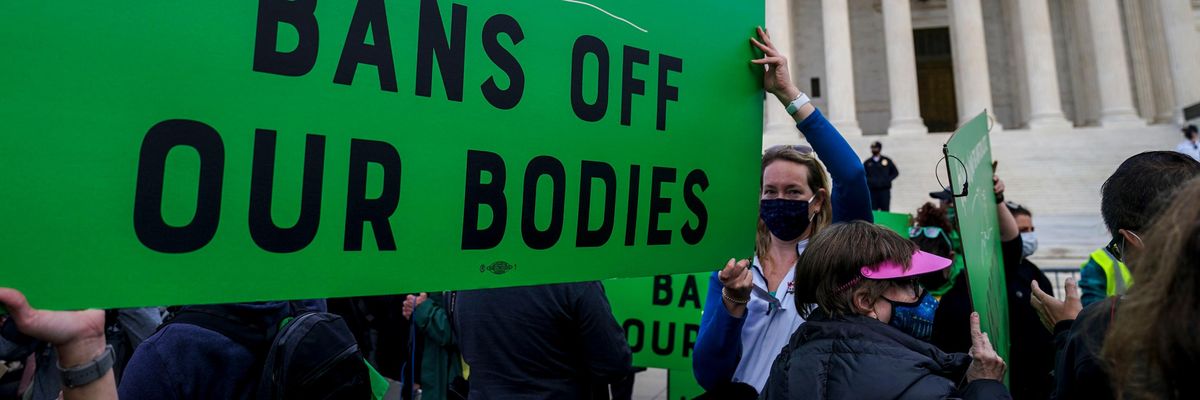
Participants hold signs during a "Hold The Line For Abortion Justice" rally at the U.S. Supreme Court on December 1, 2021 in Washington, D.C. (Photo: Leigh Vogel/Getty Images for Women's March Inc)
From SCOTUS to Shireen: Same Extremism, Same Threat
We're facing one thing: a struggle over power, and it's not over yet.
I don't know about you but so many things seem to be happening all at once in our world right now that it feels impossible, emotionally and intellectually, to keep up.
"What's happening in Palestine is about power and control. What's happening in the Supreme Court is about power and control."
As thousands marched this Saturday, in opposition to the Supreme Court's threatened overturn of Roe vs. Wade, the news broke that another young, armed, white man had shot up a grocery store in Buffalo, New York, killing 10 and injuring 13, almost all of them African American. The weekend also marked the 74th anniversary of the expulsion of Palestinians from the newly formed state of Israel, an anniversary that took place, this year, amid anger over the killing of Al Jazeera journalist, Shireen Abu Akleh whose last report before being killed by Israeli forces was on one of the more than 500 villages from which Palestinians were expelled in 1948.
A Supreme Court assault on reproductive equity, another racist slaughter, and more Palestinian death. It's a lot.
At the #BansOffOurBodies march in Brooklyn, I asked Palestinian American Linda Sarsour, co-chair of the Women's March, how she was thinking about it all. She's just returned from a freedom journey to Ghana, a major transhipment point for the US Atlantic slave trade. The news from Buffalo hadn't reached us yet. Here's Linda:
"Even when you think about the context of Palestinian people, control over their travel, control on whether they have access to education, control over basic things like electricity and water, control on whether I from one village can visit my sister in another village. There's constant policing of who we are, and obstacles to being able to fully thrive. That was what enslavement was about. It was about someone saying, I own you. I dictate to you, I will control who your family is. I will control where you go and what you do. And the fight in America is also about power and control; controlling who gets to decide if America is their sanctuary, which immigrants come and which can't come, what healthcare I have, and when do I have it? Even the idea that our healthcare is tied to our employment, so I must be employed in order to have healthcare in America. So many levels . . .
"This is a struggle of power. Who has power and control over my body? Enslavement was about power. What's happening in Palestine is about power and control. What's happening in the Supreme Court is about power and control. So I always say to people, this is not about any individual issue. The question that we have to ask ourselves is who and when do we allow others to have power over our private decisions that we make in our life? So this fight for me as a Muslim American is not necessarily about abortion. It's about whether the government gets to tell me what to do with my body . . . "
We're not facing so many things, in other words. It doesn't make it smaller. It does make it easier to grasp. We're facing one thing: a struggle over power, and it's not over yet.
An Urgent Message From Our Co-Founder
Dear Common Dreams reader, It’s been nearly 30 years since I co-founded Common Dreams with my late wife, Lina Newhouser. We had the radical notion that journalism should serve the public good, not corporate profits. It was clear to us from the outset what it would take to build such a project. No paid advertisements. No corporate sponsors. No millionaire publisher telling us what to think or do. Many people said we wouldn't last a year, but we proved those doubters wrong. Together with a tremendous team of journalists and dedicated staff, we built an independent media outlet free from the constraints of profits and corporate control. Our mission has always been simple: To inform. To inspire. To ignite change for the common good. Building Common Dreams was not easy. Our survival was never guaranteed. When you take on the most powerful forces—Wall Street greed, fossil fuel industry destruction, Big Tech lobbyists, and uber-rich oligarchs who have spent billions upon billions rigging the economy and democracy in their favor—the only bulwark you have is supporters who believe in your work. But here’s the urgent message from me today. It's never been this bad out there. And it's never been this hard to keep us going. At the very moment Common Dreams is most needed, the threats we face are intensifying. We need your support now more than ever. We don't accept corporate advertising and never will. We don't have a paywall because we don't think people should be blocked from critical news based on their ability to pay. Everything we do is funded by the donations of readers like you. When everyone does the little they can afford, we are strong. But if that support retreats or dries up, so do we. Will you donate now to make sure Common Dreams not only survives but thrives? —Craig Brown, Co-founder |
I don't know about you but so many things seem to be happening all at once in our world right now that it feels impossible, emotionally and intellectually, to keep up.
"What's happening in Palestine is about power and control. What's happening in the Supreme Court is about power and control."
As thousands marched this Saturday, in opposition to the Supreme Court's threatened overturn of Roe vs. Wade, the news broke that another young, armed, white man had shot up a grocery store in Buffalo, New York, killing 10 and injuring 13, almost all of them African American. The weekend also marked the 74th anniversary of the expulsion of Palestinians from the newly formed state of Israel, an anniversary that took place, this year, amid anger over the killing of Al Jazeera journalist, Shireen Abu Akleh whose last report before being killed by Israeli forces was on one of the more than 500 villages from which Palestinians were expelled in 1948.
A Supreme Court assault on reproductive equity, another racist slaughter, and more Palestinian death. It's a lot.
At the #BansOffOurBodies march in Brooklyn, I asked Palestinian American Linda Sarsour, co-chair of the Women's March, how she was thinking about it all. She's just returned from a freedom journey to Ghana, a major transhipment point for the US Atlantic slave trade. The news from Buffalo hadn't reached us yet. Here's Linda:
"Even when you think about the context of Palestinian people, control over their travel, control on whether they have access to education, control over basic things like electricity and water, control on whether I from one village can visit my sister in another village. There's constant policing of who we are, and obstacles to being able to fully thrive. That was what enslavement was about. It was about someone saying, I own you. I dictate to you, I will control who your family is. I will control where you go and what you do. And the fight in America is also about power and control; controlling who gets to decide if America is their sanctuary, which immigrants come and which can't come, what healthcare I have, and when do I have it? Even the idea that our healthcare is tied to our employment, so I must be employed in order to have healthcare in America. So many levels . . .
"This is a struggle of power. Who has power and control over my body? Enslavement was about power. What's happening in Palestine is about power and control. What's happening in the Supreme Court is about power and control. So I always say to people, this is not about any individual issue. The question that we have to ask ourselves is who and when do we allow others to have power over our private decisions that we make in our life? So this fight for me as a Muslim American is not necessarily about abortion. It's about whether the government gets to tell me what to do with my body . . . "
We're not facing so many things, in other words. It doesn't make it smaller. It does make it easier to grasp. We're facing one thing: a struggle over power, and it's not over yet.
I don't know about you but so many things seem to be happening all at once in our world right now that it feels impossible, emotionally and intellectually, to keep up.
"What's happening in Palestine is about power and control. What's happening in the Supreme Court is about power and control."
As thousands marched this Saturday, in opposition to the Supreme Court's threatened overturn of Roe vs. Wade, the news broke that another young, armed, white man had shot up a grocery store in Buffalo, New York, killing 10 and injuring 13, almost all of them African American. The weekend also marked the 74th anniversary of the expulsion of Palestinians from the newly formed state of Israel, an anniversary that took place, this year, amid anger over the killing of Al Jazeera journalist, Shireen Abu Akleh whose last report before being killed by Israeli forces was on one of the more than 500 villages from which Palestinians were expelled in 1948.
A Supreme Court assault on reproductive equity, another racist slaughter, and more Palestinian death. It's a lot.
At the #BansOffOurBodies march in Brooklyn, I asked Palestinian American Linda Sarsour, co-chair of the Women's March, how she was thinking about it all. She's just returned from a freedom journey to Ghana, a major transhipment point for the US Atlantic slave trade. The news from Buffalo hadn't reached us yet. Here's Linda:
"Even when you think about the context of Palestinian people, control over their travel, control on whether they have access to education, control over basic things like electricity and water, control on whether I from one village can visit my sister in another village. There's constant policing of who we are, and obstacles to being able to fully thrive. That was what enslavement was about. It was about someone saying, I own you. I dictate to you, I will control who your family is. I will control where you go and what you do. And the fight in America is also about power and control; controlling who gets to decide if America is their sanctuary, which immigrants come and which can't come, what healthcare I have, and when do I have it? Even the idea that our healthcare is tied to our employment, so I must be employed in order to have healthcare in America. So many levels . . .
"This is a struggle of power. Who has power and control over my body? Enslavement was about power. What's happening in Palestine is about power and control. What's happening in the Supreme Court is about power and control. So I always say to people, this is not about any individual issue. The question that we have to ask ourselves is who and when do we allow others to have power over our private decisions that we make in our life? So this fight for me as a Muslim American is not necessarily about abortion. It's about whether the government gets to tell me what to do with my body . . . "
We're not facing so many things, in other words. It doesn't make it smaller. It does make it easier to grasp. We're facing one thing: a struggle over power, and it's not over yet.