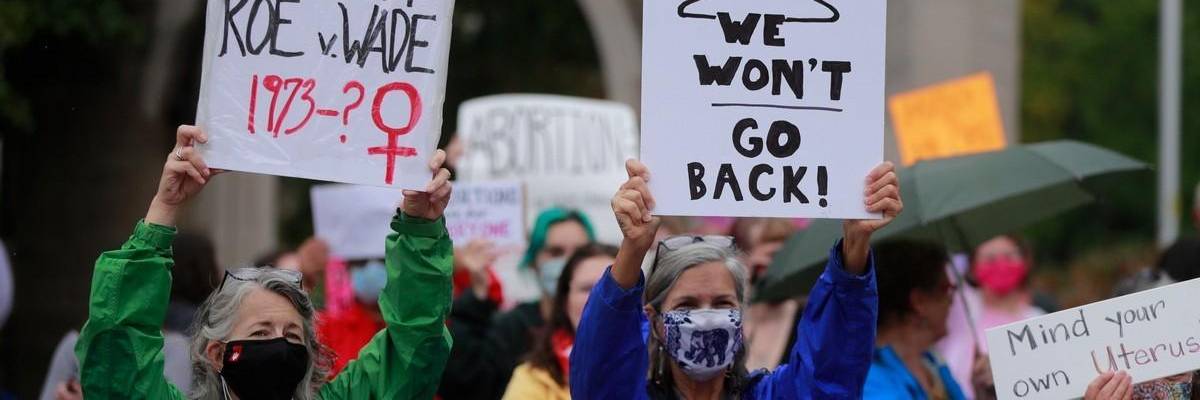
Demonstrators opposed to Texas' new abortion ban rally in Bloomington, Indiana on October 2, 2021 as part of a wave of national protests. (Photo: Jeremy Hogan/SOPA Images/LightRocket via Getty Images)
Right-Wing Court's Attack on Abortion Rights Is Call for Mass Revolt
The justices making up the majority are clearly partisans representing a zealous minority. The people must respond with mass action, litigation, legislation, and voter registration.
Supreme Court Justice Samuel Alito's draft decision to overturn Roe v. Wade asserts that women have no constitutional right over their own bodies that man or law must respect.
This arbitrary opinion in the case of Dobbs v. Jackson Women's Health Organization, part of the brazen effort of reactionary judges to roll back decades of progress toward a more perfect union, scorns the will of the vast majority of Americans.
That the Supreme Court now convenes huddled behind concrete bunkers and unscalable metal fences is testament to the fury that this judicial wilding has already sparked.
The parallels to the Court's Dred Scott decision in 1857 are chilling. In Dred Scott, a politicized court, in an opinion written by Chief Justice Roger Taney, ruled that African Americans were not citizens under the Constitution and therefore had no rights that a white man need respect, or that the federal government could protect. The decision contributed directly to the political divisions that culminated in the Civil War.
As with Alito's draft, the Dred Scott decision was leaked ahead of time. As with Alito's opinion, it was preceded by a disingenuous campaign to urge citizens to respect the decisions of the court as grounded in law, not politics.
In Dred Scott, Taney relied on a rigid standard of interpretation that ignored precedent and opinion. He argued that Black people could not be American citizens because at the time of the founding they were considered "beings of an inferior order ... and so far inferior, that they had no rights which the white man was bound to respect, and that the negro might justly and lawfully be reduced to slavery for his benefit."
In Dobbs, Alito similarly adopts a rigid standard, arguing that the Constitution contains no words about abortion and that abortion was widely outlawed at the time of the founding. Of course, at the founding, women were not citizens, didn't have the right to vote, and were treated largely as property of their husbands.
The Dred Scott decision left the question of slavery not to the national majority, which sought to outlaw it in western lands, but to state legislatures that reserved voting to white men. Alito's decision reverses a settled national precedent, supported by the majority, and leaves the question to state legislatures, most of which remain dominated by white men.
In Dred Scott, Taney reviewed the laws of the original American states, distorting and ignoring actual history to make his case. Alito reviews the laws of the states, and distorts and ignores history to bolster his opinion.
Taney believed that the decision would help temper the growing controversy over slavery that was dividing the nation. Alito suggests that overturning Roe will help reduce political divisions. Both were disastrously deluded.
Perhaps the greatest difference between Taney's opinion in Dred Scott and Alito's opinion in Dobbs is that Alito's opinion is even more lawless and more brazen. He is overturning a precedent of 50 years that at least three judges in the majority agreed was "settled law" when they testified under oath in their confirmation hearings.
Moreover, the justices making up the majority are clearly partisans representing a zealous minority. Three were nominated by Donald Trump, who lost the popular vote in 2016 and 2020, and tried to overturn the 2020 result. Two were nominated by George W. Bush, who also lost the popular vote in his first term.
The Taney decision was directed at slavery. Alito's decision not only rolls back women's right to control their bodies, it also calls into question the right to privacy, and the precedents that have protected the right to marry whomever you choose, to use contraception, to have privacy in your home, to not be discriminated against on the basis of sexual preference and more.
After the Dred Scott decision, the great Black abolitionist Frederick Douglass denounced Taney's reasoning as contrary to both the Constitution and the vision of the founders. He argued the decision would not stand: "I have no fear that the National Conscience will be put to sleep by such an open, glaring and scandalous tissue of lies."
Similarly, Alito's opinion, assuming it becomes the decision of the court, will spark fierce political battles. But it, too, will not stand, but be remembered only as a mark of ignominy.
We are not calling people to quietness, which is the absence of noise. Peace is the presence of justice. We must have mass action, litigation, legislation and registration. It's not too late.
We are at a crossroads
This country and this world are at a monumental crossroads. In a few short weeks, US voters will have an opportunity to beat back the forces of fascism and confront the billionaires who are rigging the economy, our media system, and our democracy, making it increasingly impossible for ordinary people to get by. We’re not just talking about the election. We’re talking about what must be done once these fascist elements are vanquished from power. We need a bolder set of solutions than what either major party has so far been willing to offer and a working-class movement ready to fight like hell for it. Trump didn't emerge from nowhere. The conditions that fueled MAGA authoritarianism were created by decades of radical neoliberal economic policies and a corrupt political system dominated by corporate interests. They slashed taxes on the super-rich, promising that the benefits would trickle down. They said giveaways to the corporate titans would make life more affordable for the rest of us. It was all bullshit. And when a bitter, betrayed populace searches for someone to blame, right-wing demagogues have little trouble finding scapegoats. People know when they're being lied to, but you won't hear any of this from the corporate media. Only independent journalism—powered and funded by people who believe in building a better world—can deliver truly trustworthy daily news. Our Fall Campaign is underway, and we need your help. To power our newsroom through the rest of the year, we need to raise $125,000 by midnight on October 31. So if you share our vision, please contribute whatever you can to sustain our work. |
Supreme Court Justice Samuel Alito's draft decision to overturn Roe v. Wade asserts that women have no constitutional right over their own bodies that man or law must respect.
This arbitrary opinion in the case of Dobbs v. Jackson Women's Health Organization, part of the brazen effort of reactionary judges to roll back decades of progress toward a more perfect union, scorns the will of the vast majority of Americans.
That the Supreme Court now convenes huddled behind concrete bunkers and unscalable metal fences is testament to the fury that this judicial wilding has already sparked.
The parallels to the Court's Dred Scott decision in 1857 are chilling. In Dred Scott, a politicized court, in an opinion written by Chief Justice Roger Taney, ruled that African Americans were not citizens under the Constitution and therefore had no rights that a white man need respect, or that the federal government could protect. The decision contributed directly to the political divisions that culminated in the Civil War.
As with Alito's draft, the Dred Scott decision was leaked ahead of time. As with Alito's opinion, it was preceded by a disingenuous campaign to urge citizens to respect the decisions of the court as grounded in law, not politics.
In Dred Scott, Taney relied on a rigid standard of interpretation that ignored precedent and opinion. He argued that Black people could not be American citizens because at the time of the founding they were considered "beings of an inferior order ... and so far inferior, that they had no rights which the white man was bound to respect, and that the negro might justly and lawfully be reduced to slavery for his benefit."
In Dobbs, Alito similarly adopts a rigid standard, arguing that the Constitution contains no words about abortion and that abortion was widely outlawed at the time of the founding. Of course, at the founding, women were not citizens, didn't have the right to vote, and were treated largely as property of their husbands.
The Dred Scott decision left the question of slavery not to the national majority, which sought to outlaw it in western lands, but to state legislatures that reserved voting to white men. Alito's decision reverses a settled national precedent, supported by the majority, and leaves the question to state legislatures, most of which remain dominated by white men.
In Dred Scott, Taney reviewed the laws of the original American states, distorting and ignoring actual history to make his case. Alito reviews the laws of the states, and distorts and ignores history to bolster his opinion.
Taney believed that the decision would help temper the growing controversy over slavery that was dividing the nation. Alito suggests that overturning Roe will help reduce political divisions. Both were disastrously deluded.
Perhaps the greatest difference between Taney's opinion in Dred Scott and Alito's opinion in Dobbs is that Alito's opinion is even more lawless and more brazen. He is overturning a precedent of 50 years that at least three judges in the majority agreed was "settled law" when they testified under oath in their confirmation hearings.
Moreover, the justices making up the majority are clearly partisans representing a zealous minority. Three were nominated by Donald Trump, who lost the popular vote in 2016 and 2020, and tried to overturn the 2020 result. Two were nominated by George W. Bush, who also lost the popular vote in his first term.
The Taney decision was directed at slavery. Alito's decision not only rolls back women's right to control their bodies, it also calls into question the right to privacy, and the precedents that have protected the right to marry whomever you choose, to use contraception, to have privacy in your home, to not be discriminated against on the basis of sexual preference and more.
After the Dred Scott decision, the great Black abolitionist Frederick Douglass denounced Taney's reasoning as contrary to both the Constitution and the vision of the founders. He argued the decision would not stand: "I have no fear that the National Conscience will be put to sleep by such an open, glaring and scandalous tissue of lies."
Similarly, Alito's opinion, assuming it becomes the decision of the court, will spark fierce political battles. But it, too, will not stand, but be remembered only as a mark of ignominy.
We are not calling people to quietness, which is the absence of noise. Peace is the presence of justice. We must have mass action, litigation, legislation and registration. It's not too late.
Supreme Court Justice Samuel Alito's draft decision to overturn Roe v. Wade asserts that women have no constitutional right over their own bodies that man or law must respect.
This arbitrary opinion in the case of Dobbs v. Jackson Women's Health Organization, part of the brazen effort of reactionary judges to roll back decades of progress toward a more perfect union, scorns the will of the vast majority of Americans.
That the Supreme Court now convenes huddled behind concrete bunkers and unscalable metal fences is testament to the fury that this judicial wilding has already sparked.
The parallels to the Court's Dred Scott decision in 1857 are chilling. In Dred Scott, a politicized court, in an opinion written by Chief Justice Roger Taney, ruled that African Americans were not citizens under the Constitution and therefore had no rights that a white man need respect, or that the federal government could protect. The decision contributed directly to the political divisions that culminated in the Civil War.
As with Alito's draft, the Dred Scott decision was leaked ahead of time. As with Alito's opinion, it was preceded by a disingenuous campaign to urge citizens to respect the decisions of the court as grounded in law, not politics.
In Dred Scott, Taney relied on a rigid standard of interpretation that ignored precedent and opinion. He argued that Black people could not be American citizens because at the time of the founding they were considered "beings of an inferior order ... and so far inferior, that they had no rights which the white man was bound to respect, and that the negro might justly and lawfully be reduced to slavery for his benefit."
In Dobbs, Alito similarly adopts a rigid standard, arguing that the Constitution contains no words about abortion and that abortion was widely outlawed at the time of the founding. Of course, at the founding, women were not citizens, didn't have the right to vote, and were treated largely as property of their husbands.
The Dred Scott decision left the question of slavery not to the national majority, which sought to outlaw it in western lands, but to state legislatures that reserved voting to white men. Alito's decision reverses a settled national precedent, supported by the majority, and leaves the question to state legislatures, most of which remain dominated by white men.
In Dred Scott, Taney reviewed the laws of the original American states, distorting and ignoring actual history to make his case. Alito reviews the laws of the states, and distorts and ignores history to bolster his opinion.
Taney believed that the decision would help temper the growing controversy over slavery that was dividing the nation. Alito suggests that overturning Roe will help reduce political divisions. Both were disastrously deluded.
Perhaps the greatest difference between Taney's opinion in Dred Scott and Alito's opinion in Dobbs is that Alito's opinion is even more lawless and more brazen. He is overturning a precedent of 50 years that at least three judges in the majority agreed was "settled law" when they testified under oath in their confirmation hearings.
Moreover, the justices making up the majority are clearly partisans representing a zealous minority. Three were nominated by Donald Trump, who lost the popular vote in 2016 and 2020, and tried to overturn the 2020 result. Two were nominated by George W. Bush, who also lost the popular vote in his first term.
The Taney decision was directed at slavery. Alito's decision not only rolls back women's right to control their bodies, it also calls into question the right to privacy, and the precedents that have protected the right to marry whomever you choose, to use contraception, to have privacy in your home, to not be discriminated against on the basis of sexual preference and more.
After the Dred Scott decision, the great Black abolitionist Frederick Douglass denounced Taney's reasoning as contrary to both the Constitution and the vision of the founders. He argued the decision would not stand: "I have no fear that the National Conscience will be put to sleep by such an open, glaring and scandalous tissue of lies."
Similarly, Alito's opinion, assuming it becomes the decision of the court, will spark fierce political battles. But it, too, will not stand, but be remembered only as a mark of ignominy.
We are not calling people to quietness, which is the absence of noise. Peace is the presence of justice. We must have mass action, litigation, legislation and registration. It's not too late.