SUBSCRIBE TO OUR FREE NEWSLETTER
Daily news & progressive opinion—funded by the people, not the corporations—delivered straight to your inbox.
5
#000000
#FFFFFF
To donate by check, phone, or other method, see our More Ways to Give page.
Daily news & progressive opinion—funded by the people, not the corporations—delivered straight to your inbox.
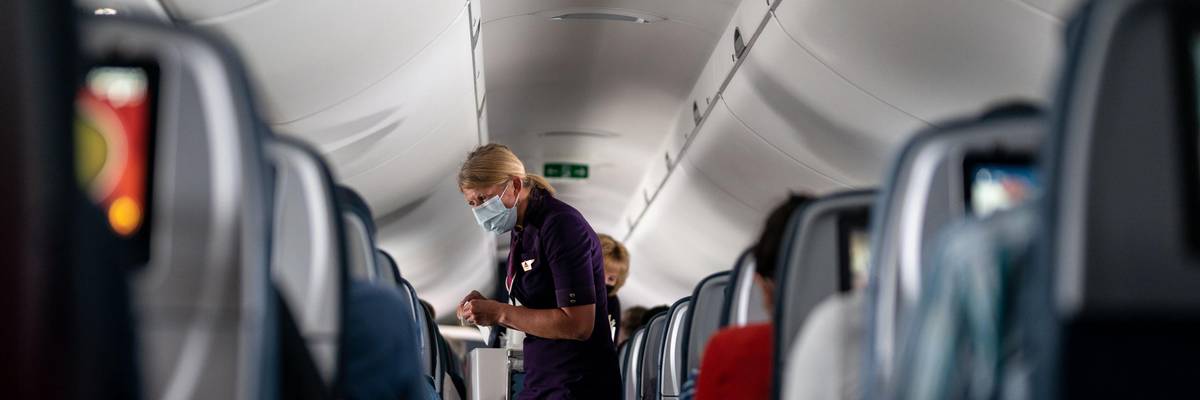
Flight attendants hand out refreshments to a packed Delta Airlines flight traveling from Ronald Regan National Airport to Minneapolis-Saint Paul International Airport on Friday, May 21, 2021. (Photo: Kent Nishimura/Los Angeles Times via Getty Images)
The federal transportation face mask mandate is over. A federal judge in Florida struck it down last week, citing an overreach of statutory authority by the Centers for Disease Control and Prevention (CDC) and a violation of administrative law. All the major airlines quickly responded by dropping the mandate on their flights, leaving passengers to fend for themselves on whether to wear a face mask when traveling by air. While the ruling is being appealed by the Department of Justice, the White House encourages people to continue to wear face masks when traveling. The ruling also ended the face mask mandate on trains (like Amtrak) and public transportation, impacting millions of people each day.
What is needed on airplanes, and in society, are standards that reduce risk and keep everyone safe and secure. Face masks are part of this risk-reduction calculus.
Most major airports have also stopped enforcing the face mask mandate. Exceptions initially reported so far include New York JFK and LaGuardia, and Washington Dulles.
Given the controversy around face mask mandate, do face masks offer benefits on airplanes during flights?
Answering this question requires additional discussion.
First, face masks do not stop virus transmission; they reduce the risk of virus transmission.
Second, the type of face mask makes a difference. N95 face masks, approved by National Institute for Occupational Safety and Health (NIOSH), are most effective, while thin cloth face masks are most porous and least effective. Surgical masks are in between.
Third, how well a face mask fits and how it is worn is critical. If a face mask does not completely cover the nose and mouth, this neutralizes any of its risk-reduction benefits.
Given the variety of face masks used by passengers on airplanes, and how they wore them, the full benefit of the federal face mask mandate was never fully realized by all travelers. Those who correctly wore NIOSH-approved N95 face masks where most protected, while those who were less adherent were exposed to higher risk of transmission and infection.
Air cabins offer one of the safest environments when it comes to COVID-19 transmission risk. This means that those less adherent to the face mask mandate were at reduced risk during flight. High-efficiency particulate air (HEPA) filters, coupled with air circulating in the cabin every two to three minutes means that while in flight, virus transmission risk is low.
However, when the airplane engines are turned off, such as during boarding, deplaning and deicing, transmission risk rises. This is when face masks provide the greatest risk-reduction benefits.
Jet bridges also provide poor air ventilation, as do crowded airport concourses. These locations represent some of the riskiest places for virus transmission, making face masks a valuable risk reduction tool during such times and in such areas.
Trains and public transportation also offer more variable air circulation and ventilation compared to airplane cabins while in flight. This makes them ideal places to continue to wear a face mask, especially for those who prefer to not get infected or reinfected.
The most disturbing aspect of the court ruling is that a legal decision was made that ignores public health implications. Instead of striking down the mandate, is there a viable legal path forward that permits face masks to be required during the riskiest times on some transportation systems?
Sadly, given the benefits of face masks to reduce the risk of virus transmission, a face mask mandate should never have been necessary. Is it too much to ask for people to act in a manner that protects everyone around them, even if they feel inconvenienced?
There are numerous requirements enforced on airplanes, all designed to keep passengers safe. These include wearing seat belts, stowing carry-on items, and remaining seated, all required during take-off and landing. If a person violates any such requirements, they may be subject to penalties by the
Federal Aviation Administration (FAA).
Prevention is a critical component of good health. Unfortunately, prevention is often most difficult to sell to people, even when it offers the most enduring benefits. This is because prevention carries with it little or no short-term benefits, often with short-term inconveniences. Yet, prevention avoids future problems.
So, are face masks needed on airplanes? What is needed on airplanes, and in society, are standards that reduce risk and keep everyone safe and secure. Face masks are part of this risk-reduction calculus.
In an ideal world, people will recognize their role in this calculus, and make the right decision. In the real world, people celebrate when they are given the freedom to act as they wish, even when it is not in their best interest.
Dear Common Dreams reader, It’s been nearly 30 years since I co-founded Common Dreams with my late wife, Lina Newhouser. We had the radical notion that journalism should serve the public good, not corporate profits. It was clear to us from the outset what it would take to build such a project. No paid advertisements. No corporate sponsors. No millionaire publisher telling us what to think or do. Many people said we wouldn't last a year, but we proved those doubters wrong. Together with a tremendous team of journalists and dedicated staff, we built an independent media outlet free from the constraints of profits and corporate control. Our mission has always been simple: To inform. To inspire. To ignite change for the common good. Building Common Dreams was not easy. Our survival was never guaranteed. When you take on the most powerful forces—Wall Street greed, fossil fuel industry destruction, Big Tech lobbyists, and uber-rich oligarchs who have spent billions upon billions rigging the economy and democracy in their favor—the only bulwark you have is supporters who believe in your work. But here’s the urgent message from me today. It's never been this bad out there. And it's never been this hard to keep us going. At the very moment Common Dreams is most needed, the threats we face are intensifying. We need your support now more than ever. We don't accept corporate advertising and never will. We don't have a paywall because we don't think people should be blocked from critical news based on their ability to pay. Everything we do is funded by the donations of readers like you. When everyone does the little they can afford, we are strong. But if that support retreats or dries up, so do we. Will you donate now to make sure Common Dreams not only survives but thrives? —Craig Brown, Co-founder |
The federal transportation face mask mandate is over. A federal judge in Florida struck it down last week, citing an overreach of statutory authority by the Centers for Disease Control and Prevention (CDC) and a violation of administrative law. All the major airlines quickly responded by dropping the mandate on their flights, leaving passengers to fend for themselves on whether to wear a face mask when traveling by air. While the ruling is being appealed by the Department of Justice, the White House encourages people to continue to wear face masks when traveling. The ruling also ended the face mask mandate on trains (like Amtrak) and public transportation, impacting millions of people each day.
What is needed on airplanes, and in society, are standards that reduce risk and keep everyone safe and secure. Face masks are part of this risk-reduction calculus.
Most major airports have also stopped enforcing the face mask mandate. Exceptions initially reported so far include New York JFK and LaGuardia, and Washington Dulles.
Given the controversy around face mask mandate, do face masks offer benefits on airplanes during flights?
Answering this question requires additional discussion.
First, face masks do not stop virus transmission; they reduce the risk of virus transmission.
Second, the type of face mask makes a difference. N95 face masks, approved by National Institute for Occupational Safety and Health (NIOSH), are most effective, while thin cloth face masks are most porous and least effective. Surgical masks are in between.
Third, how well a face mask fits and how it is worn is critical. If a face mask does not completely cover the nose and mouth, this neutralizes any of its risk-reduction benefits.
Given the variety of face masks used by passengers on airplanes, and how they wore them, the full benefit of the federal face mask mandate was never fully realized by all travelers. Those who correctly wore NIOSH-approved N95 face masks where most protected, while those who were less adherent were exposed to higher risk of transmission and infection.
Air cabins offer one of the safest environments when it comes to COVID-19 transmission risk. This means that those less adherent to the face mask mandate were at reduced risk during flight. High-efficiency particulate air (HEPA) filters, coupled with air circulating in the cabin every two to three minutes means that while in flight, virus transmission risk is low.
However, when the airplane engines are turned off, such as during boarding, deplaning and deicing, transmission risk rises. This is when face masks provide the greatest risk-reduction benefits.
Jet bridges also provide poor air ventilation, as do crowded airport concourses. These locations represent some of the riskiest places for virus transmission, making face masks a valuable risk reduction tool during such times and in such areas.
Trains and public transportation also offer more variable air circulation and ventilation compared to airplane cabins while in flight. This makes them ideal places to continue to wear a face mask, especially for those who prefer to not get infected or reinfected.
The most disturbing aspect of the court ruling is that a legal decision was made that ignores public health implications. Instead of striking down the mandate, is there a viable legal path forward that permits face masks to be required during the riskiest times on some transportation systems?
Sadly, given the benefits of face masks to reduce the risk of virus transmission, a face mask mandate should never have been necessary. Is it too much to ask for people to act in a manner that protects everyone around them, even if they feel inconvenienced?
There are numerous requirements enforced on airplanes, all designed to keep passengers safe. These include wearing seat belts, stowing carry-on items, and remaining seated, all required during take-off and landing. If a person violates any such requirements, they may be subject to penalties by the
Federal Aviation Administration (FAA).
Prevention is a critical component of good health. Unfortunately, prevention is often most difficult to sell to people, even when it offers the most enduring benefits. This is because prevention carries with it little or no short-term benefits, often with short-term inconveniences. Yet, prevention avoids future problems.
So, are face masks needed on airplanes? What is needed on airplanes, and in society, are standards that reduce risk and keep everyone safe and secure. Face masks are part of this risk-reduction calculus.
In an ideal world, people will recognize their role in this calculus, and make the right decision. In the real world, people celebrate when they are given the freedom to act as they wish, even when it is not in their best interest.
The federal transportation face mask mandate is over. A federal judge in Florida struck it down last week, citing an overreach of statutory authority by the Centers for Disease Control and Prevention (CDC) and a violation of administrative law. All the major airlines quickly responded by dropping the mandate on their flights, leaving passengers to fend for themselves on whether to wear a face mask when traveling by air. While the ruling is being appealed by the Department of Justice, the White House encourages people to continue to wear face masks when traveling. The ruling also ended the face mask mandate on trains (like Amtrak) and public transportation, impacting millions of people each day.
What is needed on airplanes, and in society, are standards that reduce risk and keep everyone safe and secure. Face masks are part of this risk-reduction calculus.
Most major airports have also stopped enforcing the face mask mandate. Exceptions initially reported so far include New York JFK and LaGuardia, and Washington Dulles.
Given the controversy around face mask mandate, do face masks offer benefits on airplanes during flights?
Answering this question requires additional discussion.
First, face masks do not stop virus transmission; they reduce the risk of virus transmission.
Second, the type of face mask makes a difference. N95 face masks, approved by National Institute for Occupational Safety and Health (NIOSH), are most effective, while thin cloth face masks are most porous and least effective. Surgical masks are in between.
Third, how well a face mask fits and how it is worn is critical. If a face mask does not completely cover the nose and mouth, this neutralizes any of its risk-reduction benefits.
Given the variety of face masks used by passengers on airplanes, and how they wore them, the full benefit of the federal face mask mandate was never fully realized by all travelers. Those who correctly wore NIOSH-approved N95 face masks where most protected, while those who were less adherent were exposed to higher risk of transmission and infection.
Air cabins offer one of the safest environments when it comes to COVID-19 transmission risk. This means that those less adherent to the face mask mandate were at reduced risk during flight. High-efficiency particulate air (HEPA) filters, coupled with air circulating in the cabin every two to three minutes means that while in flight, virus transmission risk is low.
However, when the airplane engines are turned off, such as during boarding, deplaning and deicing, transmission risk rises. This is when face masks provide the greatest risk-reduction benefits.
Jet bridges also provide poor air ventilation, as do crowded airport concourses. These locations represent some of the riskiest places for virus transmission, making face masks a valuable risk reduction tool during such times and in such areas.
Trains and public transportation also offer more variable air circulation and ventilation compared to airplane cabins while in flight. This makes them ideal places to continue to wear a face mask, especially for those who prefer to not get infected or reinfected.
The most disturbing aspect of the court ruling is that a legal decision was made that ignores public health implications. Instead of striking down the mandate, is there a viable legal path forward that permits face masks to be required during the riskiest times on some transportation systems?
Sadly, given the benefits of face masks to reduce the risk of virus transmission, a face mask mandate should never have been necessary. Is it too much to ask for people to act in a manner that protects everyone around them, even if they feel inconvenienced?
There are numerous requirements enforced on airplanes, all designed to keep passengers safe. These include wearing seat belts, stowing carry-on items, and remaining seated, all required during take-off and landing. If a person violates any such requirements, they may be subject to penalties by the
Federal Aviation Administration (FAA).
Prevention is a critical component of good health. Unfortunately, prevention is often most difficult to sell to people, even when it offers the most enduring benefits. This is because prevention carries with it little or no short-term benefits, often with short-term inconveniences. Yet, prevention avoids future problems.
So, are face masks needed on airplanes? What is needed on airplanes, and in society, are standards that reduce risk and keep everyone safe and secure. Face masks are part of this risk-reduction calculus.
In an ideal world, people will recognize their role in this calculus, and make the right decision. In the real world, people celebrate when they are given the freedom to act as they wish, even when it is not in their best interest.