SUBSCRIBE TO OUR FREE NEWSLETTER
Daily news & progressive opinion—funded by the people, not the corporations—delivered straight to your inbox.
5
#000000
#FFFFFF
To donate by check, phone, or other method, see our More Ways to Give page.
Daily news & progressive opinion—funded by the people, not the corporations—delivered straight to your inbox.
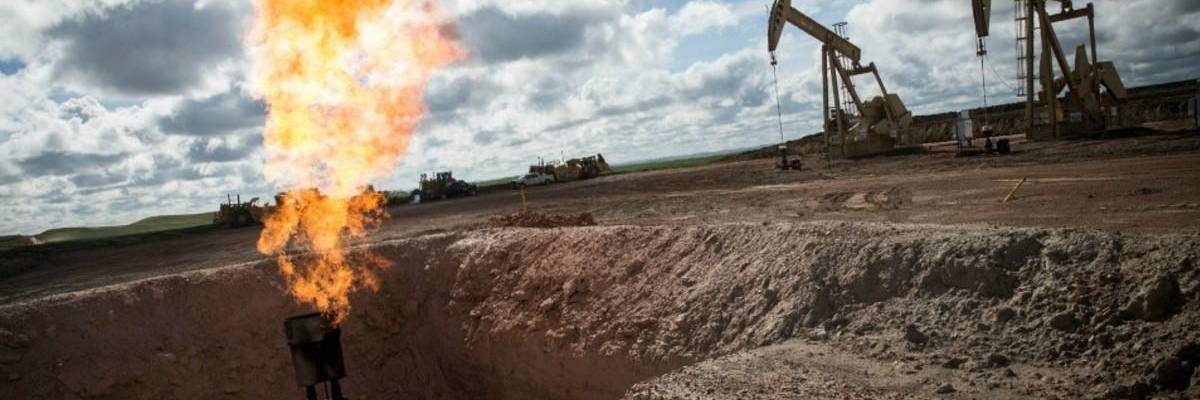
A gas flare is seen at an oil well site on outside Williston, North Dakota. (Photo: Andrew Burton/Getty Images)
The latest report from the Intergovernmental Panel on Climate Change should terrify policymakers and ordinary people around the world. The IPCC warns that some disastrous climate outcomes are now likely to occur not in the distant future, but within the next 15 years, or even the next decade.
But instead of waking up to the threat and responding quickly, policymakers remain focused on Russia's horrific war against Ukraine and its immediate consequences. While this may be understandable, the Ukraine crisis has also exposed the excessively short-term policy orientation of Western governments. Many have quickly reneged on even the relatively meager and obviously inadequate climate pledges they made only a few months ago at the United Nations Climate Change Conference in Glasgow.
"The world is rapidly running out of time to limit global warming to 1.5deg Celsius and avert a climate catastrophe."
The invasion of Ukraine and the subsequent Western-led sanctions against Russia triggered a dramatic increase in fuel prices, when the energy market was already heating up because of the economic recovery in the United States and Europe. Yet, instead of seeing this price spike as an opportunity to hasten the shift away from fossil fuels, governments in advanced economies have tried to reduce the pain by keeping domestic energy prices low, for short-term political reasons.
US President Joe Biden's administration, after unsuccessfully imploring Saudi Arabia to increase oil production, has promised to release one million barrels a day from the US government's strategic reserves for the next six months. In Europe, which has been hit much harder by the fallout from the war because of its heavy reliance on Russian natural gas, the talk is not just of more nuclear energy but also of reviving coal-based power. Coal is by far the "dirtiest" fossil fuel, and rich countries routinely pillory India and China for using it.
Only those who previously swallowed Western governments' insincere green rhetoric, rather than examining the reality, should be surprised by this turn of events. These governments have been heavily subsidizing their own fossil-fuel industries even as they exhorted much poorer countries to do more to reduce greenhouse-gas emissions. But the full extent of these subsidies has been hidden by the methods used to measure them.
The standard way to measure government support for fossil-fuel production or consumption is to look at direct budgetary transfers and subsidies, as well as tax breaks for the sector. Using this method, the OECD and the International Energy Agency estimate that governments across 52 advanced and emerging economies--accounting for about 90% of global fossil-fuel energy supply--provided fossil-fuel subsidies worth an average of $555 billion per year from 2017 to 2019.
This support declined to $345 billion in 2020, mainly because of the collapse in fuel prices and drop in consumption during the COVID-19 pandemic. But, even before the Ukraine war, there were fears that rebounding fuel prices could push up subsidies as the global economy recovered.
Those fears were more than borne out. It turned out that the bleakest estimates massively understated the actual fossil-fuel subsidies that governments provide. In a recent study, the International Monetary Fund devised a more comprehensive measure that includes both explicit subsidies, or undercharging for supply costs, and implicit subsidies, or undercharging for environmental costs and foregone consumption taxes.
The IMF estimated that global fossil-fuel subsidies in 2020 totaled $5.9 trillion, more than ten times the OECD-IEA estimate. That is not surprising: Implicit subsidies accounted for 92% of the total.
Under both methodologies, India is a heavy subsidizer of fossil fuels--although lower-income countries can be partly excused, given the high cost of the green-energy transition. But other countries' rankings change in interesting ways when implicit subsidies are considered. Russia was the largest provider of explicit fossil-fuel subsidies, but the US--with an estimated $662 billion of implicit subsidies in 2020 and nearly $800 billion in 2021--extends significantly more subsidies overall. China provided the largest implicit subsidies in 2020, totaling an estimated $2.2 trillion.
These important numbers highlight the extent to which government intervention is skewing prices, and therefore market incentives, in favor of fossil fuels, rather than against them. While governments were supporting the fossil-fuel industry to the tune of $5.9 trillion in 2020, the IPCC estimates that global climate finance from both public and private sources totaled only about $640 billion that year.
Given this huge disparity, no one should be shocked at the fossil-fuel industry's continued resilience. The world is rapidly running out of time to limit global warming to 1.5deg Celsius and avert a climate catastrophe. But the global economic system and many governments appear unable to take the threat seriously.
Dear Common Dreams reader, It’s been nearly 30 years since I co-founded Common Dreams with my late wife, Lina Newhouser. We had the radical notion that journalism should serve the public good, not corporate profits. It was clear to us from the outset what it would take to build such a project. No paid advertisements. No corporate sponsors. No millionaire publisher telling us what to think or do. Many people said we wouldn't last a year, but we proved those doubters wrong. Together with a tremendous team of journalists and dedicated staff, we built an independent media outlet free from the constraints of profits and corporate control. Our mission has always been simple: To inform. To inspire. To ignite change for the common good. Building Common Dreams was not easy. Our survival was never guaranteed. When you take on the most powerful forces—Wall Street greed, fossil fuel industry destruction, Big Tech lobbyists, and uber-rich oligarchs who have spent billions upon billions rigging the economy and democracy in their favor—the only bulwark you have is supporters who believe in your work. But here’s the urgent message from me today. It's never been this bad out there. And it's never been this hard to keep us going. At the very moment Common Dreams is most needed, the threats we face are intensifying. We need your support now more than ever. We don't accept corporate advertising and never will. We don't have a paywall because we don't think people should be blocked from critical news based on their ability to pay. Everything we do is funded by the donations of readers like you. When everyone does the little they can afford, we are strong. But if that support retreats or dries up, so do we. Will you donate now to make sure Common Dreams not only survives but thrives? —Craig Brown, Co-founder |
The latest report from the Intergovernmental Panel on Climate Change should terrify policymakers and ordinary people around the world. The IPCC warns that some disastrous climate outcomes are now likely to occur not in the distant future, but within the next 15 years, or even the next decade.
But instead of waking up to the threat and responding quickly, policymakers remain focused on Russia's horrific war against Ukraine and its immediate consequences. While this may be understandable, the Ukraine crisis has also exposed the excessively short-term policy orientation of Western governments. Many have quickly reneged on even the relatively meager and obviously inadequate climate pledges they made only a few months ago at the United Nations Climate Change Conference in Glasgow.
"The world is rapidly running out of time to limit global warming to 1.5deg Celsius and avert a climate catastrophe."
The invasion of Ukraine and the subsequent Western-led sanctions against Russia triggered a dramatic increase in fuel prices, when the energy market was already heating up because of the economic recovery in the United States and Europe. Yet, instead of seeing this price spike as an opportunity to hasten the shift away from fossil fuels, governments in advanced economies have tried to reduce the pain by keeping domestic energy prices low, for short-term political reasons.
US President Joe Biden's administration, after unsuccessfully imploring Saudi Arabia to increase oil production, has promised to release one million barrels a day from the US government's strategic reserves for the next six months. In Europe, which has been hit much harder by the fallout from the war because of its heavy reliance on Russian natural gas, the talk is not just of more nuclear energy but also of reviving coal-based power. Coal is by far the "dirtiest" fossil fuel, and rich countries routinely pillory India and China for using it.
Only those who previously swallowed Western governments' insincere green rhetoric, rather than examining the reality, should be surprised by this turn of events. These governments have been heavily subsidizing their own fossil-fuel industries even as they exhorted much poorer countries to do more to reduce greenhouse-gas emissions. But the full extent of these subsidies has been hidden by the methods used to measure them.
The standard way to measure government support for fossil-fuel production or consumption is to look at direct budgetary transfers and subsidies, as well as tax breaks for the sector. Using this method, the OECD and the International Energy Agency estimate that governments across 52 advanced and emerging economies--accounting for about 90% of global fossil-fuel energy supply--provided fossil-fuel subsidies worth an average of $555 billion per year from 2017 to 2019.
This support declined to $345 billion in 2020, mainly because of the collapse in fuel prices and drop in consumption during the COVID-19 pandemic. But, even before the Ukraine war, there were fears that rebounding fuel prices could push up subsidies as the global economy recovered.
Those fears were more than borne out. It turned out that the bleakest estimates massively understated the actual fossil-fuel subsidies that governments provide. In a recent study, the International Monetary Fund devised a more comprehensive measure that includes both explicit subsidies, or undercharging for supply costs, and implicit subsidies, or undercharging for environmental costs and foregone consumption taxes.
The IMF estimated that global fossil-fuel subsidies in 2020 totaled $5.9 trillion, more than ten times the OECD-IEA estimate. That is not surprising: Implicit subsidies accounted for 92% of the total.
Under both methodologies, India is a heavy subsidizer of fossil fuels--although lower-income countries can be partly excused, given the high cost of the green-energy transition. But other countries' rankings change in interesting ways when implicit subsidies are considered. Russia was the largest provider of explicit fossil-fuel subsidies, but the US--with an estimated $662 billion of implicit subsidies in 2020 and nearly $800 billion in 2021--extends significantly more subsidies overall. China provided the largest implicit subsidies in 2020, totaling an estimated $2.2 trillion.
These important numbers highlight the extent to which government intervention is skewing prices, and therefore market incentives, in favor of fossil fuels, rather than against them. While governments were supporting the fossil-fuel industry to the tune of $5.9 trillion in 2020, the IPCC estimates that global climate finance from both public and private sources totaled only about $640 billion that year.
Given this huge disparity, no one should be shocked at the fossil-fuel industry's continued resilience. The world is rapidly running out of time to limit global warming to 1.5deg Celsius and avert a climate catastrophe. But the global economic system and many governments appear unable to take the threat seriously.
The latest report from the Intergovernmental Panel on Climate Change should terrify policymakers and ordinary people around the world. The IPCC warns that some disastrous climate outcomes are now likely to occur not in the distant future, but within the next 15 years, or even the next decade.
But instead of waking up to the threat and responding quickly, policymakers remain focused on Russia's horrific war against Ukraine and its immediate consequences. While this may be understandable, the Ukraine crisis has also exposed the excessively short-term policy orientation of Western governments. Many have quickly reneged on even the relatively meager and obviously inadequate climate pledges they made only a few months ago at the United Nations Climate Change Conference in Glasgow.
"The world is rapidly running out of time to limit global warming to 1.5deg Celsius and avert a climate catastrophe."
The invasion of Ukraine and the subsequent Western-led sanctions against Russia triggered a dramatic increase in fuel prices, when the energy market was already heating up because of the economic recovery in the United States and Europe. Yet, instead of seeing this price spike as an opportunity to hasten the shift away from fossil fuels, governments in advanced economies have tried to reduce the pain by keeping domestic energy prices low, for short-term political reasons.
US President Joe Biden's administration, after unsuccessfully imploring Saudi Arabia to increase oil production, has promised to release one million barrels a day from the US government's strategic reserves for the next six months. In Europe, which has been hit much harder by the fallout from the war because of its heavy reliance on Russian natural gas, the talk is not just of more nuclear energy but also of reviving coal-based power. Coal is by far the "dirtiest" fossil fuel, and rich countries routinely pillory India and China for using it.
Only those who previously swallowed Western governments' insincere green rhetoric, rather than examining the reality, should be surprised by this turn of events. These governments have been heavily subsidizing their own fossil-fuel industries even as they exhorted much poorer countries to do more to reduce greenhouse-gas emissions. But the full extent of these subsidies has been hidden by the methods used to measure them.
The standard way to measure government support for fossil-fuel production or consumption is to look at direct budgetary transfers and subsidies, as well as tax breaks for the sector. Using this method, the OECD and the International Energy Agency estimate that governments across 52 advanced and emerging economies--accounting for about 90% of global fossil-fuel energy supply--provided fossil-fuel subsidies worth an average of $555 billion per year from 2017 to 2019.
This support declined to $345 billion in 2020, mainly because of the collapse in fuel prices and drop in consumption during the COVID-19 pandemic. But, even before the Ukraine war, there were fears that rebounding fuel prices could push up subsidies as the global economy recovered.
Those fears were more than borne out. It turned out that the bleakest estimates massively understated the actual fossil-fuel subsidies that governments provide. In a recent study, the International Monetary Fund devised a more comprehensive measure that includes both explicit subsidies, or undercharging for supply costs, and implicit subsidies, or undercharging for environmental costs and foregone consumption taxes.
The IMF estimated that global fossil-fuel subsidies in 2020 totaled $5.9 trillion, more than ten times the OECD-IEA estimate. That is not surprising: Implicit subsidies accounted for 92% of the total.
Under both methodologies, India is a heavy subsidizer of fossil fuels--although lower-income countries can be partly excused, given the high cost of the green-energy transition. But other countries' rankings change in interesting ways when implicit subsidies are considered. Russia was the largest provider of explicit fossil-fuel subsidies, but the US--with an estimated $662 billion of implicit subsidies in 2020 and nearly $800 billion in 2021--extends significantly more subsidies overall. China provided the largest implicit subsidies in 2020, totaling an estimated $2.2 trillion.
These important numbers highlight the extent to which government intervention is skewing prices, and therefore market incentives, in favor of fossil fuels, rather than against them. While governments were supporting the fossil-fuel industry to the tune of $5.9 trillion in 2020, the IPCC estimates that global climate finance from both public and private sources totaled only about $640 billion that year.
Given this huge disparity, no one should be shocked at the fossil-fuel industry's continued resilience. The world is rapidly running out of time to limit global warming to 1.5deg Celsius and avert a climate catastrophe. But the global economic system and many governments appear unable to take the threat seriously.