SUBSCRIBE TO OUR FREE NEWSLETTER
Daily news & progressive opinion—funded by the people, not the corporations—delivered straight to your inbox.
5
#000000
#FFFFFF
To donate by check, phone, or other method, see our More Ways to Give page.
Daily news & progressive opinion—funded by the people, not the corporations—delivered straight to your inbox.
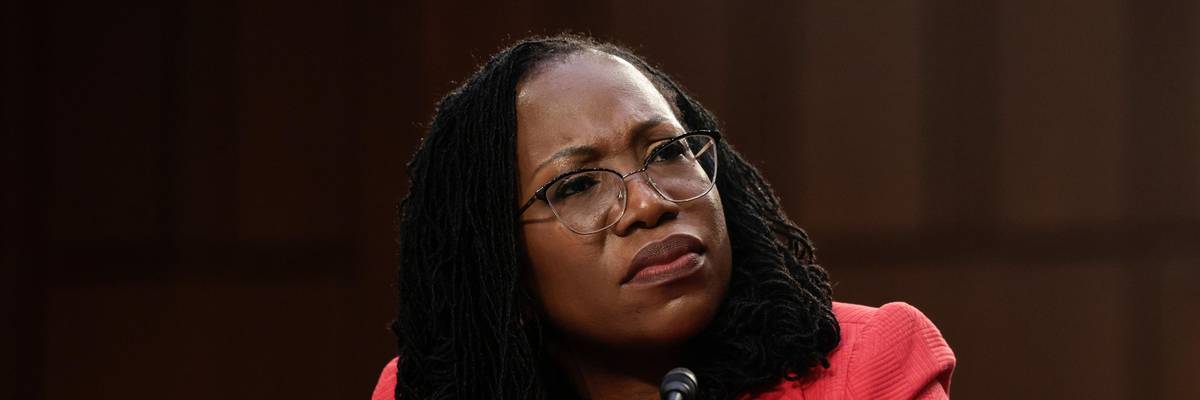
U.S. Supreme Court nominee Judge Ketanji Brown Jackson testifies during her confirmation hearing before the Senate Judiciary Committee in the Hart Senate Office Building on Capitol Hill on March 22, 2022 in Washington, D.C. (Photo: Anna Moneymaker/Getty Images)"
The confirmation of Ketanji Brown Jackson to the Supreme Court occasions a look back at some of the media coverage of her hearings. While media reported GOP senators' grandstanding harassment and aggressive repetition of baseless accusations, their need to always be signaling "balance" led to some mealy-mouthed avoidance tactics, like C-SPAN's tweet (3/23/22) describing a "heated exchange between Supreme Court Nominee Judge Ketanji Brown Jackson and Sen. @LindseyGrahamSC on child pornography sentencing"--when anyone watching would tell you only one side was heated.
Or a piece from the Washington Post (3/24/22) that began:
As Ketanji Brown Jackson this week sat through several days of hearings in her bid to join the Supreme Court, Democrats proudly took turns reflecting on the historic example she sets and the need for the judiciary--much like other institutions--to better reflect the diverse public it serves.
At the same time, some Republicans repeatedly suggested that the first Black female high court nominee was soft on crime and questioned whether critical race theory--an academic framework centered on the idea that racism is systemic--influenced her thinking as a judge.
You might think this says: Democrats noted correctly that there are no Black women on the court, while some Republicans showed part of the reason why--by inappropriately linking Black people to crime and to their own weaponized rendering of an intellectual framework.
For the Post, though:
The disparate treatment underscored the extent to which race hovered over the four grueling days of Jackson's confirmation hearings this week, serving as both a source of ebullience for the judge's supporters and an avenue for contentious questions that sometimes carried racial undertones.
So it wasn't a series of racist attacks on a Black woman in an attempt to deny her advancement. It was "race" itself, "hovering"--both over those who want to see an end to decades of discriminatory exclusion, and those who don't.
When Sen. Marsha Blackburn asked, "Is it your personal hidden agenda to incorporate critical race theory into our legal system?" and Sen. Ted Cruz demanded to know if she thought babies were racist--those would be some of those "contentious questions" with "racial undertones," leading one to wonder what a racial overtone would look like.
The word "racist" does appear in the piece--in senators' own descriptions of the 1619 Project and critical race theory, and in reporters Seung Min Kim and Marianna Sotomayor own statement that "Republican senators who would go on to question Jackson most aggressively acknowledged they could be perceived as racist in doing so."
This sort of coverage may not come off as mean-spirited, but its purposive timidity and awkward "even-handedness" ultimately provide cover for ideas and tactics that should be ruthlessly exposed for what they are. If there ever was a time to talk about "race" "hovering over" things, it's long past.
Dear Common Dreams reader, It’s been nearly 30 years since I co-founded Common Dreams with my late wife, Lina Newhouser. We had the radical notion that journalism should serve the public good, not corporate profits. It was clear to us from the outset what it would take to build such a project. No paid advertisements. No corporate sponsors. No millionaire publisher telling us what to think or do. Many people said we wouldn't last a year, but we proved those doubters wrong. Together with a tremendous team of journalists and dedicated staff, we built an independent media outlet free from the constraints of profits and corporate control. Our mission has always been simple: To inform. To inspire. To ignite change for the common good. Building Common Dreams was not easy. Our survival was never guaranteed. When you take on the most powerful forces—Wall Street greed, fossil fuel industry destruction, Big Tech lobbyists, and uber-rich oligarchs who have spent billions upon billions rigging the economy and democracy in their favor—the only bulwark you have is supporters who believe in your work. But here’s the urgent message from me today. It's never been this bad out there. And it's never been this hard to keep us going. At the very moment Common Dreams is most needed, the threats we face are intensifying. We need your support now more than ever. We don't accept corporate advertising and never will. We don't have a paywall because we don't think people should be blocked from critical news based on their ability to pay. Everything we do is funded by the donations of readers like you. When everyone does the little they can afford, we are strong. But if that support retreats or dries up, so do we. Will you donate now to make sure Common Dreams not only survives but thrives? —Craig Brown, Co-founder |
The confirmation of Ketanji Brown Jackson to the Supreme Court occasions a look back at some of the media coverage of her hearings. While media reported GOP senators' grandstanding harassment and aggressive repetition of baseless accusations, their need to always be signaling "balance" led to some mealy-mouthed avoidance tactics, like C-SPAN's tweet (3/23/22) describing a "heated exchange between Supreme Court Nominee Judge Ketanji Brown Jackson and Sen. @LindseyGrahamSC on child pornography sentencing"--when anyone watching would tell you only one side was heated.
Or a piece from the Washington Post (3/24/22) that began:
As Ketanji Brown Jackson this week sat through several days of hearings in her bid to join the Supreme Court, Democrats proudly took turns reflecting on the historic example she sets and the need for the judiciary--much like other institutions--to better reflect the diverse public it serves.
At the same time, some Republicans repeatedly suggested that the first Black female high court nominee was soft on crime and questioned whether critical race theory--an academic framework centered on the idea that racism is systemic--influenced her thinking as a judge.
You might think this says: Democrats noted correctly that there are no Black women on the court, while some Republicans showed part of the reason why--by inappropriately linking Black people to crime and to their own weaponized rendering of an intellectual framework.
For the Post, though:
The disparate treatment underscored the extent to which race hovered over the four grueling days of Jackson's confirmation hearings this week, serving as both a source of ebullience for the judge's supporters and an avenue for contentious questions that sometimes carried racial undertones.
So it wasn't a series of racist attacks on a Black woman in an attempt to deny her advancement. It was "race" itself, "hovering"--both over those who want to see an end to decades of discriminatory exclusion, and those who don't.
When Sen. Marsha Blackburn asked, "Is it your personal hidden agenda to incorporate critical race theory into our legal system?" and Sen. Ted Cruz demanded to know if she thought babies were racist--those would be some of those "contentious questions" with "racial undertones," leading one to wonder what a racial overtone would look like.
The word "racist" does appear in the piece--in senators' own descriptions of the 1619 Project and critical race theory, and in reporters Seung Min Kim and Marianna Sotomayor own statement that "Republican senators who would go on to question Jackson most aggressively acknowledged they could be perceived as racist in doing so."
This sort of coverage may not come off as mean-spirited, but its purposive timidity and awkward "even-handedness" ultimately provide cover for ideas and tactics that should be ruthlessly exposed for what they are. If there ever was a time to talk about "race" "hovering over" things, it's long past.
The confirmation of Ketanji Brown Jackson to the Supreme Court occasions a look back at some of the media coverage of her hearings. While media reported GOP senators' grandstanding harassment and aggressive repetition of baseless accusations, their need to always be signaling "balance" led to some mealy-mouthed avoidance tactics, like C-SPAN's tweet (3/23/22) describing a "heated exchange between Supreme Court Nominee Judge Ketanji Brown Jackson and Sen. @LindseyGrahamSC on child pornography sentencing"--when anyone watching would tell you only one side was heated.
Or a piece from the Washington Post (3/24/22) that began:
As Ketanji Brown Jackson this week sat through several days of hearings in her bid to join the Supreme Court, Democrats proudly took turns reflecting on the historic example she sets and the need for the judiciary--much like other institutions--to better reflect the diverse public it serves.
At the same time, some Republicans repeatedly suggested that the first Black female high court nominee was soft on crime and questioned whether critical race theory--an academic framework centered on the idea that racism is systemic--influenced her thinking as a judge.
You might think this says: Democrats noted correctly that there are no Black women on the court, while some Republicans showed part of the reason why--by inappropriately linking Black people to crime and to their own weaponized rendering of an intellectual framework.
For the Post, though:
The disparate treatment underscored the extent to which race hovered over the four grueling days of Jackson's confirmation hearings this week, serving as both a source of ebullience for the judge's supporters and an avenue for contentious questions that sometimes carried racial undertones.
So it wasn't a series of racist attacks on a Black woman in an attempt to deny her advancement. It was "race" itself, "hovering"--both over those who want to see an end to decades of discriminatory exclusion, and those who don't.
When Sen. Marsha Blackburn asked, "Is it your personal hidden agenda to incorporate critical race theory into our legal system?" and Sen. Ted Cruz demanded to know if she thought babies were racist--those would be some of those "contentious questions" with "racial undertones," leading one to wonder what a racial overtone would look like.
The word "racist" does appear in the piece--in senators' own descriptions of the 1619 Project and critical race theory, and in reporters Seung Min Kim and Marianna Sotomayor own statement that "Republican senators who would go on to question Jackson most aggressively acknowledged they could be perceived as racist in doing so."
This sort of coverage may not come off as mean-spirited, but its purposive timidity and awkward "even-handedness" ultimately provide cover for ideas and tactics that should be ruthlessly exposed for what they are. If there ever was a time to talk about "race" "hovering over" things, it's long past.