SUBSCRIBE TO OUR FREE NEWSLETTER
Daily news & progressive opinion—funded by the people, not the corporations—delivered straight to your inbox.
5
#000000
#FFFFFF
To donate by check, phone, or other method, see our More Ways to Give page.
Daily news & progressive opinion—funded by the people, not the corporations—delivered straight to your inbox.
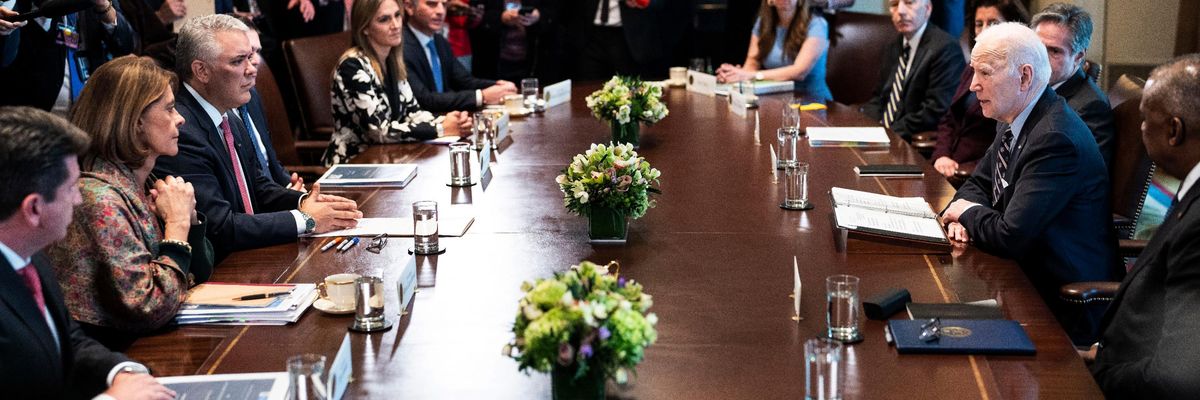
U.S. President Joe Biden and members of his cabinet meet with Colombian President Ivan Duque, Vice President and Minister of Foreign Affairs Marta Lucia Ramirez and other members of that government in the Cabinet Room of the White House on March 10, 2022 in Washington, DC. The two leaders are likely to talk about recent meetings between the United States and Venezuela, where the possibility of easing U.S. oil sanctions on Venezuela were discussed after Biden banned Russian oil imports earlier this week. (Photo: Doug Mills-Pool/Getty Images)
How the tables have turned. A high-level US delegation visited Venezuela on March 5, hoping to repair economic ties with Caracas. Venezuela, one of the world's poorest countries partly due to US-Western sanctions is, for once, in the driving seat, capable of alleviating an impending US energy crisis if dialogue with Washington continues to move forward.
US foreign policy in South America centered largely on isolating Venezuela and, by extension, weakening the socialist governments in Cuba and elsewhere.
Technically, Venezuela is not a poor country. In 1998, it was one of the leading OPEC members, producing 3.5 million barrels of oil a day (bpd). Though Caracas largely failed to take advantage of its former oil boom by diversifying its oil-dependent economy, it was the combination of lower oil prices and US-led sanctions that pushed the once relatively thriving South American country down to its knees.
In December 2018, former US President Donald Trump imposed severe sanctions on Venezuela, cutting off oil imports from the country. Though Caracas provided the US with about 200,000 bpd, the US managed to quickly replace Venezuelan oil as crude oil prices reached as low as $40 per barrel.
Indeed, the timing of Trump's move was meant to ravage, if not entirely destroy, the Venezuelan economy in order to exact political concessions, or worse. The decision to further choke off Venezuela in December of that year was perfectly timed as the global oil crisis had reached its zenith in November.
Venezuela was already struggling with US-led sanctions, regional isolation, political instability, hyperinflation and, subsequently, extreme poverty. The US government's move, then, was meant to be the final push that surely, as many US Republicans and some Democrats concluded, would end the reign of Venezuelan President Nicolas Maduro.
Venezuela has long accused the US of pursuing a regime change in Caracas, based on allegations that the socialist Maduro government had won the 2018 elections through fraud. And, just like that, it was determined that Juan Guaido, then Venezuela's opposition leader and president of the National Assembly, should be installed as the country's new president.
Since then, US foreign policy in South America centered largely on isolating Venezuela and, by extension, weakening the socialist governments in Cuba and elsewhere. In 2017, for example, the US had evacuated its embassy in the Cuban capital, Havana, claiming that its staff was being targeted by "sonic attacks" - a supposed high-frequency microwave radiation. Though such claims were never substantiated, they allowed Washington to walk back on the positive diplomatic gestures towards Cuba that were carried out by the Barack Obama administration, starting in 2016.
For years, Venezuela's inflation continued to worsen, reaching 686.4 percent last year, according to statistics provided by Bloomberg. As a result, the majority of Venezuelans continue to live below the extreme poverty line.
The government in Caracas, however, somehow survived for reasons that differ, depending on the political position of the analysts. In Venezuela, much credence is being given to the country's socialist values, the resilience of the people and to the Bolivarian movement. The anti-Maduro forces in the US, centered mostly in Florida, blame Maduro's survival on Washington's lack of resolve. A third factor, which is often overlooked, is Russia.
In 2019, Russia sent hundreds of military specialists, technicians and soldiers to Caracas under various official explanations. The presence of the Russian military helped ease fears that pro-Washington forces in Venezuela were preparing a military coup. Equally important, Russia's strong trade ties, loans and more, were instrumental in helping Venezuela escape complete bankruptcy and circumvent some of the US sanctions.
Despite the collapse of the Soviet Union decades ago, Russia remained largely committed to the USSR's geopolitical legacy. Moscow's strong relations with socialist nations in South America are a testament to such a fact. The US, on the other hand, has done little to redefine its troubled relationships with South America as if little has changed since the time of the hegemonic Monroe Doctrine of 1823.
Now, it seems that the US is about to pay for its past miscalculations. Unsurprisingly, the pro-Russia bloc in South America is expressing strong solidarity with Moscow following the latter's intervention in Ukraine and the subsequent US and Western sanctions. Wary of the developing energy crisis and the danger of having Russian allies within a largely US-dominated region, Washington is attempting, though clumsily, to reverse some of its previous missteps. On March 3, Washington decided to re-open its Havana embassy and two days later, a US delegation arrived in Venezuela.
Now that Russia's moves in Eastern Europe have re-ignited the 'Great Game' of a previous era, Venezuela, Cuba and others, though thousands of miles away, are finding themselves at the heart of the budding new Great Game. Though some in Washington are willing to reconsider their long-standing policy against the socialist bloc of South America, the US mission is rife with obstacles. Oddly, the biggest stumbling block on the US path towards South America is neither Caracas, Havana or even Moscow, but the powerful and influential lobbies and pressure groups in Washington and Florida.
A Republican Senator, Rick Scott from Illinois, was quoted in Politico as saying "the only thing the Biden admin should be discussing with Maduro is the time of his resignation." While Scott's views are shared by many top US officials, US politics this time around may have little impact on their country's foreign policy. For once, the Venezuelan government has the stage.
Dear Common Dreams reader, It’s been nearly 30 years since I co-founded Common Dreams with my late wife, Lina Newhouser. We had the radical notion that journalism should serve the public good, not corporate profits. It was clear to us from the outset what it would take to build such a project. No paid advertisements. No corporate sponsors. No millionaire publisher telling us what to think or do. Many people said we wouldn't last a year, but we proved those doubters wrong. Together with a tremendous team of journalists and dedicated staff, we built an independent media outlet free from the constraints of profits and corporate control. Our mission has always been simple: To inform. To inspire. To ignite change for the common good. Building Common Dreams was not easy. Our survival was never guaranteed. When you take on the most powerful forces—Wall Street greed, fossil fuel industry destruction, Big Tech lobbyists, and uber-rich oligarchs who have spent billions upon billions rigging the economy and democracy in their favor—the only bulwark you have is supporters who believe in your work. But here’s the urgent message from me today. It's never been this bad out there. And it's never been this hard to keep us going. At the very moment Common Dreams is most needed, the threats we face are intensifying. We need your support now more than ever. We don't accept corporate advertising and never will. We don't have a paywall because we don't think people should be blocked from critical news based on their ability to pay. Everything we do is funded by the donations of readers like you. When everyone does the little they can afford, we are strong. But if that support retreats or dries up, so do we. Will you donate now to make sure Common Dreams not only survives but thrives? —Craig Brown, Co-founder |
How the tables have turned. A high-level US delegation visited Venezuela on March 5, hoping to repair economic ties with Caracas. Venezuela, one of the world's poorest countries partly due to US-Western sanctions is, for once, in the driving seat, capable of alleviating an impending US energy crisis if dialogue with Washington continues to move forward.
US foreign policy in South America centered largely on isolating Venezuela and, by extension, weakening the socialist governments in Cuba and elsewhere.
Technically, Venezuela is not a poor country. In 1998, it was one of the leading OPEC members, producing 3.5 million barrels of oil a day (bpd). Though Caracas largely failed to take advantage of its former oil boom by diversifying its oil-dependent economy, it was the combination of lower oil prices and US-led sanctions that pushed the once relatively thriving South American country down to its knees.
In December 2018, former US President Donald Trump imposed severe sanctions on Venezuela, cutting off oil imports from the country. Though Caracas provided the US with about 200,000 bpd, the US managed to quickly replace Venezuelan oil as crude oil prices reached as low as $40 per barrel.
Indeed, the timing of Trump's move was meant to ravage, if not entirely destroy, the Venezuelan economy in order to exact political concessions, or worse. The decision to further choke off Venezuela in December of that year was perfectly timed as the global oil crisis had reached its zenith in November.
Venezuela was already struggling with US-led sanctions, regional isolation, political instability, hyperinflation and, subsequently, extreme poverty. The US government's move, then, was meant to be the final push that surely, as many US Republicans and some Democrats concluded, would end the reign of Venezuelan President Nicolas Maduro.
Venezuela has long accused the US of pursuing a regime change in Caracas, based on allegations that the socialist Maduro government had won the 2018 elections through fraud. And, just like that, it was determined that Juan Guaido, then Venezuela's opposition leader and president of the National Assembly, should be installed as the country's new president.
Since then, US foreign policy in South America centered largely on isolating Venezuela and, by extension, weakening the socialist governments in Cuba and elsewhere. In 2017, for example, the US had evacuated its embassy in the Cuban capital, Havana, claiming that its staff was being targeted by "sonic attacks" - a supposed high-frequency microwave radiation. Though such claims were never substantiated, they allowed Washington to walk back on the positive diplomatic gestures towards Cuba that were carried out by the Barack Obama administration, starting in 2016.
For years, Venezuela's inflation continued to worsen, reaching 686.4 percent last year, according to statistics provided by Bloomberg. As a result, the majority of Venezuelans continue to live below the extreme poverty line.
The government in Caracas, however, somehow survived for reasons that differ, depending on the political position of the analysts. In Venezuela, much credence is being given to the country's socialist values, the resilience of the people and to the Bolivarian movement. The anti-Maduro forces in the US, centered mostly in Florida, blame Maduro's survival on Washington's lack of resolve. A third factor, which is often overlooked, is Russia.
In 2019, Russia sent hundreds of military specialists, technicians and soldiers to Caracas under various official explanations. The presence of the Russian military helped ease fears that pro-Washington forces in Venezuela were preparing a military coup. Equally important, Russia's strong trade ties, loans and more, were instrumental in helping Venezuela escape complete bankruptcy and circumvent some of the US sanctions.
Despite the collapse of the Soviet Union decades ago, Russia remained largely committed to the USSR's geopolitical legacy. Moscow's strong relations with socialist nations in South America are a testament to such a fact. The US, on the other hand, has done little to redefine its troubled relationships with South America as if little has changed since the time of the hegemonic Monroe Doctrine of 1823.
Now, it seems that the US is about to pay for its past miscalculations. Unsurprisingly, the pro-Russia bloc in South America is expressing strong solidarity with Moscow following the latter's intervention in Ukraine and the subsequent US and Western sanctions. Wary of the developing energy crisis and the danger of having Russian allies within a largely US-dominated region, Washington is attempting, though clumsily, to reverse some of its previous missteps. On March 3, Washington decided to re-open its Havana embassy and two days later, a US delegation arrived in Venezuela.
Now that Russia's moves in Eastern Europe have re-ignited the 'Great Game' of a previous era, Venezuela, Cuba and others, though thousands of miles away, are finding themselves at the heart of the budding new Great Game. Though some in Washington are willing to reconsider their long-standing policy against the socialist bloc of South America, the US mission is rife with obstacles. Oddly, the biggest stumbling block on the US path towards South America is neither Caracas, Havana or even Moscow, but the powerful and influential lobbies and pressure groups in Washington and Florida.
A Republican Senator, Rick Scott from Illinois, was quoted in Politico as saying "the only thing the Biden admin should be discussing with Maduro is the time of his resignation." While Scott's views are shared by many top US officials, US politics this time around may have little impact on their country's foreign policy. For once, the Venezuelan government has the stage.
How the tables have turned. A high-level US delegation visited Venezuela on March 5, hoping to repair economic ties with Caracas. Venezuela, one of the world's poorest countries partly due to US-Western sanctions is, for once, in the driving seat, capable of alleviating an impending US energy crisis if dialogue with Washington continues to move forward.
US foreign policy in South America centered largely on isolating Venezuela and, by extension, weakening the socialist governments in Cuba and elsewhere.
Technically, Venezuela is not a poor country. In 1998, it was one of the leading OPEC members, producing 3.5 million barrels of oil a day (bpd). Though Caracas largely failed to take advantage of its former oil boom by diversifying its oil-dependent economy, it was the combination of lower oil prices and US-led sanctions that pushed the once relatively thriving South American country down to its knees.
In December 2018, former US President Donald Trump imposed severe sanctions on Venezuela, cutting off oil imports from the country. Though Caracas provided the US with about 200,000 bpd, the US managed to quickly replace Venezuelan oil as crude oil prices reached as low as $40 per barrel.
Indeed, the timing of Trump's move was meant to ravage, if not entirely destroy, the Venezuelan economy in order to exact political concessions, or worse. The decision to further choke off Venezuela in December of that year was perfectly timed as the global oil crisis had reached its zenith in November.
Venezuela was already struggling with US-led sanctions, regional isolation, political instability, hyperinflation and, subsequently, extreme poverty. The US government's move, then, was meant to be the final push that surely, as many US Republicans and some Democrats concluded, would end the reign of Venezuelan President Nicolas Maduro.
Venezuela has long accused the US of pursuing a regime change in Caracas, based on allegations that the socialist Maduro government had won the 2018 elections through fraud. And, just like that, it was determined that Juan Guaido, then Venezuela's opposition leader and president of the National Assembly, should be installed as the country's new president.
Since then, US foreign policy in South America centered largely on isolating Venezuela and, by extension, weakening the socialist governments in Cuba and elsewhere. In 2017, for example, the US had evacuated its embassy in the Cuban capital, Havana, claiming that its staff was being targeted by "sonic attacks" - a supposed high-frequency microwave radiation. Though such claims were never substantiated, they allowed Washington to walk back on the positive diplomatic gestures towards Cuba that were carried out by the Barack Obama administration, starting in 2016.
For years, Venezuela's inflation continued to worsen, reaching 686.4 percent last year, according to statistics provided by Bloomberg. As a result, the majority of Venezuelans continue to live below the extreme poverty line.
The government in Caracas, however, somehow survived for reasons that differ, depending on the political position of the analysts. In Venezuela, much credence is being given to the country's socialist values, the resilience of the people and to the Bolivarian movement. The anti-Maduro forces in the US, centered mostly in Florida, blame Maduro's survival on Washington's lack of resolve. A third factor, which is often overlooked, is Russia.
In 2019, Russia sent hundreds of military specialists, technicians and soldiers to Caracas under various official explanations. The presence of the Russian military helped ease fears that pro-Washington forces in Venezuela were preparing a military coup. Equally important, Russia's strong trade ties, loans and more, were instrumental in helping Venezuela escape complete bankruptcy and circumvent some of the US sanctions.
Despite the collapse of the Soviet Union decades ago, Russia remained largely committed to the USSR's geopolitical legacy. Moscow's strong relations with socialist nations in South America are a testament to such a fact. The US, on the other hand, has done little to redefine its troubled relationships with South America as if little has changed since the time of the hegemonic Monroe Doctrine of 1823.
Now, it seems that the US is about to pay for its past miscalculations. Unsurprisingly, the pro-Russia bloc in South America is expressing strong solidarity with Moscow following the latter's intervention in Ukraine and the subsequent US and Western sanctions. Wary of the developing energy crisis and the danger of having Russian allies within a largely US-dominated region, Washington is attempting, though clumsily, to reverse some of its previous missteps. On March 3, Washington decided to re-open its Havana embassy and two days later, a US delegation arrived in Venezuela.
Now that Russia's moves in Eastern Europe have re-ignited the 'Great Game' of a previous era, Venezuela, Cuba and others, though thousands of miles away, are finding themselves at the heart of the budding new Great Game. Though some in Washington are willing to reconsider their long-standing policy against the socialist bloc of South America, the US mission is rife with obstacles. Oddly, the biggest stumbling block on the US path towards South America is neither Caracas, Havana or even Moscow, but the powerful and influential lobbies and pressure groups in Washington and Florida.
A Republican Senator, Rick Scott from Illinois, was quoted in Politico as saying "the only thing the Biden admin should be discussing with Maduro is the time of his resignation." While Scott's views are shared by many top US officials, US politics this time around may have little impact on their country's foreign policy. For once, the Venezuelan government has the stage.