SUBSCRIBE TO OUR FREE NEWSLETTER
Daily news & progressive opinion—funded by the people, not the corporations—delivered straight to your inbox.
5
#000000
#FFFFFF
To donate by check, phone, or other method, see our More Ways to Give page.
Daily news & progressive opinion—funded by the people, not the corporations—delivered straight to your inbox.
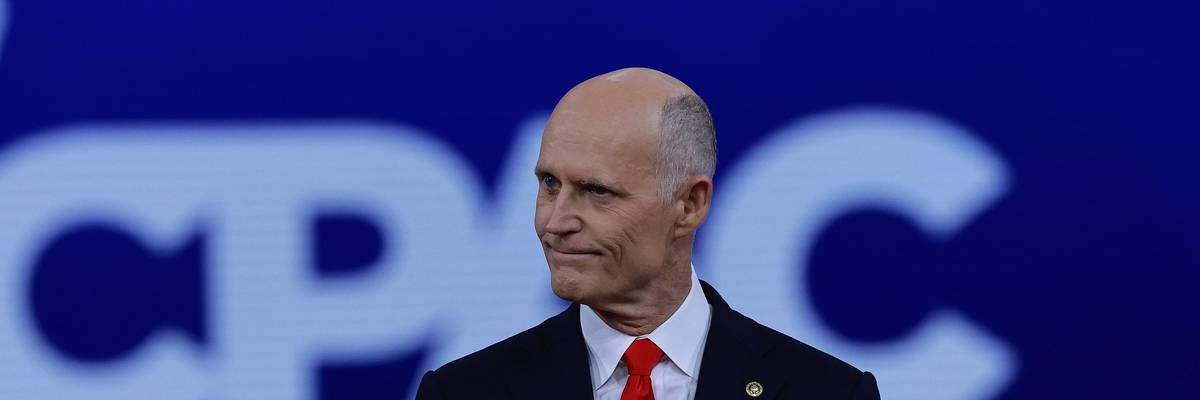
Sen. Rick Scott (R-Fla.) speaks during the Conservative Political Action Conference (CPAC) on February 26, 2022 in Orlando, Florida. (Photo: Joe Raedle/Getty Images)
Mitch McConnell, the GOP Senate leader, doesn't have a problem with billionaires. He's spent his entire political career helping billionaires make more billions. But Mitch McConnell does have a problem with one particular fabulously rich figure.
That problem just happens to be the U.S. Senate's richest senator, Rick Scott of Florida.
Senator Scott last month released "An 11-Point Plan to Rescue America," a manifesto that has exactly 11 points too many for Mitch McConnell. Average Americans, McConnell well understands, overwhelmingly support a higher minimum wage, Medicare coverage for vision and dental, and higher taxes on the rich, the sorts of proposals his Republican Party steadfastly opposes.
"To Americans who understand how our overall tax system works, Scott's proposal just seems cruel."
The more Republicans crow about the specific proposals they do support, McConnell fears, the more voters will start realizing that Republicans don't support the changes that average Americans would dearly like to see. So best to keep mum on the policy front. And the politically astute McConnell has the discipline not to deviate from that no-comment line.
Earlier this year, for instance, NBC News Capitol Hill correspondent Leigh Ann Caldwell asked McConnell what the Republican agenda would be if the GOP regained control of Congress in the 2022 midterm elections.
"That is a very good question," McConnell replied. "And I'll let you know when we take it back."
But Senator Rick Scott's "11-Point Plan" does answer that question, much to McConnell's chagrin, and Democrats have been quick to highlight one especially heartless move that Scott's manifesto enthusiastically endorses.
"All Americans should pay some income tax to have skin in the game, even if a small amount," declares Scott. "Currently over half of Americans pay no income tax."
To the mega-rich Scott -- and his fellow Americans of ample means -- this proposal no doubt seems entirely reasonable. To Americans who understand how our overall tax system works, Scott's proposal just seems cruel.
All Americans, for starters, pay some taxes. They have "skin" in the game. They may not pay any federal income tax. But if they work, they pay federal payroll tax. If they don't work, they still pay sales tax on goods they purchase. They face other state and local taxes as well.
How much would Scott's proposal cost Americans who currently pay no federal income tax? The plan from Scott -- who chairs the National Republican Senatorial Committee, the deep-pocket group coordinating the push for a Senate GOP majority -- offers no details.
Tax policy groups have filled the void. Enacting Scott's plan, calculates the Institute on Taxation and Economic Policy, would "increase taxes by more than $1,000 on average for the poorest 40 percent of Americans." In Mississippi, about 50 percent of the state's households would face tax increases.
The Institute assumes that Scott's plan would levy at least $1 of federal income tax on every American. How could a $1 minimum federal income tax leave some Americans over $1,000 poorer? Under the Scott "minimum tax" approach, poor families would lose the benefit of the various existing "tax credits" meant to benefit all qualifying Americans.
One example: In 2020, all Americans with kids could claim a $2,000 credit off their taxes for every child under 17. Those families with a higher total credit than tax liability could receive a refund of the excess credit amount up to $1,400 per child.
In other words, a single mom with a single child who owed $600 in taxes would receive, under the federal child tax credit benefit, a $1,400 check from the IRS. That single mom, under Scott's minimum federal income tax, would lose that $1,400 benefit. Scott's plan, in essence, would leave families making $400,000 a year with a full $2,000 benefit for each child and leave low-income families with at best only a fraction of that benefit total.
Overall, says the Tax Policy Center's Howard Gleckman, the Scott plan to "Rescue America" would raise over $100 billion in new taxes, with over 80 percent of that coming from households making about $54,000 or less. The Center works from the assumption that every household nationally would have to pay at least $100 in federal income tax under the Scott plan.
"Low-income families with children would pay the most," notes the Tax Policy Center analysis, "Achieving Scott's goal would slash their after-tax incomes by more than $5,000, or more than 20 percent."
Meanwhile, points out a Patriotic Millionaires analysis, those "uber-wealthy Americans who avoid federal income tax thanks to a series of loopholes that allow them to claim little to no income" would continue to face no more than a minuscule tax on their mega millions under the Scott "11 Points."
"In the end," the Patriotic Millionaires sum up, Scott's plan amounts to "a wink and a nod to his wealthy donors to keep stealing."
The nearly 750 billionaires who call the United States home last year added $1 trillion to their combined fortunes, an Americans for Tax Fairness review of Forbes data revealed earlier this year. The co-founders of the private-equity giant KKR, Henry Kravis and George Roberts, last year each collected over $100 million in dividend and "carried interest" income.
These sorts of hauls have given America's richest -- masters of the universe like Rick Scott and his well-endowed pals -- the political power to bend the nation's tax system in a direction amazingly friendly to grand fortune. They have left the rest of us with a society that can never seem to afford the services and support that families of modest means once felt they could count on.
We need to bend power back toward the people. Enough with Rick Scott and his minimum income tax. We need a maximum income.
Dear Common Dreams reader, It’s been nearly 30 years since I co-founded Common Dreams with my late wife, Lina Newhouser. We had the radical notion that journalism should serve the public good, not corporate profits. It was clear to us from the outset what it would take to build such a project. No paid advertisements. No corporate sponsors. No millionaire publisher telling us what to think or do. Many people said we wouldn't last a year, but we proved those doubters wrong. Together with a tremendous team of journalists and dedicated staff, we built an independent media outlet free from the constraints of profits and corporate control. Our mission has always been simple: To inform. To inspire. To ignite change for the common good. Building Common Dreams was not easy. Our survival was never guaranteed. When you take on the most powerful forces—Wall Street greed, fossil fuel industry destruction, Big Tech lobbyists, and uber-rich oligarchs who have spent billions upon billions rigging the economy and democracy in their favor—the only bulwark you have is supporters who believe in your work. But here’s the urgent message from me today. It's never been this bad out there. And it's never been this hard to keep us going. At the very moment Common Dreams is most needed, the threats we face are intensifying. We need your support now more than ever. We don't accept corporate advertising and never will. We don't have a paywall because we don't think people should be blocked from critical news based on their ability to pay. Everything we do is funded by the donations of readers like you. When everyone does the little they can afford, we are strong. But if that support retreats or dries up, so do we. Will you donate now to make sure Common Dreams not only survives but thrives? —Craig Brown, Co-founder |
Mitch McConnell, the GOP Senate leader, doesn't have a problem with billionaires. He's spent his entire political career helping billionaires make more billions. But Mitch McConnell does have a problem with one particular fabulously rich figure.
That problem just happens to be the U.S. Senate's richest senator, Rick Scott of Florida.
Senator Scott last month released "An 11-Point Plan to Rescue America," a manifesto that has exactly 11 points too many for Mitch McConnell. Average Americans, McConnell well understands, overwhelmingly support a higher minimum wage, Medicare coverage for vision and dental, and higher taxes on the rich, the sorts of proposals his Republican Party steadfastly opposes.
"To Americans who understand how our overall tax system works, Scott's proposal just seems cruel."
The more Republicans crow about the specific proposals they do support, McConnell fears, the more voters will start realizing that Republicans don't support the changes that average Americans would dearly like to see. So best to keep mum on the policy front. And the politically astute McConnell has the discipline not to deviate from that no-comment line.
Earlier this year, for instance, NBC News Capitol Hill correspondent Leigh Ann Caldwell asked McConnell what the Republican agenda would be if the GOP regained control of Congress in the 2022 midterm elections.
"That is a very good question," McConnell replied. "And I'll let you know when we take it back."
But Senator Rick Scott's "11-Point Plan" does answer that question, much to McConnell's chagrin, and Democrats have been quick to highlight one especially heartless move that Scott's manifesto enthusiastically endorses.
"All Americans should pay some income tax to have skin in the game, even if a small amount," declares Scott. "Currently over half of Americans pay no income tax."
To the mega-rich Scott -- and his fellow Americans of ample means -- this proposal no doubt seems entirely reasonable. To Americans who understand how our overall tax system works, Scott's proposal just seems cruel.
All Americans, for starters, pay some taxes. They have "skin" in the game. They may not pay any federal income tax. But if they work, they pay federal payroll tax. If they don't work, they still pay sales tax on goods they purchase. They face other state and local taxes as well.
How much would Scott's proposal cost Americans who currently pay no federal income tax? The plan from Scott -- who chairs the National Republican Senatorial Committee, the deep-pocket group coordinating the push for a Senate GOP majority -- offers no details.
Tax policy groups have filled the void. Enacting Scott's plan, calculates the Institute on Taxation and Economic Policy, would "increase taxes by more than $1,000 on average for the poorest 40 percent of Americans." In Mississippi, about 50 percent of the state's households would face tax increases.
The Institute assumes that Scott's plan would levy at least $1 of federal income tax on every American. How could a $1 minimum federal income tax leave some Americans over $1,000 poorer? Under the Scott "minimum tax" approach, poor families would lose the benefit of the various existing "tax credits" meant to benefit all qualifying Americans.
One example: In 2020, all Americans with kids could claim a $2,000 credit off their taxes for every child under 17. Those families with a higher total credit than tax liability could receive a refund of the excess credit amount up to $1,400 per child.
In other words, a single mom with a single child who owed $600 in taxes would receive, under the federal child tax credit benefit, a $1,400 check from the IRS. That single mom, under Scott's minimum federal income tax, would lose that $1,400 benefit. Scott's plan, in essence, would leave families making $400,000 a year with a full $2,000 benefit for each child and leave low-income families with at best only a fraction of that benefit total.
Overall, says the Tax Policy Center's Howard Gleckman, the Scott plan to "Rescue America" would raise over $100 billion in new taxes, with over 80 percent of that coming from households making about $54,000 or less. The Center works from the assumption that every household nationally would have to pay at least $100 in federal income tax under the Scott plan.
"Low-income families with children would pay the most," notes the Tax Policy Center analysis, "Achieving Scott's goal would slash their after-tax incomes by more than $5,000, or more than 20 percent."
Meanwhile, points out a Patriotic Millionaires analysis, those "uber-wealthy Americans who avoid federal income tax thanks to a series of loopholes that allow them to claim little to no income" would continue to face no more than a minuscule tax on their mega millions under the Scott "11 Points."
"In the end," the Patriotic Millionaires sum up, Scott's plan amounts to "a wink and a nod to his wealthy donors to keep stealing."
The nearly 750 billionaires who call the United States home last year added $1 trillion to their combined fortunes, an Americans for Tax Fairness review of Forbes data revealed earlier this year. The co-founders of the private-equity giant KKR, Henry Kravis and George Roberts, last year each collected over $100 million in dividend and "carried interest" income.
These sorts of hauls have given America's richest -- masters of the universe like Rick Scott and his well-endowed pals -- the political power to bend the nation's tax system in a direction amazingly friendly to grand fortune. They have left the rest of us with a society that can never seem to afford the services and support that families of modest means once felt they could count on.
We need to bend power back toward the people. Enough with Rick Scott and his minimum income tax. We need a maximum income.
Mitch McConnell, the GOP Senate leader, doesn't have a problem with billionaires. He's spent his entire political career helping billionaires make more billions. But Mitch McConnell does have a problem with one particular fabulously rich figure.
That problem just happens to be the U.S. Senate's richest senator, Rick Scott of Florida.
Senator Scott last month released "An 11-Point Plan to Rescue America," a manifesto that has exactly 11 points too many for Mitch McConnell. Average Americans, McConnell well understands, overwhelmingly support a higher minimum wage, Medicare coverage for vision and dental, and higher taxes on the rich, the sorts of proposals his Republican Party steadfastly opposes.
"To Americans who understand how our overall tax system works, Scott's proposal just seems cruel."
The more Republicans crow about the specific proposals they do support, McConnell fears, the more voters will start realizing that Republicans don't support the changes that average Americans would dearly like to see. So best to keep mum on the policy front. And the politically astute McConnell has the discipline not to deviate from that no-comment line.
Earlier this year, for instance, NBC News Capitol Hill correspondent Leigh Ann Caldwell asked McConnell what the Republican agenda would be if the GOP regained control of Congress in the 2022 midterm elections.
"That is a very good question," McConnell replied. "And I'll let you know when we take it back."
But Senator Rick Scott's "11-Point Plan" does answer that question, much to McConnell's chagrin, and Democrats have been quick to highlight one especially heartless move that Scott's manifesto enthusiastically endorses.
"All Americans should pay some income tax to have skin in the game, even if a small amount," declares Scott. "Currently over half of Americans pay no income tax."
To the mega-rich Scott -- and his fellow Americans of ample means -- this proposal no doubt seems entirely reasonable. To Americans who understand how our overall tax system works, Scott's proposal just seems cruel.
All Americans, for starters, pay some taxes. They have "skin" in the game. They may not pay any federal income tax. But if they work, they pay federal payroll tax. If they don't work, they still pay sales tax on goods they purchase. They face other state and local taxes as well.
How much would Scott's proposal cost Americans who currently pay no federal income tax? The plan from Scott -- who chairs the National Republican Senatorial Committee, the deep-pocket group coordinating the push for a Senate GOP majority -- offers no details.
Tax policy groups have filled the void. Enacting Scott's plan, calculates the Institute on Taxation and Economic Policy, would "increase taxes by more than $1,000 on average for the poorest 40 percent of Americans." In Mississippi, about 50 percent of the state's households would face tax increases.
The Institute assumes that Scott's plan would levy at least $1 of federal income tax on every American. How could a $1 minimum federal income tax leave some Americans over $1,000 poorer? Under the Scott "minimum tax" approach, poor families would lose the benefit of the various existing "tax credits" meant to benefit all qualifying Americans.
One example: In 2020, all Americans with kids could claim a $2,000 credit off their taxes for every child under 17. Those families with a higher total credit than tax liability could receive a refund of the excess credit amount up to $1,400 per child.
In other words, a single mom with a single child who owed $600 in taxes would receive, under the federal child tax credit benefit, a $1,400 check from the IRS. That single mom, under Scott's minimum federal income tax, would lose that $1,400 benefit. Scott's plan, in essence, would leave families making $400,000 a year with a full $2,000 benefit for each child and leave low-income families with at best only a fraction of that benefit total.
Overall, says the Tax Policy Center's Howard Gleckman, the Scott plan to "Rescue America" would raise over $100 billion in new taxes, with over 80 percent of that coming from households making about $54,000 or less. The Center works from the assumption that every household nationally would have to pay at least $100 in federal income tax under the Scott plan.
"Low-income families with children would pay the most," notes the Tax Policy Center analysis, "Achieving Scott's goal would slash their after-tax incomes by more than $5,000, or more than 20 percent."
Meanwhile, points out a Patriotic Millionaires analysis, those "uber-wealthy Americans who avoid federal income tax thanks to a series of loopholes that allow them to claim little to no income" would continue to face no more than a minuscule tax on their mega millions under the Scott "11 Points."
"In the end," the Patriotic Millionaires sum up, Scott's plan amounts to "a wink and a nod to his wealthy donors to keep stealing."
The nearly 750 billionaires who call the United States home last year added $1 trillion to their combined fortunes, an Americans for Tax Fairness review of Forbes data revealed earlier this year. The co-founders of the private-equity giant KKR, Henry Kravis and George Roberts, last year each collected over $100 million in dividend and "carried interest" income.
These sorts of hauls have given America's richest -- masters of the universe like Rick Scott and his well-endowed pals -- the political power to bend the nation's tax system in a direction amazingly friendly to grand fortune. They have left the rest of us with a society that can never seem to afford the services and support that families of modest means once felt they could count on.
We need to bend power back toward the people. Enough with Rick Scott and his minimum income tax. We need a maximum income.