SUBSCRIBE TO OUR FREE NEWSLETTER
Daily news & progressive opinion—funded by the people, not the corporations—delivered straight to your inbox.
5
#000000
#FFFFFF
To donate by check, phone, or other method, see our More Ways to Give page.
Daily news & progressive opinion—funded by the people, not the corporations—delivered straight to your inbox.
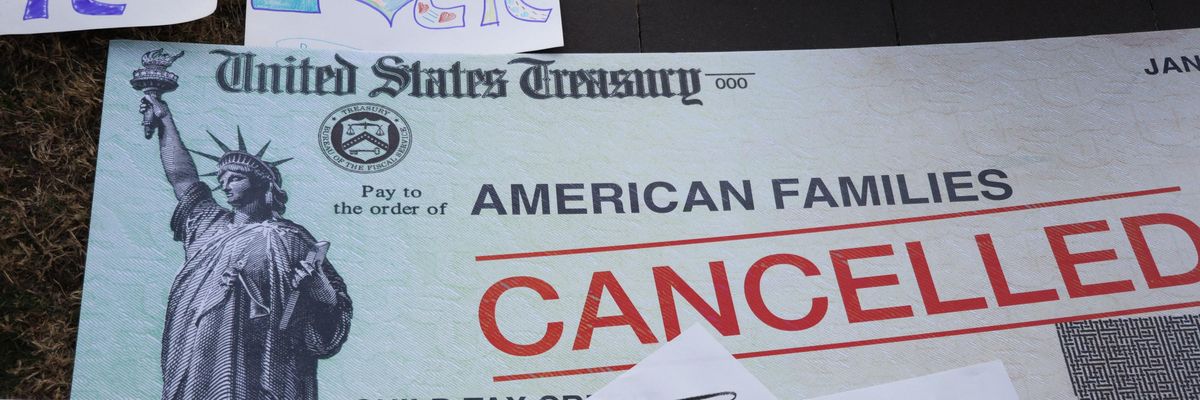
Children draw on top of a "cancelled check" prop during a rally in front of the U.S. Capitol on December 13, 2021, in Washington, D.C. (Photo: Alex Wong/Getty Images)
Ada Mae's beautiful blonde curls are wild on this sunny, mild winter afternoon.
My family wasn't just surviving--we were on our way to thriving. That's exactly what a safety net is for. But now what's going to happen?
I've just picked her up from the homeschool co-op that supplements the first-grade lessons we've been doing at home, and we're hanging out at the park. This is my favorite time of the week, watching her play with other kids.
But I'm also remembering my own childhood--cold Missouri winters without boots, hats, or mittens. The grind of poverty was tough on my family, and that trauma pursued me into adulthood.
I would do anything to keep my child from that fate, but we've had our close calls.
We were nearly homeless when the pandemic struck. I'd tried to pull myself out of poverty so many times by then--I'd even just finished graduate school. But trying to enter the job market as Covid-19 shut down the economy proved difficult. There wasn't going to be enough money for rent.
Fortunately, the Covid-19 relief programs Congress passed--like the stimulus checks and those monthly Child Tax Credit payments--helped me keep our apartment.
With this help, I could look for work while homeschooling my daughter. I was even able to put a few dollars into a savings account for the first time in my life, which was a huge relief. My family wasn't just surviving--we were on our way to thriving.
That's exactly what a safety net is for. But now what's going to happen?
The credit expired last December because Republicans, plus Democrat Joe Manchin, have stalled efforts to extend this tax relief to working families. Millions of families like mine missed our check in January--and we won't get another unless they're renewed.
Those monthly Child Tax Credits allowed Ada Mae to attend her beloved homeschool co-op, so necessary for her social well-being. They provided financial stability that helped me be more present with her, when I wasn't worrying about how the next bill would be paid. And they gave me space to look for--and get--better-paying work in the field in which I'm now qualified.
There are lots of stories like ours. A Columbia study found that the December payments alone kept 3.7 million children out of poverty, reducing the monthly child poverty rate by about 30%.
But in the first month without payments, Columbia experts project that the monthly child poverty rate may rise from the current 12% to over 17%--the highest it's been in over a year.
As these numbers show, parents weren't squandering these payments on luxuries. They used them to live less precariously.
The failure to renew the expanded Child Tax Credit isn't just cruel and short-sighted--it's economically unsound.
A quarter of parents used the credit on child care so they could return to work. A third of the payments went to essential school expenses. And at least 90% of families were using the credits on necessities for their families.
Perhaps most dramatically, new research has found that cash payments to low-income families significantly improve infant brain development and learning later in life.
This is the sort of lifeline that changes children's lives. So why are we taking a torch to it? Why would we lift children out of poverty only to slam them back into it a few months later?
The failure to renew the expanded Child Tax Credit isn't just cruel and short-sighted--it's economically unsound. For the economy to fully recover, workers and families must be able to survive inflation and other pandemic-related hardships. The enhanced Child Tax Credit was arguably our best tool for that.
It certainly was for me and my beautiful, confident Ada Mae.
All of our children deserve the best chance in life, free from the brutal precariousness of poverty. The enhanced Child Tax Credit is that best chance. Let's not miss it.
Dear Common Dreams reader, It’s been nearly 30 years since I co-founded Common Dreams with my late wife, Lina Newhouser. We had the radical notion that journalism should serve the public good, not corporate profits. It was clear to us from the outset what it would take to build such a project. No paid advertisements. No corporate sponsors. No millionaire publisher telling us what to think or do. Many people said we wouldn't last a year, but we proved those doubters wrong. Together with a tremendous team of journalists and dedicated staff, we built an independent media outlet free from the constraints of profits and corporate control. Our mission has always been simple: To inform. To inspire. To ignite change for the common good. Building Common Dreams was not easy. Our survival was never guaranteed. When you take on the most powerful forces—Wall Street greed, fossil fuel industry destruction, Big Tech lobbyists, and uber-rich oligarchs who have spent billions upon billions rigging the economy and democracy in their favor—the only bulwark you have is supporters who believe in your work. But here’s the urgent message from me today. It's never been this bad out there. And it's never been this hard to keep us going. At the very moment Common Dreams is most needed, the threats we face are intensifying. We need your support now more than ever. We don't accept corporate advertising and never will. We don't have a paywall because we don't think people should be blocked from critical news based on their ability to pay. Everything we do is funded by the donations of readers like you. When everyone does the little they can afford, we are strong. But if that support retreats or dries up, so do we. Will you donate now to make sure Common Dreams not only survives but thrives? —Craig Brown, Co-founder |
Ada Mae's beautiful blonde curls are wild on this sunny, mild winter afternoon.
My family wasn't just surviving--we were on our way to thriving. That's exactly what a safety net is for. But now what's going to happen?
I've just picked her up from the homeschool co-op that supplements the first-grade lessons we've been doing at home, and we're hanging out at the park. This is my favorite time of the week, watching her play with other kids.
But I'm also remembering my own childhood--cold Missouri winters without boots, hats, or mittens. The grind of poverty was tough on my family, and that trauma pursued me into adulthood.
I would do anything to keep my child from that fate, but we've had our close calls.
We were nearly homeless when the pandemic struck. I'd tried to pull myself out of poverty so many times by then--I'd even just finished graduate school. But trying to enter the job market as Covid-19 shut down the economy proved difficult. There wasn't going to be enough money for rent.
Fortunately, the Covid-19 relief programs Congress passed--like the stimulus checks and those monthly Child Tax Credit payments--helped me keep our apartment.
With this help, I could look for work while homeschooling my daughter. I was even able to put a few dollars into a savings account for the first time in my life, which was a huge relief. My family wasn't just surviving--we were on our way to thriving.
That's exactly what a safety net is for. But now what's going to happen?
The credit expired last December because Republicans, plus Democrat Joe Manchin, have stalled efforts to extend this tax relief to working families. Millions of families like mine missed our check in January--and we won't get another unless they're renewed.
Those monthly Child Tax Credits allowed Ada Mae to attend her beloved homeschool co-op, so necessary for her social well-being. They provided financial stability that helped me be more present with her, when I wasn't worrying about how the next bill would be paid. And they gave me space to look for--and get--better-paying work in the field in which I'm now qualified.
There are lots of stories like ours. A Columbia study found that the December payments alone kept 3.7 million children out of poverty, reducing the monthly child poverty rate by about 30%.
But in the first month without payments, Columbia experts project that the monthly child poverty rate may rise from the current 12% to over 17%--the highest it's been in over a year.
As these numbers show, parents weren't squandering these payments on luxuries. They used them to live less precariously.
The failure to renew the expanded Child Tax Credit isn't just cruel and short-sighted--it's economically unsound.
A quarter of parents used the credit on child care so they could return to work. A third of the payments went to essential school expenses. And at least 90% of families were using the credits on necessities for their families.
Perhaps most dramatically, new research has found that cash payments to low-income families significantly improve infant brain development and learning later in life.
This is the sort of lifeline that changes children's lives. So why are we taking a torch to it? Why would we lift children out of poverty only to slam them back into it a few months later?
The failure to renew the expanded Child Tax Credit isn't just cruel and short-sighted--it's economically unsound. For the economy to fully recover, workers and families must be able to survive inflation and other pandemic-related hardships. The enhanced Child Tax Credit was arguably our best tool for that.
It certainly was for me and my beautiful, confident Ada Mae.
All of our children deserve the best chance in life, free from the brutal precariousness of poverty. The enhanced Child Tax Credit is that best chance. Let's not miss it.
Ada Mae's beautiful blonde curls are wild on this sunny, mild winter afternoon.
My family wasn't just surviving--we were on our way to thriving. That's exactly what a safety net is for. But now what's going to happen?
I've just picked her up from the homeschool co-op that supplements the first-grade lessons we've been doing at home, and we're hanging out at the park. This is my favorite time of the week, watching her play with other kids.
But I'm also remembering my own childhood--cold Missouri winters without boots, hats, or mittens. The grind of poverty was tough on my family, and that trauma pursued me into adulthood.
I would do anything to keep my child from that fate, but we've had our close calls.
We were nearly homeless when the pandemic struck. I'd tried to pull myself out of poverty so many times by then--I'd even just finished graduate school. But trying to enter the job market as Covid-19 shut down the economy proved difficult. There wasn't going to be enough money for rent.
Fortunately, the Covid-19 relief programs Congress passed--like the stimulus checks and those monthly Child Tax Credit payments--helped me keep our apartment.
With this help, I could look for work while homeschooling my daughter. I was even able to put a few dollars into a savings account for the first time in my life, which was a huge relief. My family wasn't just surviving--we were on our way to thriving.
That's exactly what a safety net is for. But now what's going to happen?
The credit expired last December because Republicans, plus Democrat Joe Manchin, have stalled efforts to extend this tax relief to working families. Millions of families like mine missed our check in January--and we won't get another unless they're renewed.
Those monthly Child Tax Credits allowed Ada Mae to attend her beloved homeschool co-op, so necessary for her social well-being. They provided financial stability that helped me be more present with her, when I wasn't worrying about how the next bill would be paid. And they gave me space to look for--and get--better-paying work in the field in which I'm now qualified.
There are lots of stories like ours. A Columbia study found that the December payments alone kept 3.7 million children out of poverty, reducing the monthly child poverty rate by about 30%.
But in the first month without payments, Columbia experts project that the monthly child poverty rate may rise from the current 12% to over 17%--the highest it's been in over a year.
As these numbers show, parents weren't squandering these payments on luxuries. They used them to live less precariously.
The failure to renew the expanded Child Tax Credit isn't just cruel and short-sighted--it's economically unsound.
A quarter of parents used the credit on child care so they could return to work. A third of the payments went to essential school expenses. And at least 90% of families were using the credits on necessities for their families.
Perhaps most dramatically, new research has found that cash payments to low-income families significantly improve infant brain development and learning later in life.
This is the sort of lifeline that changes children's lives. So why are we taking a torch to it? Why would we lift children out of poverty only to slam them back into it a few months later?
The failure to renew the expanded Child Tax Credit isn't just cruel and short-sighted--it's economically unsound. For the economy to fully recover, workers and families must be able to survive inflation and other pandemic-related hardships. The enhanced Child Tax Credit was arguably our best tool for that.
It certainly was for me and my beautiful, confident Ada Mae.
All of our children deserve the best chance in life, free from the brutal precariousness of poverty. The enhanced Child Tax Credit is that best chance. Let's not miss it.