SUBSCRIBE TO OUR FREE NEWSLETTER
Daily news & progressive opinion—funded by the people, not the corporations—delivered straight to your inbox.
5
#000000
#FFFFFF
To donate by check, phone, or other method, see our More Ways to Give page.
Daily news & progressive opinion—funded by the people, not the corporations—delivered straight to your inbox.
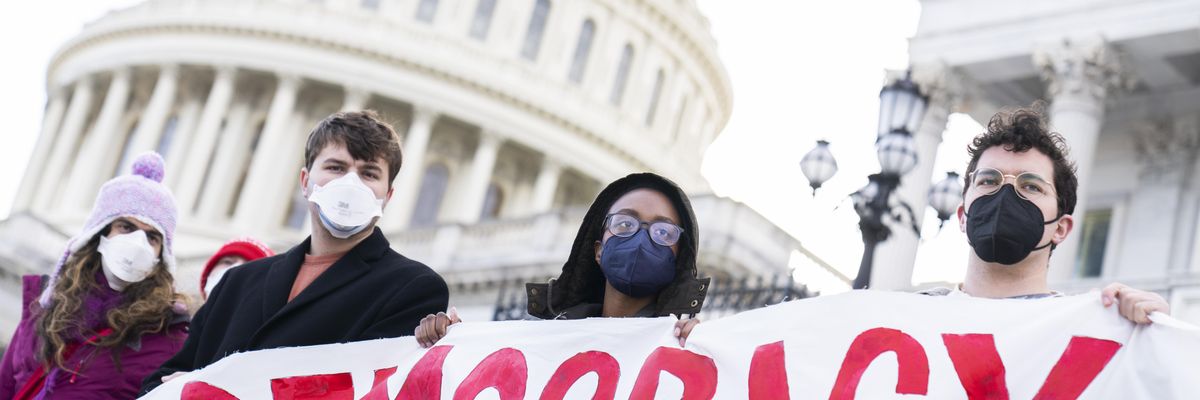
Demonstrators hold a sign at rally with Rep. Jamaal Bowman (D-N.Y.) outside the U.S. Capitol to urge the Senate to pass voting rights legislation on Wednesday, January 19, 2022. (Photo: Tom Williams/CQ-Roll Call, Inc via Getty Images)
Can America be a democracy if a minority writes the rules to entrench minority rule?
Last week, Senate Republicans invoking the cause of "states' rights" united in a filibuster to block democratic reforms, including the effort to revive the Voting Rights Act. They were empowered to do so by the decision of two wayward Democratic senators -- Joe Manchin of West Virginia and Kyrsten Sinema of Arizona -- to protect the filibuster, choosing obstruction over reforms they claim to support. The 50 Republicans voting against reform represent 41 million fewer voters than the 50 Democrats who support reform.
For African Americans, the Republican commitment to rig the rules for the minority is particularly ominous. "States' rights" was the cover story used by the Southern plantation class after the Civil War to suppress the Black vote and impose apartheid -- legal segregation -- on the South. Today, "states' rights" is used to justify systematic Republican efforts to make it harder to vote, particularly in urban areas with high numbers of Blacks and other people of color.
For African Americans, freedom, citizenship and the right to vote are inextricably linked. With the victory of the Union in the Civil War, the 13th, 14th and 15th amendments were passed -- freeing the slaves, requiring equal protection under the law, and protecting the right to vote. Those rights were trampled by segregation. It took 100 years and the civil rights movement to end segregation and pass the Voting Rights Act.
Now we witness a reaction once more as Republicans seek to suppress the vote. Once more they invoke states' rights to oppose federal efforts to protect this basic right.
The question now is what can be done about it. This is not a time for the wringing of hands, for giving up. It is a time to act.
The Biden administration still has statutory authority under what is left of the Voting Rights Act -- as well as constitutional authority -- to protect the right to vote. As attorney Gerald Griggs argued, the president could issue executive orders to empower the Justice Department to send in federal monitors in states that are sued by the Justice Department for violating the right to vote. The attorney general could file suit against states violating the Voting Rights Act and order suspension of all tests and devices that abridge the right to vote. The attorney general could use the enforcement power of the Voting Rights Act to prevent state officials from undertaking voter purges or efforts to impede the casting or tabulation of the vote.
These laws are on the books. It is time to set up a special task force to ensure that they are enforced.
But judicial action is not sufficient. In the end, we won the right to vote -- and passed the Voting Rights Act in 1965 -- not because the Constitution demanded it, or the courts ordered it.
We won because people marched, demonstrated, and risked their lives to demand the right to vote. The Voting Rights Act was passed in the halls of Congress in Washington, D.C., but it was won on the bridge in Selma, Alabama. Lyndon Johnson and Congress were reacting to a demand that could no longer be ignored.
We need street heat. Manchin struts around Washington rationalizing his vote against support for families with children, against paid family leave, against lower prescription drug prices, against tuition-free community college. He represents one of the poorest states in the union, in dire need of investment and reform. He needs to be reminded where he comes from -- and who he is supposed to represent. We need street heat with a huge march in the streets in West Virginia.
And we need street heat on the anniversary of Selma. Pundits say people don't care about the right to vote. Republicans, they argue, can filibuster it and pay no price at the polls. To change that, citizens of conscience must mobilize once more -- going back to Selma -- and then across the 50 states to demand that the right to vote be protected.
The stakes are very high. Minority rule mocks democracy. It is corrosive, undermining the legitimacy of our government. It is destructive, allowing the few to pocket the gold while the many get the shaft. Now is the time for the majority to make their voices heard.
Voting rights!
Dear Common Dreams reader, It’s been nearly 30 years since I co-founded Common Dreams with my late wife, Lina Newhouser. We had the radical notion that journalism should serve the public good, not corporate profits. It was clear to us from the outset what it would take to build such a project. No paid advertisements. No corporate sponsors. No millionaire publisher telling us what to think or do. Many people said we wouldn't last a year, but we proved those doubters wrong. Together with a tremendous team of journalists and dedicated staff, we built an independent media outlet free from the constraints of profits and corporate control. Our mission has always been simple: To inform. To inspire. To ignite change for the common good. Building Common Dreams was not easy. Our survival was never guaranteed. When you take on the most powerful forces—Wall Street greed, fossil fuel industry destruction, Big Tech lobbyists, and uber-rich oligarchs who have spent billions upon billions rigging the economy and democracy in their favor—the only bulwark you have is supporters who believe in your work. But here’s the urgent message from me today. It's never been this bad out there. And it's never been this hard to keep us going. At the very moment Common Dreams is most needed, the threats we face are intensifying. We need your support now more than ever. We don't accept corporate advertising and never will. We don't have a paywall because we don't think people should be blocked from critical news based on their ability to pay. Everything we do is funded by the donations of readers like you. When everyone does the little they can afford, we are strong. But if that support retreats or dries up, so do we. Will you donate now to make sure Common Dreams not only survives but thrives? —Craig Brown, Co-founder |
Can America be a democracy if a minority writes the rules to entrench minority rule?
Last week, Senate Republicans invoking the cause of "states' rights" united in a filibuster to block democratic reforms, including the effort to revive the Voting Rights Act. They were empowered to do so by the decision of two wayward Democratic senators -- Joe Manchin of West Virginia and Kyrsten Sinema of Arizona -- to protect the filibuster, choosing obstruction over reforms they claim to support. The 50 Republicans voting against reform represent 41 million fewer voters than the 50 Democrats who support reform.
For African Americans, the Republican commitment to rig the rules for the minority is particularly ominous. "States' rights" was the cover story used by the Southern plantation class after the Civil War to suppress the Black vote and impose apartheid -- legal segregation -- on the South. Today, "states' rights" is used to justify systematic Republican efforts to make it harder to vote, particularly in urban areas with high numbers of Blacks and other people of color.
For African Americans, freedom, citizenship and the right to vote are inextricably linked. With the victory of the Union in the Civil War, the 13th, 14th and 15th amendments were passed -- freeing the slaves, requiring equal protection under the law, and protecting the right to vote. Those rights were trampled by segregation. It took 100 years and the civil rights movement to end segregation and pass the Voting Rights Act.
Now we witness a reaction once more as Republicans seek to suppress the vote. Once more they invoke states' rights to oppose federal efforts to protect this basic right.
The question now is what can be done about it. This is not a time for the wringing of hands, for giving up. It is a time to act.
The Biden administration still has statutory authority under what is left of the Voting Rights Act -- as well as constitutional authority -- to protect the right to vote. As attorney Gerald Griggs argued, the president could issue executive orders to empower the Justice Department to send in federal monitors in states that are sued by the Justice Department for violating the right to vote. The attorney general could file suit against states violating the Voting Rights Act and order suspension of all tests and devices that abridge the right to vote. The attorney general could use the enforcement power of the Voting Rights Act to prevent state officials from undertaking voter purges or efforts to impede the casting or tabulation of the vote.
These laws are on the books. It is time to set up a special task force to ensure that they are enforced.
But judicial action is not sufficient. In the end, we won the right to vote -- and passed the Voting Rights Act in 1965 -- not because the Constitution demanded it, or the courts ordered it.
We won because people marched, demonstrated, and risked their lives to demand the right to vote. The Voting Rights Act was passed in the halls of Congress in Washington, D.C., but it was won on the bridge in Selma, Alabama. Lyndon Johnson and Congress were reacting to a demand that could no longer be ignored.
We need street heat. Manchin struts around Washington rationalizing his vote against support for families with children, against paid family leave, against lower prescription drug prices, against tuition-free community college. He represents one of the poorest states in the union, in dire need of investment and reform. He needs to be reminded where he comes from -- and who he is supposed to represent. We need street heat with a huge march in the streets in West Virginia.
And we need street heat on the anniversary of Selma. Pundits say people don't care about the right to vote. Republicans, they argue, can filibuster it and pay no price at the polls. To change that, citizens of conscience must mobilize once more -- going back to Selma -- and then across the 50 states to demand that the right to vote be protected.
The stakes are very high. Minority rule mocks democracy. It is corrosive, undermining the legitimacy of our government. It is destructive, allowing the few to pocket the gold while the many get the shaft. Now is the time for the majority to make their voices heard.
Voting rights!
Can America be a democracy if a minority writes the rules to entrench minority rule?
Last week, Senate Republicans invoking the cause of "states' rights" united in a filibuster to block democratic reforms, including the effort to revive the Voting Rights Act. They were empowered to do so by the decision of two wayward Democratic senators -- Joe Manchin of West Virginia and Kyrsten Sinema of Arizona -- to protect the filibuster, choosing obstruction over reforms they claim to support. The 50 Republicans voting against reform represent 41 million fewer voters than the 50 Democrats who support reform.
For African Americans, the Republican commitment to rig the rules for the minority is particularly ominous. "States' rights" was the cover story used by the Southern plantation class after the Civil War to suppress the Black vote and impose apartheid -- legal segregation -- on the South. Today, "states' rights" is used to justify systematic Republican efforts to make it harder to vote, particularly in urban areas with high numbers of Blacks and other people of color.
For African Americans, freedom, citizenship and the right to vote are inextricably linked. With the victory of the Union in the Civil War, the 13th, 14th and 15th amendments were passed -- freeing the slaves, requiring equal protection under the law, and protecting the right to vote. Those rights were trampled by segregation. It took 100 years and the civil rights movement to end segregation and pass the Voting Rights Act.
Now we witness a reaction once more as Republicans seek to suppress the vote. Once more they invoke states' rights to oppose federal efforts to protect this basic right.
The question now is what can be done about it. This is not a time for the wringing of hands, for giving up. It is a time to act.
The Biden administration still has statutory authority under what is left of the Voting Rights Act -- as well as constitutional authority -- to protect the right to vote. As attorney Gerald Griggs argued, the president could issue executive orders to empower the Justice Department to send in federal monitors in states that are sued by the Justice Department for violating the right to vote. The attorney general could file suit against states violating the Voting Rights Act and order suspension of all tests and devices that abridge the right to vote. The attorney general could use the enforcement power of the Voting Rights Act to prevent state officials from undertaking voter purges or efforts to impede the casting or tabulation of the vote.
These laws are on the books. It is time to set up a special task force to ensure that they are enforced.
But judicial action is not sufficient. In the end, we won the right to vote -- and passed the Voting Rights Act in 1965 -- not because the Constitution demanded it, or the courts ordered it.
We won because people marched, demonstrated, and risked their lives to demand the right to vote. The Voting Rights Act was passed in the halls of Congress in Washington, D.C., but it was won on the bridge in Selma, Alabama. Lyndon Johnson and Congress were reacting to a demand that could no longer be ignored.
We need street heat. Manchin struts around Washington rationalizing his vote against support for families with children, against paid family leave, against lower prescription drug prices, against tuition-free community college. He represents one of the poorest states in the union, in dire need of investment and reform. He needs to be reminded where he comes from -- and who he is supposed to represent. We need street heat with a huge march in the streets in West Virginia.
And we need street heat on the anniversary of Selma. Pundits say people don't care about the right to vote. Republicans, they argue, can filibuster it and pay no price at the polls. To change that, citizens of conscience must mobilize once more -- going back to Selma -- and then across the 50 states to demand that the right to vote be protected.
The stakes are very high. Minority rule mocks democracy. It is corrosive, undermining the legitimacy of our government. It is destructive, allowing the few to pocket the gold while the many get the shaft. Now is the time for the majority to make their voices heard.
Voting rights!