SUBSCRIBE TO OUR FREE NEWSLETTER
Daily news & progressive opinion—funded by the people, not the corporations—delivered straight to your inbox.
5
#000000
#FFFFFF
To donate by check, phone, or other method, see our More Ways to Give page.
Daily news & progressive opinion—funded by the people, not the corporations—delivered straight to your inbox.
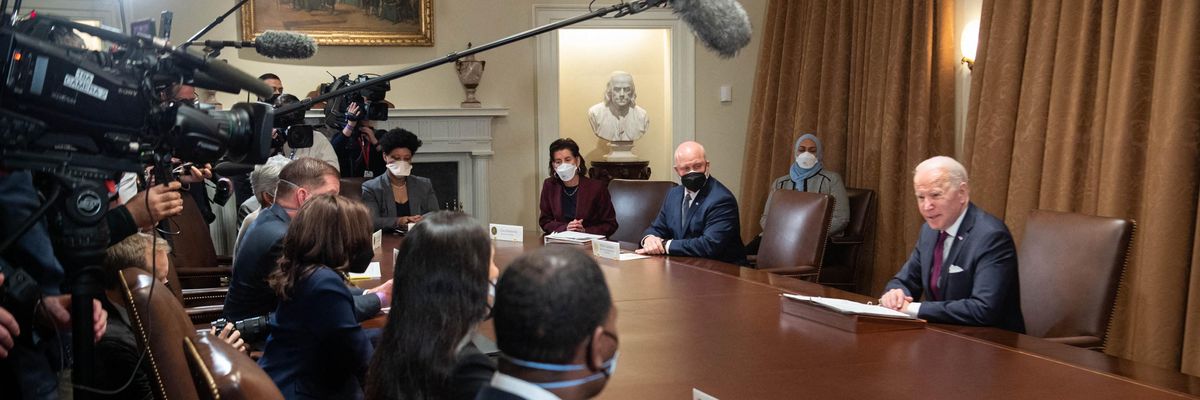
US President Joe Biden speaks about Russia and Ukraine prior to a meeting with members of the Infrastructure Implementation Task Force to discuss the Bipartisan Infrastructure Law, in the Cabinet Room of the White House in Washington, DC, on January 20, 2022. Biden said Thursday that any entry of Russian troops into Ukraine is "an invasion," a day after appearing to suggest a "minor" attack could invite a lesser response from NATO allies. "If any assembled Russian units move across the Ukrainian border, that is an invasion," Biden said, adding he had been "absolutely clear" with his Russian counterpart Vladimir Putin. (Photo: Saul Loeb/AFP via Getty Images)
As Moscow signals its apparent readiness for war over Ukraine, the U.S. government seems determined to ignore Russia's not-so-ridiculous concerns over the military alliances of neighboring states and the prospect of nuclear weapons on its borders.
Avoiding war doesn't necessarily mean that the rights and interests of smaller nations have to be abandoned. But practically speaking, the path to peace does require mutual accommodation by all parties.
Should Americans worry about our country inserting itself into another war?
Ukraine is far away, and Russia isn't directly threatening us. Nonetheless, the U.S. intends to arm and support Ukraine if it comes to war, and there can be no certainty whether a proxy war might escalate. Nuclear powers need to tread carefully around each other.
Let's look at the U.S. response to Russia's insistence that Ukraine not join NATO, the U.S.-dominated military alliance that Russia wants to keep out of its immediate periphery.
Washington rejects that demand. The U.S. representative at talks with Russia recently declared it to be among America's "bedrock principles" that there be "no tolerance of overt or tacit spheres of influence, no restrictions on the sovereign right of nations to choose their own alliances."
Contrary to these noble statements, America has long deemed it a bedrock principle that the United States has a sphere of influence: all of North and South America!
Remember the "Monroe Doctrine" you learned about in high school history? In 1823, President James Monroe warned European nations that the entire western hemisphere was our turf and that they entered it at their risk.
The nature of that risk became all too clear in 1962, when Cuba tried to exercise its "sovereign right" to choose its own alliance.
After the U.S. tried to overthrow its government, Cuba chose to ally with the Soviet Union and let the Russians put nuclear missiles in Cuba. The U.S. response was to bring the world to the brink of nuclear war rather than accept the Soviets' move into our sphere of influence.
So much for "bedrock principles."
The U.S. now proclaims it a "bedrock principle" that Ukraine, at least, can make an alliance with whomever they want, Russian sensibilities be damned. But suppose Mexico decided to join the Collective Security Treaty Organization, the Russian-sponsored counterpart to NATO?
Can anyone imagine the U.S. would quietly acknowledge Mexico's right to do so?
The fact that a country considers it a prerogative to limit the destiny of its neighbors doesn't make that right, whether it's the U.S. or the Russians doing it. Ukraine has the right to defend itself, the right to conduct its internal affairs as it pleases, and the right not to be dismembered by a powerful neighbor.
However, it's a sad reality of international affairs that powerful nations tell themselves that they (but no one else) have the right to meddle in the affairs of weaker neighbors.
Avoiding war doesn't necessarily mean that the rights and interests of smaller nations have to be abandoned. But practically speaking, the path to peace does require mutual accommodation by all parties.
Finding the right accommodation may not be easy.
It is not unreasonable for the Russians not to want a hostile alliance--and potentially nuclear weapons--along their border. But Russia's key interests do not reasonably include dismembering Ukraine.
Meanwhile the U.S. is not crazy for wanting Ukraine to be free to connect economically and culturally with Western Europe. But it's not a key interest, requiring a confrontation between nuclear-armed states, to insist that Ukraine has the "right" to join NATO.
Peace cannot be found if the U.S. relies on the self-righteous assertion of principles that our government refuses to apply to itself.
Dear Common Dreams reader, It’s been nearly 30 years since I co-founded Common Dreams with my late wife, Lina Newhouser. We had the radical notion that journalism should serve the public good, not corporate profits. It was clear to us from the outset what it would take to build such a project. No paid advertisements. No corporate sponsors. No millionaire publisher telling us what to think or do. Many people said we wouldn't last a year, but we proved those doubters wrong. Together with a tremendous team of journalists and dedicated staff, we built an independent media outlet free from the constraints of profits and corporate control. Our mission has always been simple: To inform. To inspire. To ignite change for the common good. Building Common Dreams was not easy. Our survival was never guaranteed. When you take on the most powerful forces—Wall Street greed, fossil fuel industry destruction, Big Tech lobbyists, and uber-rich oligarchs who have spent billions upon billions rigging the economy and democracy in their favor—the only bulwark you have is supporters who believe in your work. But here’s the urgent message from me today. It's never been this bad out there. And it's never been this hard to keep us going. At the very moment Common Dreams is most needed, the threats we face are intensifying. We need your support now more than ever. We don't accept corporate advertising and never will. We don't have a paywall because we don't think people should be blocked from critical news based on their ability to pay. Everything we do is funded by the donations of readers like you. When everyone does the little they can afford, we are strong. But if that support retreats or dries up, so do we. Will you donate now to make sure Common Dreams not only survives but thrives? —Craig Brown, Co-founder |
As Moscow signals its apparent readiness for war over Ukraine, the U.S. government seems determined to ignore Russia's not-so-ridiculous concerns over the military alliances of neighboring states and the prospect of nuclear weapons on its borders.
Avoiding war doesn't necessarily mean that the rights and interests of smaller nations have to be abandoned. But practically speaking, the path to peace does require mutual accommodation by all parties.
Should Americans worry about our country inserting itself into another war?
Ukraine is far away, and Russia isn't directly threatening us. Nonetheless, the U.S. intends to arm and support Ukraine if it comes to war, and there can be no certainty whether a proxy war might escalate. Nuclear powers need to tread carefully around each other.
Let's look at the U.S. response to Russia's insistence that Ukraine not join NATO, the U.S.-dominated military alliance that Russia wants to keep out of its immediate periphery.
Washington rejects that demand. The U.S. representative at talks with Russia recently declared it to be among America's "bedrock principles" that there be "no tolerance of overt or tacit spheres of influence, no restrictions on the sovereign right of nations to choose their own alliances."
Contrary to these noble statements, America has long deemed it a bedrock principle that the United States has a sphere of influence: all of North and South America!
Remember the "Monroe Doctrine" you learned about in high school history? In 1823, President James Monroe warned European nations that the entire western hemisphere was our turf and that they entered it at their risk.
The nature of that risk became all too clear in 1962, when Cuba tried to exercise its "sovereign right" to choose its own alliance.
After the U.S. tried to overthrow its government, Cuba chose to ally with the Soviet Union and let the Russians put nuclear missiles in Cuba. The U.S. response was to bring the world to the brink of nuclear war rather than accept the Soviets' move into our sphere of influence.
So much for "bedrock principles."
The U.S. now proclaims it a "bedrock principle" that Ukraine, at least, can make an alliance with whomever they want, Russian sensibilities be damned. But suppose Mexico decided to join the Collective Security Treaty Organization, the Russian-sponsored counterpart to NATO?
Can anyone imagine the U.S. would quietly acknowledge Mexico's right to do so?
The fact that a country considers it a prerogative to limit the destiny of its neighbors doesn't make that right, whether it's the U.S. or the Russians doing it. Ukraine has the right to defend itself, the right to conduct its internal affairs as it pleases, and the right not to be dismembered by a powerful neighbor.
However, it's a sad reality of international affairs that powerful nations tell themselves that they (but no one else) have the right to meddle in the affairs of weaker neighbors.
Avoiding war doesn't necessarily mean that the rights and interests of smaller nations have to be abandoned. But practically speaking, the path to peace does require mutual accommodation by all parties.
Finding the right accommodation may not be easy.
It is not unreasonable for the Russians not to want a hostile alliance--and potentially nuclear weapons--along their border. But Russia's key interests do not reasonably include dismembering Ukraine.
Meanwhile the U.S. is not crazy for wanting Ukraine to be free to connect economically and culturally with Western Europe. But it's not a key interest, requiring a confrontation between nuclear-armed states, to insist that Ukraine has the "right" to join NATO.
Peace cannot be found if the U.S. relies on the self-righteous assertion of principles that our government refuses to apply to itself.
As Moscow signals its apparent readiness for war over Ukraine, the U.S. government seems determined to ignore Russia's not-so-ridiculous concerns over the military alliances of neighboring states and the prospect of nuclear weapons on its borders.
Avoiding war doesn't necessarily mean that the rights and interests of smaller nations have to be abandoned. But practically speaking, the path to peace does require mutual accommodation by all parties.
Should Americans worry about our country inserting itself into another war?
Ukraine is far away, and Russia isn't directly threatening us. Nonetheless, the U.S. intends to arm and support Ukraine if it comes to war, and there can be no certainty whether a proxy war might escalate. Nuclear powers need to tread carefully around each other.
Let's look at the U.S. response to Russia's insistence that Ukraine not join NATO, the U.S.-dominated military alliance that Russia wants to keep out of its immediate periphery.
Washington rejects that demand. The U.S. representative at talks with Russia recently declared it to be among America's "bedrock principles" that there be "no tolerance of overt or tacit spheres of influence, no restrictions on the sovereign right of nations to choose their own alliances."
Contrary to these noble statements, America has long deemed it a bedrock principle that the United States has a sphere of influence: all of North and South America!
Remember the "Monroe Doctrine" you learned about in high school history? In 1823, President James Monroe warned European nations that the entire western hemisphere was our turf and that they entered it at their risk.
The nature of that risk became all too clear in 1962, when Cuba tried to exercise its "sovereign right" to choose its own alliance.
After the U.S. tried to overthrow its government, Cuba chose to ally with the Soviet Union and let the Russians put nuclear missiles in Cuba. The U.S. response was to bring the world to the brink of nuclear war rather than accept the Soviets' move into our sphere of influence.
So much for "bedrock principles."
The U.S. now proclaims it a "bedrock principle" that Ukraine, at least, can make an alliance with whomever they want, Russian sensibilities be damned. But suppose Mexico decided to join the Collective Security Treaty Organization, the Russian-sponsored counterpart to NATO?
Can anyone imagine the U.S. would quietly acknowledge Mexico's right to do so?
The fact that a country considers it a prerogative to limit the destiny of its neighbors doesn't make that right, whether it's the U.S. or the Russians doing it. Ukraine has the right to defend itself, the right to conduct its internal affairs as it pleases, and the right not to be dismembered by a powerful neighbor.
However, it's a sad reality of international affairs that powerful nations tell themselves that they (but no one else) have the right to meddle in the affairs of weaker neighbors.
Avoiding war doesn't necessarily mean that the rights and interests of smaller nations have to be abandoned. But practically speaking, the path to peace does require mutual accommodation by all parties.
Finding the right accommodation may not be easy.
It is not unreasonable for the Russians not to want a hostile alliance--and potentially nuclear weapons--along their border. But Russia's key interests do not reasonably include dismembering Ukraine.
Meanwhile the U.S. is not crazy for wanting Ukraine to be free to connect economically and culturally with Western Europe. But it's not a key interest, requiring a confrontation between nuclear-armed states, to insist that Ukraine has the "right" to join NATO.
Peace cannot be found if the U.S. relies on the self-righteous assertion of principles that our government refuses to apply to itself.