

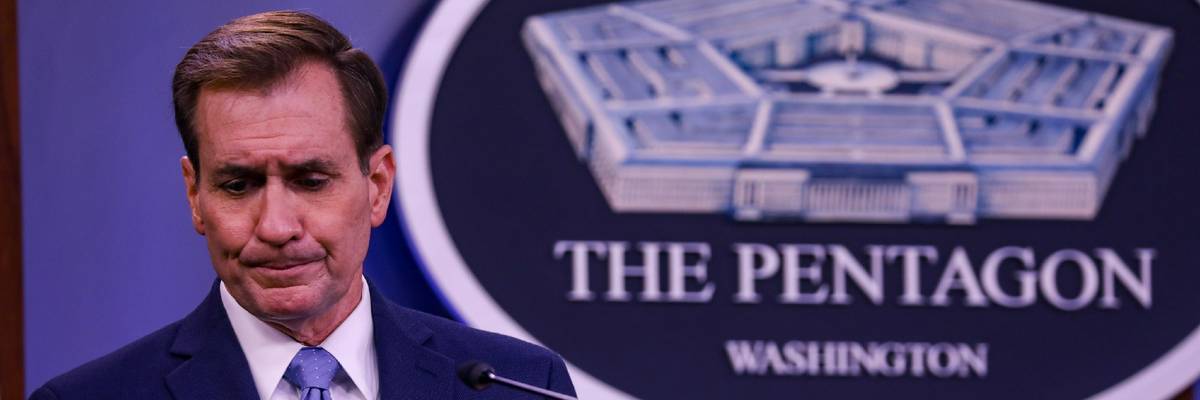
Pentagon Press Secretary John Kirby speaks to the media on January 28, 2021 in Arlington, Virginia. (Photo: Yasin Ozturk/Anadolu Agency via Getty Images)
Congress Needs to Investigate the Pentagon's Failure to Protect Civilians
A New York Times exposé on a previously undisclosed attack on dozens of noncombatants in Syria is indicative of DOD's impunity.
Pentagon leadership cannot -- or will not -- fix its civilian casualties problem. It's long past time for Congress to step in.
On November 17, Defense Secretary Lloyd Austin said, "we are committed to protecting civilians and getting this right. ...We have more work to do in that regard, clearly." His remarks came in response to a New York Times investigation showing that the U.S. military killed up to 64 civilians in Baghouz, Syria, in 2019. If this feels reminiscent of the August drone strike in Kabul, Afghanistan that killed 10 civilians including 7 children, that's because it is.
"Congress should have been conducting this kind of robust oversight of military operations all along. It simply hasn't."
These civilian deaths occurred two years and thousands of miles apart but they're part of a common problem going back 20 years. The U.S. Defense Department has been unwilling or unable to revise its procedures to save civilian lives. Given the high cost of ongoing failure, an independent investigation is needed to finally fix what's going wrong. We're looking to Congress.
Long before the mea culpas of the Kabul and Baghouz strikes, defense secretaries have touted the U.S. military's efforts to limit harm. The talking point goes something like "no military works harder than ours to avoid civilian casualties." There's some truth in that, given the number of trainings, studies, standard operating procedures, and tactical directives -- all focused on minimizing civilian harm.
But civilians keep getting killed. Sometimes their deaths are violations of international humanitarian law, or the laws of war, including "mistakes" in targeting. Sometimes they are the unintended consequence of using lethal force, what the military calls "collateral damage." What's clear is that minimizing civilian harm is not a priority. A policy that was supposed to ensure proper investigations has been in the works for five years under the Pentagon's civilian leadership, years longer than any concept of operations planning would take to invade a country. There's no meaningful accountability for civilian deaths. And the cover-up exposed by the Times is so clearly wrong it's in a category of its own.
That report on Baghouz shows that the U.S. military can ignore safeguards put in place to prevent civilian casualties. In that case, strike operators relied on overly vague justifications of self-defense. The unit responsible justified 80 percent of their strikes as "self-defense" even though they were generally far from the front line. In the Kabul strike, the assessments tracking one man over many hours were wrong. The claim that the U.S. military is the most precise in the world is only true if it's the right target -- and it's clearly not the right target as often as we hear it is.
Perhaps more alarming, the Defense Department fails to exercise oversight after clearly problematic strikes occur. Even though a military lawyer promptly reported potential violations of international humanitarian law upon reviewing footage of the 2019 Baghouz strikes, others in the force allegedly went to great lengths to cover up what had occurred. They wove a narrative that included falsified strike logs to make the strike appear legal. Still, the links in the chain of command did not act.
When the same military lawyer later filed a report with the Air Force Inspector General, an investigative team substantiated the complaint. But the leadership turned a blind eye. When one member of the investigative team continued to raise concerns, he was fired.
That is the opposite of accountability.
Human rights groups in the United States have long questioned the validity of the Defense Department's reporting on civilian casualties. Consider that since the Times report on the 2019 Syria strikes, the U.S. government has only acknowledged killing four civilians. They claim that they cannot conclusively identify the combatant status of the 60 others killed. We're familiar with this line of reasoning, having heard it as a mantra in response to mountains of evidence we've submitted for years of harm to civilians.
It is past time for statements, tweets, and apologies. And it's certainly past time for us to trust the Defense Department to fix this since those explicitly responsible for doing so have failed over and over.
Congress should have been conducting this kind of robust oversight of military operations all along. It simply hasn't.
The House Armed Services Committee has already announced an investigation and the Senate Armed Services Committee should immediately do the same. SASC's involvement is especially critical given that its 2008 report on detainee treatment can serve as a model for what an investigation into civilian harm could look like.
The critical piece is to evaluate not just the individual strikes but systemic failures by the U.S. military and its civilian leadership -- failures to set the right guidance on civilian harm, to follow up on investigations, to avoid safeguards and oversight. The timeline should be the 20 years of military operations beginning after 9-11. But let's at least start with a review of what current policies and procedures are in place to protect civilians.
Any investigations into specific incidents of civilian harm should identify individuals who committed or covered up illegal acts against civilians, and recommend the right course of action for accountability, including opening criminal investigations. And investigators should propose changes to U.S. policy and practice, depending on their findings.
Congress can step up its oversight, but let's remember where the buck stops. It's the job of the president to set a command environment in which civilian deaths like the ones we're reading about in the news -- and certainly lying about civilian deaths -- isn't tolerated. The reported Syria strike occurred under President Donald Trump, who loosened targeting rules meant to protect civilians. But the Kabul strike happened under President Joe Biden's watch. Given his rhetorical emphasis on human rights, we'd have expected an all-hands-on-deck tasking to the Pentagon to address the gaps in guidance, accountability, and transparency. No such missive, as far as we know, has come from the White House.
Without independent oversight, the Syria expose into civilian casualties by U.S. forces won't be the last. More civilian deaths can be prevented. Just don't leave it to the Pentagon.
An Urgent Message From Our Co-Founder
Dear Common Dreams reader, It’s been nearly 30 years since I co-founded Common Dreams with my late wife, Lina Newhouser. We had the radical notion that journalism should serve the public good, not corporate profits. It was clear to us from the outset what it would take to build such a project. No paid advertisements. No corporate sponsors. No millionaire publisher telling us what to think or do. Many people said we wouldn't last a year, but we proved those doubters wrong. Together with a tremendous team of journalists and dedicated staff, we built an independent media outlet free from the constraints of profits and corporate control. Our mission has always been simple: To inform. To inspire. To ignite change for the common good. Building Common Dreams was not easy. Our survival was never guaranteed. When you take on the most powerful forces—Wall Street greed, fossil fuel industry destruction, Big Tech lobbyists, and uber-rich oligarchs who have spent billions upon billions rigging the economy and democracy in their favor—the only bulwark you have is supporters who believe in your work. But here’s the urgent message from me today. It's never been this bad out there. And it's never been this hard to keep us going. At the very moment Common Dreams is most needed, the threats we face are intensifying. We need your support now more than ever. We don't accept corporate advertising and never will. We don't have a paywall because we don't think people should be blocked from critical news based on their ability to pay. Everything we do is funded by the donations of readers like you. When everyone does the little they can afford, we are strong. But if that support retreats or dries up, so do we. Will you donate now to make sure Common Dreams not only survives but thrives? —Craig Brown, Co-founder |
Pentagon leadership cannot -- or will not -- fix its civilian casualties problem. It's long past time for Congress to step in.
On November 17, Defense Secretary Lloyd Austin said, "we are committed to protecting civilians and getting this right. ...We have more work to do in that regard, clearly." His remarks came in response to a New York Times investigation showing that the U.S. military killed up to 64 civilians in Baghouz, Syria, in 2019. If this feels reminiscent of the August drone strike in Kabul, Afghanistan that killed 10 civilians including 7 children, that's because it is.
"Congress should have been conducting this kind of robust oversight of military operations all along. It simply hasn't."
These civilian deaths occurred two years and thousands of miles apart but they're part of a common problem going back 20 years. The U.S. Defense Department has been unwilling or unable to revise its procedures to save civilian lives. Given the high cost of ongoing failure, an independent investigation is needed to finally fix what's going wrong. We're looking to Congress.
Long before the mea culpas of the Kabul and Baghouz strikes, defense secretaries have touted the U.S. military's efforts to limit harm. The talking point goes something like "no military works harder than ours to avoid civilian casualties." There's some truth in that, given the number of trainings, studies, standard operating procedures, and tactical directives -- all focused on minimizing civilian harm.
But civilians keep getting killed. Sometimes their deaths are violations of international humanitarian law, or the laws of war, including "mistakes" in targeting. Sometimes they are the unintended consequence of using lethal force, what the military calls "collateral damage." What's clear is that minimizing civilian harm is not a priority. A policy that was supposed to ensure proper investigations has been in the works for five years under the Pentagon's civilian leadership, years longer than any concept of operations planning would take to invade a country. There's no meaningful accountability for civilian deaths. And the cover-up exposed by the Times is so clearly wrong it's in a category of its own.
That report on Baghouz shows that the U.S. military can ignore safeguards put in place to prevent civilian casualties. In that case, strike operators relied on overly vague justifications of self-defense. The unit responsible justified 80 percent of their strikes as "self-defense" even though they were generally far from the front line. In the Kabul strike, the assessments tracking one man over many hours were wrong. The claim that the U.S. military is the most precise in the world is only true if it's the right target -- and it's clearly not the right target as often as we hear it is.
Perhaps more alarming, the Defense Department fails to exercise oversight after clearly problematic strikes occur. Even though a military lawyer promptly reported potential violations of international humanitarian law upon reviewing footage of the 2019 Baghouz strikes, others in the force allegedly went to great lengths to cover up what had occurred. They wove a narrative that included falsified strike logs to make the strike appear legal. Still, the links in the chain of command did not act.
When the same military lawyer later filed a report with the Air Force Inspector General, an investigative team substantiated the complaint. But the leadership turned a blind eye. When one member of the investigative team continued to raise concerns, he was fired.
That is the opposite of accountability.
Human rights groups in the United States have long questioned the validity of the Defense Department's reporting on civilian casualties. Consider that since the Times report on the 2019 Syria strikes, the U.S. government has only acknowledged killing four civilians. They claim that they cannot conclusively identify the combatant status of the 60 others killed. We're familiar with this line of reasoning, having heard it as a mantra in response to mountains of evidence we've submitted for years of harm to civilians.
It is past time for statements, tweets, and apologies. And it's certainly past time for us to trust the Defense Department to fix this since those explicitly responsible for doing so have failed over and over.
Congress should have been conducting this kind of robust oversight of military operations all along. It simply hasn't.
The House Armed Services Committee has already announced an investigation and the Senate Armed Services Committee should immediately do the same. SASC's involvement is especially critical given that its 2008 report on detainee treatment can serve as a model for what an investigation into civilian harm could look like.
The critical piece is to evaluate not just the individual strikes but systemic failures by the U.S. military and its civilian leadership -- failures to set the right guidance on civilian harm, to follow up on investigations, to avoid safeguards and oversight. The timeline should be the 20 years of military operations beginning after 9-11. But let's at least start with a review of what current policies and procedures are in place to protect civilians.
Any investigations into specific incidents of civilian harm should identify individuals who committed or covered up illegal acts against civilians, and recommend the right course of action for accountability, including opening criminal investigations. And investigators should propose changes to U.S. policy and practice, depending on their findings.
Congress can step up its oversight, but let's remember where the buck stops. It's the job of the president to set a command environment in which civilian deaths like the ones we're reading about in the news -- and certainly lying about civilian deaths -- isn't tolerated. The reported Syria strike occurred under President Donald Trump, who loosened targeting rules meant to protect civilians. But the Kabul strike happened under President Joe Biden's watch. Given his rhetorical emphasis on human rights, we'd have expected an all-hands-on-deck tasking to the Pentagon to address the gaps in guidance, accountability, and transparency. No such missive, as far as we know, has come from the White House.
Without independent oversight, the Syria expose into civilian casualties by U.S. forces won't be the last. More civilian deaths can be prevented. Just don't leave it to the Pentagon.
Pentagon leadership cannot -- or will not -- fix its civilian casualties problem. It's long past time for Congress to step in.
On November 17, Defense Secretary Lloyd Austin said, "we are committed to protecting civilians and getting this right. ...We have more work to do in that regard, clearly." His remarks came in response to a New York Times investigation showing that the U.S. military killed up to 64 civilians in Baghouz, Syria, in 2019. If this feels reminiscent of the August drone strike in Kabul, Afghanistan that killed 10 civilians including 7 children, that's because it is.
"Congress should have been conducting this kind of robust oversight of military operations all along. It simply hasn't."
These civilian deaths occurred two years and thousands of miles apart but they're part of a common problem going back 20 years. The U.S. Defense Department has been unwilling or unable to revise its procedures to save civilian lives. Given the high cost of ongoing failure, an independent investigation is needed to finally fix what's going wrong. We're looking to Congress.
Long before the mea culpas of the Kabul and Baghouz strikes, defense secretaries have touted the U.S. military's efforts to limit harm. The talking point goes something like "no military works harder than ours to avoid civilian casualties." There's some truth in that, given the number of trainings, studies, standard operating procedures, and tactical directives -- all focused on minimizing civilian harm.
But civilians keep getting killed. Sometimes their deaths are violations of international humanitarian law, or the laws of war, including "mistakes" in targeting. Sometimes they are the unintended consequence of using lethal force, what the military calls "collateral damage." What's clear is that minimizing civilian harm is not a priority. A policy that was supposed to ensure proper investigations has been in the works for five years under the Pentagon's civilian leadership, years longer than any concept of operations planning would take to invade a country. There's no meaningful accountability for civilian deaths. And the cover-up exposed by the Times is so clearly wrong it's in a category of its own.
That report on Baghouz shows that the U.S. military can ignore safeguards put in place to prevent civilian casualties. In that case, strike operators relied on overly vague justifications of self-defense. The unit responsible justified 80 percent of their strikes as "self-defense" even though they were generally far from the front line. In the Kabul strike, the assessments tracking one man over many hours were wrong. The claim that the U.S. military is the most precise in the world is only true if it's the right target -- and it's clearly not the right target as often as we hear it is.
Perhaps more alarming, the Defense Department fails to exercise oversight after clearly problematic strikes occur. Even though a military lawyer promptly reported potential violations of international humanitarian law upon reviewing footage of the 2019 Baghouz strikes, others in the force allegedly went to great lengths to cover up what had occurred. They wove a narrative that included falsified strike logs to make the strike appear legal. Still, the links in the chain of command did not act.
When the same military lawyer later filed a report with the Air Force Inspector General, an investigative team substantiated the complaint. But the leadership turned a blind eye. When one member of the investigative team continued to raise concerns, he was fired.
That is the opposite of accountability.
Human rights groups in the United States have long questioned the validity of the Defense Department's reporting on civilian casualties. Consider that since the Times report on the 2019 Syria strikes, the U.S. government has only acknowledged killing four civilians. They claim that they cannot conclusively identify the combatant status of the 60 others killed. We're familiar with this line of reasoning, having heard it as a mantra in response to mountains of evidence we've submitted for years of harm to civilians.
It is past time for statements, tweets, and apologies. And it's certainly past time for us to trust the Defense Department to fix this since those explicitly responsible for doing so have failed over and over.
Congress should have been conducting this kind of robust oversight of military operations all along. It simply hasn't.
The House Armed Services Committee has already announced an investigation and the Senate Armed Services Committee should immediately do the same. SASC's involvement is especially critical given that its 2008 report on detainee treatment can serve as a model for what an investigation into civilian harm could look like.
The critical piece is to evaluate not just the individual strikes but systemic failures by the U.S. military and its civilian leadership -- failures to set the right guidance on civilian harm, to follow up on investigations, to avoid safeguards and oversight. The timeline should be the 20 years of military operations beginning after 9-11. But let's at least start with a review of what current policies and procedures are in place to protect civilians.
Any investigations into specific incidents of civilian harm should identify individuals who committed or covered up illegal acts against civilians, and recommend the right course of action for accountability, including opening criminal investigations. And investigators should propose changes to U.S. policy and practice, depending on their findings.
Congress can step up its oversight, but let's remember where the buck stops. It's the job of the president to set a command environment in which civilian deaths like the ones we're reading about in the news -- and certainly lying about civilian deaths -- isn't tolerated. The reported Syria strike occurred under President Donald Trump, who loosened targeting rules meant to protect civilians. But the Kabul strike happened under President Joe Biden's watch. Given his rhetorical emphasis on human rights, we'd have expected an all-hands-on-deck tasking to the Pentagon to address the gaps in guidance, accountability, and transparency. No such missive, as far as we know, has come from the White House.
Without independent oversight, the Syria expose into civilian casualties by U.S. forces won't be the last. More civilian deaths can be prevented. Just don't leave it to the Pentagon.