SUBSCRIBE TO OUR FREE NEWSLETTER
Daily news & progressive opinion—funded by the people, not the corporations—delivered straight to your inbox.
5
#000000
#FFFFFF
To donate by check, phone, or other method, see our More Ways to Give page.
Daily news & progressive opinion—funded by the people, not the corporations—delivered straight to your inbox.
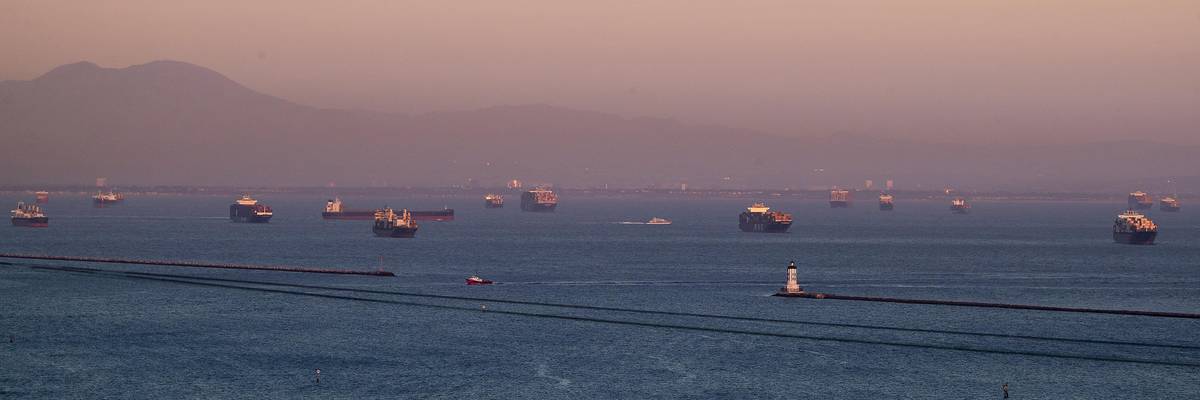
The sunset illuminates the scene of dozens of container ships siting off the coast of the Ports of Los Angeles and Long Beach, waiting to be unloaded Wednesday, Oct. 13, 2021. (Allen J. Schaben / Los Angeles Times via Getty Images)
A chain is no stronger than its weakest link. Weak links have been the story for much of the last year. That should force us to consider the possibility that weak links are not just a sh**t happens event but symptomatic of larger pathologies pervading many of our most basic industries.
Consider Boeing, once regarded as the crown jewel not only of aviation but even of the entire manufacturing sector. Technological excellence, innovation, and quality control were its watchwords. More recently it is a different, dispiriting story.
Marie Christine Duggan, writing in Dollars and Sense, reports:
Years of deferred maintenance, short-term thinking, and obsessive focus on stock prices and dividends have come to exact their toll. She writes that in 2017, Boeing put 66% of its total spending into dividends and stock buybacks, whereas in 1990 that proportion of spending went instead to new equipment to manufacture things.
In a market economy how did Boeing get away with production of a product becoming ever more inadequate.? Part of the reason is that Boeing is a monopoly with only one international competitor, AirBus. When competitors are so severely limited they tend to collaborate. Furthermore, the company, like most major corporations today, is listed on public stock exchanges in an era when markets as perfect information processing machines and maximizing shareholder value are the guiding norms. These institutional and cultural features helped sustain and were sustained by an inflated sense of self-worth among the elites who ran these corporations. Cory Doctorow puts this well: Monopolies are brittle. The ideology that underpins them is fundamentally eugenic: that there exist among us superbeings, genetic sports who were born with the extraordinary insights and genius that entitle them to rule over the rest of us. If we let nature run its course, according to this ideology, these benevolent dictators will usher in an era of global prosperity. This is catastrophically, idiotically, manifestly wrong. First, even people who are very smart about some things are very stupid about other things."
These priorities were resisted both by unions and by mid-level technical and engineering staff. Boeing sought to move its operations to South Carolina, an anti=union state.
Duggan writes:
This experience leads me to question the wisdom of President Biden's first specific supply chain policy, opening LA port 24/7. My first reaction was who will do the graveyard shift and with what costs in terms of accidents and mistakes? Overtime will surely be necessary and will it be forced? What role did unions--both leaders and rank and file- have in this decision.?
If the highly concentrated and regulated market of plane manufacture led to the ultimate supply chain failure, a fatal crash, it does not follow that a market with many buyers and many sellers will produce a just and stable alternative. Josh Wingrove, Jill R Shah, and Brendan Case write at Bloomberg:
More broadly both should emphatically reject neoliberal notions of just-in-time delivery systems and other transport, advertising, and investment decisions driven solely by the stock market.
But the president has instead focused on trying to produce new drivers by streamlining licensing. The White House says "an average of 50,000 commercial drivers licenses and learners permits have been issued each month this year, 14% above 2019 and far above 2020 levels when the pandemic shuttered training programs." And then the newly licensed drivers discover they have to work long hours for nothing, and move on, right? "
The metaphor of supply CHAINS is misleading. Institutional and individual biases and decisions constitute these. Many of today's supply chain crises are rooted in part in the excesses of neoliberal capitalism. Monoculture agriculture, international trade, and pharmaceuticals come immediately to mind. This capitalism professes faith in markets but manipulates the market to express and concentrate power, then uses that power to extort further gains. At a minimum anti-trust and labor's right to organize are necessary conditions both for social justice and safer supply chains.
Dear Common Dreams reader, It’s been nearly 30 years since I co-founded Common Dreams with my late wife, Lina Newhouser. We had the radical notion that journalism should serve the public good, not corporate profits. It was clear to us from the outset what it would take to build such a project. No paid advertisements. No corporate sponsors. No millionaire publisher telling us what to think or do. Many people said we wouldn't last a year, but we proved those doubters wrong. Together with a tremendous team of journalists and dedicated staff, we built an independent media outlet free from the constraints of profits and corporate control. Our mission has always been simple: To inform. To inspire. To ignite change for the common good. Building Common Dreams was not easy. Our survival was never guaranteed. When you take on the most powerful forces—Wall Street greed, fossil fuel industry destruction, Big Tech lobbyists, and uber-rich oligarchs who have spent billions upon billions rigging the economy and democracy in their favor—the only bulwark you have is supporters who believe in your work. But here’s the urgent message from me today. It's never been this bad out there. And it's never been this hard to keep us going. At the very moment Common Dreams is most needed, the threats we face are intensifying. We need your support now more than ever. We don't accept corporate advertising and never will. We don't have a paywall because we don't think people should be blocked from critical news based on their ability to pay. Everything we do is funded by the donations of readers like you. When everyone does the little they can afford, we are strong. But if that support retreats or dries up, so do we. Will you donate now to make sure Common Dreams not only survives but thrives? —Craig Brown, Co-founder |
A chain is no stronger than its weakest link. Weak links have been the story for much of the last year. That should force us to consider the possibility that weak links are not just a sh**t happens event but symptomatic of larger pathologies pervading many of our most basic industries.
Consider Boeing, once regarded as the crown jewel not only of aviation but even of the entire manufacturing sector. Technological excellence, innovation, and quality control were its watchwords. More recently it is a different, dispiriting story.
Marie Christine Duggan, writing in Dollars and Sense, reports:
Years of deferred maintenance, short-term thinking, and obsessive focus on stock prices and dividends have come to exact their toll. She writes that in 2017, Boeing put 66% of its total spending into dividends and stock buybacks, whereas in 1990 that proportion of spending went instead to new equipment to manufacture things.
In a market economy how did Boeing get away with production of a product becoming ever more inadequate.? Part of the reason is that Boeing is a monopoly with only one international competitor, AirBus. When competitors are so severely limited they tend to collaborate. Furthermore, the company, like most major corporations today, is listed on public stock exchanges in an era when markets as perfect information processing machines and maximizing shareholder value are the guiding norms. These institutional and cultural features helped sustain and were sustained by an inflated sense of self-worth among the elites who ran these corporations. Cory Doctorow puts this well: Monopolies are brittle. The ideology that underpins them is fundamentally eugenic: that there exist among us superbeings, genetic sports who were born with the extraordinary insights and genius that entitle them to rule over the rest of us. If we let nature run its course, according to this ideology, these benevolent dictators will usher in an era of global prosperity. This is catastrophically, idiotically, manifestly wrong. First, even people who are very smart about some things are very stupid about other things."
These priorities were resisted both by unions and by mid-level technical and engineering staff. Boeing sought to move its operations to South Carolina, an anti=union state.
Duggan writes:
This experience leads me to question the wisdom of President Biden's first specific supply chain policy, opening LA port 24/7. My first reaction was who will do the graveyard shift and with what costs in terms of accidents and mistakes? Overtime will surely be necessary and will it be forced? What role did unions--both leaders and rank and file- have in this decision.?
If the highly concentrated and regulated market of plane manufacture led to the ultimate supply chain failure, a fatal crash, it does not follow that a market with many buyers and many sellers will produce a just and stable alternative. Josh Wingrove, Jill R Shah, and Brendan Case write at Bloomberg:
More broadly both should emphatically reject neoliberal notions of just-in-time delivery systems and other transport, advertising, and investment decisions driven solely by the stock market.
But the president has instead focused on trying to produce new drivers by streamlining licensing. The White House says "an average of 50,000 commercial drivers licenses and learners permits have been issued each month this year, 14% above 2019 and far above 2020 levels when the pandemic shuttered training programs." And then the newly licensed drivers discover they have to work long hours for nothing, and move on, right? "
The metaphor of supply CHAINS is misleading. Institutional and individual biases and decisions constitute these. Many of today's supply chain crises are rooted in part in the excesses of neoliberal capitalism. Monoculture agriculture, international trade, and pharmaceuticals come immediately to mind. This capitalism professes faith in markets but manipulates the market to express and concentrate power, then uses that power to extort further gains. At a minimum anti-trust and labor's right to organize are necessary conditions both for social justice and safer supply chains.
A chain is no stronger than its weakest link. Weak links have been the story for much of the last year. That should force us to consider the possibility that weak links are not just a sh**t happens event but symptomatic of larger pathologies pervading many of our most basic industries.
Consider Boeing, once regarded as the crown jewel not only of aviation but even of the entire manufacturing sector. Technological excellence, innovation, and quality control were its watchwords. More recently it is a different, dispiriting story.
Marie Christine Duggan, writing in Dollars and Sense, reports:
Years of deferred maintenance, short-term thinking, and obsessive focus on stock prices and dividends have come to exact their toll. She writes that in 2017, Boeing put 66% of its total spending into dividends and stock buybacks, whereas in 1990 that proportion of spending went instead to new equipment to manufacture things.
In a market economy how did Boeing get away with production of a product becoming ever more inadequate.? Part of the reason is that Boeing is a monopoly with only one international competitor, AirBus. When competitors are so severely limited they tend to collaborate. Furthermore, the company, like most major corporations today, is listed on public stock exchanges in an era when markets as perfect information processing machines and maximizing shareholder value are the guiding norms. These institutional and cultural features helped sustain and were sustained by an inflated sense of self-worth among the elites who ran these corporations. Cory Doctorow puts this well: Monopolies are brittle. The ideology that underpins them is fundamentally eugenic: that there exist among us superbeings, genetic sports who were born with the extraordinary insights and genius that entitle them to rule over the rest of us. If we let nature run its course, according to this ideology, these benevolent dictators will usher in an era of global prosperity. This is catastrophically, idiotically, manifestly wrong. First, even people who are very smart about some things are very stupid about other things."
These priorities were resisted both by unions and by mid-level technical and engineering staff. Boeing sought to move its operations to South Carolina, an anti=union state.
Duggan writes:
This experience leads me to question the wisdom of President Biden's first specific supply chain policy, opening LA port 24/7. My first reaction was who will do the graveyard shift and with what costs in terms of accidents and mistakes? Overtime will surely be necessary and will it be forced? What role did unions--both leaders and rank and file- have in this decision.?
If the highly concentrated and regulated market of plane manufacture led to the ultimate supply chain failure, a fatal crash, it does not follow that a market with many buyers and many sellers will produce a just and stable alternative. Josh Wingrove, Jill R Shah, and Brendan Case write at Bloomberg:
More broadly both should emphatically reject neoliberal notions of just-in-time delivery systems and other transport, advertising, and investment decisions driven solely by the stock market.
But the president has instead focused on trying to produce new drivers by streamlining licensing. The White House says "an average of 50,000 commercial drivers licenses and learners permits have been issued each month this year, 14% above 2019 and far above 2020 levels when the pandemic shuttered training programs." And then the newly licensed drivers discover they have to work long hours for nothing, and move on, right? "
The metaphor of supply CHAINS is misleading. Institutional and individual biases and decisions constitute these. Many of today's supply chain crises are rooted in part in the excesses of neoliberal capitalism. Monoculture agriculture, international trade, and pharmaceuticals come immediately to mind. This capitalism professes faith in markets but manipulates the market to express and concentrate power, then uses that power to extort further gains. At a minimum anti-trust and labor's right to organize are necessary conditions both for social justice and safer supply chains.