SUBSCRIBE TO OUR FREE NEWSLETTER
Daily news & progressive opinion—funded by the people, not the corporations—delivered straight to your inbox.
5
#000000
#FFFFFF
To donate by check, phone, or other method, see our More Ways to Give page.
Daily news & progressive opinion—funded by the people, not the corporations—delivered straight to your inbox.
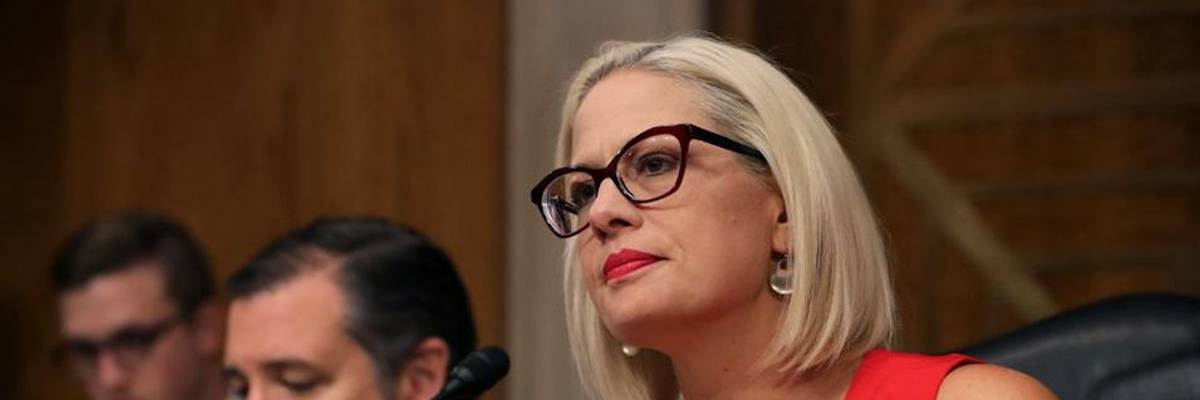
Sen. Kyrsten Sinema (D-Ariz.) and a handful of right-wing Democrats pose a potentially existential threat to the $3.5 trillion Build Back Better Act, a sweeping budget reconciliation package that, if passed, would fund robust climate action. (Photo: Chip Somodevilla/Getty Images)
Barely a year ago, my colleagues Chuck Collins and Omar Ocampo noted the passing of "a disturbing milestone in the U.S. history of concentrated wealth and power." On August 13, 2020, just twelve obscenely wealthy Americans held a combined $1.015 trillion. They called those twelve the "Oligarchic Dozen."
Or we've accepted the notion that the use of revenue derived from taxing billionaires in a meaningful way to alleviate human pain and suffering would be bad policy.
Oh, how quaint, how yesteryear.
On October 29, 2021, just half that group--just six extraordinarily rich people--held wealth totaling $1.003 trillion.
Meet our "Oligarchic Half-Dozen": Elon Musk ($292.6 billion), Jeff Bezos ($195.9), Bill Gates ($137.4), Larry Ellison ($130.0), Larry Page ($126.2), and Sergey Brin ($121.6). That number for Elon Musk, definitely not a typo: America now has its first "quarter-trillionaire."
Chuck and Omar had it right: The arrival of the Oligarchic Dozen last year should have disturbed us all. The appearance of the Oligarchic Half-Dozen just one year later should be absolutely alarming.
But apparently not alarming enough to Congress and the Biden administration. In the face of recent blockbuster reporting--by ProPublica on the paltry rate that gigantic wealth increases translate into taxable income and by both ProPublica and Bloomberg on the routine use of obscene estate tax loopholes--the Biden administration's Build Back Better framework released last week threw every proposal directed at billionaire wealth concentration overboard.
At the behest of Joe Manchin and a few other lawmakers, the so-called "Billionaire Income Tax" proposal developed by Senator Ron Wyden suddenly disappeared off the bargaining table. Wyden's modest proposal would have required billionaires to recognize their wealth gains as income and pay tax as those gains accrued.
The new framework also includes no measure to close the stepped-up basis loophole, the neat trick that lets billionaires avoid income tax on a lifetime of investment gains through the unavoidable act of dying. This loophole survives thanks to a massive and shamelessly dishonest lobbying campaign purportedly waged on behalf of farm families, all of whom would have been protected from any adverse impacts.
For no known reason at all, but possibly at the insistence of Senator Kyrsten Sinema, measures in the recent House Ways and Means proposal that would have narrowed several gaping estate tax loopholes now don't appear in the framework either.
Who should get blamed for all this? We have plenty of suspects who've contributed to the stupefying result now before us. Implicitly, we've decided that the further accumulation of billionaire fortunes--and the imminent arrival of our first trillionaires--make for good public policy. Or we've accepted the notion that the use of revenue derived from taxing billionaires in a meaningful way to alleviate human pain and suffering would be bad policy. Or both.
This can't get much crazier.
Dear Common Dreams reader, It’s been nearly 30 years since I co-founded Common Dreams with my late wife, Lina Newhouser. We had the radical notion that journalism should serve the public good, not corporate profits. It was clear to us from the outset what it would take to build such a project. No paid advertisements. No corporate sponsors. No millionaire publisher telling us what to think or do. Many people said we wouldn't last a year, but we proved those doubters wrong. Together with a tremendous team of journalists and dedicated staff, we built an independent media outlet free from the constraints of profits and corporate control. Our mission has always been simple: To inform. To inspire. To ignite change for the common good. Building Common Dreams was not easy. Our survival was never guaranteed. When you take on the most powerful forces—Wall Street greed, fossil fuel industry destruction, Big Tech lobbyists, and uber-rich oligarchs who have spent billions upon billions rigging the economy and democracy in their favor—the only bulwark you have is supporters who believe in your work. But here’s the urgent message from me today. It's never been this bad out there. And it's never been this hard to keep us going. At the very moment Common Dreams is most needed, the threats we face are intensifying. We need your support now more than ever. We don't accept corporate advertising and never will. We don't have a paywall because we don't think people should be blocked from critical news based on their ability to pay. Everything we do is funded by the donations of readers like you. When everyone does the little they can afford, we are strong. But if that support retreats or dries up, so do we. Will you donate now to make sure Common Dreams not only survives but thrives? —Craig Brown, Co-founder |
Barely a year ago, my colleagues Chuck Collins and Omar Ocampo noted the passing of "a disturbing milestone in the U.S. history of concentrated wealth and power." On August 13, 2020, just twelve obscenely wealthy Americans held a combined $1.015 trillion. They called those twelve the "Oligarchic Dozen."
Or we've accepted the notion that the use of revenue derived from taxing billionaires in a meaningful way to alleviate human pain and suffering would be bad policy.
Oh, how quaint, how yesteryear.
On October 29, 2021, just half that group--just six extraordinarily rich people--held wealth totaling $1.003 trillion.
Meet our "Oligarchic Half-Dozen": Elon Musk ($292.6 billion), Jeff Bezos ($195.9), Bill Gates ($137.4), Larry Ellison ($130.0), Larry Page ($126.2), and Sergey Brin ($121.6). That number for Elon Musk, definitely not a typo: America now has its first "quarter-trillionaire."
Chuck and Omar had it right: The arrival of the Oligarchic Dozen last year should have disturbed us all. The appearance of the Oligarchic Half-Dozen just one year later should be absolutely alarming.
But apparently not alarming enough to Congress and the Biden administration. In the face of recent blockbuster reporting--by ProPublica on the paltry rate that gigantic wealth increases translate into taxable income and by both ProPublica and Bloomberg on the routine use of obscene estate tax loopholes--the Biden administration's Build Back Better framework released last week threw every proposal directed at billionaire wealth concentration overboard.
At the behest of Joe Manchin and a few other lawmakers, the so-called "Billionaire Income Tax" proposal developed by Senator Ron Wyden suddenly disappeared off the bargaining table. Wyden's modest proposal would have required billionaires to recognize their wealth gains as income and pay tax as those gains accrued.
The new framework also includes no measure to close the stepped-up basis loophole, the neat trick that lets billionaires avoid income tax on a lifetime of investment gains through the unavoidable act of dying. This loophole survives thanks to a massive and shamelessly dishonest lobbying campaign purportedly waged on behalf of farm families, all of whom would have been protected from any adverse impacts.
For no known reason at all, but possibly at the insistence of Senator Kyrsten Sinema, measures in the recent House Ways and Means proposal that would have narrowed several gaping estate tax loopholes now don't appear in the framework either.
Who should get blamed for all this? We have plenty of suspects who've contributed to the stupefying result now before us. Implicitly, we've decided that the further accumulation of billionaire fortunes--and the imminent arrival of our first trillionaires--make for good public policy. Or we've accepted the notion that the use of revenue derived from taxing billionaires in a meaningful way to alleviate human pain and suffering would be bad policy. Or both.
This can't get much crazier.
Barely a year ago, my colleagues Chuck Collins and Omar Ocampo noted the passing of "a disturbing milestone in the U.S. history of concentrated wealth and power." On August 13, 2020, just twelve obscenely wealthy Americans held a combined $1.015 trillion. They called those twelve the "Oligarchic Dozen."
Or we've accepted the notion that the use of revenue derived from taxing billionaires in a meaningful way to alleviate human pain and suffering would be bad policy.
Oh, how quaint, how yesteryear.
On October 29, 2021, just half that group--just six extraordinarily rich people--held wealth totaling $1.003 trillion.
Meet our "Oligarchic Half-Dozen": Elon Musk ($292.6 billion), Jeff Bezos ($195.9), Bill Gates ($137.4), Larry Ellison ($130.0), Larry Page ($126.2), and Sergey Brin ($121.6). That number for Elon Musk, definitely not a typo: America now has its first "quarter-trillionaire."
Chuck and Omar had it right: The arrival of the Oligarchic Dozen last year should have disturbed us all. The appearance of the Oligarchic Half-Dozen just one year later should be absolutely alarming.
But apparently not alarming enough to Congress and the Biden administration. In the face of recent blockbuster reporting--by ProPublica on the paltry rate that gigantic wealth increases translate into taxable income and by both ProPublica and Bloomberg on the routine use of obscene estate tax loopholes--the Biden administration's Build Back Better framework released last week threw every proposal directed at billionaire wealth concentration overboard.
At the behest of Joe Manchin and a few other lawmakers, the so-called "Billionaire Income Tax" proposal developed by Senator Ron Wyden suddenly disappeared off the bargaining table. Wyden's modest proposal would have required billionaires to recognize their wealth gains as income and pay tax as those gains accrued.
The new framework also includes no measure to close the stepped-up basis loophole, the neat trick that lets billionaires avoid income tax on a lifetime of investment gains through the unavoidable act of dying. This loophole survives thanks to a massive and shamelessly dishonest lobbying campaign purportedly waged on behalf of farm families, all of whom would have been protected from any adverse impacts.
For no known reason at all, but possibly at the insistence of Senator Kyrsten Sinema, measures in the recent House Ways and Means proposal that would have narrowed several gaping estate tax loopholes now don't appear in the framework either.
Who should get blamed for all this? We have plenty of suspects who've contributed to the stupefying result now before us. Implicitly, we've decided that the further accumulation of billionaire fortunes--and the imminent arrival of our first trillionaires--make for good public policy. Or we've accepted the notion that the use of revenue derived from taxing billionaires in a meaningful way to alleviate human pain and suffering would be bad policy. Or both.
This can't get much crazier.