SUBSCRIBE TO OUR FREE NEWSLETTER
Daily news & progressive opinion—funded by the people, not the corporations—delivered straight to your inbox.
5
#000000
#FFFFFF
To donate by check, phone, or other method, see our More Ways to Give page.


Daily news & progressive opinion—funded by the people, not the corporations—delivered straight to your inbox.

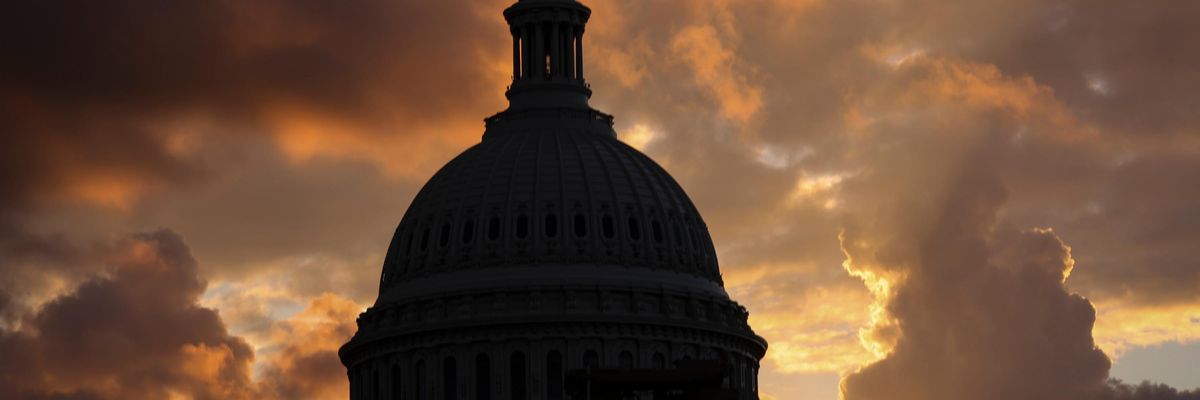
The U.S. Capitol is seen at sunset on September 17, 2021 in Washington, DC. (Photo by Tasos Katopodis/Getty Images)
In Washington, the big debate over President Biden's Building Back Better program is coming to a head. It will soon be settled--one way or another.
Most Americans who work hard, worry about the pandemic, fear for their children in school, and struggle to plan in this troubled time have neither the time nor the faith to pay much attention to posturing politicians.
Opponents focus on the price tag because they dare not argue against the necessity of the wildly popular reforms.
This time, however, it is important to understand what is at stake. The press focuses on the debate over unimaginably large numbers--$3.5 trillion against $1.5 trillion, and the $550 billion infrastructure bill against the $3.5 billion reconciliation bill. But this isn't a debate about numbers. It is an argument about morals, about what kind of country we are, and what kind of country we want to be.
The dollars are the least interesting thing about the Biden plan. What is compelling is that it addresses pressing needs and offers action. Aid to families with children that would cut the number of children in poverty in half. Paid family leave so that working mothers and fathers can have the time to care for their babies or their family in time of sickness. Major steps to make daycare affordable so that young couples won't be afraid to have children and mothers and fathers can afford to work.
Tuition-free community college and advanced training so that young people can afford to go to college no matter their parent's income. Medicare coverage for dental, eye and hearing costs so that seniors can afford the treatment they need. Lower prescription drug costs so we can afford the drugs we need, and the government can save billions that would otherwise be ripped off by the drug companies. The first modest down payment on addressing the real, present and growing costs of extreme weather and climate change.
We don't know what will happen. The 50-50 split in the Senate and the four-vote Democratic margin in the House, along with unanimous Republican obstruction, means that Democrats must unite to get anything done. That allows the wealthy and corporations to focus their legion of lobbyists and millions in ad campaigns on a handful of politicians.
Joe Manchin, one of the most notorious foot-draggers, said one thing that is true: If Democrats want to see change, "elect more liberals" (read "reformers with integrity)." To forestall that, Republicans in states across the country are passing laws to make it harder to vote, particularly for the young, for people of color, for the infirm. And they are empowering legislatures in states they control to overturn the results of an election if they don't like the outcome. That's a good part of the reason pundits say Democrats are likely to lose seats in the House and Senate in the midterms next year.
We can elect new, large reform majorities that cannot simply pass the Build Back Better Agenda but go beyond it to address the inequality and injustice, the market fundamentalist idolatry, the rigged system that fails most Americans.
The Republican agenda and pundit projections are based on business as usual and on a distracted, low-turnout electorate that can easily be turned off by making voting more difficult.
In that assumption lies our power. As Dr. King taught us, we can mobilize and vote in large numbers to teach them the cost of their insult. We can elect new, large reform majorities that cannot simply pass the Build Back Better Agenda but go beyond it to address the inequality and injustice, the market fundamentalist idolatry, the rigged system that fails most Americans.
In primary elections and in general elections, we can choose reformers over the corrupt, those who represent their voters over those who serve their donors.
That can start now. On campuses, young people flock to class and to football games, but they would flock to register and vote if they knew the stakes. They should be able to vote where they currently live and get their mail, which now is on their college campus. Working and poor people could ensure they are registered and know where to vote as the rules are changed. Parents and teachers can inform one another on the possibility of real change.
In 2020, the turnout of voters for both parties exceeded all expectations. We should start now to let politicians know that they will be rewarded for leading, not obstructing, the change we need.

Dear Common Dreams reader, It’s been nearly 30 years since I co-founded Common Dreams with my late wife, Lina Newhouser. We had the radical notion that journalism should serve the public good, not corporate profits. It was clear to us from the outset what it would take to build such a project. No paid advertisements. No corporate sponsors. No millionaire publisher telling us what to think or do. Many people said we wouldn't last a year, but we proved those doubters wrong. Together with a tremendous team of journalists and dedicated staff, we built an independent media outlet free from the constraints of profits and corporate control. Our mission has always been simple: To inform. To inspire. To ignite change for the common good. Building Common Dreams was not easy. Our survival was never guaranteed. When you take on the most powerful forces—Wall Street greed, fossil fuel industry destruction, Big Tech lobbyists, and uber-rich oligarchs who have spent billions upon billions rigging the economy and democracy in their favor—the only bulwark you have is supporters who believe in your work. But here’s the urgent message from me today. It's never been this bad out there. And it's never been this hard to keep us going. At the very moment Common Dreams is most needed, the threats we face are intensifying. We need your support now more than ever. We don't accept corporate advertising and never will. We don't have a paywall because we don't think people should be blocked from critical news based on their ability to pay. Everything we do is funded by the donations of readers like you. When everyone does the little they can afford, we are strong. But if that support retreats or dries up, so do we. Will you donate now to make sure Common Dreams not only survives but thrives? —Craig Brown, Co-founder |
In Washington, the big debate over President Biden's Building Back Better program is coming to a head. It will soon be settled--one way or another.
Most Americans who work hard, worry about the pandemic, fear for their children in school, and struggle to plan in this troubled time have neither the time nor the faith to pay much attention to posturing politicians.
Opponents focus on the price tag because they dare not argue against the necessity of the wildly popular reforms.
This time, however, it is important to understand what is at stake. The press focuses on the debate over unimaginably large numbers--$3.5 trillion against $1.5 trillion, and the $550 billion infrastructure bill against the $3.5 billion reconciliation bill. But this isn't a debate about numbers. It is an argument about morals, about what kind of country we are, and what kind of country we want to be.
The dollars are the least interesting thing about the Biden plan. What is compelling is that it addresses pressing needs and offers action. Aid to families with children that would cut the number of children in poverty in half. Paid family leave so that working mothers and fathers can have the time to care for their babies or their family in time of sickness. Major steps to make daycare affordable so that young couples won't be afraid to have children and mothers and fathers can afford to work.
Tuition-free community college and advanced training so that young people can afford to go to college no matter their parent's income. Medicare coverage for dental, eye and hearing costs so that seniors can afford the treatment they need. Lower prescription drug costs so we can afford the drugs we need, and the government can save billions that would otherwise be ripped off by the drug companies. The first modest down payment on addressing the real, present and growing costs of extreme weather and climate change.
We don't know what will happen. The 50-50 split in the Senate and the four-vote Democratic margin in the House, along with unanimous Republican obstruction, means that Democrats must unite to get anything done. That allows the wealthy and corporations to focus their legion of lobbyists and millions in ad campaigns on a handful of politicians.
Joe Manchin, one of the most notorious foot-draggers, said one thing that is true: If Democrats want to see change, "elect more liberals" (read "reformers with integrity)." To forestall that, Republicans in states across the country are passing laws to make it harder to vote, particularly for the young, for people of color, for the infirm. And they are empowering legislatures in states they control to overturn the results of an election if they don't like the outcome. That's a good part of the reason pundits say Democrats are likely to lose seats in the House and Senate in the midterms next year.
We can elect new, large reform majorities that cannot simply pass the Build Back Better Agenda but go beyond it to address the inequality and injustice, the market fundamentalist idolatry, the rigged system that fails most Americans.
The Republican agenda and pundit projections are based on business as usual and on a distracted, low-turnout electorate that can easily be turned off by making voting more difficult.
In that assumption lies our power. As Dr. King taught us, we can mobilize and vote in large numbers to teach them the cost of their insult. We can elect new, large reform majorities that cannot simply pass the Build Back Better Agenda but go beyond it to address the inequality and injustice, the market fundamentalist idolatry, the rigged system that fails most Americans.
In primary elections and in general elections, we can choose reformers over the corrupt, those who represent their voters over those who serve their donors.
That can start now. On campuses, young people flock to class and to football games, but they would flock to register and vote if they knew the stakes. They should be able to vote where they currently live and get their mail, which now is on their college campus. Working and poor people could ensure they are registered and know where to vote as the rules are changed. Parents and teachers can inform one another on the possibility of real change.
In 2020, the turnout of voters for both parties exceeded all expectations. We should start now to let politicians know that they will be rewarded for leading, not obstructing, the change we need.
In Washington, the big debate over President Biden's Building Back Better program is coming to a head. It will soon be settled--one way or another.
Most Americans who work hard, worry about the pandemic, fear for their children in school, and struggle to plan in this troubled time have neither the time nor the faith to pay much attention to posturing politicians.
Opponents focus on the price tag because they dare not argue against the necessity of the wildly popular reforms.
This time, however, it is important to understand what is at stake. The press focuses on the debate over unimaginably large numbers--$3.5 trillion against $1.5 trillion, and the $550 billion infrastructure bill against the $3.5 billion reconciliation bill. But this isn't a debate about numbers. It is an argument about morals, about what kind of country we are, and what kind of country we want to be.
The dollars are the least interesting thing about the Biden plan. What is compelling is that it addresses pressing needs and offers action. Aid to families with children that would cut the number of children in poverty in half. Paid family leave so that working mothers and fathers can have the time to care for their babies or their family in time of sickness. Major steps to make daycare affordable so that young couples won't be afraid to have children and mothers and fathers can afford to work.
Tuition-free community college and advanced training so that young people can afford to go to college no matter their parent's income. Medicare coverage for dental, eye and hearing costs so that seniors can afford the treatment they need. Lower prescription drug costs so we can afford the drugs we need, and the government can save billions that would otherwise be ripped off by the drug companies. The first modest down payment on addressing the real, present and growing costs of extreme weather and climate change.
We don't know what will happen. The 50-50 split in the Senate and the four-vote Democratic margin in the House, along with unanimous Republican obstruction, means that Democrats must unite to get anything done. That allows the wealthy and corporations to focus their legion of lobbyists and millions in ad campaigns on a handful of politicians.
Joe Manchin, one of the most notorious foot-draggers, said one thing that is true: If Democrats want to see change, "elect more liberals" (read "reformers with integrity)." To forestall that, Republicans in states across the country are passing laws to make it harder to vote, particularly for the young, for people of color, for the infirm. And they are empowering legislatures in states they control to overturn the results of an election if they don't like the outcome. That's a good part of the reason pundits say Democrats are likely to lose seats in the House and Senate in the midterms next year.
We can elect new, large reform majorities that cannot simply pass the Build Back Better Agenda but go beyond it to address the inequality and injustice, the market fundamentalist idolatry, the rigged system that fails most Americans.
The Republican agenda and pundit projections are based on business as usual and on a distracted, low-turnout electorate that can easily be turned off by making voting more difficult.
In that assumption lies our power. As Dr. King taught us, we can mobilize and vote in large numbers to teach them the cost of their insult. We can elect new, large reform majorities that cannot simply pass the Build Back Better Agenda but go beyond it to address the inequality and injustice, the market fundamentalist idolatry, the rigged system that fails most Americans.
In primary elections and in general elections, we can choose reformers over the corrupt, those who represent their voters over those who serve their donors.
That can start now. On campuses, young people flock to class and to football games, but they would flock to register and vote if they knew the stakes. They should be able to vote where they currently live and get their mail, which now is on their college campus. Working and poor people could ensure they are registered and know where to vote as the rules are changed. Parents and teachers can inform one another on the possibility of real change.
In 2020, the turnout of voters for both parties exceeded all expectations. We should start now to let politicians know that they will be rewarded for leading, not obstructing, the change we need.