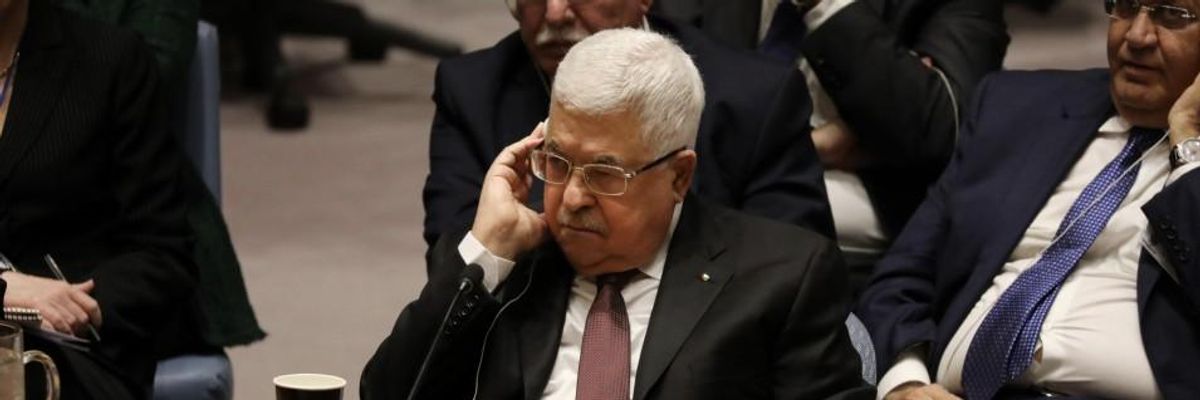
Palestinian President Mahmoud Abbas listens at the United Nations Security Council in New York on February 11, 2020. (Photo: Spencer Platt/Getty Images)
Palestinian Parties, Organizations Greet Abbas' Pledge to Take Israel to ICC as 'Historic'
Palestinian President Mahmoud Abbas pledged to take Israel to the International Criminal Court if its squatter-settlements aren't withdrawn within a year.
Al-Quds [Jerusalem] reports that Palestinians in the West Bank greeted President Mahmoud Abbas's UN speech, in which he pledged to take Israel to the International Criminal Court if its squatter-settlements weren't withdrawn within a year, with widespread acclaim.
The International Criminal Court decided in March of this year that it has jurisdiction over the Palestinian West Bank and Gaza because the Palestine Authority has invited it to consider rights abuses there. Palestine is a signatory to the Statute of Rome, which established the ICC at the Hague in the late 1990s, and member states can ask the court to take up cases. Palestine was able to become a signatory because it was granted the status of non-member observer state at the UN by the General Assembly in 2012. This is the same status enjoyed by the Vatican.
Fatah greeted the speech as "an historic document" from the Palestinians to the world. Muhammad Gharib saw it as a gauntlet thrown down to international institutions demanding that they abide by their own principles and resolutions and that they cease their double standard when it comes to Palestine.
The Palestine National Council said that Friday's speech before the UN General Assembly returned the Palestinian cause to its roots in that it focused on the creation of a Palestinian state in accordance with UN General Assembly resolution 181, which called for partition of British Mandate Palestine into Jewish and Palestinian states, and resolution 194, which called for the return of Palestinian refugees to Palestine. The chair of the PNC, Salim Zanoun, underlined that the plan would require the unity of the various Palestinian parties and factions.
He pointed out the Abbas's speech put the onus on international bodies, including the UN, to be responsible about the establishment of a Palestinian state with genuine sovereignty.
Israeli Prime Minister Naftali Bennett says he will not allow a Palestinian state to be formed, in stark contrast to the Biden administration's stated support for a two-state solution. Despite Israeli attempts to depict the Palestinians as unwilling to negotiate, it seems clear that the road block is the Israeli government, which has put out of bounds the very goal of any negotiations before they could start.
Israel seized the Palestinian Territories by main force in 1967 and has egregiously violated international law by illegally annexing some of them and by flooding hundreds of thousands of its own citizens into the Palestinian West Bank, stealing land owned by Palestinian families on which to settle these squatters. Its occupation has a shape incompatible with the Hague Regulations of 1907 and the Fourth Geneva Convention on Occupied territories of 1949, and so is itself illegal.
The Fatah Youth Movement said it would attempt to implement Abbas's speech by improving communication among Palestinian youth and confronting the Israeli Occupation's creeping annexation of Palestinian-owned land.
The Palestinian Democratic Union (FIDA) praised the speech as a road map for Palestine in the coming phase. It also called for new Palestinian elections.
Russia's Sputnik news service reports that political scientist and Palestine Authority adviser on international relations Osama Shaath said that Abbas's speech placed a burden on the international community. He underlined Abbas's "demand to hold an international peace conference under international auspices and under international supervision to implement United Nations resolutions, especially Resolution No. 2334."
We are at a crossroads
This country and this world are at a monumental crossroads. In a few short weeks, US voters will have an opportunity to beat back the forces of fascism and confront the billionaires who are rigging the economy, our media system, and our democracy, making it increasingly impossible for ordinary people to get by. We’re not just talking about the election. We’re talking about what must be done once these fascist elements are vanquished from power. We need a bolder set of solutions than what either major party has so far been willing to offer and a working-class movement ready to fight like hell for it. Trump didn't emerge from nowhere. The conditions that fueled MAGA authoritarianism were created by decades of radical neoliberal economic policies and a corrupt political system dominated by corporate interests. They slashed taxes on the super-rich, promising that the benefits would trickle down. They said giveaways to the corporate titans would make life more affordable for the rest of us. It was all bullshit. And when a bitter, betrayed populace searches for someone to blame, right-wing demagogues have little trouble finding scapegoats. People know when they're being lied to, but you won't hear any of this from the corporate media. Only independent journalism—powered and funded by people who believe in building a better world—can deliver truly trustworthy daily news. Our Fall Campaign is underway, and we need your help. To power our newsroom through the rest of the year, we need to raise $125,000 by midnight on October 31. So if you share our vision, please contribute whatever you can to sustain our work. |
Al-Quds [Jerusalem] reports that Palestinians in the West Bank greeted President Mahmoud Abbas's UN speech, in which he pledged to take Israel to the International Criminal Court if its squatter-settlements weren't withdrawn within a year, with widespread acclaim.
The International Criminal Court decided in March of this year that it has jurisdiction over the Palestinian West Bank and Gaza because the Palestine Authority has invited it to consider rights abuses there. Palestine is a signatory to the Statute of Rome, which established the ICC at the Hague in the late 1990s, and member states can ask the court to take up cases. Palestine was able to become a signatory because it was granted the status of non-member observer state at the UN by the General Assembly in 2012. This is the same status enjoyed by the Vatican.
Fatah greeted the speech as "an historic document" from the Palestinians to the world. Muhammad Gharib saw it as a gauntlet thrown down to international institutions demanding that they abide by their own principles and resolutions and that they cease their double standard when it comes to Palestine.
The Palestine National Council said that Friday's speech before the UN General Assembly returned the Palestinian cause to its roots in that it focused on the creation of a Palestinian state in accordance with UN General Assembly resolution 181, which called for partition of British Mandate Palestine into Jewish and Palestinian states, and resolution 194, which called for the return of Palestinian refugees to Palestine. The chair of the PNC, Salim Zanoun, underlined that the plan would require the unity of the various Palestinian parties and factions.
He pointed out the Abbas's speech put the onus on international bodies, including the UN, to be responsible about the establishment of a Palestinian state with genuine sovereignty.
Israeli Prime Minister Naftali Bennett says he will not allow a Palestinian state to be formed, in stark contrast to the Biden administration's stated support for a two-state solution. Despite Israeli attempts to depict the Palestinians as unwilling to negotiate, it seems clear that the road block is the Israeli government, which has put out of bounds the very goal of any negotiations before they could start.
Israel seized the Palestinian Territories by main force in 1967 and has egregiously violated international law by illegally annexing some of them and by flooding hundreds of thousands of its own citizens into the Palestinian West Bank, stealing land owned by Palestinian families on which to settle these squatters. Its occupation has a shape incompatible with the Hague Regulations of 1907 and the Fourth Geneva Convention on Occupied territories of 1949, and so is itself illegal.
The Fatah Youth Movement said it would attempt to implement Abbas's speech by improving communication among Palestinian youth and confronting the Israeli Occupation's creeping annexation of Palestinian-owned land.
The Palestinian Democratic Union (FIDA) praised the speech as a road map for Palestine in the coming phase. It also called for new Palestinian elections.
Russia's Sputnik news service reports that political scientist and Palestine Authority adviser on international relations Osama Shaath said that Abbas's speech placed a burden on the international community. He underlined Abbas's "demand to hold an international peace conference under international auspices and under international supervision to implement United Nations resolutions, especially Resolution No. 2334."
Al-Quds [Jerusalem] reports that Palestinians in the West Bank greeted President Mahmoud Abbas's UN speech, in which he pledged to take Israel to the International Criminal Court if its squatter-settlements weren't withdrawn within a year, with widespread acclaim.
The International Criminal Court decided in March of this year that it has jurisdiction over the Palestinian West Bank and Gaza because the Palestine Authority has invited it to consider rights abuses there. Palestine is a signatory to the Statute of Rome, which established the ICC at the Hague in the late 1990s, and member states can ask the court to take up cases. Palestine was able to become a signatory because it was granted the status of non-member observer state at the UN by the General Assembly in 2012. This is the same status enjoyed by the Vatican.
Fatah greeted the speech as "an historic document" from the Palestinians to the world. Muhammad Gharib saw it as a gauntlet thrown down to international institutions demanding that they abide by their own principles and resolutions and that they cease their double standard when it comes to Palestine.
The Palestine National Council said that Friday's speech before the UN General Assembly returned the Palestinian cause to its roots in that it focused on the creation of a Palestinian state in accordance with UN General Assembly resolution 181, which called for partition of British Mandate Palestine into Jewish and Palestinian states, and resolution 194, which called for the return of Palestinian refugees to Palestine. The chair of the PNC, Salim Zanoun, underlined that the plan would require the unity of the various Palestinian parties and factions.
He pointed out the Abbas's speech put the onus on international bodies, including the UN, to be responsible about the establishment of a Palestinian state with genuine sovereignty.
Israeli Prime Minister Naftali Bennett says he will not allow a Palestinian state to be formed, in stark contrast to the Biden administration's stated support for a two-state solution. Despite Israeli attempts to depict the Palestinians as unwilling to negotiate, it seems clear that the road block is the Israeli government, which has put out of bounds the very goal of any negotiations before they could start.
Israel seized the Palestinian Territories by main force in 1967 and has egregiously violated international law by illegally annexing some of them and by flooding hundreds of thousands of its own citizens into the Palestinian West Bank, stealing land owned by Palestinian families on which to settle these squatters. Its occupation has a shape incompatible with the Hague Regulations of 1907 and the Fourth Geneva Convention on Occupied territories of 1949, and so is itself illegal.
The Fatah Youth Movement said it would attempt to implement Abbas's speech by improving communication among Palestinian youth and confronting the Israeli Occupation's creeping annexation of Palestinian-owned land.
The Palestinian Democratic Union (FIDA) praised the speech as a road map for Palestine in the coming phase. It also called for new Palestinian elections.
Russia's Sputnik news service reports that political scientist and Palestine Authority adviser on international relations Osama Shaath said that Abbas's speech placed a burden on the international community. He underlined Abbas's "demand to hold an international peace conference under international auspices and under international supervision to implement United Nations resolutions, especially Resolution No. 2334."