SUBSCRIBE TO OUR FREE NEWSLETTER
Daily news & progressive opinion—funded by the people, not the corporations—delivered straight to your inbox.
5
#000000
#FFFFFF
To donate by check, phone, or other method, see our More Ways to Give page.
Daily news & progressive opinion—funded by the people, not the corporations—delivered straight to your inbox.
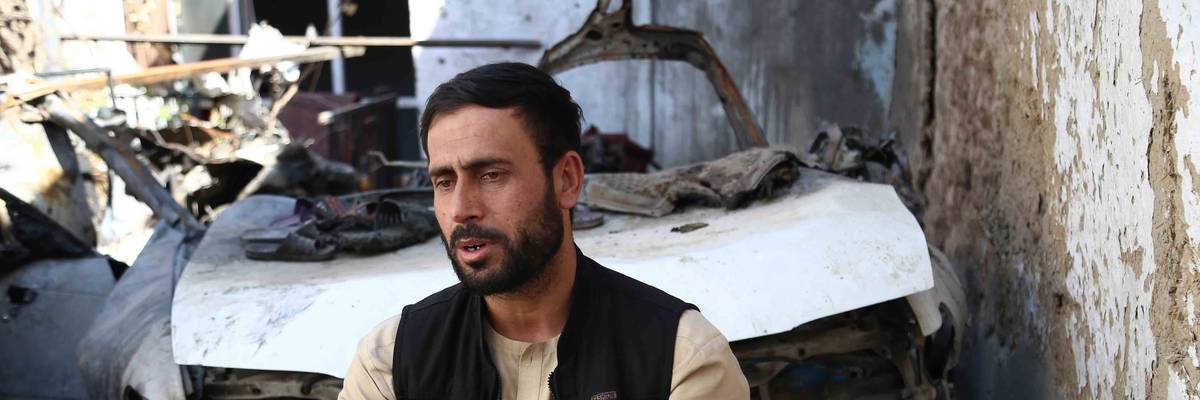
Emal Hamedi, a survivor of the U.S. drone strike, is seen at a site of the attack in Kabul, capital of Afghanistan, Sept. 18, 2021. The U.S. military admitted on Friday that a U.S. drone strike in late August in Kabul killed as many as 10 civilians, including 7 children. (Photo: Saifurahman Safi/Xinhua via Getty Images)
There are stories that seem to leap from the pages of the Old Testament directly into our newsfeeds. These stories slow down the frenetic pace of news consumption, forcing us to ponder what it means to exist in a world where such brokenness is possible--and sanctioned in the name of national security.
Over the weekend, Washington Post reporter Sudarsan Raghavan told the story of how 10 members of the Ahmadi family of Kabul were killed by a U.S. drone strike in the final chaotic days of the American occupation of Afghanistan.
Seven of the 10 victims of the "righteous strike" were children.
Immediately after the Aug. 29 strike, the Biden administration and military officials claimed that an aptly named Hellfire missile had been deployed to "neutralize" a bomb maker preparing an imminent strike against Americans and Afghan citizens trying to flee the country at the Kabul airport.
Officials hoped that it would be the last preemptive action by the U.S. military in a country it had occupied for two decades, but it did not hesitate to call the smoldering ruins of the home it destroyed and the death toll it generated a "righteous strike."
Even as stories contradicting the official narrative began circulating, American officials continued to insist that drone surveillance and field intelligence all pointed to the the presence of "ISIS-K terrorists" in the compound and that a major bomb plot against American personnel and Afghans fleeing the country had been disrupted.
Because the U.S. wanted to avoid a repeat of the Aug. 27 suicide bombings that killed 13 U.S. service members and scores of Afghans--an added layer of humiliation to a narrative that was already playing poorly with those back home who had ignored the war for 20 years--the U.S. military wanted to demonstrate that it still possessed some agency even in the closing days of another failed war.
Seven of the 10 victims of the "righteous strike" were children. Zamarai Ahmadi, the family's sole source of income, was paid $500 a month working for the California-based charity Nutrition and Education International. He was not a terrorist. Neither were his three sons who died with him--Zamir, 20, Faisal, 16, and Farzad, 11.
Also killed by the fire and shrapnel that rained down on the family's compound were the children of one of Zamarai's brothers--Arween, 7, Binyamin, 6 and Ayat, 2.
Emal Ahmadi, Zamarai's 32-year-old brother survived the drone attack on their home, but Malika, his 3-year-old daughter didn't. Neither did his nephew, Nasser, 30, or Sumaiya, a cousin's infant daughter. It has been left to Emal to tell the tale of the Ahmadi family's obliteration and declare its innocence when the Americans insisted that their home was an ISIS bomb factory.
Because Emal and Zamarai feared Taliban retribution, they filed for special visas that would allow them and their family to enter the United States because of their work on behalf of American aid workers. They had a track record of service to the American company. Many of their relatives served in Afghan intelligence and the military, too. They weren't strangers.
But Hellfire missiles aren't partial to nuances like guilt or innocence or political sympathy. A drone missile's only mission is to kill everyone within its blast radius. It is left to generals and public relations flacks to smooth over the collateral damage.
But this was a drone strike that had refused to be flushed down the usual memory hole of military malpractice. According to The Washington Post story, Emal wouldn't allow his grief to shut him up when his family was destroyed and their dead children absurdly portrayed as bomb makers in initial reports.
Last week, the Pentagon finally admitted that it had misunderstood the intelligence that led to the drone targeting of the Ahmadi family. Despite apologizing for it, no one in the upper echelons of the military or the Biden administration has reached out to the family directly in their time of unspeakable grief. So far, the apology appears to be nothing more than theater for the benefit of the press and a mostly inattentive American public at this point.
The remnants of the Ahmadi family have not cried out for revenge according to The Washington Post: "Rather, the Ahmadis grasp onto a sense of pragmatism," Mr. Raghavan wrote. "They want compensation from the U.S. government and help in leaving Afghanistan and getting resettled in the United States or another safe country, family members said."
In other words, the Ahmadi family wants reparations for a distinct and measurable harm that was done to them by the U.S. government less than a month ago.
"Whether in America or another country, we want peace and comfort for our remaining years," Mr. Raghavan quoted a member of the family saying. "Everyone makes mistakes. The Americans cannot bring back our loved ones, but they can take us out of here."
While politely requesting help in relocating to the West, the Ahmadi family also wants everyone involved in the chain of command that ended with the fiery execution of much of their family held accountable for their mistake. They don't want revenge, but they do want justice--or whatever passes for justice in America today. They deserve it and they should get it.
There are many cliches that usually come into play in a story like this--"the fog of war," "war is hell," etc. These bromides have the benefit of being partially true, but it's a version of truth that has been flattened to anesthetize us from the horror of what war truly is.
Because we're Americans, we have the option of ignoring it. Other than the broken veterans filling the streets, homeless shelters and prisons across America, wars rarely touch us directly, so we have developed a very casual relationship with the existential pain that comes with being a society at war. We rarely think about the things that are done, ostensibly to "protect us" from some "foreign devil" usually ensconced in an Islamic country.
The drone operator who ended several lines of the Ahmadi family isn't as much a victim as the people who were killed, but it's possible to be a "victim" and not realize it yet. One day his--or her--conscience will explode and life will be unbearable for a time.
We shouldn't lose sight of the fact that the Ahmadis' story is as old as the tale of Job, the oldest disaster narrative in the Bible, according to many Old Testament scholars.
Whenever the Ahmadis visit the graves of their loved ones 30 minutes away on a rocky hillside, it must seem to them that God and the devil have been playing an especially fierce game of bocce ball with their souls.
For years, they sided with the Americans on both the humanitarian and military fronts. They did everything they could to stay in the good graces of the righteous occupiers. Up until the moment a Hellfire missile pinpointed their white Toyota sedan in the family compound, they probably thought they were blessed.
But instead of "cursing God" or denouncing the Americans, the Ahmadi family very cleverly took a page from Job. After that mythic patriarch's family was destroyed and his wealth and health taken from him for no discernible reason, Job insisted through tears, broken teeth and snot on the restoration of justice to his world in the face of inexplicable horror and injustice.
The Ahmadi family did everything asked of them to support the American occupation of their country. Their faithfulness was rewarded with fire from heaven. They had to borrow money to bury their beloved dead while America slandered them as terrorists before independent reporting proved those allegations were lies.
With refugees from Haiti, Mexico, Central America and Afghanistan pleading for entry to the United States, this is an especially fraught time for many who are traditionally suspicious of immigrants under the best of circumstances. They don't want mercy to be shown to anyone if it means allowing their war stories, their horror and their experiences to cross these borders where we'd rather not know about them.
At at a time when our society is bitterly divided over questions of whether showing hospitality to "strangers and foreigners" as the Bible calls them and the "poor, huddled masses" mentioned on the base of Lady Liberty is a virtue worth preserving in a democracy, there really shouldn't be any doubt of what is owed to the Ahmadi family.
They belong in America. They've already shed more blood for this country than most Americans ever will.
Dear Common Dreams reader, It’s been nearly 30 years since I co-founded Common Dreams with my late wife, Lina Newhouser. We had the radical notion that journalism should serve the public good, not corporate profits. It was clear to us from the outset what it would take to build such a project. No paid advertisements. No corporate sponsors. No millionaire publisher telling us what to think or do. Many people said we wouldn't last a year, but we proved those doubters wrong. Together with a tremendous team of journalists and dedicated staff, we built an independent media outlet free from the constraints of profits and corporate control. Our mission has always been simple: To inform. To inspire. To ignite change for the common good. Building Common Dreams was not easy. Our survival was never guaranteed. When you take on the most powerful forces—Wall Street greed, fossil fuel industry destruction, Big Tech lobbyists, and uber-rich oligarchs who have spent billions upon billions rigging the economy and democracy in their favor—the only bulwark you have is supporters who believe in your work. But here’s the urgent message from me today. It's never been this bad out there. And it's never been this hard to keep us going. At the very moment Common Dreams is most needed, the threats we face are intensifying. We need your support now more than ever. We don't accept corporate advertising and never will. We don't have a paywall because we don't think people should be blocked from critical news based on their ability to pay. Everything we do is funded by the donations of readers like you. When everyone does the little they can afford, we are strong. But if that support retreats or dries up, so do we. Will you donate now to make sure Common Dreams not only survives but thrives? —Craig Brown, Co-founder |
There are stories that seem to leap from the pages of the Old Testament directly into our newsfeeds. These stories slow down the frenetic pace of news consumption, forcing us to ponder what it means to exist in a world where such brokenness is possible--and sanctioned in the name of national security.
Over the weekend, Washington Post reporter Sudarsan Raghavan told the story of how 10 members of the Ahmadi family of Kabul were killed by a U.S. drone strike in the final chaotic days of the American occupation of Afghanistan.
Seven of the 10 victims of the "righteous strike" were children.
Immediately after the Aug. 29 strike, the Biden administration and military officials claimed that an aptly named Hellfire missile had been deployed to "neutralize" a bomb maker preparing an imminent strike against Americans and Afghan citizens trying to flee the country at the Kabul airport.
Officials hoped that it would be the last preemptive action by the U.S. military in a country it had occupied for two decades, but it did not hesitate to call the smoldering ruins of the home it destroyed and the death toll it generated a "righteous strike."
Even as stories contradicting the official narrative began circulating, American officials continued to insist that drone surveillance and field intelligence all pointed to the the presence of "ISIS-K terrorists" in the compound and that a major bomb plot against American personnel and Afghans fleeing the country had been disrupted.
Because the U.S. wanted to avoid a repeat of the Aug. 27 suicide bombings that killed 13 U.S. service members and scores of Afghans--an added layer of humiliation to a narrative that was already playing poorly with those back home who had ignored the war for 20 years--the U.S. military wanted to demonstrate that it still possessed some agency even in the closing days of another failed war.
Seven of the 10 victims of the "righteous strike" were children. Zamarai Ahmadi, the family's sole source of income, was paid $500 a month working for the California-based charity Nutrition and Education International. He was not a terrorist. Neither were his three sons who died with him--Zamir, 20, Faisal, 16, and Farzad, 11.
Also killed by the fire and shrapnel that rained down on the family's compound were the children of one of Zamarai's brothers--Arween, 7, Binyamin, 6 and Ayat, 2.
Emal Ahmadi, Zamarai's 32-year-old brother survived the drone attack on their home, but Malika, his 3-year-old daughter didn't. Neither did his nephew, Nasser, 30, or Sumaiya, a cousin's infant daughter. It has been left to Emal to tell the tale of the Ahmadi family's obliteration and declare its innocence when the Americans insisted that their home was an ISIS bomb factory.
Because Emal and Zamarai feared Taliban retribution, they filed for special visas that would allow them and their family to enter the United States because of their work on behalf of American aid workers. They had a track record of service to the American company. Many of their relatives served in Afghan intelligence and the military, too. They weren't strangers.
But Hellfire missiles aren't partial to nuances like guilt or innocence or political sympathy. A drone missile's only mission is to kill everyone within its blast radius. It is left to generals and public relations flacks to smooth over the collateral damage.
But this was a drone strike that had refused to be flushed down the usual memory hole of military malpractice. According to The Washington Post story, Emal wouldn't allow his grief to shut him up when his family was destroyed and their dead children absurdly portrayed as bomb makers in initial reports.
Last week, the Pentagon finally admitted that it had misunderstood the intelligence that led to the drone targeting of the Ahmadi family. Despite apologizing for it, no one in the upper echelons of the military or the Biden administration has reached out to the family directly in their time of unspeakable grief. So far, the apology appears to be nothing more than theater for the benefit of the press and a mostly inattentive American public at this point.
The remnants of the Ahmadi family have not cried out for revenge according to The Washington Post: "Rather, the Ahmadis grasp onto a sense of pragmatism," Mr. Raghavan wrote. "They want compensation from the U.S. government and help in leaving Afghanistan and getting resettled in the United States or another safe country, family members said."
In other words, the Ahmadi family wants reparations for a distinct and measurable harm that was done to them by the U.S. government less than a month ago.
"Whether in America or another country, we want peace and comfort for our remaining years," Mr. Raghavan quoted a member of the family saying. "Everyone makes mistakes. The Americans cannot bring back our loved ones, but they can take us out of here."
While politely requesting help in relocating to the West, the Ahmadi family also wants everyone involved in the chain of command that ended with the fiery execution of much of their family held accountable for their mistake. They don't want revenge, but they do want justice--or whatever passes for justice in America today. They deserve it and they should get it.
There are many cliches that usually come into play in a story like this--"the fog of war," "war is hell," etc. These bromides have the benefit of being partially true, but it's a version of truth that has been flattened to anesthetize us from the horror of what war truly is.
Because we're Americans, we have the option of ignoring it. Other than the broken veterans filling the streets, homeless shelters and prisons across America, wars rarely touch us directly, so we have developed a very casual relationship with the existential pain that comes with being a society at war. We rarely think about the things that are done, ostensibly to "protect us" from some "foreign devil" usually ensconced in an Islamic country.
The drone operator who ended several lines of the Ahmadi family isn't as much a victim as the people who were killed, but it's possible to be a "victim" and not realize it yet. One day his--or her--conscience will explode and life will be unbearable for a time.
We shouldn't lose sight of the fact that the Ahmadis' story is as old as the tale of Job, the oldest disaster narrative in the Bible, according to many Old Testament scholars.
Whenever the Ahmadis visit the graves of their loved ones 30 minutes away on a rocky hillside, it must seem to them that God and the devil have been playing an especially fierce game of bocce ball with their souls.
For years, they sided with the Americans on both the humanitarian and military fronts. They did everything they could to stay in the good graces of the righteous occupiers. Up until the moment a Hellfire missile pinpointed their white Toyota sedan in the family compound, they probably thought they were blessed.
But instead of "cursing God" or denouncing the Americans, the Ahmadi family very cleverly took a page from Job. After that mythic patriarch's family was destroyed and his wealth and health taken from him for no discernible reason, Job insisted through tears, broken teeth and snot on the restoration of justice to his world in the face of inexplicable horror and injustice.
The Ahmadi family did everything asked of them to support the American occupation of their country. Their faithfulness was rewarded with fire from heaven. They had to borrow money to bury their beloved dead while America slandered them as terrorists before independent reporting proved those allegations were lies.
With refugees from Haiti, Mexico, Central America and Afghanistan pleading for entry to the United States, this is an especially fraught time for many who are traditionally suspicious of immigrants under the best of circumstances. They don't want mercy to be shown to anyone if it means allowing their war stories, their horror and their experiences to cross these borders where we'd rather not know about them.
At at a time when our society is bitterly divided over questions of whether showing hospitality to "strangers and foreigners" as the Bible calls them and the "poor, huddled masses" mentioned on the base of Lady Liberty is a virtue worth preserving in a democracy, there really shouldn't be any doubt of what is owed to the Ahmadi family.
They belong in America. They've already shed more blood for this country than most Americans ever will.
There are stories that seem to leap from the pages of the Old Testament directly into our newsfeeds. These stories slow down the frenetic pace of news consumption, forcing us to ponder what it means to exist in a world where such brokenness is possible--and sanctioned in the name of national security.
Over the weekend, Washington Post reporter Sudarsan Raghavan told the story of how 10 members of the Ahmadi family of Kabul were killed by a U.S. drone strike in the final chaotic days of the American occupation of Afghanistan.
Seven of the 10 victims of the "righteous strike" were children.
Immediately after the Aug. 29 strike, the Biden administration and military officials claimed that an aptly named Hellfire missile had been deployed to "neutralize" a bomb maker preparing an imminent strike against Americans and Afghan citizens trying to flee the country at the Kabul airport.
Officials hoped that it would be the last preemptive action by the U.S. military in a country it had occupied for two decades, but it did not hesitate to call the smoldering ruins of the home it destroyed and the death toll it generated a "righteous strike."
Even as stories contradicting the official narrative began circulating, American officials continued to insist that drone surveillance and field intelligence all pointed to the the presence of "ISIS-K terrorists" in the compound and that a major bomb plot against American personnel and Afghans fleeing the country had been disrupted.
Because the U.S. wanted to avoid a repeat of the Aug. 27 suicide bombings that killed 13 U.S. service members and scores of Afghans--an added layer of humiliation to a narrative that was already playing poorly with those back home who had ignored the war for 20 years--the U.S. military wanted to demonstrate that it still possessed some agency even in the closing days of another failed war.
Seven of the 10 victims of the "righteous strike" were children. Zamarai Ahmadi, the family's sole source of income, was paid $500 a month working for the California-based charity Nutrition and Education International. He was not a terrorist. Neither were his three sons who died with him--Zamir, 20, Faisal, 16, and Farzad, 11.
Also killed by the fire and shrapnel that rained down on the family's compound were the children of one of Zamarai's brothers--Arween, 7, Binyamin, 6 and Ayat, 2.
Emal Ahmadi, Zamarai's 32-year-old brother survived the drone attack on their home, but Malika, his 3-year-old daughter didn't. Neither did his nephew, Nasser, 30, or Sumaiya, a cousin's infant daughter. It has been left to Emal to tell the tale of the Ahmadi family's obliteration and declare its innocence when the Americans insisted that their home was an ISIS bomb factory.
Because Emal and Zamarai feared Taliban retribution, they filed for special visas that would allow them and their family to enter the United States because of their work on behalf of American aid workers. They had a track record of service to the American company. Many of their relatives served in Afghan intelligence and the military, too. They weren't strangers.
But Hellfire missiles aren't partial to nuances like guilt or innocence or political sympathy. A drone missile's only mission is to kill everyone within its blast radius. It is left to generals and public relations flacks to smooth over the collateral damage.
But this was a drone strike that had refused to be flushed down the usual memory hole of military malpractice. According to The Washington Post story, Emal wouldn't allow his grief to shut him up when his family was destroyed and their dead children absurdly portrayed as bomb makers in initial reports.
Last week, the Pentagon finally admitted that it had misunderstood the intelligence that led to the drone targeting of the Ahmadi family. Despite apologizing for it, no one in the upper echelons of the military or the Biden administration has reached out to the family directly in their time of unspeakable grief. So far, the apology appears to be nothing more than theater for the benefit of the press and a mostly inattentive American public at this point.
The remnants of the Ahmadi family have not cried out for revenge according to The Washington Post: "Rather, the Ahmadis grasp onto a sense of pragmatism," Mr. Raghavan wrote. "They want compensation from the U.S. government and help in leaving Afghanistan and getting resettled in the United States or another safe country, family members said."
In other words, the Ahmadi family wants reparations for a distinct and measurable harm that was done to them by the U.S. government less than a month ago.
"Whether in America or another country, we want peace and comfort for our remaining years," Mr. Raghavan quoted a member of the family saying. "Everyone makes mistakes. The Americans cannot bring back our loved ones, but they can take us out of here."
While politely requesting help in relocating to the West, the Ahmadi family also wants everyone involved in the chain of command that ended with the fiery execution of much of their family held accountable for their mistake. They don't want revenge, but they do want justice--or whatever passes for justice in America today. They deserve it and they should get it.
There are many cliches that usually come into play in a story like this--"the fog of war," "war is hell," etc. These bromides have the benefit of being partially true, but it's a version of truth that has been flattened to anesthetize us from the horror of what war truly is.
Because we're Americans, we have the option of ignoring it. Other than the broken veterans filling the streets, homeless shelters and prisons across America, wars rarely touch us directly, so we have developed a very casual relationship with the existential pain that comes with being a society at war. We rarely think about the things that are done, ostensibly to "protect us" from some "foreign devil" usually ensconced in an Islamic country.
The drone operator who ended several lines of the Ahmadi family isn't as much a victim as the people who were killed, but it's possible to be a "victim" and not realize it yet. One day his--or her--conscience will explode and life will be unbearable for a time.
We shouldn't lose sight of the fact that the Ahmadis' story is as old as the tale of Job, the oldest disaster narrative in the Bible, according to many Old Testament scholars.
Whenever the Ahmadis visit the graves of their loved ones 30 minutes away on a rocky hillside, it must seem to them that God and the devil have been playing an especially fierce game of bocce ball with their souls.
For years, they sided with the Americans on both the humanitarian and military fronts. They did everything they could to stay in the good graces of the righteous occupiers. Up until the moment a Hellfire missile pinpointed their white Toyota sedan in the family compound, they probably thought they were blessed.
But instead of "cursing God" or denouncing the Americans, the Ahmadi family very cleverly took a page from Job. After that mythic patriarch's family was destroyed and his wealth and health taken from him for no discernible reason, Job insisted through tears, broken teeth and snot on the restoration of justice to his world in the face of inexplicable horror and injustice.
The Ahmadi family did everything asked of them to support the American occupation of their country. Their faithfulness was rewarded with fire from heaven. They had to borrow money to bury their beloved dead while America slandered them as terrorists before independent reporting proved those allegations were lies.
With refugees from Haiti, Mexico, Central America and Afghanistan pleading for entry to the United States, this is an especially fraught time for many who are traditionally suspicious of immigrants under the best of circumstances. They don't want mercy to be shown to anyone if it means allowing their war stories, their horror and their experiences to cross these borders where we'd rather not know about them.
At at a time when our society is bitterly divided over questions of whether showing hospitality to "strangers and foreigners" as the Bible calls them and the "poor, huddled masses" mentioned on the base of Lady Liberty is a virtue worth preserving in a democracy, there really shouldn't be any doubt of what is owed to the Ahmadi family.
They belong in America. They've already shed more blood for this country than most Americans ever will.