

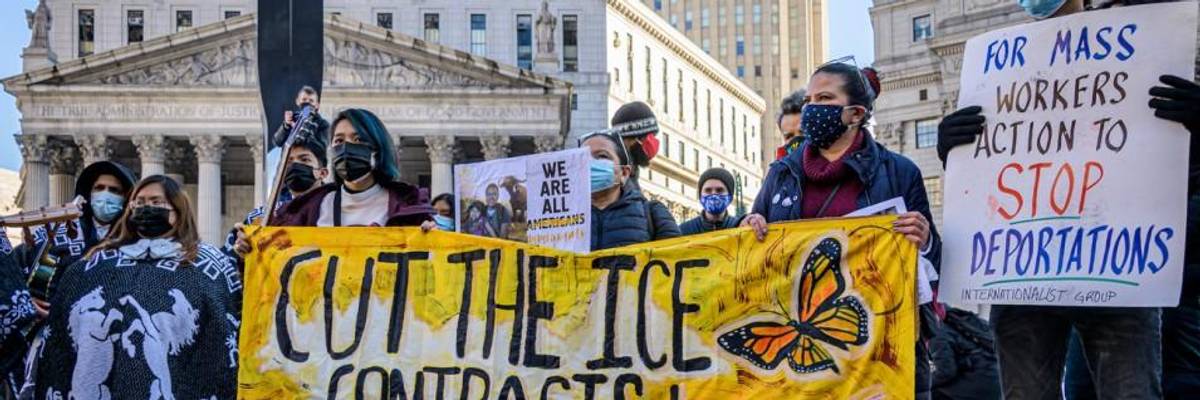
Demonstrators protest U.S. Immigration and Customs Enforcement (ICE) detention in New York City on February 6, 2021. (Photo: Erik McGregor/LightRocket via Getty Images)
There Is Nothing 'Civil' or Humane About the Detention of Noncitizens
The system itself is rotten—plagued by death, abuse, impunity, and violence.
Last week, Homeland Security Secretary Alejandro Mayorkas announced that U.S. Immigration and Customs Enforcement (ICE) will stop detaining immigrants in two county jails, in Massachusetts and Georgia, currently under federal investigation for abuses ranging from the use of flash-bang grenades and dogs against immigrants in custody to unwanted and unconsented to gynecological procedures. In heralding these closures, Secretary Mayorkas declared, "We have an obligation to make lasting improvements to our civil immigration detention system."
The decision to end the detention of immigrants at the Irwin County Detention Center in Georgia and the Bristol County House of Corrections in Massachusetts presents a tremendous victory.
No, Mr. Secretary, we have an obligation to end it.
Today, immigration detentions are at the lowest number in decades, thanks to a combination of tenacious organizing and advocacy efforts, strategic litigation, and the impact of a global pandemic. But this "low" is still quite high: somewhere around 15,000 to 20,000 persons on any given day. Under the Trump administration, that number reached more than 55,000 in 2019. If left unchecked, we could soon reach that number again.
The Immigration and Nationality Act was passed in 1952 and, among other things, allowed immigration authorities to exercise their discretion to grant release from detention on bond for certain noncitizens. Two years later, in 1954, the United States announced it would end detention except in extraordinary circumstances. Some targeted, and discriminatory, detentions of mostly Black and Brown noncitizens continued, namely detention of those who arrived with the Mariel boatlift of Cubans, and Haitian and Central American asylum-seekers. But the number of those in custody remained relatively low, hovering just under 7,000 in the early 1990s.
Over the next 25 years, the number of noncitizens detained by ICE grew dramatically. This was because of changes in immigration law and criminal law that increasingly, and relentlessly, targeted poor communities and communities of color; criminalized crimes of poverty; and made detention and deportation mandatory for minor, nonviolent misdemeanors. In the past 25 years, such mass detention and subsequent deportation has destroyed families and communities, created overwhelming financial hardship, and given rise to significant mental health problems.
There is nothing "civil" about the so-called "civil immigration detention system." Indeed, those held in immigration custody are incarcerated in a network of over 200 jails and prisons across the United States. As Justice Sonia Sotomayor asked during an oral argument in 2018: "You put [immigrant detainees] in orange suits, they are shackled during visitation and court visits, they are subject to surveillance and strip searches, they are referred to by number, not by name. So in which ways is immigration detention different than criminal detention?" The answer, of course, is that there is no difference. The system itself is rotten--plagued by death, abuse, impunity, and violence. In 2020 alone, 21 people died in immigration detention, and staggering patterns of sexual assault in immigration detention came to light. Of 1,224 complaints made regarding sexual abuse in immigration detention between 2010 and 2017, only 43 were investigated.
The decision to end the detention of immigrants at the Irwin County Detention Center in Georgia and the Bristol County House of Corrections in Massachusetts presents a tremendous victory. No one, whether in civil or criminal custody, should be subject to the kinds of physical, sexual, and verbal abuses often inflicted upon immigrants at these facilities. And the bravery of the men and women who spoke out about the horrific treatment they suffered, as well as the tireless work of organizers and advocates on their behalf, cannot be understated.
In 1891, the U.S. government demanded that ships keep passengers aboard until they could determine whether foreign passengers could be legally admitted into the United States. Frustrated that ships were now makeshift hotels and could not be used for business, private steamship companies set up warehouses ashore to hold noncitizen passengers. When inspectors from the Department of Labor visited, they described the warehouses as "death traps."
From the beginning, there has been nothing civil or humane about the detention of noncitizens. As the number of people in immigration detention has soared, reported abuses have multiplied and grown more horrifying. The "death traps" of the 1890s are with us today. Immigration detention cannot be improved, and the closure of Irwin and Bristol should be the first step toward ending immigration detention altogether.
An Urgent Message From Our Co-Founder
Dear Common Dreams reader, It’s been nearly 30 years since I co-founded Common Dreams with my late wife, Lina Newhouser. We had the radical notion that journalism should serve the public good, not corporate profits. It was clear to us from the outset what it would take to build such a project. No paid advertisements. No corporate sponsors. No millionaire publisher telling us what to think or do. Many people said we wouldn't last a year, but we proved those doubters wrong. Together with a tremendous team of journalists and dedicated staff, we built an independent media outlet free from the constraints of profits and corporate control. Our mission has always been simple: To inform. To inspire. To ignite change for the common good. Building Common Dreams was not easy. Our survival was never guaranteed. When you take on the most powerful forces—Wall Street greed, fossil fuel industry destruction, Big Tech lobbyists, and uber-rich oligarchs who have spent billions upon billions rigging the economy and democracy in their favor—the only bulwark you have is supporters who believe in your work. But here’s the urgent message from me today. It's never been this bad out there. And it's never been this hard to keep us going. At the very moment Common Dreams is most needed, the threats we face are intensifying. We need your support now more than ever. We don't accept corporate advertising and never will. We don't have a paywall because we don't think people should be blocked from critical news based on their ability to pay. Everything we do is funded by the donations of readers like you. When everyone does the little they can afford, we are strong. But if that support retreats or dries up, so do we. Will you donate now to make sure Common Dreams not only survives but thrives? —Craig Brown, Co-founder |
Last week, Homeland Security Secretary Alejandro Mayorkas announced that U.S. Immigration and Customs Enforcement (ICE) will stop detaining immigrants in two county jails, in Massachusetts and Georgia, currently under federal investigation for abuses ranging from the use of flash-bang grenades and dogs against immigrants in custody to unwanted and unconsented to gynecological procedures. In heralding these closures, Secretary Mayorkas declared, "We have an obligation to make lasting improvements to our civil immigration detention system."
The decision to end the detention of immigrants at the Irwin County Detention Center in Georgia and the Bristol County House of Corrections in Massachusetts presents a tremendous victory.
No, Mr. Secretary, we have an obligation to end it.
Today, immigration detentions are at the lowest number in decades, thanks to a combination of tenacious organizing and advocacy efforts, strategic litigation, and the impact of a global pandemic. But this "low" is still quite high: somewhere around 15,000 to 20,000 persons on any given day. Under the Trump administration, that number reached more than 55,000 in 2019. If left unchecked, we could soon reach that number again.
The Immigration and Nationality Act was passed in 1952 and, among other things, allowed immigration authorities to exercise their discretion to grant release from detention on bond for certain noncitizens. Two years later, in 1954, the United States announced it would end detention except in extraordinary circumstances. Some targeted, and discriminatory, detentions of mostly Black and Brown noncitizens continued, namely detention of those who arrived with the Mariel boatlift of Cubans, and Haitian and Central American asylum-seekers. But the number of those in custody remained relatively low, hovering just under 7,000 in the early 1990s.
Over the next 25 years, the number of noncitizens detained by ICE grew dramatically. This was because of changes in immigration law and criminal law that increasingly, and relentlessly, targeted poor communities and communities of color; criminalized crimes of poverty; and made detention and deportation mandatory for minor, nonviolent misdemeanors. In the past 25 years, such mass detention and subsequent deportation has destroyed families and communities, created overwhelming financial hardship, and given rise to significant mental health problems.
There is nothing "civil" about the so-called "civil immigration detention system." Indeed, those held in immigration custody are incarcerated in a network of over 200 jails and prisons across the United States. As Justice Sonia Sotomayor asked during an oral argument in 2018: "You put [immigrant detainees] in orange suits, they are shackled during visitation and court visits, they are subject to surveillance and strip searches, they are referred to by number, not by name. So in which ways is immigration detention different than criminal detention?" The answer, of course, is that there is no difference. The system itself is rotten--plagued by death, abuse, impunity, and violence. In 2020 alone, 21 people died in immigration detention, and staggering patterns of sexual assault in immigration detention came to light. Of 1,224 complaints made regarding sexual abuse in immigration detention between 2010 and 2017, only 43 were investigated.
The decision to end the detention of immigrants at the Irwin County Detention Center in Georgia and the Bristol County House of Corrections in Massachusetts presents a tremendous victory. No one, whether in civil or criminal custody, should be subject to the kinds of physical, sexual, and verbal abuses often inflicted upon immigrants at these facilities. And the bravery of the men and women who spoke out about the horrific treatment they suffered, as well as the tireless work of organizers and advocates on their behalf, cannot be understated.
In 1891, the U.S. government demanded that ships keep passengers aboard until they could determine whether foreign passengers could be legally admitted into the United States. Frustrated that ships were now makeshift hotels and could not be used for business, private steamship companies set up warehouses ashore to hold noncitizen passengers. When inspectors from the Department of Labor visited, they described the warehouses as "death traps."
From the beginning, there has been nothing civil or humane about the detention of noncitizens. As the number of people in immigration detention has soared, reported abuses have multiplied and grown more horrifying. The "death traps" of the 1890s are with us today. Immigration detention cannot be improved, and the closure of Irwin and Bristol should be the first step toward ending immigration detention altogether.
Last week, Homeland Security Secretary Alejandro Mayorkas announced that U.S. Immigration and Customs Enforcement (ICE) will stop detaining immigrants in two county jails, in Massachusetts and Georgia, currently under federal investigation for abuses ranging from the use of flash-bang grenades and dogs against immigrants in custody to unwanted and unconsented to gynecological procedures. In heralding these closures, Secretary Mayorkas declared, "We have an obligation to make lasting improvements to our civil immigration detention system."
The decision to end the detention of immigrants at the Irwin County Detention Center in Georgia and the Bristol County House of Corrections in Massachusetts presents a tremendous victory.
No, Mr. Secretary, we have an obligation to end it.
Today, immigration detentions are at the lowest number in decades, thanks to a combination of tenacious organizing and advocacy efforts, strategic litigation, and the impact of a global pandemic. But this "low" is still quite high: somewhere around 15,000 to 20,000 persons on any given day. Under the Trump administration, that number reached more than 55,000 in 2019. If left unchecked, we could soon reach that number again.
The Immigration and Nationality Act was passed in 1952 and, among other things, allowed immigration authorities to exercise their discretion to grant release from detention on bond for certain noncitizens. Two years later, in 1954, the United States announced it would end detention except in extraordinary circumstances. Some targeted, and discriminatory, detentions of mostly Black and Brown noncitizens continued, namely detention of those who arrived with the Mariel boatlift of Cubans, and Haitian and Central American asylum-seekers. But the number of those in custody remained relatively low, hovering just under 7,000 in the early 1990s.
Over the next 25 years, the number of noncitizens detained by ICE grew dramatically. This was because of changes in immigration law and criminal law that increasingly, and relentlessly, targeted poor communities and communities of color; criminalized crimes of poverty; and made detention and deportation mandatory for minor, nonviolent misdemeanors. In the past 25 years, such mass detention and subsequent deportation has destroyed families and communities, created overwhelming financial hardship, and given rise to significant mental health problems.
There is nothing "civil" about the so-called "civil immigration detention system." Indeed, those held in immigration custody are incarcerated in a network of over 200 jails and prisons across the United States. As Justice Sonia Sotomayor asked during an oral argument in 2018: "You put [immigrant detainees] in orange suits, they are shackled during visitation and court visits, they are subject to surveillance and strip searches, they are referred to by number, not by name. So in which ways is immigration detention different than criminal detention?" The answer, of course, is that there is no difference. The system itself is rotten--plagued by death, abuse, impunity, and violence. In 2020 alone, 21 people died in immigration detention, and staggering patterns of sexual assault in immigration detention came to light. Of 1,224 complaints made regarding sexual abuse in immigration detention between 2010 and 2017, only 43 were investigated.
The decision to end the detention of immigrants at the Irwin County Detention Center in Georgia and the Bristol County House of Corrections in Massachusetts presents a tremendous victory. No one, whether in civil or criminal custody, should be subject to the kinds of physical, sexual, and verbal abuses often inflicted upon immigrants at these facilities. And the bravery of the men and women who spoke out about the horrific treatment they suffered, as well as the tireless work of organizers and advocates on their behalf, cannot be understated.
In 1891, the U.S. government demanded that ships keep passengers aboard until they could determine whether foreign passengers could be legally admitted into the United States. Frustrated that ships were now makeshift hotels and could not be used for business, private steamship companies set up warehouses ashore to hold noncitizen passengers. When inspectors from the Department of Labor visited, they described the warehouses as "death traps."
From the beginning, there has been nothing civil or humane about the detention of noncitizens. As the number of people in immigration detention has soared, reported abuses have multiplied and grown more horrifying. The "death traps" of the 1890s are with us today. Immigration detention cannot be improved, and the closure of Irwin and Bristol should be the first step toward ending immigration detention altogether.