SUBSCRIBE TO OUR FREE NEWSLETTER
Daily news & progressive opinion—funded by the people, not the corporations—delivered straight to your inbox.
5
#000000
#FFFFFF
To donate by check, phone, or other method, see our More Ways to Give page.
Daily news & progressive opinion—funded by the people, not the corporations—delivered straight to your inbox.
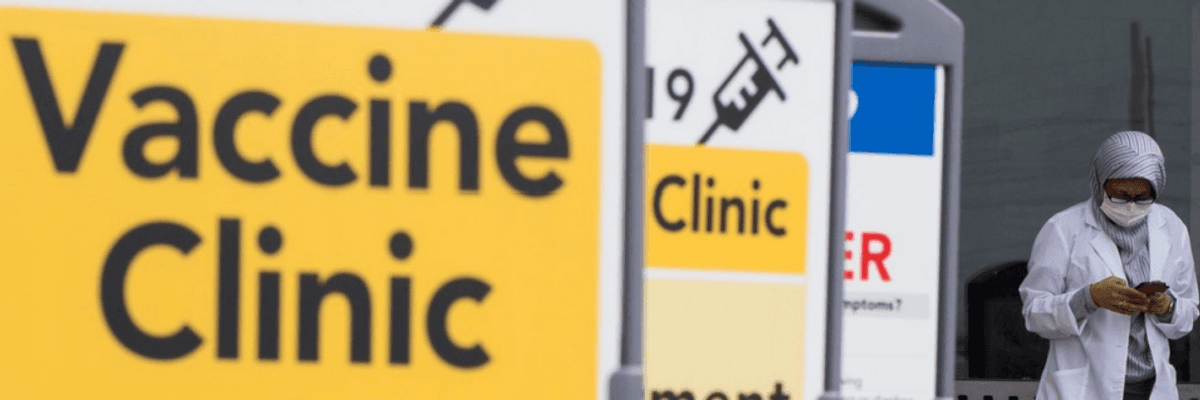
A woman wearing a face mask is seen outside a Covid-19 vaccine clinic in Mississauga, Ontario, Canada, on April 6, 2021. (Photo: Zou Zheng/Xinhua via Getty) (Xinhua/Zou Zheng via Getty Images)
Canada's faltering COVID-19 vaccine rollout is all the more stunning in light of news that little Cuba is on the brink of having its own vaccine--actually one of five COVID vaccines being developed by the tiny nation's booming biotech industry.
It's hard to believe it has come to this. Forty years ago, when a biotech industry was just a gleam in Fidel Castro's eye, Canada had already made it to the top.
"The situation reveals how much Canada is at the mercy of the powerful drug industry now that we no longer have a domestic vaccine capacity that we control."
We already had one of the world's leading biotech firms--Connaught Labs, a publicly owned enterprise that had developed and produced its own vaccines for seven decades, and whose research scientists were considered among the best in the world.
Cuba, on the other hand, had only a modest lab with six technicians. But Castro had a dream--creating an innovative biotech industry to produce vaccines for Cubans and others in developing countries often ignored by Big Pharma.
Brian Mulroney had a different dream--privatizing Canada's public enterprises in line with requests from the business community. So, in the 1980s, the Mulroney government sold Connaught Labs, then one of the world's most innovative vaccine developers.
That privatization has left us scrambling for vaccines in today's pandemic--a dangerous situation that last week drove the desperate Trudeau government to announce a $415 million federal contribution to the expansion of vaccine production capacity at the old Connaught plant, now owned by French pharmaceutical giant Sanofi Pasteur.
That is not a solution. On the contrary, it's a reckless use of a lot of public money.
It's not clear what strings will be attached--if any--to the $415 million from Ottawa, plus $55 million from Ontario, for a total of nearly half a billion dollars of public money.
Ottawa is in ongoing negotiations with Sanofi over a contract aimed at giving Canadians priority access to vaccines produced at the Connaught plant during a future pandemic, federal industry minister Francois-Philippe Champagne said last week.
But surely it would have been better to postpone announcing the $415 million until after Sanofi had agreed to the government's terms about priority access for Canadians.
Without that nailed down, we can just keep our fingers crossed that Sanofi will come through for us in the future.
The situation reveals how much Canada is at the mercy of the powerful drug industry now that we no longer have a domestic vaccine capacity that we control.
Indeed, Sanofi might use its negotiations with Ottawa to push hard on another issue that's important to Sanofi and other Big Pharma companies.
In December 2017, Big Pharma was outraged when the Trudeau government announced changes to the Patented Medicines Regulations aimed at reducing patented drug prices by billions of dollars.
Big Pharma has retaliated by not submitting 39 drugs, including treatments for cancer and Parkinson's, to Health Canada for approval, citing uncertainty over the proposed changes.
With Big Pharma effectively holding a gun to Canada's head, the Trudeau government has twice postponed implementing the tough new regulations, now delayed until July 1.
The pandemic has only increased the clout of the industry, which largely controls access to COVID vaccines desperately needed by Canadians and others.
"If we really want a biotech company we can rely on and that doesn't hold a gun to our head, we should spend our money creating an enterprise that we actually own and control--a little secret learned by Cuba."
That increased clout may explain why Justin Trudeau sided with Big Pharma--risking his image as a "progressive"--in opposing a World Trade Organization resolution overriding drug companies' patent rights so poor countries can access COVID vaccines.
Many commentators argue that we should be more accommodating to Big Pharma, given its life-and-death powers
But, despite providing lengthy patent protection for its drugs, Canada hasn't gained much in return. Multinational drug companies operate here mostly through branch plants that carry out little research.
Now we're poised to give Sanofi hundreds of millions of taxpayer dollars in the hope of ensuring a future vaccine supply--perhaps in exchange for cancelling regulations aimed at saving Canadians billions of dollars in drug costs?
If we really want a biotech company we can rely on and that doesn't hold a gun to our head, we should spend our money creating an enterprise that we actually own and control--a little secret learned by Cuba and, decades earlier, by the brilliant Canadians who created Connaught.
Dear Common Dreams reader, It’s been nearly 30 years since I co-founded Common Dreams with my late wife, Lina Newhouser. We had the radical notion that journalism should serve the public good, not corporate profits. It was clear to us from the outset what it would take to build such a project. No paid advertisements. No corporate sponsors. No millionaire publisher telling us what to think or do. Many people said we wouldn't last a year, but we proved those doubters wrong. Together with a tremendous team of journalists and dedicated staff, we built an independent media outlet free from the constraints of profits and corporate control. Our mission has always been simple: To inform. To inspire. To ignite change for the common good. Building Common Dreams was not easy. Our survival was never guaranteed. When you take on the most powerful forces—Wall Street greed, fossil fuel industry destruction, Big Tech lobbyists, and uber-rich oligarchs who have spent billions upon billions rigging the economy and democracy in their favor—the only bulwark you have is supporters who believe in your work. But here’s the urgent message from me today. It's never been this bad out there. And it's never been this hard to keep us going. At the very moment Common Dreams is most needed, the threats we face are intensifying. We need your support now more than ever. We don't accept corporate advertising and never will. We don't have a paywall because we don't think people should be blocked from critical news based on their ability to pay. Everything we do is funded by the donations of readers like you. When everyone does the little they can afford, we are strong. But if that support retreats or dries up, so do we. Will you donate now to make sure Common Dreams not only survives but thrives? —Craig Brown, Co-founder |
Canada's faltering COVID-19 vaccine rollout is all the more stunning in light of news that little Cuba is on the brink of having its own vaccine--actually one of five COVID vaccines being developed by the tiny nation's booming biotech industry.
It's hard to believe it has come to this. Forty years ago, when a biotech industry was just a gleam in Fidel Castro's eye, Canada had already made it to the top.
"The situation reveals how much Canada is at the mercy of the powerful drug industry now that we no longer have a domestic vaccine capacity that we control."
We already had one of the world's leading biotech firms--Connaught Labs, a publicly owned enterprise that had developed and produced its own vaccines for seven decades, and whose research scientists were considered among the best in the world.
Cuba, on the other hand, had only a modest lab with six technicians. But Castro had a dream--creating an innovative biotech industry to produce vaccines for Cubans and others in developing countries often ignored by Big Pharma.
Brian Mulroney had a different dream--privatizing Canada's public enterprises in line with requests from the business community. So, in the 1980s, the Mulroney government sold Connaught Labs, then one of the world's most innovative vaccine developers.
That privatization has left us scrambling for vaccines in today's pandemic--a dangerous situation that last week drove the desperate Trudeau government to announce a $415 million federal contribution to the expansion of vaccine production capacity at the old Connaught plant, now owned by French pharmaceutical giant Sanofi Pasteur.
That is not a solution. On the contrary, it's a reckless use of a lot of public money.
It's not clear what strings will be attached--if any--to the $415 million from Ottawa, plus $55 million from Ontario, for a total of nearly half a billion dollars of public money.
Ottawa is in ongoing negotiations with Sanofi over a contract aimed at giving Canadians priority access to vaccines produced at the Connaught plant during a future pandemic, federal industry minister Francois-Philippe Champagne said last week.
But surely it would have been better to postpone announcing the $415 million until after Sanofi had agreed to the government's terms about priority access for Canadians.
Without that nailed down, we can just keep our fingers crossed that Sanofi will come through for us in the future.
The situation reveals how much Canada is at the mercy of the powerful drug industry now that we no longer have a domestic vaccine capacity that we control.
Indeed, Sanofi might use its negotiations with Ottawa to push hard on another issue that's important to Sanofi and other Big Pharma companies.
In December 2017, Big Pharma was outraged when the Trudeau government announced changes to the Patented Medicines Regulations aimed at reducing patented drug prices by billions of dollars.
Big Pharma has retaliated by not submitting 39 drugs, including treatments for cancer and Parkinson's, to Health Canada for approval, citing uncertainty over the proposed changes.
With Big Pharma effectively holding a gun to Canada's head, the Trudeau government has twice postponed implementing the tough new regulations, now delayed until July 1.
The pandemic has only increased the clout of the industry, which largely controls access to COVID vaccines desperately needed by Canadians and others.
"If we really want a biotech company we can rely on and that doesn't hold a gun to our head, we should spend our money creating an enterprise that we actually own and control--a little secret learned by Cuba."
That increased clout may explain why Justin Trudeau sided with Big Pharma--risking his image as a "progressive"--in opposing a World Trade Organization resolution overriding drug companies' patent rights so poor countries can access COVID vaccines.
Many commentators argue that we should be more accommodating to Big Pharma, given its life-and-death powers
But, despite providing lengthy patent protection for its drugs, Canada hasn't gained much in return. Multinational drug companies operate here mostly through branch plants that carry out little research.
Now we're poised to give Sanofi hundreds of millions of taxpayer dollars in the hope of ensuring a future vaccine supply--perhaps in exchange for cancelling regulations aimed at saving Canadians billions of dollars in drug costs?
If we really want a biotech company we can rely on and that doesn't hold a gun to our head, we should spend our money creating an enterprise that we actually own and control--a little secret learned by Cuba and, decades earlier, by the brilliant Canadians who created Connaught.
Canada's faltering COVID-19 vaccine rollout is all the more stunning in light of news that little Cuba is on the brink of having its own vaccine--actually one of five COVID vaccines being developed by the tiny nation's booming biotech industry.
It's hard to believe it has come to this. Forty years ago, when a biotech industry was just a gleam in Fidel Castro's eye, Canada had already made it to the top.
"The situation reveals how much Canada is at the mercy of the powerful drug industry now that we no longer have a domestic vaccine capacity that we control."
We already had one of the world's leading biotech firms--Connaught Labs, a publicly owned enterprise that had developed and produced its own vaccines for seven decades, and whose research scientists were considered among the best in the world.
Cuba, on the other hand, had only a modest lab with six technicians. But Castro had a dream--creating an innovative biotech industry to produce vaccines for Cubans and others in developing countries often ignored by Big Pharma.
Brian Mulroney had a different dream--privatizing Canada's public enterprises in line with requests from the business community. So, in the 1980s, the Mulroney government sold Connaught Labs, then one of the world's most innovative vaccine developers.
That privatization has left us scrambling for vaccines in today's pandemic--a dangerous situation that last week drove the desperate Trudeau government to announce a $415 million federal contribution to the expansion of vaccine production capacity at the old Connaught plant, now owned by French pharmaceutical giant Sanofi Pasteur.
That is not a solution. On the contrary, it's a reckless use of a lot of public money.
It's not clear what strings will be attached--if any--to the $415 million from Ottawa, plus $55 million from Ontario, for a total of nearly half a billion dollars of public money.
Ottawa is in ongoing negotiations with Sanofi over a contract aimed at giving Canadians priority access to vaccines produced at the Connaught plant during a future pandemic, federal industry minister Francois-Philippe Champagne said last week.
But surely it would have been better to postpone announcing the $415 million until after Sanofi had agreed to the government's terms about priority access for Canadians.
Without that nailed down, we can just keep our fingers crossed that Sanofi will come through for us in the future.
The situation reveals how much Canada is at the mercy of the powerful drug industry now that we no longer have a domestic vaccine capacity that we control.
Indeed, Sanofi might use its negotiations with Ottawa to push hard on another issue that's important to Sanofi and other Big Pharma companies.
In December 2017, Big Pharma was outraged when the Trudeau government announced changes to the Patented Medicines Regulations aimed at reducing patented drug prices by billions of dollars.
Big Pharma has retaliated by not submitting 39 drugs, including treatments for cancer and Parkinson's, to Health Canada for approval, citing uncertainty over the proposed changes.
With Big Pharma effectively holding a gun to Canada's head, the Trudeau government has twice postponed implementing the tough new regulations, now delayed until July 1.
The pandemic has only increased the clout of the industry, which largely controls access to COVID vaccines desperately needed by Canadians and others.
"If we really want a biotech company we can rely on and that doesn't hold a gun to our head, we should spend our money creating an enterprise that we actually own and control--a little secret learned by Cuba."
That increased clout may explain why Justin Trudeau sided with Big Pharma--risking his image as a "progressive"--in opposing a World Trade Organization resolution overriding drug companies' patent rights so poor countries can access COVID vaccines.
Many commentators argue that we should be more accommodating to Big Pharma, given its life-and-death powers
But, despite providing lengthy patent protection for its drugs, Canada hasn't gained much in return. Multinational drug companies operate here mostly through branch plants that carry out little research.
Now we're poised to give Sanofi hundreds of millions of taxpayer dollars in the hope of ensuring a future vaccine supply--perhaps in exchange for cancelling regulations aimed at saving Canadians billions of dollars in drug costs?
If we really want a biotech company we can rely on and that doesn't hold a gun to our head, we should spend our money creating an enterprise that we actually own and control--a little secret learned by Cuba and, decades earlier, by the brilliant Canadians who created Connaught.