

SUBSCRIBE TO OUR FREE NEWSLETTER
Daily news & progressive opinion—funded by the people, not the corporations—delivered straight to your inbox.
5
#000000
#FFFFFF
To donate by check, phone, or other method, see our More Ways to Give page.

Daily news & progressive opinion—funded by the people, not the corporations—delivered straight to your inbox.

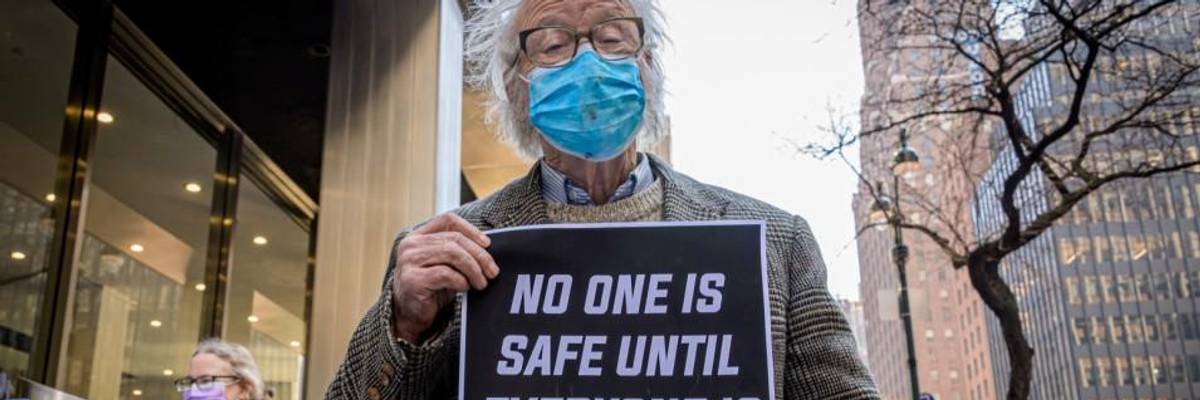
A coalition of health justice advocates gathered outside Pfizer's headquarters in Manhattan on March 11, 2021 to call on the Biden administration to push pharmaceutical companies to commit to equitable global vaccine distribution and help end the pandemic everywhere by supporting the waiver of the World Trade Organization's monopoly protections for Big Pharma. (Photo: Erik McGregor/LightRocket via Getty Images)
We're a year into the pandemic, and thanks to vaccines, it appears we may finally have an end in sight. But, as is too often the case, vaccine distribution has been anything but equitable.
People in rich countries, such as the United States and countries in the European Union, are receiving a far larger share of vaccine doses relative to their share of the global population, according to analysis from Agence France-Presse. Meanwhile, the poorest countries are left waiting in despair as Covid-19 cases continue to rise.
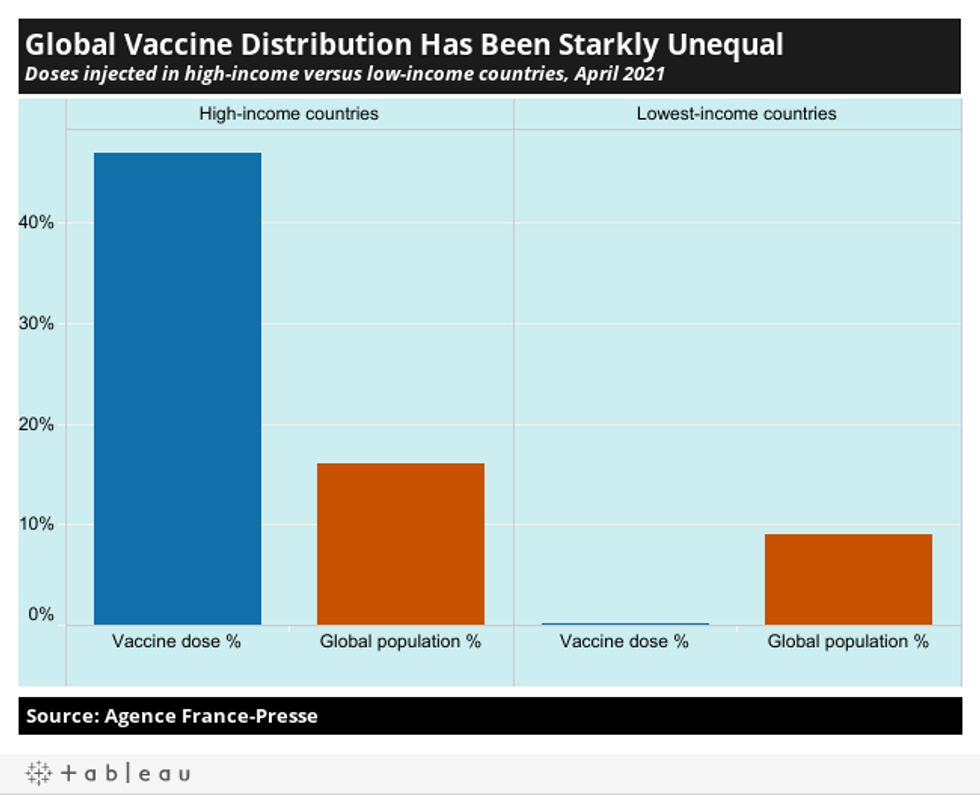
Of the more than 455 million doses of Covid-19 vaccines that have been injected, people in in high-income countries have received 56 percent--far more than their 16 percent share of the global population.
Corporate profits are not more important than the lives of millions of poor people around the globe.
People in the 29 lowest-income countries have received only 0.1 percent of vaccines, despite making up nine percent of the global population.
The World Health Organization is sounding the alarm on this inequality.
"The inequitable distribution of vaccines is not just a moral outrage," said WHO Director-General Tedros Adhanom Ghebreyesus in a press conference this week, "it's also economically and epidemiologically self-defeating."
There are many reasons for this growing inequity. One is that rich nations used their wealth to jump to the front of the line and purchase as many doses as possible. As one Yale epidemiologist described it, "It was like a run on toilet paper," with rich countries barging their way through to snap up limited doses like customers did with Charmin at the start of the pandemic.
Another major factor is that Western nations joined up with pharma giants to invest in vaccine development and are protecting corporate patent monopolies. According to leaked documents, the United States, the UK, and the European Union are shamefully blocking further cooperation within the WHO to open up vaccine access.
Global health advocates and nations like South Africa and India are pushing for a waiver in WTO intellectual property rules that would allow expanded global vaccine production and quicker end to the pandemic.
If we are really serious about ending this pandemic as swiftly as possible, it is imperative that these patents are opened up. Corporate profits are not more important than the lives of millions of poor people around the globe.
Dear Common Dreams reader, It’s been nearly 30 years since I co-founded Common Dreams with my late wife, Lina Newhouser. We had the radical notion that journalism should serve the public good, not corporate profits. It was clear to us from the outset what it would take to build such a project. No paid advertisements. No corporate sponsors. No millionaire publisher telling us what to think or do. Many people said we wouldn't last a year, but we proved those doubters wrong. Together with a tremendous team of journalists and dedicated staff, we built an independent media outlet free from the constraints of profits and corporate control. Our mission has always been simple: To inform. To inspire. To ignite change for the common good. Building Common Dreams was not easy. Our survival was never guaranteed. When you take on the most powerful forces—Wall Street greed, fossil fuel industry destruction, Big Tech lobbyists, and uber-rich oligarchs who have spent billions upon billions rigging the economy and democracy in their favor—the only bulwark you have is supporters who believe in your work. But here’s the urgent message from me today. It's never been this bad out there. And it's never been this hard to keep us going. At the very moment Common Dreams is most needed, the threats we face are intensifying. We need your support now more than ever. We don't accept corporate advertising and never will. We don't have a paywall because we don't think people should be blocked from critical news based on their ability to pay. Everything we do is funded by the donations of readers like you. When everyone does the little they can afford, we are strong. But if that support retreats or dries up, so do we. Will you donate now to make sure Common Dreams not only survives but thrives? —Craig Brown, Co-founder |
We're a year into the pandemic, and thanks to vaccines, it appears we may finally have an end in sight. But, as is too often the case, vaccine distribution has been anything but equitable.
People in rich countries, such as the United States and countries in the European Union, are receiving a far larger share of vaccine doses relative to their share of the global population, according to analysis from Agence France-Presse. Meanwhile, the poorest countries are left waiting in despair as Covid-19 cases continue to rise.
Of the more than 455 million doses of Covid-19 vaccines that have been injected, people in in high-income countries have received 56 percent--far more than their 16 percent share of the global population.
Corporate profits are not more important than the lives of millions of poor people around the globe.
People in the 29 lowest-income countries have received only 0.1 percent of vaccines, despite making up nine percent of the global population.
The World Health Organization is sounding the alarm on this inequality.
"The inequitable distribution of vaccines is not just a moral outrage," said WHO Director-General Tedros Adhanom Ghebreyesus in a press conference this week, "it's also economically and epidemiologically self-defeating."
There are many reasons for this growing inequity. One is that rich nations used their wealth to jump to the front of the line and purchase as many doses as possible. As one Yale epidemiologist described it, "It was like a run on toilet paper," with rich countries barging their way through to snap up limited doses like customers did with Charmin at the start of the pandemic.
Another major factor is that Western nations joined up with pharma giants to invest in vaccine development and are protecting corporate patent monopolies. According to leaked documents, the United States, the UK, and the European Union are shamefully blocking further cooperation within the WHO to open up vaccine access.
Global health advocates and nations like South Africa and India are pushing for a waiver in WTO intellectual property rules that would allow expanded global vaccine production and quicker end to the pandemic.
If we are really serious about ending this pandemic as swiftly as possible, it is imperative that these patents are opened up. Corporate profits are not more important than the lives of millions of poor people around the globe.
We're a year into the pandemic, and thanks to vaccines, it appears we may finally have an end in sight. But, as is too often the case, vaccine distribution has been anything but equitable.
People in rich countries, such as the United States and countries in the European Union, are receiving a far larger share of vaccine doses relative to their share of the global population, according to analysis from Agence France-Presse. Meanwhile, the poorest countries are left waiting in despair as Covid-19 cases continue to rise.
Of the more than 455 million doses of Covid-19 vaccines that have been injected, people in in high-income countries have received 56 percent--far more than their 16 percent share of the global population.
Corporate profits are not more important than the lives of millions of poor people around the globe.
People in the 29 lowest-income countries have received only 0.1 percent of vaccines, despite making up nine percent of the global population.
The World Health Organization is sounding the alarm on this inequality.
"The inequitable distribution of vaccines is not just a moral outrage," said WHO Director-General Tedros Adhanom Ghebreyesus in a press conference this week, "it's also economically and epidemiologically self-defeating."
There are many reasons for this growing inequity. One is that rich nations used their wealth to jump to the front of the line and purchase as many doses as possible. As one Yale epidemiologist described it, "It was like a run on toilet paper," with rich countries barging their way through to snap up limited doses like customers did with Charmin at the start of the pandemic.
Another major factor is that Western nations joined up with pharma giants to invest in vaccine development and are protecting corporate patent monopolies. According to leaked documents, the United States, the UK, and the European Union are shamefully blocking further cooperation within the WHO to open up vaccine access.
Global health advocates and nations like South Africa and India are pushing for a waiver in WTO intellectual property rules that would allow expanded global vaccine production and quicker end to the pandemic.
If we are really serious about ending this pandemic as swiftly as possible, it is imperative that these patents are opened up. Corporate profits are not more important than the lives of millions of poor people around the globe.