SUBSCRIBE TO OUR FREE NEWSLETTER
Daily news & progressive opinion—funded by the people, not the corporations—delivered straight to your inbox.
5
#000000
#FFFFFF
To donate by check, phone, or other method, see our More Ways to Give page.
Daily news & progressive opinion—funded by the people, not the corporations—delivered straight to your inbox.
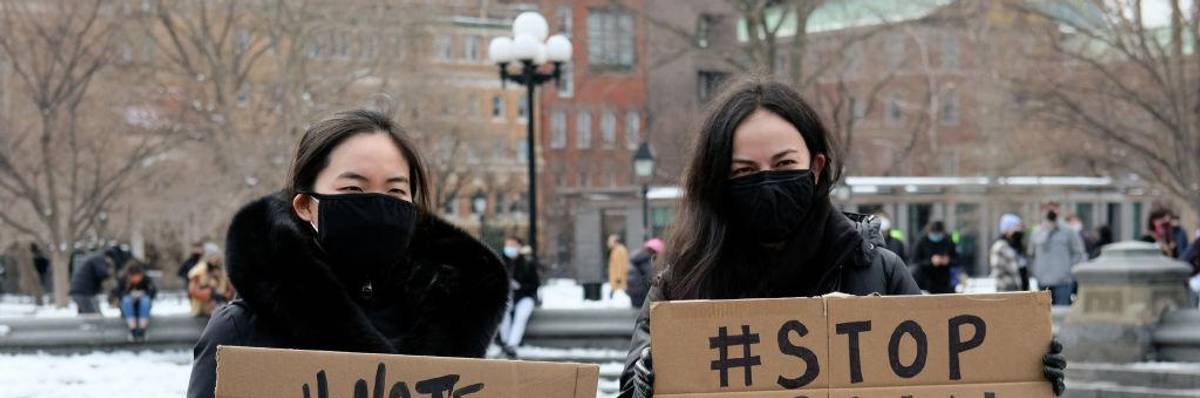
Protestors hold signs that read "hate is a virus" and "stop Asian hate" at the End The Violence Towards Asians rally in Washington Square Park on February 20, 2021 in New York City. Since the start of the coronavirus pandemic, violence towards Asian Americans has increased at a much higher rate than previous years. The New York City Police Department (NYPD) reported a 1,900% increase in anti-Asian hate crimes in 2020. (Photo by Dia Dipasupil/Getty Images)
A new wave of anti-Asian racial violence is sweeping the country. Sadly, racial violence, bigotry and hatred directed at Asian Americans has scarred their history in this country.
Nothing is more dehumanizing. Asian Americans come from many countries and many cultures. They have played a remarkable role in building this country. And yet, the violence erases their humanity, identifies them as the other, and ignores their contributions.
I remember in May of 1983, I met with Lily Chin and Asian American leaders at San Francisco Chinatown's Cameron House. A year earlier, her son Vincent was chased down in the streets of Detroit by two unemployed white auto workers, who beat him to death with baseball bats.
Violence targeting Asian Americans is becoming an alarming weekly, if not daily, occurrence.
"It's because of you mother-(expletive)s we're out of work!" shouted one of his attackers. They thought Vincent was Japanese. This was the 1980s when U.S. auto plants were shutting down during the Reagan recession, and blame was wrongfully placed on competition from Japanese auto imports, setting off a wave of anti-Japanese/anti-Asian hysteria.
I was struck then by the way Lily Chin stood up and fought against this injustice, and how leaders like Norman Fong, Mabel Teng and Helen Zia organized marches and resistance in the Asian American communities from Los Angeles to New York.
They rose up to organize against anti-Asian racial violence. They found common ground with African Americans, Latinos and others, and forged alliances with people and organizations that have long been targets of racial violence. The fight against racial violence became a key pillar of my 1984 presidential campaign, and Asian Americans became an integral part of our Rainbow Coalition from its very start.
Trump combined this vitriol with a big lie, blaming our loss of jobs to China. The reality is that American corporations took our jobs to China, seeking to take advantage of low-wage labor with few rights and few environmental protections. It was U.S. policy that failed to protect our jobs. Now Trump and others blame China when it was our leaders who were at fault.
Words matter. The scapegoating of Asian Americans is taking an ugly, violent turn: On Jan. 28, 2021, 84-year-old Vicha Ratanapakdee was out for a morning walk in San Francisco when he was violently assaulted. Days later, he died.
On Feb. 3 in Manhattan, Noel Quintana, 61, was riding the subway when his assaulter slashed his face.
Last year, an Asian woman in Brooklyn had acid thrown in her face as she took out the garbage. A Burmese man and his two children were slashed by a knife-wielding attacker while shopping in Midland, Texas.
On street corners and in shopping malls, "Asian Americans Have Been Attacked, Spat On, and Cursed Out," as reported by Slate. Stop AAPI Hate received reports of more than 3,000 incidents of anti-Asian violence in 2020.
It's reminiscent of the post-9/11 hysteria that targeted Muslims, as well as Sikhs and other South Asians living in the U.S.
For Chinese Americans, Lunar New Year in the month of February is usually a time for firecrackers, lion dances and celebration in Asian communities. This year, community leaders marked the occasion by confronting this inglorious rise of racial violence.
Some of the most shameful chapters of our history involve racial prejudice against Asian Americans.
From progressive Asian community activists to Hollywood actors, business leaders and athletes, Asian communities are rising up and confronting this new wave of racial violence. Community activists are organizing self-patrols and community escorts for the elderly. They want these anti-Asian attacks to be prosecuted as hate crimes.
In the best tradition of the civil and human rights movement, they are holding marches and rallies to defend their communities against violence, and building alliances with African Americans, Latinos and other communities fighting against racial injustice.
NBA basketball player Jeremy Lin said, "It would be hypocritical of me to say I'm anti-racism if I only stand up for people who look like me. There is definitely power in unification and solidarity. ... We as minorities also have to collaborate, unify and use our voices and stand up for each other."
President Biden has weighed in, issuing an executive memorandum saying the "inflammatory and xenophobic rhetoric has put Asian American and Pacific Islander persons, families, communities and businesses at risk." Special task forces are being organized by local police departments. Local elected leaders have taken to the media to call for unity with the Chinese and Asian communities and decry the violence and harassment.
Some of the most shameful chapters of our history involve racial prejudice against Asian Americans. In 1882, the Chinese Exclusion Act (extended to all Asians in 1924) made it illegal for Chinese to immigrate to the U.S. In the Rock Springs Massacre of 1885, white mobs in Wyoming murdered 28 Chinese coal miners and burned Chinatown to the ground. World War II witnessed the internment of 120,000 Japanese Americans in U.S. concentration camps, even as many of their sons fought loyally in the U.S. Armed Forces.
Asian communities are suffering, even as they are summoning the courage of Lily Chin, turning their pain into power, determined to stop the violence and never surrender. At Rainbow PUSH, we stand with them, and call on all citizens of conscience to join them in their drive to confront the hatred and stop the violence.
Dear Common Dreams reader, It’s been nearly 30 years since I co-founded Common Dreams with my late wife, Lina Newhouser. We had the radical notion that journalism should serve the public good, not corporate profits. It was clear to us from the outset what it would take to build such a project. No paid advertisements. No corporate sponsors. No millionaire publisher telling us what to think or do. Many people said we wouldn't last a year, but we proved those doubters wrong. Together with a tremendous team of journalists and dedicated staff, we built an independent media outlet free from the constraints of profits and corporate control. Our mission has always been simple: To inform. To inspire. To ignite change for the common good. Building Common Dreams was not easy. Our survival was never guaranteed. When you take on the most powerful forces—Wall Street greed, fossil fuel industry destruction, Big Tech lobbyists, and uber-rich oligarchs who have spent billions upon billions rigging the economy and democracy in their favor—the only bulwark you have is supporters who believe in your work. But here’s the urgent message from me today. It's never been this bad out there. And it's never been this hard to keep us going. At the very moment Common Dreams is most needed, the threats we face are intensifying. We need your support now more than ever. We don't accept corporate advertising and never will. We don't have a paywall because we don't think people should be blocked from critical news based on their ability to pay. Everything we do is funded by the donations of readers like you. When everyone does the little they can afford, we are strong. But if that support retreats or dries up, so do we. Will you donate now to make sure Common Dreams not only survives but thrives? —Craig Brown, Co-founder |
A new wave of anti-Asian racial violence is sweeping the country. Sadly, racial violence, bigotry and hatred directed at Asian Americans has scarred their history in this country.
Nothing is more dehumanizing. Asian Americans come from many countries and many cultures. They have played a remarkable role in building this country. And yet, the violence erases their humanity, identifies them as the other, and ignores their contributions.
I remember in May of 1983, I met with Lily Chin and Asian American leaders at San Francisco Chinatown's Cameron House. A year earlier, her son Vincent was chased down in the streets of Detroit by two unemployed white auto workers, who beat him to death with baseball bats.
Violence targeting Asian Americans is becoming an alarming weekly, if not daily, occurrence.
"It's because of you mother-(expletive)s we're out of work!" shouted one of his attackers. They thought Vincent was Japanese. This was the 1980s when U.S. auto plants were shutting down during the Reagan recession, and blame was wrongfully placed on competition from Japanese auto imports, setting off a wave of anti-Japanese/anti-Asian hysteria.
I was struck then by the way Lily Chin stood up and fought against this injustice, and how leaders like Norman Fong, Mabel Teng and Helen Zia organized marches and resistance in the Asian American communities from Los Angeles to New York.
They rose up to organize against anti-Asian racial violence. They found common ground with African Americans, Latinos and others, and forged alliances with people and organizations that have long been targets of racial violence. The fight against racial violence became a key pillar of my 1984 presidential campaign, and Asian Americans became an integral part of our Rainbow Coalition from its very start.
Trump combined this vitriol with a big lie, blaming our loss of jobs to China. The reality is that American corporations took our jobs to China, seeking to take advantage of low-wage labor with few rights and few environmental protections. It was U.S. policy that failed to protect our jobs. Now Trump and others blame China when it was our leaders who were at fault.
Words matter. The scapegoating of Asian Americans is taking an ugly, violent turn: On Jan. 28, 2021, 84-year-old Vicha Ratanapakdee was out for a morning walk in San Francisco when he was violently assaulted. Days later, he died.
On Feb. 3 in Manhattan, Noel Quintana, 61, was riding the subway when his assaulter slashed his face.
Last year, an Asian woman in Brooklyn had acid thrown in her face as she took out the garbage. A Burmese man and his two children were slashed by a knife-wielding attacker while shopping in Midland, Texas.
On street corners and in shopping malls, "Asian Americans Have Been Attacked, Spat On, and Cursed Out," as reported by Slate. Stop AAPI Hate received reports of more than 3,000 incidents of anti-Asian violence in 2020.
It's reminiscent of the post-9/11 hysteria that targeted Muslims, as well as Sikhs and other South Asians living in the U.S.
For Chinese Americans, Lunar New Year in the month of February is usually a time for firecrackers, lion dances and celebration in Asian communities. This year, community leaders marked the occasion by confronting this inglorious rise of racial violence.
Some of the most shameful chapters of our history involve racial prejudice against Asian Americans.
From progressive Asian community activists to Hollywood actors, business leaders and athletes, Asian communities are rising up and confronting this new wave of racial violence. Community activists are organizing self-patrols and community escorts for the elderly. They want these anti-Asian attacks to be prosecuted as hate crimes.
In the best tradition of the civil and human rights movement, they are holding marches and rallies to defend their communities against violence, and building alliances with African Americans, Latinos and other communities fighting against racial injustice.
NBA basketball player Jeremy Lin said, "It would be hypocritical of me to say I'm anti-racism if I only stand up for people who look like me. There is definitely power in unification and solidarity. ... We as minorities also have to collaborate, unify and use our voices and stand up for each other."
President Biden has weighed in, issuing an executive memorandum saying the "inflammatory and xenophobic rhetoric has put Asian American and Pacific Islander persons, families, communities and businesses at risk." Special task forces are being organized by local police departments. Local elected leaders have taken to the media to call for unity with the Chinese and Asian communities and decry the violence and harassment.
Some of the most shameful chapters of our history involve racial prejudice against Asian Americans. In 1882, the Chinese Exclusion Act (extended to all Asians in 1924) made it illegal for Chinese to immigrate to the U.S. In the Rock Springs Massacre of 1885, white mobs in Wyoming murdered 28 Chinese coal miners and burned Chinatown to the ground. World War II witnessed the internment of 120,000 Japanese Americans in U.S. concentration camps, even as many of their sons fought loyally in the U.S. Armed Forces.
Asian communities are suffering, even as they are summoning the courage of Lily Chin, turning their pain into power, determined to stop the violence and never surrender. At Rainbow PUSH, we stand with them, and call on all citizens of conscience to join them in their drive to confront the hatred and stop the violence.
A new wave of anti-Asian racial violence is sweeping the country. Sadly, racial violence, bigotry and hatred directed at Asian Americans has scarred their history in this country.
Nothing is more dehumanizing. Asian Americans come from many countries and many cultures. They have played a remarkable role in building this country. And yet, the violence erases their humanity, identifies them as the other, and ignores their contributions.
I remember in May of 1983, I met with Lily Chin and Asian American leaders at San Francisco Chinatown's Cameron House. A year earlier, her son Vincent was chased down in the streets of Detroit by two unemployed white auto workers, who beat him to death with baseball bats.
Violence targeting Asian Americans is becoming an alarming weekly, if not daily, occurrence.
"It's because of you mother-(expletive)s we're out of work!" shouted one of his attackers. They thought Vincent was Japanese. This was the 1980s when U.S. auto plants were shutting down during the Reagan recession, and blame was wrongfully placed on competition from Japanese auto imports, setting off a wave of anti-Japanese/anti-Asian hysteria.
I was struck then by the way Lily Chin stood up and fought against this injustice, and how leaders like Norman Fong, Mabel Teng and Helen Zia organized marches and resistance in the Asian American communities from Los Angeles to New York.
They rose up to organize against anti-Asian racial violence. They found common ground with African Americans, Latinos and others, and forged alliances with people and organizations that have long been targets of racial violence. The fight against racial violence became a key pillar of my 1984 presidential campaign, and Asian Americans became an integral part of our Rainbow Coalition from its very start.
Trump combined this vitriol with a big lie, blaming our loss of jobs to China. The reality is that American corporations took our jobs to China, seeking to take advantage of low-wage labor with few rights and few environmental protections. It was U.S. policy that failed to protect our jobs. Now Trump and others blame China when it was our leaders who were at fault.
Words matter. The scapegoating of Asian Americans is taking an ugly, violent turn: On Jan. 28, 2021, 84-year-old Vicha Ratanapakdee was out for a morning walk in San Francisco when he was violently assaulted. Days later, he died.
On Feb. 3 in Manhattan, Noel Quintana, 61, was riding the subway when his assaulter slashed his face.
Last year, an Asian woman in Brooklyn had acid thrown in her face as she took out the garbage. A Burmese man and his two children were slashed by a knife-wielding attacker while shopping in Midland, Texas.
On street corners and in shopping malls, "Asian Americans Have Been Attacked, Spat On, and Cursed Out," as reported by Slate. Stop AAPI Hate received reports of more than 3,000 incidents of anti-Asian violence in 2020.
It's reminiscent of the post-9/11 hysteria that targeted Muslims, as well as Sikhs and other South Asians living in the U.S.
For Chinese Americans, Lunar New Year in the month of February is usually a time for firecrackers, lion dances and celebration in Asian communities. This year, community leaders marked the occasion by confronting this inglorious rise of racial violence.
Some of the most shameful chapters of our history involve racial prejudice against Asian Americans.
From progressive Asian community activists to Hollywood actors, business leaders and athletes, Asian communities are rising up and confronting this new wave of racial violence. Community activists are organizing self-patrols and community escorts for the elderly. They want these anti-Asian attacks to be prosecuted as hate crimes.
In the best tradition of the civil and human rights movement, they are holding marches and rallies to defend their communities against violence, and building alliances with African Americans, Latinos and other communities fighting against racial injustice.
NBA basketball player Jeremy Lin said, "It would be hypocritical of me to say I'm anti-racism if I only stand up for people who look like me. There is definitely power in unification and solidarity. ... We as minorities also have to collaborate, unify and use our voices and stand up for each other."
President Biden has weighed in, issuing an executive memorandum saying the "inflammatory and xenophobic rhetoric has put Asian American and Pacific Islander persons, families, communities and businesses at risk." Special task forces are being organized by local police departments. Local elected leaders have taken to the media to call for unity with the Chinese and Asian communities and decry the violence and harassment.
Some of the most shameful chapters of our history involve racial prejudice against Asian Americans. In 1882, the Chinese Exclusion Act (extended to all Asians in 1924) made it illegal for Chinese to immigrate to the U.S. In the Rock Springs Massacre of 1885, white mobs in Wyoming murdered 28 Chinese coal miners and burned Chinatown to the ground. World War II witnessed the internment of 120,000 Japanese Americans in U.S. concentration camps, even as many of their sons fought loyally in the U.S. Armed Forces.
Asian communities are suffering, even as they are summoning the courage of Lily Chin, turning their pain into power, determined to stop the violence and never surrender. At Rainbow PUSH, we stand with them, and call on all citizens of conscience to join them in their drive to confront the hatred and stop the violence.