SUBSCRIBE TO OUR FREE NEWSLETTER
Daily news & progressive opinion—funded by the people, not the corporations—delivered straight to your inbox.
5
#000000
#FFFFFF
To donate by check, phone, or other method, see our More Ways to Give page.
Daily news & progressive opinion—funded by the people, not the corporations—delivered straight to your inbox.
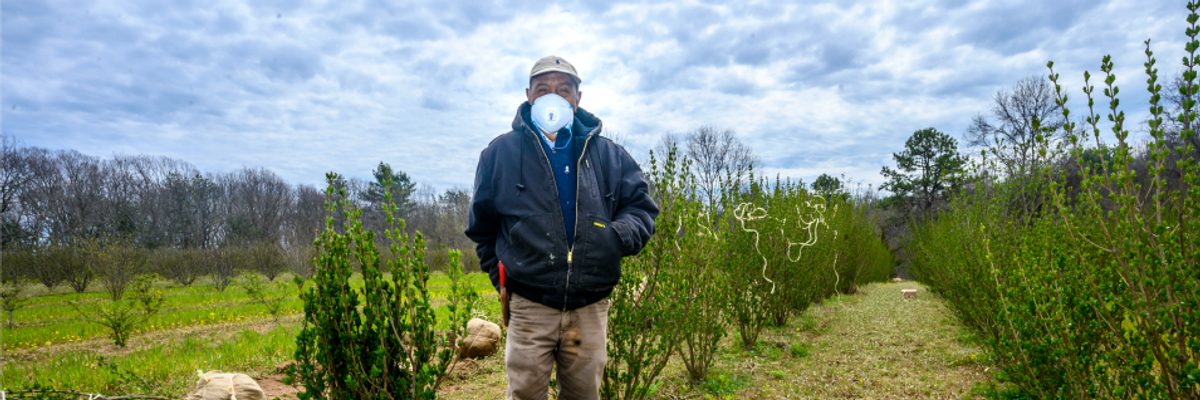
Farmworker Juan Antonio wears a face mask in a field in Riverhead, New York on April 14, 2020 during the COVID-19 crisis. (Photo: Alejandra Villa Loarca/Newsday RM via Getty Images).
We've put Joe Biden in the White House ... but what do we get back for that? We get a real possibility of winning some progressive policies. Not that he will turn into a fireball of democratic populism, but unlike in 1992 and 2008, when then-President Bill Clinton and then-President Barack Obama fleetingly raised hopes that progress was possible, respectively, two new factors give progressive proposals a greater chance this time.
One: Biden himself. Despite a long career representing Delaware, the home state of corporate America, a core part of Biden's political makeup is that he's Joe Labor. He comes to the job with a genuine affinity for working stiffs. He's comfortable in union halls and working-class bars, and he unabashedly campaigned as "a union guy." Neither Clinton nor Obama had that in them. For Biden, labor rights are about showing gut-level respect for working families, caring a bit less about the wealth of Wall Street and more about the well-being of workers.
Two: you and me. This is not '92 or '08, when our incoming presidents simply said, "Thank you and goodbye," to grassroots backers and then handed the government's economic keys to Wall Street bankers and corporate lobbyists. We won't allow Biden to do that, and he knows it. Today, there's an organized, battle-tested left on alert in practically every congressional district. It includes street-savvy and digitally connected movements of color, scrappy labor organizers and mobilizers, aggressive contingents of climate activists, and ever-watchful Berniecrats and Elizabeth Warren enthusiasts. Plus, we now have a growing cadre of unwilting agitators who're members of Congress, willing to expose and oppose insider sellouts.
This time, progressive forces are neither weak nor meek, and we're not about to be shushed or shooed away by Joe or a go-slow establishment. We're akin to the insistent forces of fundamental change who asserted themselves 89 years ago after Franklin D. Roosevelt won the presidency. FDR had not run as a fiery New Dealer but as a centrist Democrat promising little more than to rid the White House of the clueless, nearly comatose former President Herbert Hoover. The moment he was elected, militant grassroots movements, along with such popular political firebrands on his left as Huey Long, Maury Maverick and Upton Sinclair, were in his face. They are the ones who created the historic New Deal reform agenda ... and then made Roosevelt spend political capital to pass it.
The USDA's top leadership has been somewhere between indifferent and hostile toward the majority of workaday rural people who need an ally.
Quick, name the ag secretaries under Jimmy Carter, Clinton and Obama, representing 20 years that Democratic presidents had control of ag and rural policies. Few Americans can name even one, because ... well, what did they do, even as crisis after crisis ripped through the farmlands and communities they were supposed to serve?
Consider Biden's current nominee, Tom Vilsack. He actually tried to resign as secretary under Obama in 2015, complaining, "There are days when I have literally nothing to do." Seriously? At the time whole towns were boarding up, massive hog factories were exploiting farmers and local residents, states were slashing food assistance, climate change was advancing relentlessly and more? Get to work Mr. Secretary! Vilsack subsequently found work as chief Washington lobbyist for dairy-exporting corporations, drawing a million-dollar annual paycheck. Meanwhile, every day, two more U.S. dairy farms go bankrupt under low milk-price policies he sanctioned. Does he not think farmers notice ... and turn Republican?
As a former agriculture commissioner of Texas, I know that the USDA (created in 1862 by then-President Abe Lincoln to be what he called "The People's Department") could become a transformative force for the Common Good. But our recent presidents have written the position off as a Cabinet slot meant to keep the corporate giants of agribusiness content and in charge. Thus, the USDA's top leadership has been somewhere between indifferent and hostile toward the majority of workaday rural people who need an ally.
Impossible? That's what those who pushed hard and fast for the New Deal were told.
Dear Common Dreams reader, It’s been nearly 30 years since I co-founded Common Dreams with my late wife, Lina Newhouser. We had the radical notion that journalism should serve the public good, not corporate profits. It was clear to us from the outset what it would take to build such a project. No paid advertisements. No corporate sponsors. No millionaire publisher telling us what to think or do. Many people said we wouldn't last a year, but we proved those doubters wrong. Together with a tremendous team of journalists and dedicated staff, we built an independent media outlet free from the constraints of profits and corporate control. Our mission has always been simple: To inform. To inspire. To ignite change for the common good. Building Common Dreams was not easy. Our survival was never guaranteed. When you take on the most powerful forces—Wall Street greed, fossil fuel industry destruction, Big Tech lobbyists, and uber-rich oligarchs who have spent billions upon billions rigging the economy and democracy in their favor—the only bulwark you have is supporters who believe in your work. But here’s the urgent message from me today. It's never been this bad out there. And it's never been this hard to keep us going. At the very moment Common Dreams is most needed, the threats we face are intensifying. We need your support now more than ever. We don't accept corporate advertising and never will. We don't have a paywall because we don't think people should be blocked from critical news based on their ability to pay. Everything we do is funded by the donations of readers like you. When everyone does the little they can afford, we are strong. But if that support retreats or dries up, so do we. Will you donate now to make sure Common Dreams not only survives but thrives? —Craig Brown, Co-founder |
We've put Joe Biden in the White House ... but what do we get back for that? We get a real possibility of winning some progressive policies. Not that he will turn into a fireball of democratic populism, but unlike in 1992 and 2008, when then-President Bill Clinton and then-President Barack Obama fleetingly raised hopes that progress was possible, respectively, two new factors give progressive proposals a greater chance this time.
One: Biden himself. Despite a long career representing Delaware, the home state of corporate America, a core part of Biden's political makeup is that he's Joe Labor. He comes to the job with a genuine affinity for working stiffs. He's comfortable in union halls and working-class bars, and he unabashedly campaigned as "a union guy." Neither Clinton nor Obama had that in them. For Biden, labor rights are about showing gut-level respect for working families, caring a bit less about the wealth of Wall Street and more about the well-being of workers.
Two: you and me. This is not '92 or '08, when our incoming presidents simply said, "Thank you and goodbye," to grassroots backers and then handed the government's economic keys to Wall Street bankers and corporate lobbyists. We won't allow Biden to do that, and he knows it. Today, there's an organized, battle-tested left on alert in practically every congressional district. It includes street-savvy and digitally connected movements of color, scrappy labor organizers and mobilizers, aggressive contingents of climate activists, and ever-watchful Berniecrats and Elizabeth Warren enthusiasts. Plus, we now have a growing cadre of unwilting agitators who're members of Congress, willing to expose and oppose insider sellouts.
This time, progressive forces are neither weak nor meek, and we're not about to be shushed or shooed away by Joe or a go-slow establishment. We're akin to the insistent forces of fundamental change who asserted themselves 89 years ago after Franklin D. Roosevelt won the presidency. FDR had not run as a fiery New Dealer but as a centrist Democrat promising little more than to rid the White House of the clueless, nearly comatose former President Herbert Hoover. The moment he was elected, militant grassroots movements, along with such popular political firebrands on his left as Huey Long, Maury Maverick and Upton Sinclair, were in his face. They are the ones who created the historic New Deal reform agenda ... and then made Roosevelt spend political capital to pass it.
The USDA's top leadership has been somewhere between indifferent and hostile toward the majority of workaday rural people who need an ally.
Quick, name the ag secretaries under Jimmy Carter, Clinton and Obama, representing 20 years that Democratic presidents had control of ag and rural policies. Few Americans can name even one, because ... well, what did they do, even as crisis after crisis ripped through the farmlands and communities they were supposed to serve?
Consider Biden's current nominee, Tom Vilsack. He actually tried to resign as secretary under Obama in 2015, complaining, "There are days when I have literally nothing to do." Seriously? At the time whole towns were boarding up, massive hog factories were exploiting farmers and local residents, states were slashing food assistance, climate change was advancing relentlessly and more? Get to work Mr. Secretary! Vilsack subsequently found work as chief Washington lobbyist for dairy-exporting corporations, drawing a million-dollar annual paycheck. Meanwhile, every day, two more U.S. dairy farms go bankrupt under low milk-price policies he sanctioned. Does he not think farmers notice ... and turn Republican?
As a former agriculture commissioner of Texas, I know that the USDA (created in 1862 by then-President Abe Lincoln to be what he called "The People's Department") could become a transformative force for the Common Good. But our recent presidents have written the position off as a Cabinet slot meant to keep the corporate giants of agribusiness content and in charge. Thus, the USDA's top leadership has been somewhere between indifferent and hostile toward the majority of workaday rural people who need an ally.
Impossible? That's what those who pushed hard and fast for the New Deal were told.
We've put Joe Biden in the White House ... but what do we get back for that? We get a real possibility of winning some progressive policies. Not that he will turn into a fireball of democratic populism, but unlike in 1992 and 2008, when then-President Bill Clinton and then-President Barack Obama fleetingly raised hopes that progress was possible, respectively, two new factors give progressive proposals a greater chance this time.
One: Biden himself. Despite a long career representing Delaware, the home state of corporate America, a core part of Biden's political makeup is that he's Joe Labor. He comes to the job with a genuine affinity for working stiffs. He's comfortable in union halls and working-class bars, and he unabashedly campaigned as "a union guy." Neither Clinton nor Obama had that in them. For Biden, labor rights are about showing gut-level respect for working families, caring a bit less about the wealth of Wall Street and more about the well-being of workers.
Two: you and me. This is not '92 or '08, when our incoming presidents simply said, "Thank you and goodbye," to grassroots backers and then handed the government's economic keys to Wall Street bankers and corporate lobbyists. We won't allow Biden to do that, and he knows it. Today, there's an organized, battle-tested left on alert in practically every congressional district. It includes street-savvy and digitally connected movements of color, scrappy labor organizers and mobilizers, aggressive contingents of climate activists, and ever-watchful Berniecrats and Elizabeth Warren enthusiasts. Plus, we now have a growing cadre of unwilting agitators who're members of Congress, willing to expose and oppose insider sellouts.
This time, progressive forces are neither weak nor meek, and we're not about to be shushed or shooed away by Joe or a go-slow establishment. We're akin to the insistent forces of fundamental change who asserted themselves 89 years ago after Franklin D. Roosevelt won the presidency. FDR had not run as a fiery New Dealer but as a centrist Democrat promising little more than to rid the White House of the clueless, nearly comatose former President Herbert Hoover. The moment he was elected, militant grassroots movements, along with such popular political firebrands on his left as Huey Long, Maury Maverick and Upton Sinclair, were in his face. They are the ones who created the historic New Deal reform agenda ... and then made Roosevelt spend political capital to pass it.
The USDA's top leadership has been somewhere between indifferent and hostile toward the majority of workaday rural people who need an ally.
Quick, name the ag secretaries under Jimmy Carter, Clinton and Obama, representing 20 years that Democratic presidents had control of ag and rural policies. Few Americans can name even one, because ... well, what did they do, even as crisis after crisis ripped through the farmlands and communities they were supposed to serve?
Consider Biden's current nominee, Tom Vilsack. He actually tried to resign as secretary under Obama in 2015, complaining, "There are days when I have literally nothing to do." Seriously? At the time whole towns were boarding up, massive hog factories were exploiting farmers and local residents, states were slashing food assistance, climate change was advancing relentlessly and more? Get to work Mr. Secretary! Vilsack subsequently found work as chief Washington lobbyist for dairy-exporting corporations, drawing a million-dollar annual paycheck. Meanwhile, every day, two more U.S. dairy farms go bankrupt under low milk-price policies he sanctioned. Does he not think farmers notice ... and turn Republican?
As a former agriculture commissioner of Texas, I know that the USDA (created in 1862 by then-President Abe Lincoln to be what he called "The People's Department") could become a transformative force for the Common Good. But our recent presidents have written the position off as a Cabinet slot meant to keep the corporate giants of agribusiness content and in charge. Thus, the USDA's top leadership has been somewhere between indifferent and hostile toward the majority of workaday rural people who need an ally.
Impossible? That's what those who pushed hard and fast for the New Deal were told.