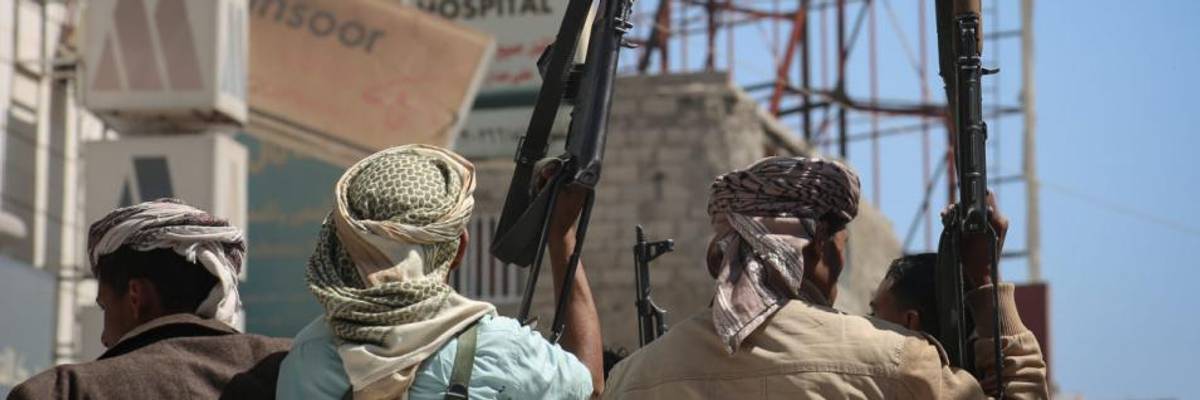
Soldiers in the fight against the Houthis, Taiz City, Yemen, 2016. (Photo: akramalrasny/Shutterstock)
Biden to Lift the Wrongheaded Houthi Terrorist Designation--But What's Next?
Having reversed the worst of Trump's policies, Biden must now tackle those of the Obama administration.
On Friday night, the Biden administration announced that it would lift the designation of the Houthi movement as a foreign terrorist organization, reversing one of the Trump administration's final acts.
Lifting the terrorism designation may help to prevent a famine, but it will not help to end Yemen's civil war.
The decision was welcomed by aid groups, which had condemned the designation as likely to precipitate the world's worst famine in 40 years. Martin Griffiths, the U.N. special envoy for Yemen, worried that designating the Houthis as terrorists would also hamstring his efforts to negotiate an end to the long-running conflict.
The Houthis, known formally as Ansar Allah, have committed atrocities during the horrific war in Yemen, as have all the other parties involved. Yet their designation as a foreign terrorist organization was rushed and apparently ill-considered, as the Houthis do not meet the official criteria for designation. The Trump administration had made a habit out of imposing or lifting such designations for political purposes, such as removing the designation on Sudan following its normalization with Israel and returning Cuba to the terrorism sponsor list nine days before Biden's inauguration.
Friday's announcement was condemned on Twitter with suspiciously repetitive tweets and hashtags, suggesting the mobilization of bots, likely at the behest of Saudi Arabia. One of the hashtags #StopHouthiTerrorismInYemen included English text, as well as a meaningless series of five characters, possibly intended to evade Twitter algorithms intended to prevent bot armies from flooding the platform with identical tweets.
Yet Saudi bots were not the only critics of Biden's decision. Yemenis displaced by the Houthis, as well as many in the south, fear that the move will further empower the group's position in eventual negotiations. The Houthis have engaged in horrific acts of violence and torture, laid countless landmines, and forced thousands to flee their homes. The Houthis are essentially using the Yemeni population under their control--approximately 20 million people--as hostages. Biden's efforts are intended to save the population from the violence inflicted from the air by Saudi Arabia, whose six-year-old bombing campaign has destroyed much of the country's infrastructure, as well as on the ground where millions face severe malnutrition bordering on starvation and disease--problems exacerbated by Houthi indifference, yet even worse by their designation as terrorists. Lifting the terrorism designation may help to prevent a famine, but it will not help to end Yemen's civil war.
In addition to the looming threat of famine, another major concern is the FSO Safer, an oil tanker rotting off the coast of Yemen, with 48 million tons of oil about to spill into the Red Sea. An oil spill of this magnitude threatens not only further devastate Yemen's coastal communities, but also destroy coral reefs and fish habitats off the coasts of Saudi Arabia, Egypt, Sudan, Eritrea, and Djibouti.
The United States has little leverage over the Houthis, and some fear that, by lifting the FTO designation, Biden has given the group an easy win without acquiring anything in return. This interpretation is flawed. At present, tens of thousands of Yemenis are dying of starvation and preventable disease. The most urgent priority is to provide aid. Lifting the FTO designation allows aid organizations to re-engage with the Houthis without fear of legal repercussions for engaging with terrorists. Although humanitarian exceptions were granted when the Trump administration added the Houthis to the terrorism list on January 19, such exemptions have proved inadequate in other contexts, such as Iran.
Having reversed the worst of Trump's policies, Biden must now tackle those of the Obama administration, namely providing various forms of logistical and intelligence support to Saudi-led coalition that intervened in Yemen's civil war in 2015 when the Houthis, who are based in the north, took over the country's capital, Sana'a. Stopping the flow of foreign funding from the UAE to the Southern Transitional Council (STC) and from Saudi Arabia to the Hadi government is critical to shifting the incentives of these warring factions and convincing them that a negotiated settlement is in their interest. The more difficult task is establishing a working relationship with Iran in order to pressure it to withdraw its own support for the Houthis.
The most difficult aspect is likely to be convincing the Houthis to accept a political settlement. The Houthis feel they have the upper hand in the war and have few reasons to stop fighting now. The Armed Conflict Location and Event Data Project identified the city of Marib as a crucial location to watch for additional conflict. Marib is east of Sana'a and the current refuge for hundreds of thousands of internally displaced people who fled the capital region to escape Houthi violence and control. The frontlines are only a few miles from the city, and, if Marib is captured, the Houthis will hold almost all major urban centers in the former North Yemen, further consolidating their power.
Ideally, the United States, Saudi Arabia, the UAE, Iran, and the international community will agree to end support for their respective warring parties and commit to funding the reconstruction of Yemen, while internal Yemeni actors negotiate an inclusive political settlement. Biden's moves to ameliorate the situation in Yemen are commendable, but must be only the beginning.
We are at a crossroads
This country and this world are at a monumental crossroads. In a few short weeks, US voters will have an opportunity to beat back the forces of fascism and confront the billionaires who are rigging the economy, our media system, and our democracy, making it increasingly impossible for ordinary people to get by. We’re not just talking about the election. We’re talking about what must be done once these fascist elements are vanquished from power. We need a bolder set of solutions than what either major party has so far been willing to offer and a working-class movement ready to fight like hell for it. Trump didn't emerge from nowhere. The conditions that fueled MAGA authoritarianism were created by decades of radical neoliberal economic policies and a corrupt political system dominated by corporate interests. They slashed taxes on the super-rich, promising that the benefits would trickle down. They said giveaways to the corporate titans would make life more affordable for the rest of us. It was all bullshit. And when a bitter, betrayed populace searches for someone to blame, right-wing demagogues have little trouble finding scapegoats. People know when they're being lied to, but you won't hear any of this from the corporate media. Only independent journalism—powered and funded by people who believe in building a better world—can deliver truly trustworthy daily news. Our Fall Campaign is underway, and we need your help. To power our newsroom through the rest of the year, we need to raise $125,000 by midnight on October 31. So if you share our vision, please contribute whatever you can to sustain our work. |
On Friday night, the Biden administration announced that it would lift the designation of the Houthi movement as a foreign terrorist organization, reversing one of the Trump administration's final acts.
Lifting the terrorism designation may help to prevent a famine, but it will not help to end Yemen's civil war.
The decision was welcomed by aid groups, which had condemned the designation as likely to precipitate the world's worst famine in 40 years. Martin Griffiths, the U.N. special envoy for Yemen, worried that designating the Houthis as terrorists would also hamstring his efforts to negotiate an end to the long-running conflict.
The Houthis, known formally as Ansar Allah, have committed atrocities during the horrific war in Yemen, as have all the other parties involved. Yet their designation as a foreign terrorist organization was rushed and apparently ill-considered, as the Houthis do not meet the official criteria for designation. The Trump administration had made a habit out of imposing or lifting such designations for political purposes, such as removing the designation on Sudan following its normalization with Israel and returning Cuba to the terrorism sponsor list nine days before Biden's inauguration.
Friday's announcement was condemned on Twitter with suspiciously repetitive tweets and hashtags, suggesting the mobilization of bots, likely at the behest of Saudi Arabia. One of the hashtags #StopHouthiTerrorismInYemen included English text, as well as a meaningless series of five characters, possibly intended to evade Twitter algorithms intended to prevent bot armies from flooding the platform with identical tweets.
Yet Saudi bots were not the only critics of Biden's decision. Yemenis displaced by the Houthis, as well as many in the south, fear that the move will further empower the group's position in eventual negotiations. The Houthis have engaged in horrific acts of violence and torture, laid countless landmines, and forced thousands to flee their homes. The Houthis are essentially using the Yemeni population under their control--approximately 20 million people--as hostages. Biden's efforts are intended to save the population from the violence inflicted from the air by Saudi Arabia, whose six-year-old bombing campaign has destroyed much of the country's infrastructure, as well as on the ground where millions face severe malnutrition bordering on starvation and disease--problems exacerbated by Houthi indifference, yet even worse by their designation as terrorists. Lifting the terrorism designation may help to prevent a famine, but it will not help to end Yemen's civil war.
In addition to the looming threat of famine, another major concern is the FSO Safer, an oil tanker rotting off the coast of Yemen, with 48 million tons of oil about to spill into the Red Sea. An oil spill of this magnitude threatens not only further devastate Yemen's coastal communities, but also destroy coral reefs and fish habitats off the coasts of Saudi Arabia, Egypt, Sudan, Eritrea, and Djibouti.
The United States has little leverage over the Houthis, and some fear that, by lifting the FTO designation, Biden has given the group an easy win without acquiring anything in return. This interpretation is flawed. At present, tens of thousands of Yemenis are dying of starvation and preventable disease. The most urgent priority is to provide aid. Lifting the FTO designation allows aid organizations to re-engage with the Houthis without fear of legal repercussions for engaging with terrorists. Although humanitarian exceptions were granted when the Trump administration added the Houthis to the terrorism list on January 19, such exemptions have proved inadequate in other contexts, such as Iran.
Having reversed the worst of Trump's policies, Biden must now tackle those of the Obama administration, namely providing various forms of logistical and intelligence support to Saudi-led coalition that intervened in Yemen's civil war in 2015 when the Houthis, who are based in the north, took over the country's capital, Sana'a. Stopping the flow of foreign funding from the UAE to the Southern Transitional Council (STC) and from Saudi Arabia to the Hadi government is critical to shifting the incentives of these warring factions and convincing them that a negotiated settlement is in their interest. The more difficult task is establishing a working relationship with Iran in order to pressure it to withdraw its own support for the Houthis.
The most difficult aspect is likely to be convincing the Houthis to accept a political settlement. The Houthis feel they have the upper hand in the war and have few reasons to stop fighting now. The Armed Conflict Location and Event Data Project identified the city of Marib as a crucial location to watch for additional conflict. Marib is east of Sana'a and the current refuge for hundreds of thousands of internally displaced people who fled the capital region to escape Houthi violence and control. The frontlines are only a few miles from the city, and, if Marib is captured, the Houthis will hold almost all major urban centers in the former North Yemen, further consolidating their power.
Ideally, the United States, Saudi Arabia, the UAE, Iran, and the international community will agree to end support for their respective warring parties and commit to funding the reconstruction of Yemen, while internal Yemeni actors negotiate an inclusive political settlement. Biden's moves to ameliorate the situation in Yemen are commendable, but must be only the beginning.
On Friday night, the Biden administration announced that it would lift the designation of the Houthi movement as a foreign terrorist organization, reversing one of the Trump administration's final acts.
Lifting the terrorism designation may help to prevent a famine, but it will not help to end Yemen's civil war.
The decision was welcomed by aid groups, which had condemned the designation as likely to precipitate the world's worst famine in 40 years. Martin Griffiths, the U.N. special envoy for Yemen, worried that designating the Houthis as terrorists would also hamstring his efforts to negotiate an end to the long-running conflict.
The Houthis, known formally as Ansar Allah, have committed atrocities during the horrific war in Yemen, as have all the other parties involved. Yet their designation as a foreign terrorist organization was rushed and apparently ill-considered, as the Houthis do not meet the official criteria for designation. The Trump administration had made a habit out of imposing or lifting such designations for political purposes, such as removing the designation on Sudan following its normalization with Israel and returning Cuba to the terrorism sponsor list nine days before Biden's inauguration.
Friday's announcement was condemned on Twitter with suspiciously repetitive tweets and hashtags, suggesting the mobilization of bots, likely at the behest of Saudi Arabia. One of the hashtags #StopHouthiTerrorismInYemen included English text, as well as a meaningless series of five characters, possibly intended to evade Twitter algorithms intended to prevent bot armies from flooding the platform with identical tweets.
Yet Saudi bots were not the only critics of Biden's decision. Yemenis displaced by the Houthis, as well as many in the south, fear that the move will further empower the group's position in eventual negotiations. The Houthis have engaged in horrific acts of violence and torture, laid countless landmines, and forced thousands to flee their homes. The Houthis are essentially using the Yemeni population under their control--approximately 20 million people--as hostages. Biden's efforts are intended to save the population from the violence inflicted from the air by Saudi Arabia, whose six-year-old bombing campaign has destroyed much of the country's infrastructure, as well as on the ground where millions face severe malnutrition bordering on starvation and disease--problems exacerbated by Houthi indifference, yet even worse by their designation as terrorists. Lifting the terrorism designation may help to prevent a famine, but it will not help to end Yemen's civil war.
In addition to the looming threat of famine, another major concern is the FSO Safer, an oil tanker rotting off the coast of Yemen, with 48 million tons of oil about to spill into the Red Sea. An oil spill of this magnitude threatens not only further devastate Yemen's coastal communities, but also destroy coral reefs and fish habitats off the coasts of Saudi Arabia, Egypt, Sudan, Eritrea, and Djibouti.
The United States has little leverage over the Houthis, and some fear that, by lifting the FTO designation, Biden has given the group an easy win without acquiring anything in return. This interpretation is flawed. At present, tens of thousands of Yemenis are dying of starvation and preventable disease. The most urgent priority is to provide aid. Lifting the FTO designation allows aid organizations to re-engage with the Houthis without fear of legal repercussions for engaging with terrorists. Although humanitarian exceptions were granted when the Trump administration added the Houthis to the terrorism list on January 19, such exemptions have proved inadequate in other contexts, such as Iran.
Having reversed the worst of Trump's policies, Biden must now tackle those of the Obama administration, namely providing various forms of logistical and intelligence support to Saudi-led coalition that intervened in Yemen's civil war in 2015 when the Houthis, who are based in the north, took over the country's capital, Sana'a. Stopping the flow of foreign funding from the UAE to the Southern Transitional Council (STC) and from Saudi Arabia to the Hadi government is critical to shifting the incentives of these warring factions and convincing them that a negotiated settlement is in their interest. The more difficult task is establishing a working relationship with Iran in order to pressure it to withdraw its own support for the Houthis.
The most difficult aspect is likely to be convincing the Houthis to accept a political settlement. The Houthis feel they have the upper hand in the war and have few reasons to stop fighting now. The Armed Conflict Location and Event Data Project identified the city of Marib as a crucial location to watch for additional conflict. Marib is east of Sana'a and the current refuge for hundreds of thousands of internally displaced people who fled the capital region to escape Houthi violence and control. The frontlines are only a few miles from the city, and, if Marib is captured, the Houthis will hold almost all major urban centers in the former North Yemen, further consolidating their power.
Ideally, the United States, Saudi Arabia, the UAE, Iran, and the international community will agree to end support for their respective warring parties and commit to funding the reconstruction of Yemen, while internal Yemeni actors negotiate an inclusive political settlement. Biden's moves to ameliorate the situation in Yemen are commendable, but must be only the beginning.